


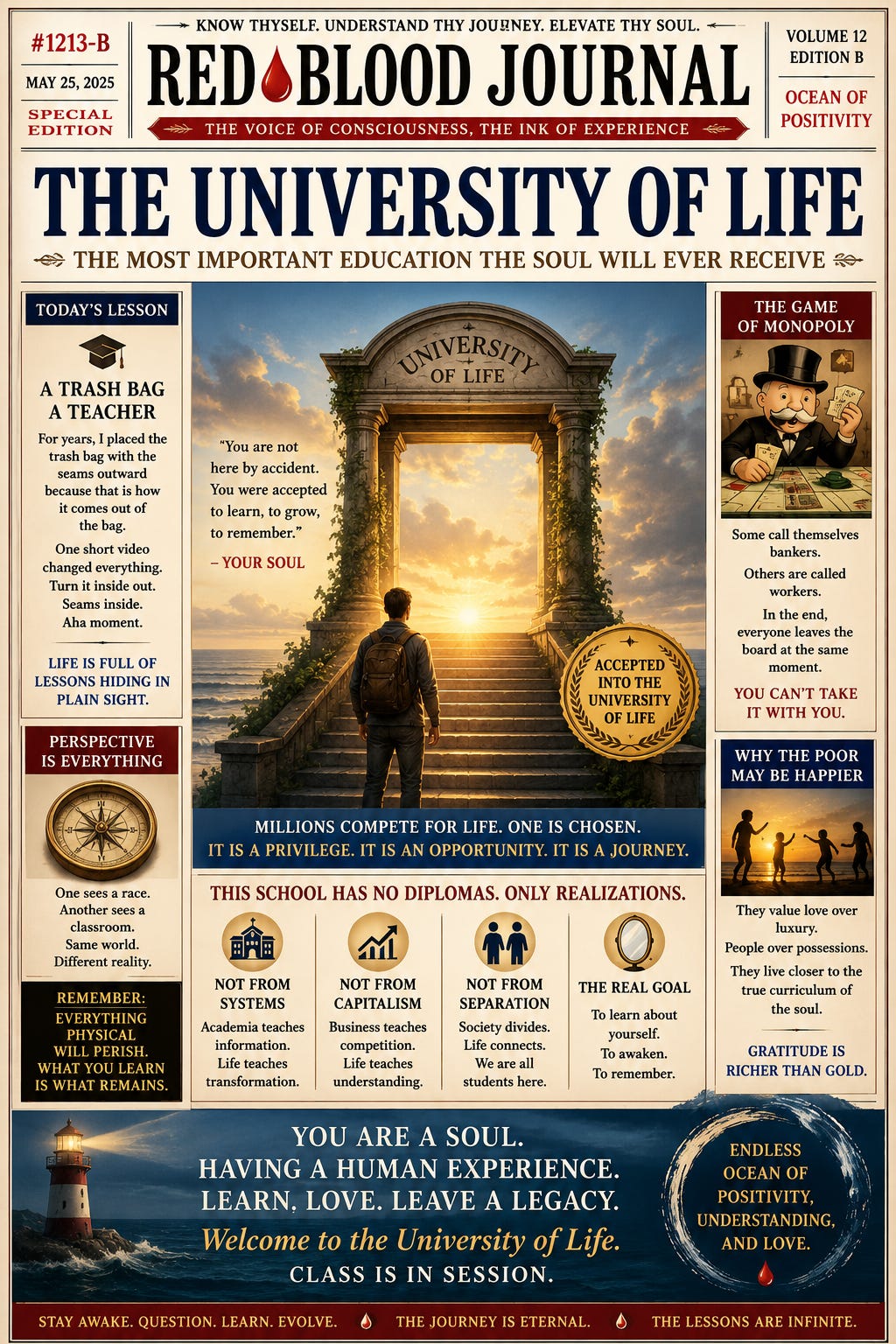
🩸 RBJ #1213-B — THE UNIVERSITY OF LIFE
Red Blood Journal Transmission
A strange thing happened with a kitchen trash bag.
For years, the bag was placed into the trash can exactly as it came from the package. The seams faced outward because that was the way it naturally unfolded. There was never a reason to question it.
Then one day, a short video appeared explaining that the bag should actually be turned inside out so the seams remain inside the container. The fit was better, the appearance cleaner, and suddenly an ordinary object revealed a lesson that had been hidden in plain sight.
An ordinary trash bag became a teacher.
The lesson was not about garbage.
The lesson was about assumptions.
Most of life is lived through habit. People inherit ideas, customs, beliefs, routines, fears, ambitions, and definitions of success without ever stopping to examine them. They simply unfold as they came from the package.
Only occasionally does a moment arrive that causes an individual to pause and ask:
“What if I have been looking at this the wrong way?”
That moment is one of the most valuable experiences available in what may be called the University of Life.
The University of Life has no campus.
There are no professors standing at podiums.
There are no diplomas hanging on walls.
Yet every human being attends it.
Some believe existence begins and ends with the physical body. Others believe consciousness continues beyond it. Regardless of perspective, every life appears to function as a classroom in which experiences become lessons.
From one viewpoint, countless possibilities compete for the chance to become life. Millions of sperm race toward a single egg. Only one succeeds.
The odds alone suggest something extraordinary.
The result is a new student entering the University of Life.
A new journey begins.
A new opportunity to learn.
A new opportunity to discover what lies beneath the surface of personality, possessions, status, and identity.
Yet many students become distracted.
The educational system often teaches how to earn a living, but rarely how to understand oneself.
The business world often teaches how to accumulate wealth, but rarely how to discover contentment.
Politics often teaches division, but rarely unity.
Society often teaches competition, but rarely self-awareness.
As a result, many spend their lives believing the purpose of existence is to gather more material possessions than everyone else.
The winner becomes the person with the largest pile.
The largest house.
The largest account.
The largest collection of things.
Yet everyone already knows something important.
Everything physical eventually disappears.
Every possession is temporary.
Every title is temporary.
Every institution is temporary.
Even the body itself is temporary.
The race continues anyway.
Some individuals become so focused on the game that they forget they are players inside it.
They begin to view society as a giant Monopoly board.
Workers move around the board earning paper.
Bankers control the flow of paper.
The objective becomes collecting as much as possible before the game ends.
Yet from another perspective, both the worker and the banker leave the board at exactly the same moment.
Neither carries the money with them.
Neither carries the property.
Neither carries the title.
The only thing that remains is what was learned during the experience.
Perhaps this explains a mystery that has puzzled observers throughout history.
Why do many poor communities appear happier than many wealthy communities?
Not always.
But often enough to notice.
The answer may not be material.
People with fewer possessions frequently place greater value on relationships, family, friendship, gratitude, and shared experiences.
Without realizing it, they may remain closer to the original curriculum of the University of Life.
The curriculum is not ownership.
It is understanding.
Not accumulation.
But realization.
Not conquering others.
But discovering oneself.
The greatest lesson may be that perspective determines everything.
One person sees a temporary world and rushes to acquire.
Another sees a temporary world and chooses to understand.
One sees competition.
Another sees education.
One sees a marketplace.
Another sees a classroom.
The same world exists before both of them.
Yet they experience entirely different realities.
Just as a trash bag can suddenly be seen from a different angle, life itself can be viewed from a different perspective.
And when that happens, an ordinary day becomes a lesson.
A challenge becomes a teacher.
A mistake becomes a chapter.
A hardship becomes an examination.
A life becomes an education.
The Ocean Perspective
If existence is a university, then every person is both student and teacher.
Every encounter offers a lesson.
Every difficulty offers growth.
Every success offers gratitude.
The purpose may not be to leave the classroom with the largest pile of possessions, but with the deepest understanding of what it means to be conscious, aware, and alive.
And perhaps the highest graduation is realizing that beneath all competition, division, status, and material pursuit lies the same destination for every student.
An endless Ocean of Positivity, Understanding, and Love.
Fantastic. 🌊❤️🩸
👁️ The Curriculum of the University of Life
Jun 2, 2026
The provided text introduces the University of Life, a conceptual framework where everyday existence serves as a continuous educational journey.
By using the simple imagery of a trash bag turned inside out, the author argues that shifting one’s perspective can reveal hidden truths about long-held assumptions and habits.
The narrative critiques society’s obsession with material accumulation and status, suggesting that these physical pursuits are merely temporary distractions from the true goal of self-discovery.
Instead of viewing the world as a competitive marketplace, individuals are encouraged to see life as a classroom where challenges and relationships foster deeper understanding.
Ultimately, the source posits that the highest form of learning involves moving beyond division to reach a state of universal love and awareness.
The value of one’s life is measured not by possessions, but by the wisdom gained through conscious experience.


