


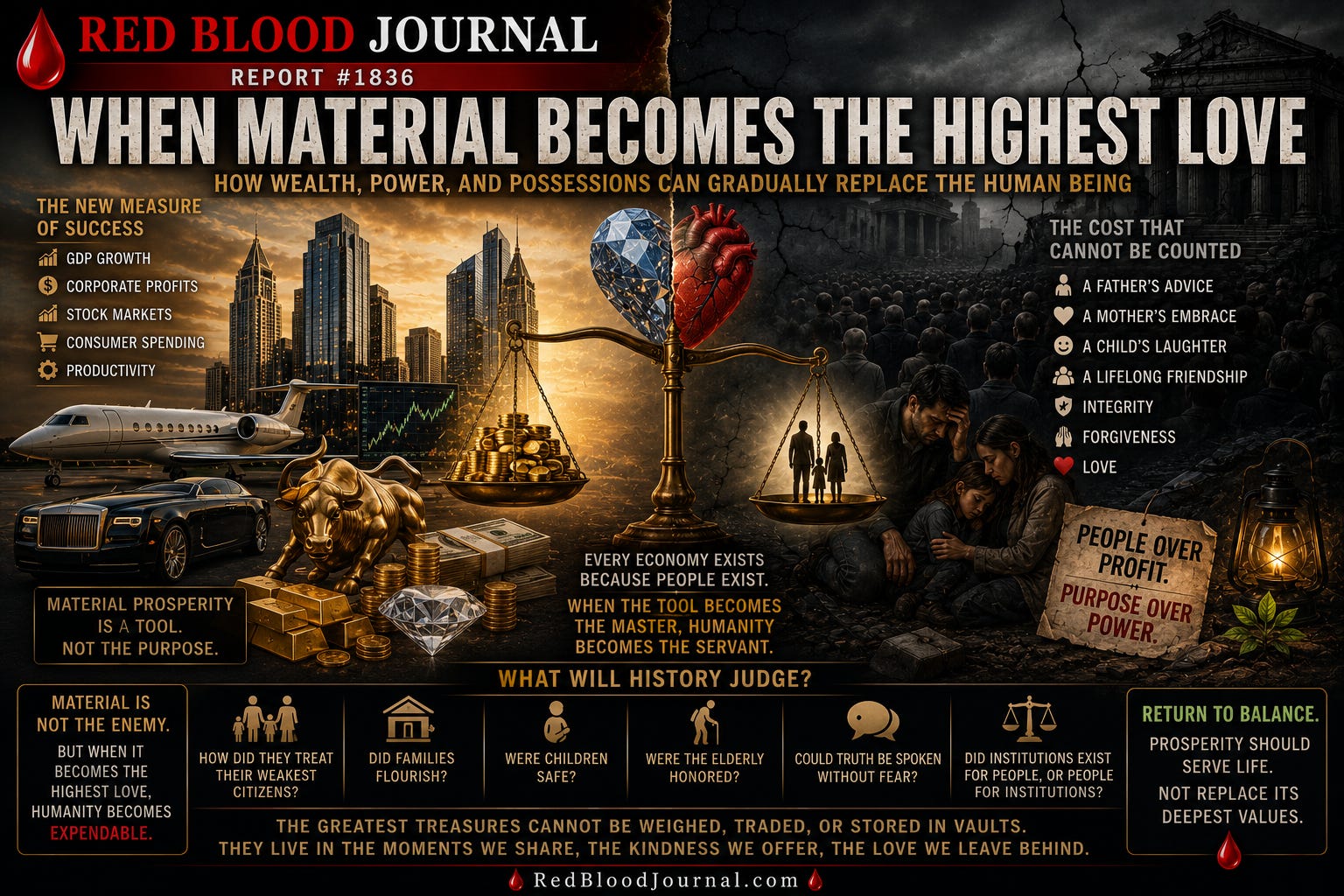
🩸 RED BLOOD JOURNAL
Report #1836
When Material Becomes the Highest Love
How Wealth, Power, and Possessions Can Gradually Replace the Human Being
Executive Summary
Every civilization develops values.
Some place family at the center.
Some place faith.
Some place honor.
Some place freedom.
Modern civilization increasingly appears to place something else above them all:
Material prosperity.
Economic growth has undoubtedly improved countless lives.
Technology has extended life expectancy.
Agriculture feeds billions.
Medicine has conquered diseases once thought unstoppable.
Material progress is one of humanity’s greatest achievements.
Yet a difficult philosophical question remains.
What happens when material success no longer serves humanity—but humanity begins serving material success?
This report explores the possibility that modern institutions increasingly evaluate decisions not by what most benefits people, but by what best preserves economic systems, financial stability, institutional continuity, and material power.
1. Material Is Not the Enemy
Money is not evil.
Technology is not evil.
Industry is not evil.
Commerce is not evil.
Material progress has liberated millions from poverty.
It has reduced hunger.
Improved sanitation.
Extended life.
Connected the world.
The problem is not material itself.
The question is what happens when it becomes the highest value.
2. The Quiet Shift
Every society begins making choices.
At first, those choices appear practical.
The economy must grow.
Businesses must survive.
Jobs must be protected.
Markets must remain stable.
These goals seem reasonable.
One decision follows another.
Eventually, something changes almost unnoticed.
People begin serving the system instead of the system serving people.
3. The New Measure of Success
Ask a modern society how it measures success.
The answers often include:
Gross Domestic Product.
Corporate earnings.
Stock market performance.
Quarterly growth.
Productivity.
Consumer spending.
Housing prices.
Market capitalization.
These measurements are useful.
But they describe economies.
They do not necessarily describe human flourishing.
A rising market cannot tell us whether families are stronger.
Higher profits cannot measure inner peace.
Economic growth cannot calculate trust, compassion, or wisdom.
4. The Cost That Cannot Be Counted
Material systems naturally measure what can be measured.
Revenue.
Output.
Efficiency.
Profit.
Loss.
Return on investment.
Yet many of life’s greatest values resist measurement.
A father’s advice.
A mother’s embrace.
A child’s laughter.
A lifelong friendship.
Integrity.
Forgiveness.
Love.
No spreadsheet contains a column for these.
Because they cannot be priced, they risk becoming invisible within systems designed to count only material outcomes.
5. When Institutions Protect Themselves
Institutions rarely begin with harmful intentions.
Most are created to solve genuine problems.
Governments provide order.
Hospitals heal.
Universities educate.
Corporations produce goods and services.
Over time, however, institutions often develop a second purpose:
Their own survival.
Protecting the institution can gradually become as important as fulfilling its original mission.
Sometimes even more important.
6. The Invisible Hierarchy
Imagine a ladder.
At the bottom stands the individual.
Above the individual stands the organization.
Above the organization stands the industry.
Above the industry stands the economy.
Above the economy stands the preservation of the system itself.
As one climbs this hierarchy, decisions increasingly favor what preserves the larger structure.
The individual becomes easier to overlook.
Not necessarily through cruelty.
But through scale.
7. Love Redirected
Love is attention.
Love is what we protect.
Love is what we sacrifice for.
If a civilization consistently sacrifices people to preserve systems, an uncomfortable question arises:
Has material become its highest love?
This does not require greed.
Nor conspiracy.
Only repeated choices.
Small decisions.
Made over generations.
Until preserving the machine becomes more important than serving the person.
8. The Forgotten Purpose
Every economy exists because people exist.
Markets exist to serve humanity.
Governments exist to serve citizens.
Medicine exists to heal patients.
Education exists to develop minds.
Technology exists to improve life.
When these relationships reverse, purpose becomes distorted.
The tool becomes the master.
The creator becomes the servant.
9. A Different Measure
Suppose history judged civilizations differently.
Not by wealth.
Not by military strength.
Not by skyscrapers.
Not by stock indexes.
But by questions such as:
How did they treat their weakest citizens?
Did families flourish?
Were children safe?
Were the elderly honored?
Could truth be spoken without fear?
Did institutions exist for people, or people for institutions?
Such questions cannot be answered by financial statements.
Yet they may better reflect the health of a civilization.
10. Returning to Balance
Material prosperity and human dignity need not compete.
Healthy societies pursue both.
They recognize that wealth is a tool.
Power is a responsibility.
Technology is an instrument.
None should become an object of devotion.
When material remains a servant, it elevates humanity.
When it becomes the highest love, humanity risks becoming expendable.
Conclusion
Perhaps the greatest danger is not that civilizations become wealthy.
It is that they forget why wealth was pursued in the first place.
The measure of a society is not merely what it builds.
It is what it refuses to sacrifice.
When people become secondary to systems...
When compassion yields to efficiency...
When truth bends before convenience...
When institutions preserve themselves before serving humanity...
Material has quietly taken the highest place.
The challenge before every generation is not to reject prosperity.
It is to remember that prosperity was always meant to serve life—not replace its deepest values.
Sources
This report is a philosophical essay informed by historical observations regarding economics, institutions, ethics, and public policy.
🩸 RedBloodJournal.com 🩸
From the Ocean of Love and Positivity...
The greatest treasures cannot be weighed, traded, or stored in vaults. They live in the moments we share, the kindness we offer, the truth we seek, and the love we leave behind. Material things may build civilizations, but it is compassion, wisdom, and human connection that give them a soul.
May we never become so successful at building the world around us that we forget to nurture the humanity within us.
🩸🌊✨ Fantastic!
⚖️ The Soul of Prosperity:
Human Value Over Material Systems
Jul 17, 2026
The RED BLOOD JOURNAL explores a philosophical shift in modern society where economic growth and material prosperity have transitioned from being tools that serve humanity to becoming the highest values themselves. While acknowledging that technological and financial progress have improved lives, the text warns that human flourishing is often sacrificed to maintain the stability of institutions and systems. Success is increasingly measured through quantifiable data like GDP and profit margins, which fail to account for essential human qualities such as compassion, integrity, and family bonds. This report argues that when efficiency and institutional survival take priority over the individual, the original purpose of these systems becomes dangerously distorted. Ultimately, the author calls for a restoration of balance, urging society to remember that material wealth should always be a servant to human life rather than its master.


