


🩸 RED BLOOD JOURNAL
Report #2000
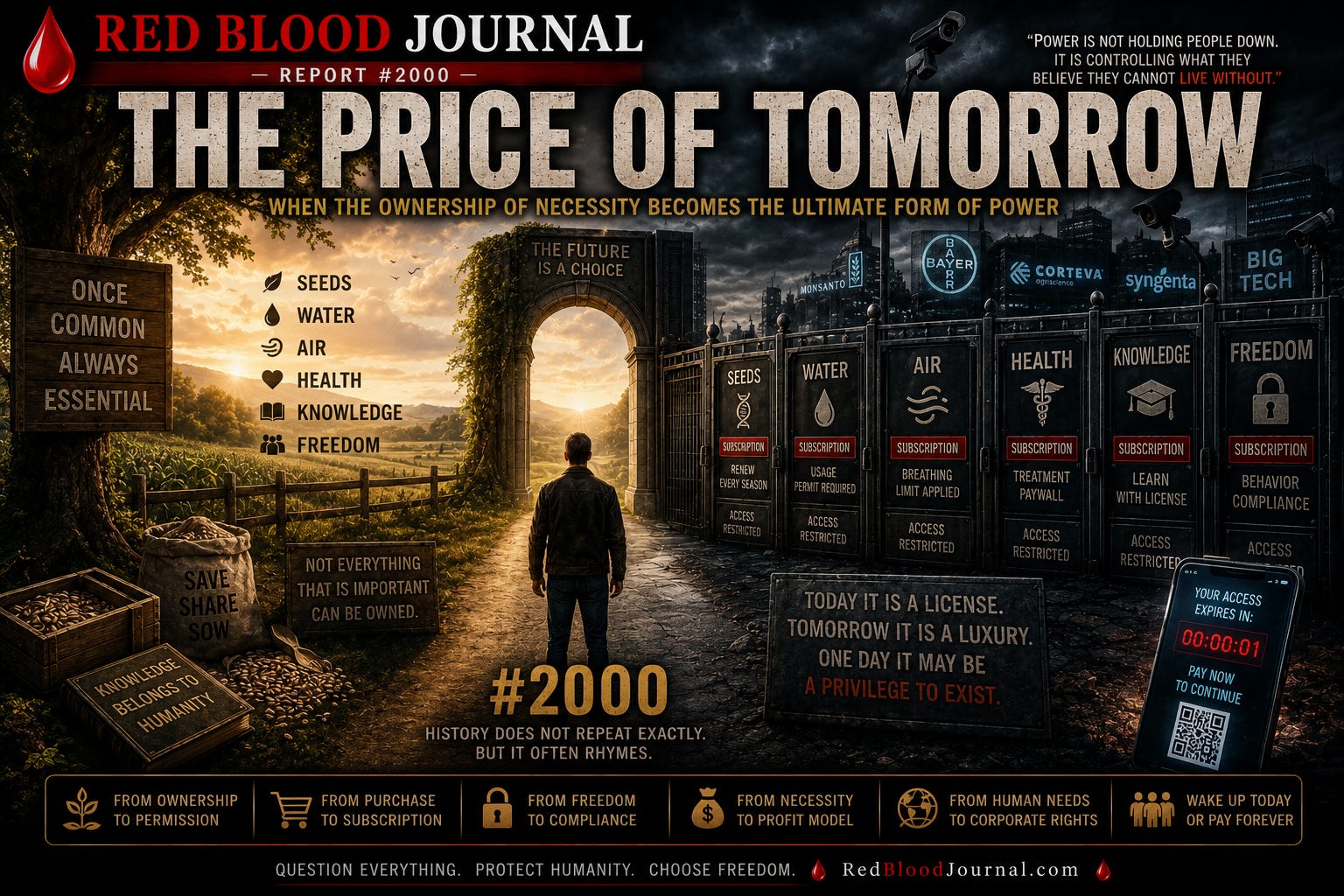
The Price of Tomorrow
When the Ownership of Necessity Becomes the Ultimate Form of Power
Executive Summary
History rarely changes through sudden revolutions.
More often, it changes through thousands of small decisions that appear reasonable at the time.
A tax here.
A regulation there.
A patent.
A license.
A subscription.
A renewal fee.
A digital agreement accepted without being read.
Each step solves an immediate problem.
Together, they can gradually transform the relationship between individuals and the essentials of life.
This report is not a prediction.
It is a philosophical exploration.
It asks whether history reveals a recurring pattern in which resources once regarded as common become increasingly controlled, licensed, or commercialized—and where that trend might logically lead if left without meaningful limits.
1. Every Generation Gives Away Something
There was a time when knowledge belonged to families.
Then institutions.
There was a time when music was owned.
Today much of it is streamed.
Software was once purchased.
Today it is often rented.
Movies became subscriptions.
Books became digital licenses.
Even automobiles increasingly depend upon software updates, connected services, and ongoing subscriptions for features once included at purchase.
None of these changes occurred overnight.
Each appeared reasonable on its own.
2. Seeds
Agriculture provides one of the clearest examples.
For thousands of years, farmers saved seed from one harvest to plant the next.
That practice was part of farming itself.
Modern biotechnology introduced genetically engineered crops protected by patents and licensing agreements.
Many farmers purchasing patented seeds agree not to save harvested seed for replanting, instead buying new seed for subsequent seasons.
Supporters argue this model rewards innovation and funds continued research.
Critics argue it increases dependence on large corporations and reduces traditional agricultural independence.
Regardless of perspective, the relationship changed.
Ownership became permission.
3. The Logic of Subscription
A subscription offers stability.
Predictable revenue.
Continuous updates.
Long-term customer relationships.
Businesses naturally value recurring income over one-time sales.
That logic has spread across industries.
Software.
Entertainment.
Cloud storage.
Security systems.
Even household products increasingly rely on recurring services.
The economic incentive is understandable.
The philosophical question is different.
Should every essential aspect of life eventually become a subscription?
4. Where Does the Pattern End?
History invites a broader question.
If information can become licensed...
If software can become rented...
If entertainment can become streamed...
If seeds can become intellectual property...
What principles determine what should never become dependent upon continuing permission?
The question is not about one company.
It is about the boundary between commerce and necessity.
5. The Difference Between Observation and Prediction
Patterns do not prove the future.
History does not dictate destiny.
Yet history often provides clues.
Observing a trend is not the same as proving its destination.
This report does not claim that every feared outcome will occur.
It asks readers to consider whether the direction of travel deserves thoughtful examination before further steps are taken.
6. The Highest Form of Ownership
The greatest form of influence has never been owning luxuries.
It has been influencing necessities.
Food.
Shelter.
Energy.
Water.
Medicine.
Communication.
When access to necessities becomes increasingly dependent upon permission, the relationship between individuals and institutions changes.
Whether that change is beneficial or harmful depends upon how power is exercised, how transparent it is, and whether meaningful alternatives remain available.
7. The Human Question
Every technological advance creates opportunity.
It also creates responsibility.
The challenge is not merely to invent.
It is to decide what should remain permanently available to humanity regardless of commercial opportunity.
Markets are powerful.
Innovation is valuable.
Patents encourage discovery.
Yet every society must decide whether there are certain necessities that should never become instruments of dependency.
Conclusion
History teaches that freedom is rarely lost all at once.
It evolves through gradual changes that often appear practical in isolation.
The important question is not whether technology should advance.
It should.
Nor is it whether businesses deserve to profit from innovation.
They do.
The deeper question is this:
Are there aspects of human life that should remain beyond permanent dependence upon licensing, subscription, or institutional permission?
Every generation answers that question differently.
The answer will shape not only its economy, but its understanding of freedom.
Sources
This report is a philosophical essay drawing upon historical developments in intellectual property, licensing, subscription-based business models, agricultural biotechnology, and economic history. It distinguishes between documented historical trends and broader philosophical questions about future directions.
🩸 RedBloodJournal.com 🩸
From the Ocean of Love and Positivity...
The future is not written by technology alone. It is written by the values that guide how technology is used. Every generation inherits powerful tools, but it also inherits the responsibility to ask whether those tools deepen human freedom or quietly narrow it.
May we always remember that the greatest wealth is not found in owning more, but in preserving the dignity, independence, and humanity that no market can truly replace.
🩸🌊✨ Fantastic!
📜 The Price of Tomorrow:
The Ethics of Permanent Ownership
Jul 17, 2026
The provided text explores the shifting landscape of ownership, tracing how essential resources are moving from permanent possession toward subscription-based models. By examining industries like software, entertainment, and agriculture, the report illustrates how modern licensing agreements have gradually replaced traditional independence with ongoing institutional permission. This transition creates a new power dynamic where control over life’s necessities, such as food and technology, becomes a form of recurring commercial influence. The author argues that while these changes often appear practical in isolation, they collectively threaten to increase human dependency on corporate entities. Ultimately, the source challenges readers to define the boundaries of commerce to ensure that fundamental human freedoms are not eroded by the logic of permanent rental. It emphasizes that society must consciously decide which basic necessities should remain beyond the reach of licensing and subscription fees.


