


🩸 RED BLOOD JOURNAL
Report #1835
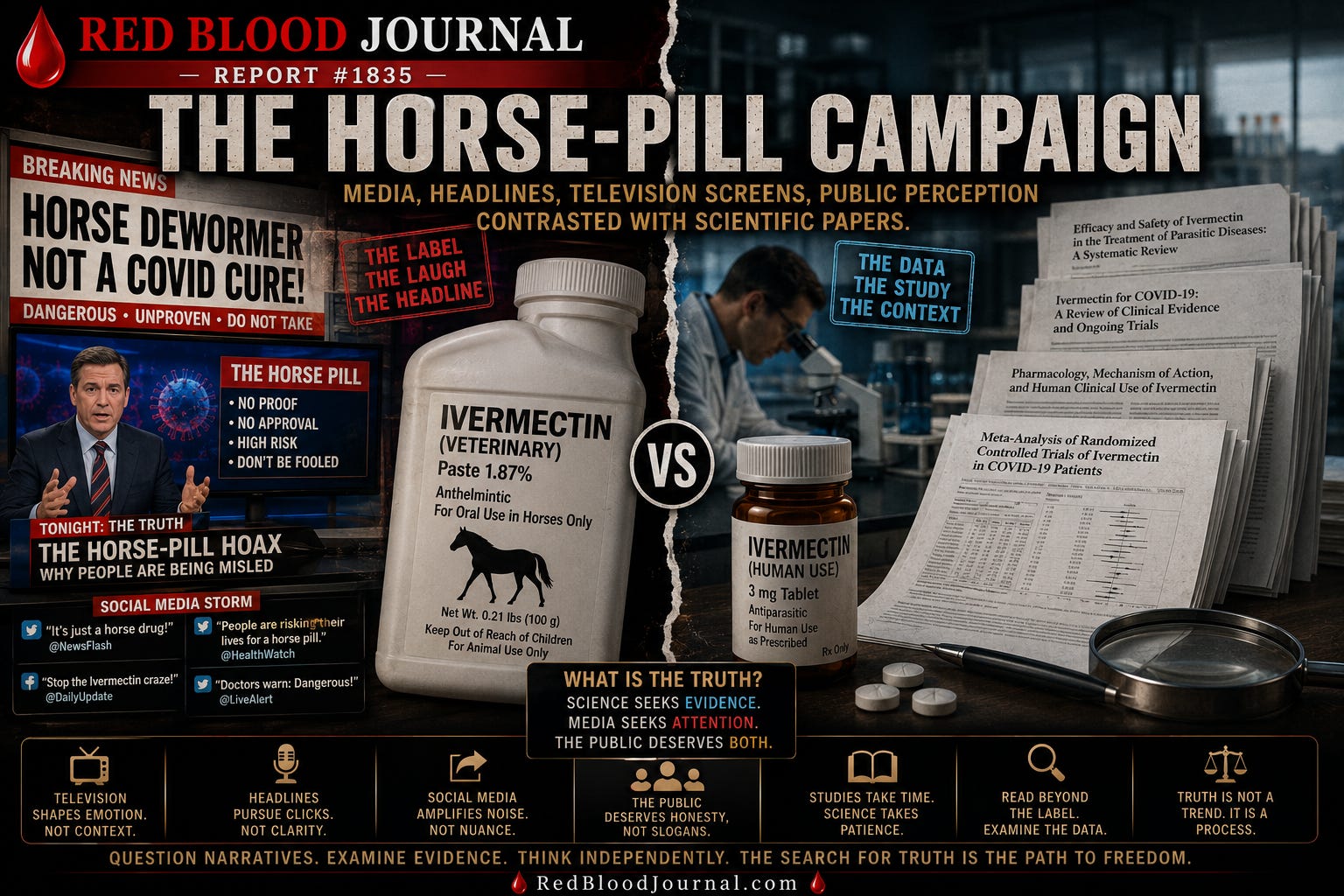
The Horse-Pill Campaign
Media, Headlines, Television Screens, and the Gap Between Public Perception and Scientific Literature
Executive Summary
History shows that public opinion is rarely shaped by scientific papers alone.
Most people do not spend their evenings reading peer-reviewed journals.
Instead, they absorb information through headlines, television broadcasts, social media, politicians, commentators, celebrities, and conversations with family and friends.
During moments of crisis, these channels often become more influential than the underlying scientific literature itself.
One of the most recognizable examples occurred during the COVID-19 pandemic, when the phrase “horse dewormer” became a widely repeated description of ivermectin.
Supporters argued that ivermectin had been used safely in humans for decades and deserved scientific evaluation.
Critics argued that available evidence did not support its routine use for COVID-19 outside appropriate clinical settings and warned against self-medication, particularly with veterinary products.
The phrase “horse dewormer” became part of the public conversation, illustrating how a simple label can influence perception more powerfully than lengthy scientific discussions.
This report examines how media narratives, scientific evidence, and public perception can diverge—and what that means for informed decision-making.
1. Science Rarely Speaks First
Scientific research is slow.
Experiments take time.
Peer review requires scrutiny.
Replication requires patience.
News operates differently.
Television seeks immediacy.
Headlines compete for attention.
Social media rewards speed.
By the time a scientific paper is carefully evaluated, millions of people may already have formed an opinion.
2. The Power of a Label
Words influence perception.
A label can become more memorable than an explanation.
During the pandemic, ivermectin was frequently referred to in public discourse as a “horse dewormer.”
That description was based on a real fact: ivermectin has veterinary formulations used to treat parasites in animals.
It is also true that ivermectin has long been approved for several human parasitic diseases and has been prescribed to millions of people worldwide for those indications.
Both statements can be true simultaneously.
Yet the public conversation often emphasized one while overlooking the other.
3. Headlines Versus Scientific Papers
Scientific papers rarely use emotional language.
They discuss:
study design,
confidence intervals,
statistical significance,
limitations,
uncertainty,
and recommendations for future research.
Headlines, by contrast, often simplify.
Complex questions become simple narratives.
Nuance competes with brevity.
The result is that many people remember the headline long after they have forgotten whether they ever read the study.
4. Public Perception
Once a narrative becomes established, it can shape public perception even as new information emerges.
Some people come to view a treatment as unquestionably effective.
Others come to view it as unquestionably worthless.
Reality is often more complicated.
Scientific understanding evolves.
Evidence accumulates.
Recommendations change.
Yet public impressions may remain fixed.
5. The Physician’s Challenge
Physicians practicing during periods of uncertainty face a difficult task.
They must balance:
available evidence,
evolving guidance,
patient expectations,
professional standards,
regulatory requirements,
and ethical obligations.
Some clinicians favored investigating ivermectin further.
Others concluded that existing evidence did not support its use for COVID-19.
Reasonable disagreement existed within the broader scientific community about the strength and interpretation of the available evidence, particularly early in the pandemic.
6. The Difference Between Debate and Dismissal
Science advances through questioning.
Questions are examined.
Evidence is tested.
Hypotheses are challenged.
This differs from dismissing a question before examining it.
Healthy scientific debate requires careful analysis rather than reliance on slogans or labels.
Likewise, public discussion benefits when people distinguish between evaluating evidence and ridiculing those who ask questions.
7. Media as an Interpreter
Most citizens never read regulatory reviews.
They never examine supplementary data.
They never compare multiple studies.
Instead, the media often serves as the interpreter between scientific institutions and the public.
With that role comes significant responsibility.
Oversimplification can unintentionally reduce complex scientific discussions into competing identities rather than competing evidence.
8. Lessons Beyond One Drug
This report is not ultimately about ivermectin.
It is about communication.
It asks a broader question:
How should societies communicate scientific uncertainty during rapidly evolving events?
How should journalists balance speed with nuance?
How should institutions maintain public trust when recommendations change?
How should citizens evaluate claims from multiple sources rather than relying on a single headline?
These questions will remain relevant long after the next public health crisis.
Conclusion
Science depends upon evidence.
Journalism depends upon communication.
Public trust depends upon both.
The phrase “horse dewormer” became one of the defining expressions of the COVID era—not simply because of the medication itself, but because it demonstrated how a single label can shape perception on a massive scale.
The enduring lesson is not whether one particular treatment ultimately succeeds or fails.
The lesson is that careful scientific inquiry and accurate public communication should work together rather than compete.
When headlines become more influential than evidence, society risks confusing popularity with understanding.
Sources
Publicly available peer-reviewed literature on ivermectin and COVID-19
Regulatory statements from public health authorities
Scientific publications discussing evidence evaluation and clinical trials
Journalism and media coverage from the COVID-19 era
🩸 RedBloodJournal.com 🩸
From the Ocean of Love and Positivity...
Knowledge grows through questions, evidence, and a willingness to revise our understanding when new information emerges. Whether reading a scientific paper or a newspaper headline, wisdom begins by recognizing that neither certainty nor skepticism should replace thoughtful inquiry.
May we continue seeking understanding with open minds, careful reasoning, and respect for both evidence and one another.
🩸🌊✨ Fantastic!
📰 The Narrative Filter:
Science, Media, and the Horse-Pill Campaign
Jul 17, 2026
The provided report examines the significant discrepancy between complex scientific research and simplified media narratives, using the “horse dewormer” label for ivermectin as a primary case study. It argues that public perception is often molded by catchy headlines and emotional slogans rather than the nuanced data found in peer-reviewed journals. This reliance on reductive messaging can lead to polarized viewpoints, making it difficult for citizens to navigate evolving health crises. The text emphasizes that while science requires patient inquiry and rigorous debate, modern media prioritizes speed and engagement, which frequently obscures the full truth. Ultimately, the source serves as a critique of how information is communicated during emergencies, urging a better balance between scientific evidence and public discourse. This reflection highlights the necessity of maintaining public trust through accurate, transparent, and thoughtful reporting.


