


🩸 RED BLOOD JOURNAL
Report #1832 – Part III
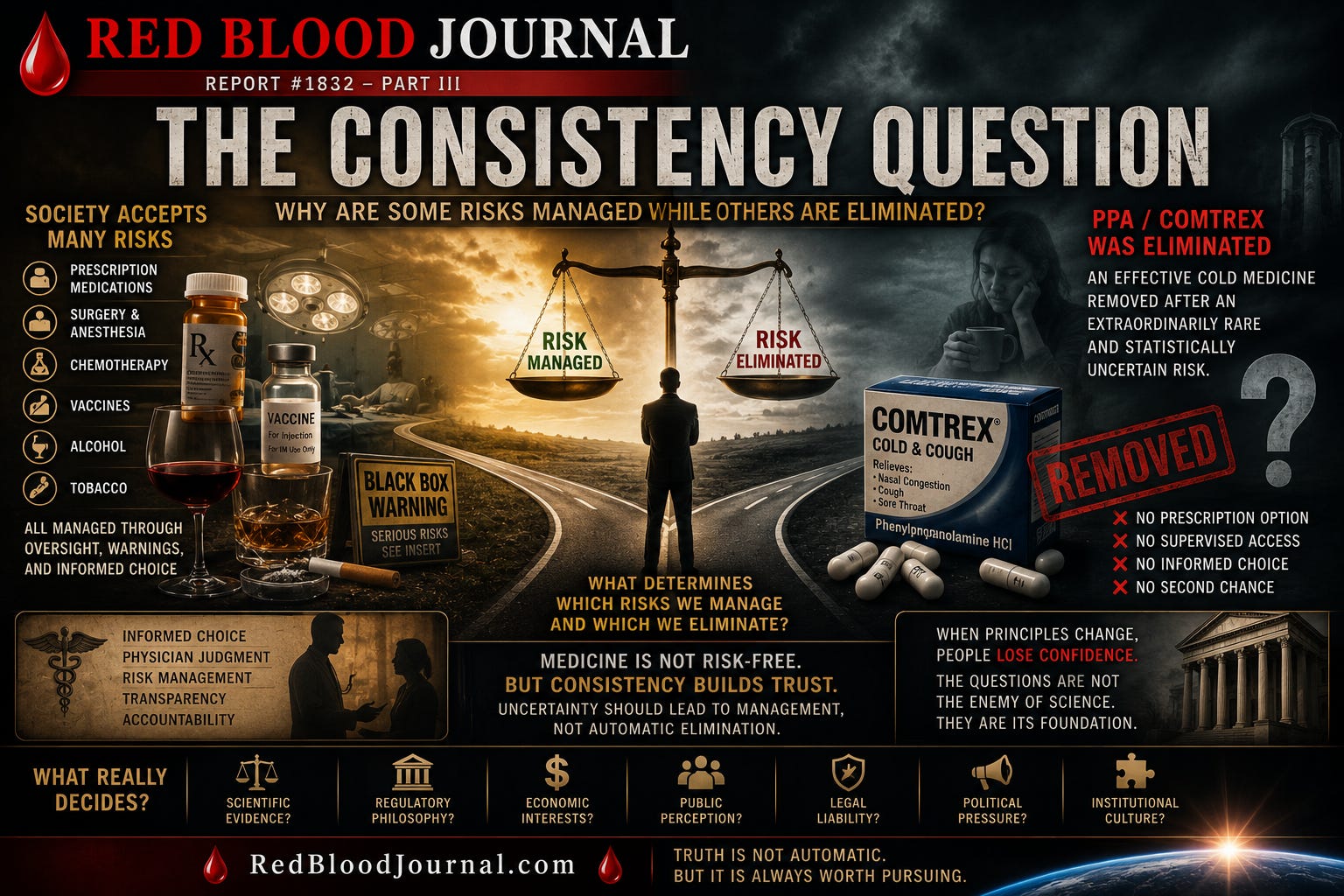
The Consistency Question
Why Are Some Risks Managed While Others Are Eliminated?
Executive Summary
Every medical decision involves risk.
There is no medication, procedure, or intervention that is entirely free of potential harm.
Modern medicine recognizes this reality every day through physician oversight, informed consent, patient screening, dosage limits, warning labels, contraindications, and continuous safety monitoring.
This raises a broader philosophical question.
If society accepts managing risk for thousands of medical products, why was phenylpropanolamine (PPA) almost completely removed from human medicine rather than placed under stricter medical supervision?
This report does not argue that PPA was harmless.
Instead, it asks whether eliminating access was the only reasonable regulatory response.
1. Medicine Has Never Been Risk-Free
Every physician understands a simple reality:
Treatments save lives.
Treatments also carry risks.
This has always been true.
Patients routinely accept these risks because the expected benefit outweighs the potential harm.
The role of medicine is therefore not to eliminate every possible danger.
It is to manage danger responsibly.
2. Risk Management Is the Foundation of Modern Medicine
Society already accepts numerous products and procedures that involve known risks.
Examples include:
Prescription medications carrying Black Box Warnings.
General anesthesia.
Elective surgery.
Chemotherapy.
Blood-thinning medications.
Opioid pain medications.
Hormone therapies.
Vaccines.
Alcohol.
Tobacco.
Each remains available through some combination of:
physician judgment,
patient screening,
informed consent,
dosage restrictions,
contraindications,
warning labels,
post-market surveillance,
and continuing scientific review.
The underlying philosophy is clear:
Risk alone does not automatically require prohibition.
Instead, medicine generally attempts to balance expected benefit against known danger.
3. The COVID Era Changed Public Trust
The COVID-19 pandemic altered the public conversation about medicine in ways that may last for decades.
Regardless of where individuals stand on the policies, recommendations, or products introduced during that period, millions of people began asking questions they had never previously considered.
Questions about:
institutional transparency,
pharmaceutical regulation,
informed consent,
conflicts of interest,
public communication,
and how governments make health decisions under uncertainty.
Trust increased for some.
Trust declined for others.
But one outcome became undeniable.
More people began examining the process itself.
4. The PPA Question
Against that backdrop, the story of phenylpropanolamine takes on renewed significance.
If modern medicine accepts that many therapies carry recognized risks while remaining available under managed conditions, why was PPA not handled in a similar way?
Possible alternatives might have included:
prescription-only availability,
physician supervision,
shorter recommended treatment duration,
stronger warning labels,
screening for high-risk patients,
lower maximum dosages,
enhanced monitoring.
Instead, the option largely disappeared from human medicine.
Whether that decision was ultimately correct is a matter of continuing debate.
But the question itself remains legitimate.
5. Beyond One Medication
This report is not ultimately about Comtrex.
Nor is it only about PPA.
It is about consistency.
When different products carrying different levels of risk receive fundamentally different regulatory treatment, thoughtful people naturally ask:
What principles determine those decisions?
Are they based solely on scientific evidence?
Or do other factors sometimes play a role?
Such factors might include:
legal liability,
economic incentives,
regulatory philosophy,
commercial interests,
public perception,
political pressure,
institutional culture.
These questions deserve careful examination.
Asking them is not an attack on medicine.
It is part of improving it.
Conclusion
Every society must decide how it balances freedom, responsibility, and protection.
Those decisions become most meaningful when they are applied consistently.
The history of phenylpropanolamine reminds us that scientific evidence is only one part of regulatory decision-making.
Policy, economics, ethics, communication, and public confidence also influence the outcome.
Understanding those influences does not weaken medicine.
It strengthens public confidence by encouraging transparency, accountability, and open discussion.
Perhaps the most enduring lesson is not whether one particular medication should or should not have remained available.
Perhaps the greater lesson is that every important decision deserves the same standard of honest inquiry.
Sources
Yale University Hemorrhagic Stroke Project (2000)
U.S. Food and Drug Administration (FDA) advisory documents on phenylpropanolamine
Historical OTC labeling information
Veterinary approvals for phenylpropanolamine (Proin®, Propalin®)
Publicly available medical literature regarding risk-benefit assessment and drug regulation
🩸 RedBloodJournal.com 🩸
From the Ocean of Love and Positivity...
Every generation inherits institutions built by those who came before.
Strong institutions should never fear honest questions. They become stronger when they can explain not only what decisions were made, but why they were made. Curiosity is not the enemy of science; it is one of its foundations.
May we continue asking thoughtful questions with humility, evaluate evidence with open minds, and seek understanding with both reason and compassion.
🩸🌊✨ Fantastic!
⚖️ The Phenylpropanolamine Paradox:
Consistency in Medical Risk Management
Jul 17, 2026
The provided text from the Red Blood Journal examines the philosophical and regulatory inconsistencies found within modern medical oversight, specifically regarding the withdrawal of phenylpropanolamine (PPA). It argues that while medicine typically manages inherent risks through supervision and informed consent, PPA was instead largely eliminated from human use despite other dangerous substances remaining available. The report suggests that this disparate treatment raises vital questions about whether health policies are driven by scientific evidence or external factors like economic incentives and political pressure. By referencing the shifting public trust following the COVID-19 pandemic, the source calls for greater institutional transparency and a uniform standard for evaluating pharmaceutical safety. Ultimately, the text advocates for a consistent regulatory framework where honest inquiry and the balancing of benefits versus harms guide medical accessibility.


