


🩸 RED BLOOD JOURNAL
REPORT #1832 – PART II
THE RISKS WE ARE ALLOWED TO TAKE
Why Some Dangers Become Matters of Personal Choice While Others Are Removed Entirely
Chapter 6
Was Complete Removal the Only Option?
Once a significant medical risk has been identified, the discussion often shifts immediately to one question:
Should the product remain available?
That is certainly an important question.
It is not, however, the only one.
Between unrestricted over-the-counter access and complete elimination exists a wide range of regulatory possibilities.
Modern medicine manages risk through many different approaches.
Some medications remain available only through prescription.
Others require periodic laboratory monitoring.
Some require physicians with specialized certification.
Others require patients to sign informed-consent documents acknowledging known risks before treatment begins.
These systems exist because medicine recognizes an important reality:
Not every patient carries the same level of risk.
Not every treatment produces the same balance of benefit and harm.
Not every decision can—or should—be reduced to a single rule applied equally to everyone.
This raises an important question.
Was phenylpropanolamine evaluated only as an over-the-counter medicine?
Or was serious consideration given to whether it could remain available under carefully controlled medical supervision?
The public record largely reflects the first question.
The second remains far less discussed.
Chapter 7
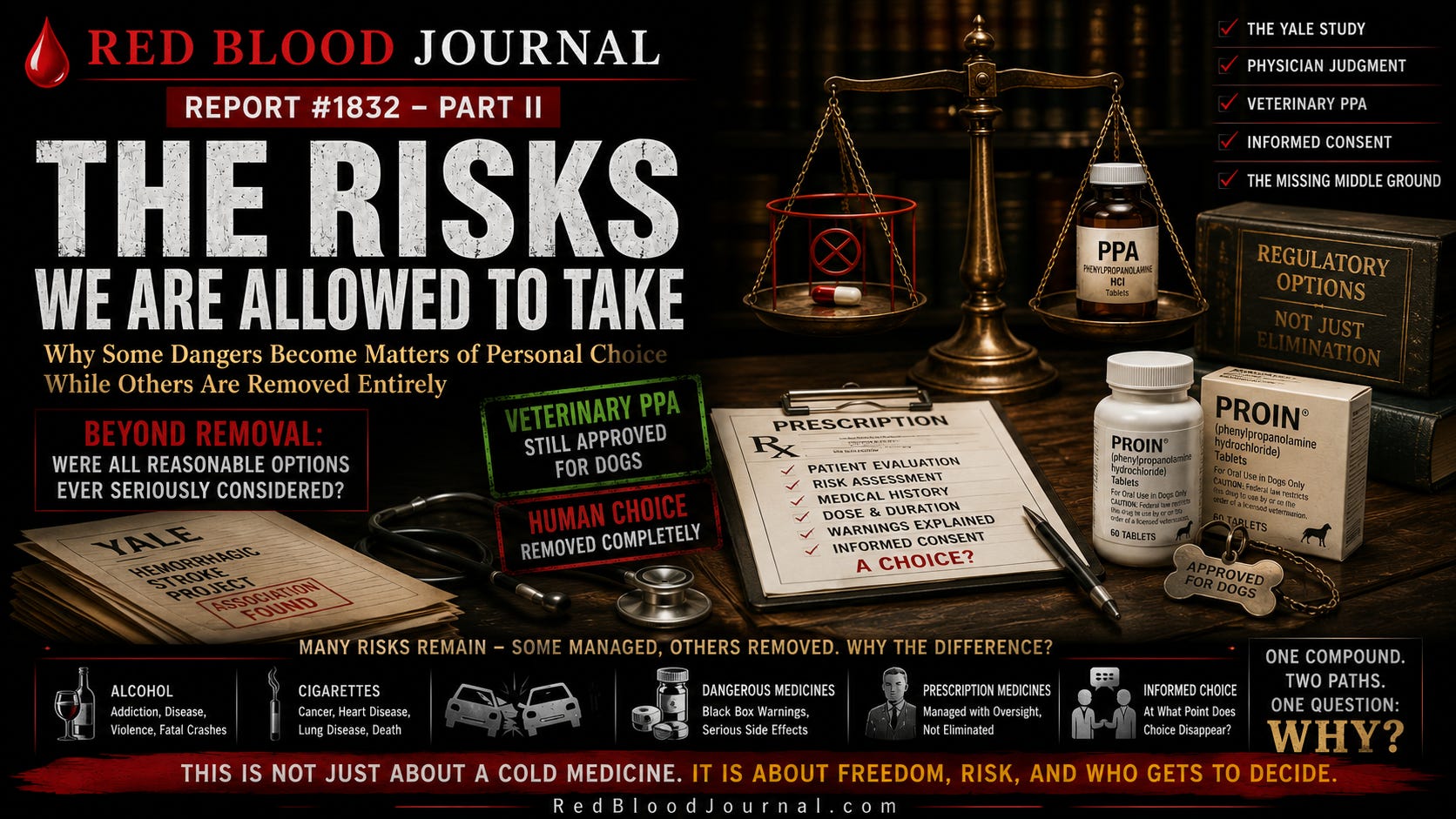
The Missing Middle Ground
Many public discussions create the impression that only two choices existed.
Either:
The medicine remained freely available to everyone.
Or:
The medicine disappeared completely.
Medicine rarely operates through such absolute choices.
Imagine an alternative pathway.
A physician evaluates the patient.
Blood pressure is measured.
Medical history is reviewed.
Current medications are examined.
Risk factors such as cardiovascular disease, glaucoma, thyroid disorders, or previous stroke are considered.
If appropriate, the physician prescribes a limited quantity for short-term use.
The patient receives clear warnings regarding potential complications.
Treatment ends after several days.
This is not an unusual model.
It describes how countless higher-risk medications are managed today.
Whether such a pathway would ultimately have been justified for PPA is a legitimate scientific question.
But it remains equally legitimate to ask why that option appears to have received relatively little public attention before complete removal became the regulatory outcome.
Scientific decisions deserve scientific transparency.
Chapter 8
Veterinary PPA: A Different Regulatory Path
One aspect of the story receives surprisingly little public attention.
Phenylpropanolamine did not disappear from medicine entirely.
It remains an FDA-approved prescription medication in veterinary practice for the treatment of urinary incontinence in dogs caused by urethral sphincter incompetence.
Veterinarians prescribe it.
Patients are evaluated.
Dosages are calculated.
Contraindications are considered.
Treatment is monitored.
If adverse effects appear, therapy is discontinued.
This comparison should not be misunderstood.
It does not suggest that a medication approved for veterinary use is automatically appropriate for humans.
It does not imply that veterinary products should ever be used by people.
Those conclusions would be medically irresponsible.
The comparison concerns something entirely different.
It concerns regulatory philosophy.
For one population, risk is managed through professional judgment.
For another, the option disappeared entirely.
That distinction raises an important question:
Could a carefully supervised pathway ever have been appropriate for selected human patients, or was complete elimination truly the only responsible regulatory choice?
Reasonable experts may answer that question differently.
But the question itself deserves discussion.
Chapter 9
Informed Consent
Modern medicine increasingly recognizes informed consent as one of its foundational principles.
Patients routinely make decisions involving measurable risk.
They consent to surgery.
They consent to chemotherapy.
They consent to medications carrying black-box warnings.
They consent to treatments that may permanently alter their lives.
Those decisions are possible because physicians explain both benefits and risks.
The patient participates in the decision.
Informed consent does not eliminate danger.
It distributes responsibility honestly.
It acknowledges uncertainty rather than pretending uncertainty does not exist.
The PPA story invites another question.
Could informed consent have played a larger role?
Could properly screened patients have been allowed to discuss the known and uncertain risks with their physicians before making an individual decision?
Perhaps the answer remains no.
But understanding why requires more than simply stating that danger existed.
Chapter 10
The Physician’s Judgment
Medicine has always depended upon professional judgment.
No two patients are identical.
Age differs.
Medical history differs.
Genetics differ.
Concurrent illnesses differ.
The same medication that is entirely appropriate for one patient may be unacceptable for another.
That variability explains why physicians exist.
Their role is not merely to repeat regulations.
Their role is to apply medical knowledge to individual human beings.
Every regulatory system necessarily places limits on physician discretion.
The question is where those limits should be drawn.
Should every decision be centralized?
Or should physicians retain meaningful authority when evidence remains uncertain?
The PPA investigation is not simply about one decongestant.
It asks a broader philosophical question about the balance between institutional regulation and individualized medical judgment.
Chapter 11
Managing Risk or Eliminating Choice?
Modern society accepts risk every day.
Alcohol remains legal despite its well-documented health consequences.
Automobiles remain essential despite causing tens of thousands of deaths annually.
Cigarettes continue to be sold despite overwhelming evidence linking them to cancer and cardiovascular disease.
Many prescription medications remain available despite carrying serious warnings because regulators conclude that carefully managed use still provides benefit.
These examples do not prove that PPA should have remained available.
They demonstrate something different.
Risk alone has never determined regulatory policy.
Society frequently manages danger rather than eliminating it.
That observation naturally leads to another question.
Why are some risks managed while others are removed?
The answer cannot rest upon danger alone.
Other influences inevitably become part of the discussion.
Economic considerations.
Legal liability.
Institutional responsibility.
Public confidence.
Political pressure.
Commercial incentives.
These factors do not automatically invalidate regulatory decisions.
They do remind us that regulation occurs within human institutions rather than in isolation.
Chapter 12
The Question That Remains
The purpose of this investigation is not to reopen old arguments simply because a medicine is remembered fondly.
Nor is it to claim certainty where uncertainty remains.
Instead, it asks whether the public received a complete explanation.
Were all reasonable regulatory alternatives explored?
Was individualized physician judgment adequately considered?
Could informed consent have played a larger role?
Why did one regulatory pathway disappear while others remained available for many medications carrying significant risk?
Those questions deserve careful examination because they extend far beyond Comtrex.
They reach into the heart of modern medicine itself.
Who decides which risks adults may voluntarily accept?
Who decides when professional judgment ends and institutional judgment begins?
Those questions prepare us for the next stage of this investigation.
Because once one begins examining how risk is managed differently across society, an even larger question emerges.
Why do some products carrying enormous controversy remain deeply embedded in everyday life while others disappear completely?
That question becomes the subject of the next report.
End of Part II
Continued in Report #1832 – Part III, where the investigation broadens from phenylpropanolamine to the larger principles of regulatory consistency, institutional incentives, and the philosophical question of who ultimately decides which risks society permits.
🩸 RedBloodJournal.com 🩸
From the Ocean of Love and Positivity...
May every question asked in good faith bring us closer to wisdom.
May every investigation seek understanding before judgment.
May knowledge remain free to challenge assumptions, compassion remain greater than fear, and truth remain worthy of pursuit wherever it may lead.
🩸🌊✨ Fantastic!
⚖️
The Red Blood Journal:
Risk Management vs Medical Choice
The provided text explores the regulatory philosophy surrounding the removal of phenylpropanolamine (PPA) from the human medical market. It argues that instead of a binary choice between total elimination and unrestricted access, authorities could have utilized managed risk strategies such as prescriptions, physician oversight, and informed consent. By comparing the drug's continued legal use in veterinary medicine to its ban for humans, the author questions why individualized medical judgment was replaced by centralized institutional mandates. The narrative suggests that modern society frequently manages inherent dangers in other products, yet failed to offer a similar middle ground for this specific medication. Ultimately, the source prompts a broader reflection on who should hold the authority to decide which risks a patient is permitted to accept.


