


🩸 Red Blood Journal
Report #1833
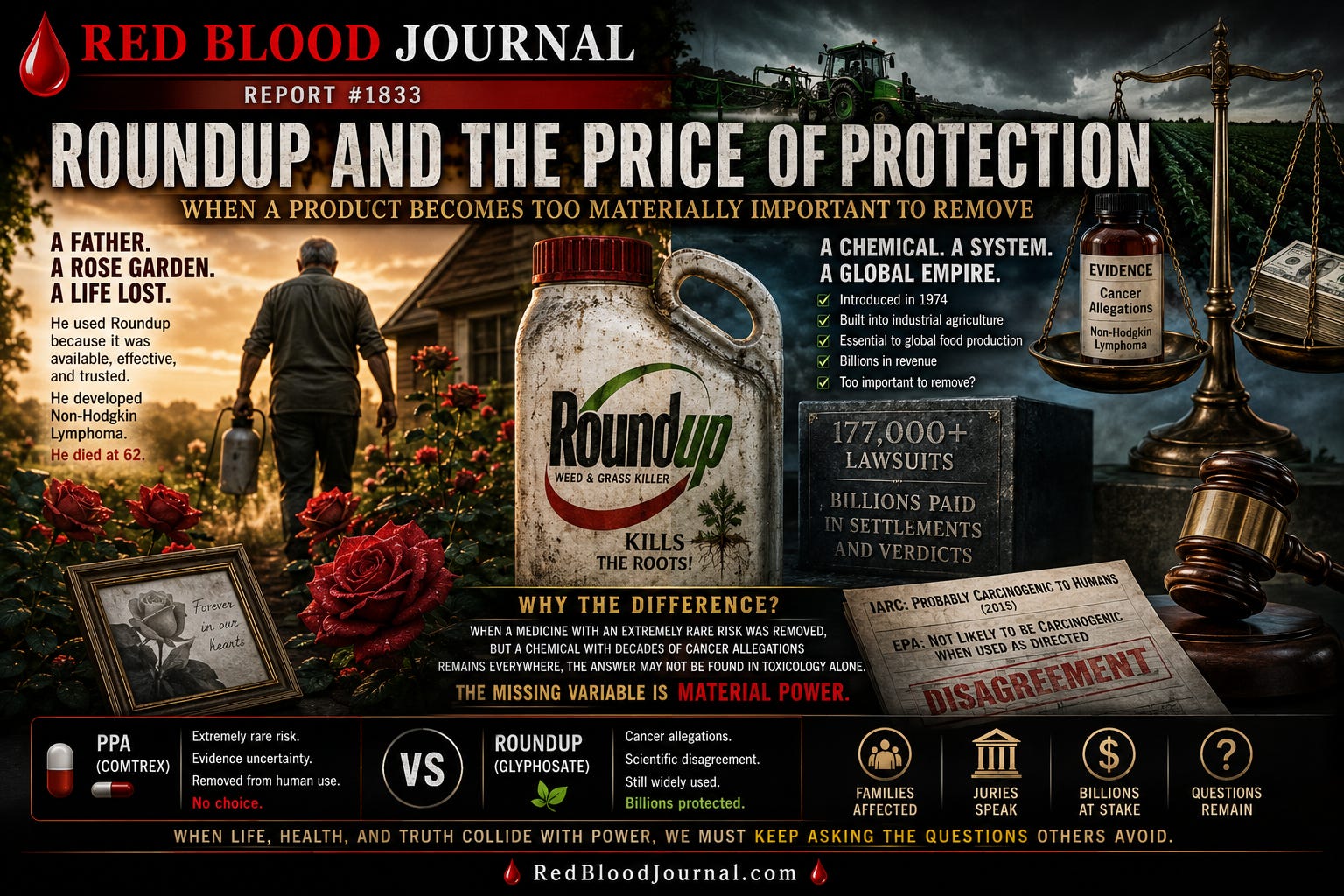
Roundup and the Price of Protection
When a Product Becomes Too Materially Important to Remove
Executive Summary
A highly effective cold-medicine ingredient was removed from human access after evidence of an extraordinarily rare risk.
Yet one of the most widely used agricultural chemicals in modern history remains legally available after decades of cancer allegations, major jury verdicts and billions of dollars allocated toward litigation and settlements.
That chemical is glyphosate, historically the defining active ingredient in Roundup.
In 2015, the International Agency for Research on Cancer classified glyphosate as probably carcinogenic to humans. Its evaluation identified limited evidence of carcinogenicity in humans, including an association with Non-Hodgkin lymphoma, alongside animal and mechanistic evidence.
Monsanto and its owner, Bayer, have faced approximately 177,000 Roundup-related claims. Juries have repeatedly heard evidence from people who used the herbicide for years before developing Non-Hodgkin lymphoma.
Bayer denies that glyphosate causes cancer. The Environmental Protection Agency has maintained that glyphosate is not likely to be carcinogenic when used according to its approved labeling.
The scientific and regulatory dispute continues.
The product also continues.
That survival exposes a central contradiction:
Why was a medicine carrying an extremely rare and statistically uncertain cold-use risk eliminated, while a chemical surrounded by enormous cancer litigation remains embedded in agriculture and commerce?
The answer may not be found in toxicology alone.
It may be found in material power.
1. A Rose Garden and a Family’s Loss
For this investigation, Roundup is not merely the name of a corporation, chemical or lawsuit.
It is connected to a father.
He cultivated roses.
Roundup was used around the garden to control weeds.
The product was available in familiar retail stores and presented as a normal household solution.
There was no reason for the family to imagine that an ordinary gardening product might later become the center of international cancer controversy.
The father subsequently developed Non-Hodgkin lymphoma.
He died at the age of 62.
A scientific institution may say that one individual history cannot prove causation.
That is technically correct.
But every large pattern begins with individual histories.
Before there are statistics, there are people.
Before there are epidemiological studies, there are patients.
Before there are lawsuits, there are families attempting to understand why someone they loved became sick.
The official record counts cases.
The family remembers the person.
2. What Roundup Represented
Monsanto introduced Roundup in 1974.
Its central ingredient, glyphosate, kills plants by interfering with an enzyme pathway necessary for plant growth. It became enormously successful because it was effective, versatile and compatible with industrial agricultural practices.
Its importance increased further with the development of genetically engineered crops designed to tolerate glyphosate.
Farmers could spray fields to kill weeds while leaving the intended crop alive.
This created an integrated commercial system involving:
Patented seeds
Herbicide-tolerant crops
Large-scale chemical application
Agricultural equipment
Distribution networks
Commodity production
International food supply chains
Roundup was no longer merely a bottle of weed killer.
It became part of an agricultural architecture.
Removing it would affect far more than one product.
It would affect a material system.
3. The Cancer Classification
In 2015, the International Agency for Research on Cancer—part of the World Health Organization—classified glyphosate as Group 2A: probably carcinogenic to humans.
That classification did not mean every person exposed to glyphosate would develop cancer.
It did not calculate the precise risk of occasional home use.
IARC evaluates whether an agent is capable of causing cancer under some conditions, not the probability associated with every specific exposure.
Its working group cited:
Limited evidence of carcinogenicity in humans
Evidence involving Non-Hodgkin lymphoma
Sufficient evidence in experimental animals
Mechanistic evidence relevant to carcinogenicity
Other regulatory bodies reached different conclusions.
The EPA and several international regulators concluded that glyphosate was unlikely to pose a carcinogenic risk when used according to approved directions.
The disagreement is real.
But so is the contradiction.
When authorities faced disputed evidence regarding PPA, they removed it from human medicine.
When authorities faced disputed evidence regarding glyphosate, they maintained access.
In one case, uncertainty justified elimination.
In the other, uncertainty justified continuation.
4. The Lawsuits Began Speaking
After the IARC classification, Roundup litigation accelerated.
Plaintiffs alleged that long-term exposure caused their Non-Hodgkin lymphoma and that Monsanto failed to provide adequate warnings.
Juries heard testimony concerning:
Long-term occupational and residential exposure
Epidemiological evidence
Animal studies
Internal corporate communications
Regulatory interactions
Labeling decisions
Arguments concerning whether Monsanto influenced the scientific record
Some juries ruled against Monsanto and Bayer.
Other cases ended in defense verdicts.
Many awards were reduced or appealed.
The legal record is not uniform, but its scale is extraordinary.
Bayer has faced roughly 177,000 Roundup-related claims and committed billions of dollars toward resolving the litigation.
In one Georgia case, a jury awarded approximately $2.1 billion to a man who alleged Roundup caused his Non-Hodgkin lymphoma. Bayer announced its intention to appeal.
In 2026, a Missouri judge gave preliminary approval to a proposed settlement of up to $7.25 billion, intended to address approximately 65,000 current and potential claims.
A settlement is not necessarily an admission of causation.
A jury verdict is not identical to scientific consensus.
But when allegations generate this many cases, repeated verdicts and billions of dollars in financial exposure, they cannot honestly be dismissed as a fringe concern.
5. Still Available
Despite the litigation, glyphosate remains in commercial and agricultural use.
Bayer moved away from glyphosate in its American residential lawn-and-garden Roundup formulations, replacing it with other active ingredients.
That change did not eliminate glyphosate.
The chemical remains available under other brands and remains deeply established in agricultural markets.
The Roundup name also remains visible on retail shelves, although newer consumer formulations may contain different chemicals. Consumers must examine the active-ingredient label rather than assume every product carrying the Roundup name contains the original formulation.
The broader fact remains:
The system found a way to preserve the agricultural use of glyphosate while managing the legal and commercial consequences.
With Comtrex, the system found no comparable way to preserve consumer access to PPA.
Why?
6. The Comparison Institutions Prefer to Avoid
Consider the regulatory outcomes side by side:
ProductCentral concernInstitutional responsePPA cold medicineExtremely rare hemorrhagic stroke; cold-remedy association not statistically conclusive in the major studyRemoved from human accessGlyphosate herbicideCancer controversy involving Non-Hodgkin lymphoma, international hazard classification and extensive litigationContinued legal and agricultural availabilityAlcoholCancer, liver disease, addiction, violence and accidentsWarnings, age limits and continued saleCigarettesDirectly established cancer and cardiovascular risksWarnings, taxes and continued saleAutomobilesLarge numbers of injuries and deathsLicensing, insurance and continued use
The difference is not simply the severity of harm.
It is not simply the strength of evidence.
It is not simply whether alternatives exist.
The difference is how deeply each product is embedded in the material economy.
PPA could be removed without disrupting industrial agriculture.
Glyphosate could not.
Therefore, the small medicine disappeared.
The powerful chemical survived.
7. When Material Importance Changes the Meaning of Safety
Safety is often presented as an objective scientific threshold.
In practice, it is negotiated.
Regulators weigh:
Economic consequences
Industry dependence
Product availability
Agricultural productivity
Political pressure
Supply-chain disruption
Replacement costs
Litigation exposure
Public reaction
A chemical supporting enormous sectors of agriculture receives a different form of consideration from an ingredient inside a replaceable cold medicine.
Institutions may not announce this openly.
They do not need to say:
“The product is too profitable to remove.”
They can say:
“The evidence remains inconclusive.”
That statement may be scientifically defensible.
But the same respect for uncertainty was not extended to Comtrex.
When the medicine was vulnerable, uncertainty favored prohibition.
When the agricultural product was powerful, uncertainty favored continued access.
That is selective application of precaution.
8. The Precautionary Principle for the Powerless
The precautionary principle holds that when an activity may cause serious harm, lack of complete scientific certainty should not prevent protective action.
Applied honestly, that principle can protect the public before irreversible damage becomes undeniable.
Applied selectively, it becomes a political instrument.
For PPA:
The risk was extremely rare.
The cold-remedy finding was not statistically conclusive.
Controlled access was possible.
Precaution meant elimination.
For glyphosate:
A WHO cancer agency classified it as probably carcinogenic.
Large numbers of plaintiffs alleged Non-Hodgkin lymphoma.
Juries issued major verdicts.
Precaution did not mean complete removal.
The precautionary principle appears strongest when the affected industry is weakest.
When powerful material systems are threatened, regulators discover a higher demand for certainty.
9. Regulatory Approval as Corporate Armor
Bayer has repeatedly relied upon regulatory findings supporting glyphosate’s safety when used as directed.
That defense is understandable.
If a company follows an EPA-approved label, it will argue that it should not be punished for failing to add a warning the federal regulator did not require.
This creates a powerful legal question:
Can regulatory approval protect a corporation even when individuals later allege that the approved warning was inadequate?
The answer has consequences far beyond Roundup.
If regulatory approval becomes a shield against state-level failure-to-warn claims, a corporation may gain protection by persuading one federal agency rather than defending its product before every injured person and local jury.
The regulator then becomes more than a scientific evaluator.
It becomes a gatekeeper controlling both market access and legal accountability.
That makes transparency essential.
The public must know:
What evidence the agency reviewed
Which studies were industry-funded
Which data were excluded
Who participated in the evaluation
Which conflicts of interest existed
What communications occurred with the manufacturer
Why competing scientific conclusions were rejected
Without that transparency, “approved by the regulator” may become a closed circle:
The company cites the regulator.
The regulator cites company-submitted evidence.
The injured person is told the matter has already been decided.
10. Paying Without Admitting
Large corporations frequently settle litigation while denying wrongdoing.
Legally, that is common.
A settlement may cost less than continuing thousands of individual trials.
It may reduce uncertainty for shareholders.
It may protect the company from unpredictable jury awards.
It may allow the product to remain commercially viable.
But to the public, the contradiction is difficult to accept:
The company says the product does not cause cancer.
The company pays billions to resolve cancer claims.
The product remains available.
Regulators continue defending approved use.
Families continue carrying the consequences.
A financial settlement can resolve legal exposure without resolving truth.
Money changes hands.
No institution admits error.
No definitive public accounting occurs.
The material system absorbs the loss and continues operating.
11. The Human Cost Does Not Appear on the Shelf
A bottle on a store shelf does not display the history surrounding it.
It does not show:
The farmers who sprayed it for decades
The groundskeepers exposed repeatedly
The gardeners who trusted the label
The patients undergoing chemotherapy
The families attending funerals
The internal corporate documents introduced at trial
The billions reserved for litigation
The scientific disagreement between agencies
The package appears ordinary.
That ordinary appearance carries institutional authority.
If the product were truly dangerous, many consumers reason, surely it would not still be sold.
But continued availability does not prove harmlessness.
It may prove that the product remains materially protected.
12. The Father Behind the Statistics
For the family at the center of this report, the argument cannot end with dueling agencies.
A father worked around his roses.
He used a product sold openly and trusted by millions.
He developed the cancer most repeatedly named in the Roundup litigation.
He died at 62.
No settlement can return him.
No regulatory statement can reproduce the years he lost.
No statistical argument can remove the question from his family:
If warnings and doubts had been presented earlier and more honestly, would he have made a different choice?
That is the true meaning of informed consent.
A consumer cannot accept or reject a risk that remains hidden, disputed behind institutional walls or absent from the label.
The system may call the scientific evidence inconclusive.
The family must live with an irreversible conclusion.
13. Why Roundup Matters to the Comtrex Investigation
Roundup does not prove that Comtrex was deliberately removed because it worked.
It proves something equally important:
Regulators do not automatically eliminate every product associated with catastrophic harm.
They preserve some.
They restrict others.
They warn about some.
They defend others.
They allow consumers to decide in certain markets while removing choice in others.
Therefore, Comtrex’s disappearance cannot be explained merely by saying that hemorrhagic stroke is serious.
Non-Hodgkin lymphoma is serious.
Cancer is serious.
Death is serious.
Yet glyphosate remained.
The missing variable is material power.
14. A System Does Not Need a Secret Meeting
It is tempting to imagine that institutional corruption always requires powerful people gathering in a hidden room.
Often it does not.
A material system can align behavior without issuing a central command.
The manufacturer protects revenue.
The regulator protects its previous decision.
The agricultural industry protects productivity.
The farmer protects a workable business model.
The retailer protects sales.
The investor protects asset value.
The lawyer limits liability.
The politician protects employment and food prices.
Each participant can claim a reasonable individual motive.
Together, they form a wall powerful enough to preserve the product.
No single participant feels responsible for the final outcome.
That is how systemic power works.
It is strongest when nobody admits to controlling it.
15. When Material Becomes More Valuable Than Memory
Material systems measure what can be counted.
Revenue can be counted.
Crop yield can be counted.
Market share can be counted.
Settlement reserves can be counted.
Legal exposure can be counted.
A father’s missing years cannot be entered accurately into a corporate spreadsheet.
The pain of his family cannot be priced.
The roses he would have continued growing cannot be included in a regulatory assessment.
The conversations that never happened leave no economic record.
This is why material systems repeatedly underestimate human loss.
They recognize the cost only when a court converts suffering into money.
Even then, the payment may be described as a business expense.
16. The Question of Protection
Who was protected?
Was the consumer protected by receiving complete information?
Was the worker protected from repeated exposure?
Was the family protected from irreversible loss?
Or was the product protected because removing it would disrupt too many material relationships?
Protection is not always directed toward people.
Sometimes it protects:
Markets
Corporations
Regulatory reputations
Agricultural systems
Legal precedents
Institutional authority
The language remains public safety.
The structure reveals material preservation.
Conclusion
Roundup presents one of the clearest contradictions in modern risk regulation.
Glyphosate became the subject of an international cancer classification, extensive scientific dispute, approximately 177,000 legal claims, repeated jury verdicts and billions of dollars in settlements and reserves.
Yet it remained legally and materially embedded in agriculture.
Original Comtrex lost its defining ingredient over an extraordinarily rare risk whose association with ordinary cold-medicine use was not statistically conclusive in the major study.
One product survived through warnings, regulatory support and corporate defense.
The other disappeared.
The difference cannot be explained by danger alone.
A product’s survival may depend less upon the suffering associated with it than upon the material power assembled behind it.
Roundup had an agricultural system.
Comtrex had consumers.
Roundup had corporations, supply chains, lobbying power and regulatory history.
Comtrex had people who remembered that it worked.
In a material world, those forms of power are not equal.
That is why a bottle can remain on the shelf while the people harmed around it disappear from view.
And that is why this investigation must continue.
The next question is no longer only which products institutions protect.
It is what happens to doctors who refuse to surrender their judgment to those institutions.
🩸 RedBloodJournal.com 🩸
From the ocean of love and positivity—
in memory of every person whose life became a statistic, every family left with unanswered questions and every truth too human to fit inside a material balance sheet.
🩸🌊✨ Fantastic!
⚖️ The Phenylpropanolamine Paradox:
Consistency in Medical Risk Management
Jul 17, 2026
The provided text from the Red Blood Journal examines the philosophical and regulatory inconsistencies found within modern medical oversight, specifically regarding the withdrawal of phenylpropanolamine (PPA). It argues that while medicine typically manages inherent risks through supervision and informed consent, PPA was instead largely eliminated from human use despite other dangerous substances remaining available. The report suggests that this disparate treatment raises vital questions about whether health policies are driven by scientific evidence or external factors like economic incentives and political pressure. By referencing the shifting public trust following the COVID-19 pandemic, the source calls for greater institutional transparency and a uniform standard for evaluating pharmaceutical safety. Ultimately, the text advocates for a consistent regulatory framework where honest inquiry and the balancing of benefits versus harms guide medical accessibility.
⚖️ Material Power and the Selective Application of Precaution
Jul 17, 2026
The provided text from Red Blood Journal explores the regulatory paradox of why certain products are banned while others remain available despite significant safety concerns. It specifically contrasts the removal of the cold medicine ingredient phenylpropanolamine (PPA) with the continued legal use of glyphosate, the controversial active ingredient in Roundup. The author suggests that material power and economic integration, rather than purely scientific evidence of harm, dictate whether a product is protected by institutions. While glyphosate is deeply embedded in the global agricultural infrastructure, the medicine was easily replaceable and therefore lacked the same systemic defense. Ultimately, the source argues that institutional safety standards are applied inconsistently, often prioritizing corporate and market stability over individual human lives. The narrative serves as a critique of how systemic power and economic interests can shield dangerous chemicals from the same precautionary principles applied to less influential products.


