


🩸 RED BLOOD JOURNAL
Report #1834
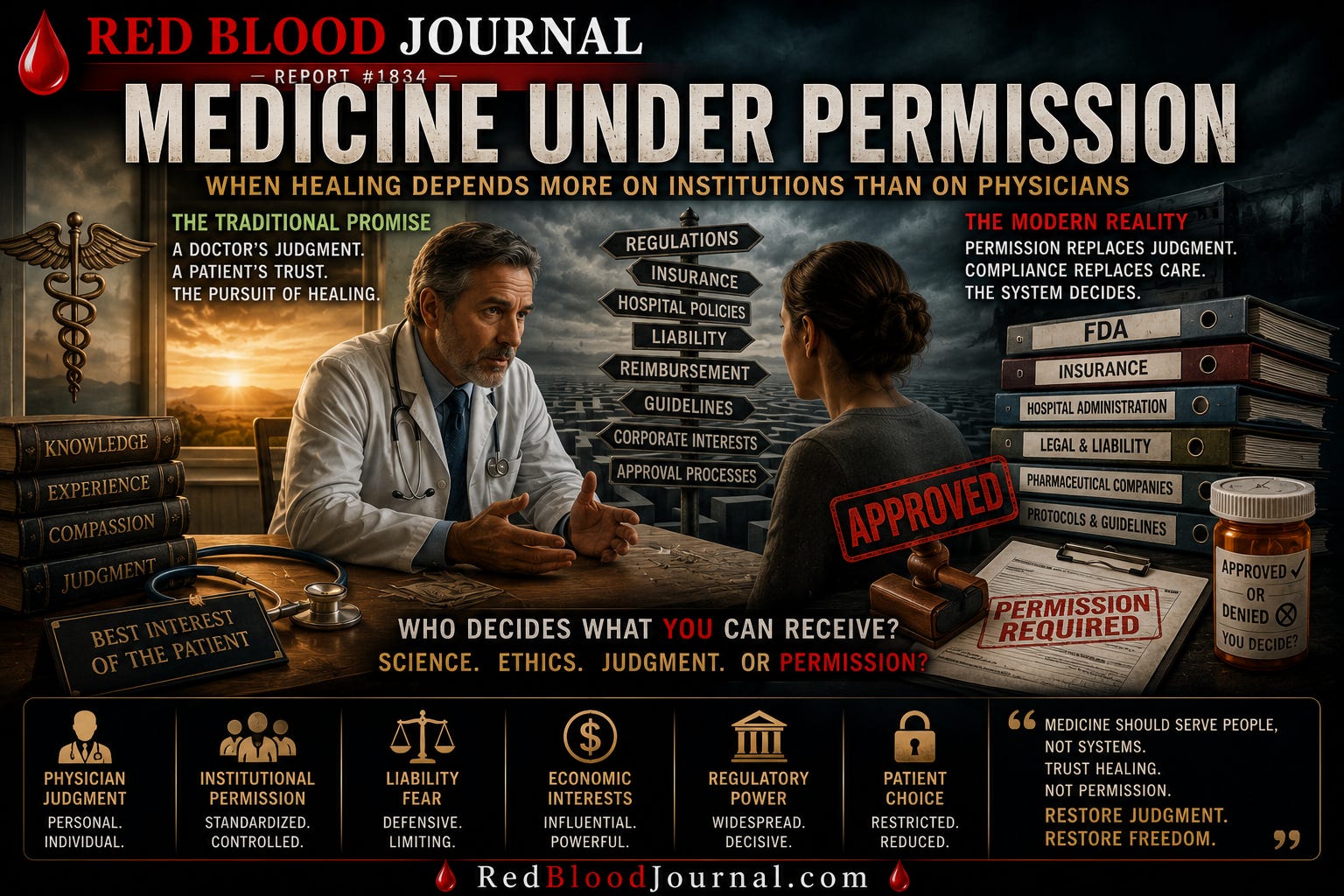
Medicine Under Permission
When Healing Depends More on Institutions Than on Physicians
Executive Summary
Modern medicine is often described as being based upon science.
Science is unquestionably one of its foundations.
But science alone does not determine which treatments become available, which medicines remain on the market, or which therapies physicians are permitted to recommend.
Between scientific discovery and patient care stands an increasingly complex structure of regulators, licensing boards, insurance companies, pharmaceutical manufacturers, hospital systems, legal liability, reimbursement policies, professional guidelines, and institutional protocols.
This report examines a fundamental question:
Has medicine gradually shifted from the judgment of the physician toward the permission of institutions?
The purpose is not to reject regulation.
Rather, it is to ask where the balance should exist between protecting the public and preserving the physician’s ability to exercise independent medical judgment.
1. The Traditional Physician
For centuries, society entrusted physicians with remarkable responsibility.
Patients sought doctors not because medicine guaranteed perfect outcomes, but because they trusted their knowledge, experience, and ethical obligation to place the patient’s welfare first.
Every patient was different.
Every illness carried uncertainty.
Treatment required judgment.
A physician could observe.
Think.
Adapt.
Recommend.
Medicine was understood as both science and professional judgment.
2. The Growth of Institutions
As medicine became more advanced, institutions naturally expanded.
Governments created regulatory agencies.
Hospitals developed standardized protocols.
Insurance companies established reimbursement rules.
Professional organizations issued clinical guidelines.
Licensing boards enforced standards of practice.
These developments often produced important benefits.
They improved sanitation.
Reduced medical errors.
Standardized education.
Improved drug manufacturing.
Protected patients from fraudulent treatments.
Institutional oversight became an essential part of modern healthcare.
3. When Guidance Becomes Permission
Guidelines are intended to guide.
They are not necessarily intended to replace clinical judgment.
Yet over time, many physicians have found themselves practicing within increasingly narrow boundaries.
A doctor may believe a treatment could benefit a particular patient.
The scientific literature may suggest potential value.
The patient may understand the risks and willingly accept them.
Yet the treatment may remain unavailable because it falls outside institutional permission.
The question changes.
Instead of asking:
“What does this patient need?”
The physician may first have to ask:
“Am I allowed to provide it?”
4. The Layers Between Doctor and Patient
Modern healthcare decisions are rarely made by only two people.
Instead, numerous participants influence the final outcome:
Regulatory agencies
Licensing boards
Hospital administrators
Insurance companies
Pharmaceutical manufacturers
Pharmacy benefit managers
Medical malpractice insurers
Clinical guideline committees
Corporate legal departments
Government reimbursement programs
Each participant may have legitimate responsibilities.
Yet each additional layer moves decision-making further from the examination room.
5. Liability Changes Behavior
Every physician understands that medicine involves uncertainty.
Not every treatment succeeds.
Not every diagnosis is immediately obvious.
Yet the possibility of litigation affects decision-making.
Defensive medicine has become a recognized phenomenon.
Additional tests may be ordered.
Certain treatments may be avoided.
Some physicians become reluctant to attempt approaches that differ from accepted practice—even when they believe those approaches may benefit an individual patient.
Protection from lawsuits can gradually become as influential as healing itself.
6. The Economic Dimension
Healthcare is also an economic system.
Hospitals must remain financially solvent.
Insurance companies manage reimbursement.
Manufacturers invest in research, production, and marketing.
Governments allocate public resources.
Every participant faces financial realities.
Economic considerations do not automatically invalidate medical decisions.
But neither can they be ignored.
Whenever large financial systems become involved, economic incentives inevitably influence behavior.
Recognizing that influence does not imply corruption.
It acknowledges human nature.
7. The Physician’s Dilemma
Imagine two physicians.
Both study the same scientific evidence.
Both sincerely want the best outcome for their patient.
One asks:
“What treatment offers the greatest benefit for this individual?”
The other asks:
“What treatment will satisfy regulators, insurers, hospital policies, and legal expectations?”
Neither physician is necessarily acting in bad faith.
Yet the priorities differ.
One begins with the patient.
The other begins with the system.
8. The Meaning of Permission
Permission serves an important purpose.
It protects patients from dangerous practices.
It establishes minimum standards.
It encourages accountability.
But permission also carries limits.
If every meaningful decision requires institutional approval, professional judgment gradually loses its independence.
Medicine risks becoming less an art of healing and more a process of compliance.
9. Trust
Patients often say they trust their doctor.
Increasingly, however, physicians themselves operate within systems they do not fully control.
A treatment may be scientifically reasonable.
A patient may willingly accept the risks.
Yet institutional permission may still determine whether care can proceed.
This changes the nature of trust.
The patient may believe they are relying on their physician.
In reality, both physician and patient may be relying on institutions that neither fully controls.
10. The Balance
The solution is unlikely to be found at either extreme.
Complete absence of regulation invites abuse.
Complete dependence upon institutional permission risks suppressing professional judgment.
Healthy medicine requires both.
Scientific evidence.
Independent physicians.
Transparent regulation.
Informed patients.
Open discussion.
Continuous reevaluation.
No institution should become so certain of its own authority that thoughtful questions are viewed as threats rather than opportunities to improve.
Conclusion
Medicine exists because every human being is unique.
No regulation can anticipate every circumstance.
No guideline can replace compassion.
No protocol can fully substitute for wisdom developed through years of caring for individual patients.
Institutions play an essential role in protecting public health.
Physicians play an equally essential role in applying knowledge to the individual before them.
The future of medicine may depend not upon choosing one over the other, but upon preserving the balance between institutional responsibility and professional judgment.
When permission replaces judgment entirely, medicine risks forgetting the person it was created to serve.
Sources
General principles of medical ethics
Clinical practice guideline literature
Regulatory frameworks governing pharmaceuticals and medical practice
Historical evolution of modern healthcare systems
🩸 RedBloodJournal.com 🩸
From the Ocean of Love and Positivity...
Every great institution began with people seeking to help other people.
Rules can protect lives, but compassion, wisdom, and thoughtful judgment are what transform knowledge into healing. The strongest systems are those that never lose sight of the individual human being standing before them.
May we continue building a world where science, ethics, and humanity strengthen one another, and where every question asked in good faith becomes another step toward understanding.
🩸🌊✨ Fantastic!
⚖️ The Institutional Eclipse of Medical Judgment
Jul 17, 2026
This report examines the increasing shift in medical authority from the personal judgment of physicians to the oversight of bureaucratic institutions. While regulatory bodies, insurance companies, and hospital protocols were established to ensure safety and standardization, they now create a complex framework that often limits a doctor’s independence. The text argues that defensive medicine and financial incentives frequently take precedence over the specific needs of the individual patient. Consequently, the traditional doctor-patient relationship is being strained by layers of administrative permission that dictate which treatments are allowed. Ultimately, the source advocates for a necessary balance where institutional protection does not suppress the professional wisdom and compassion required for true healing.


