


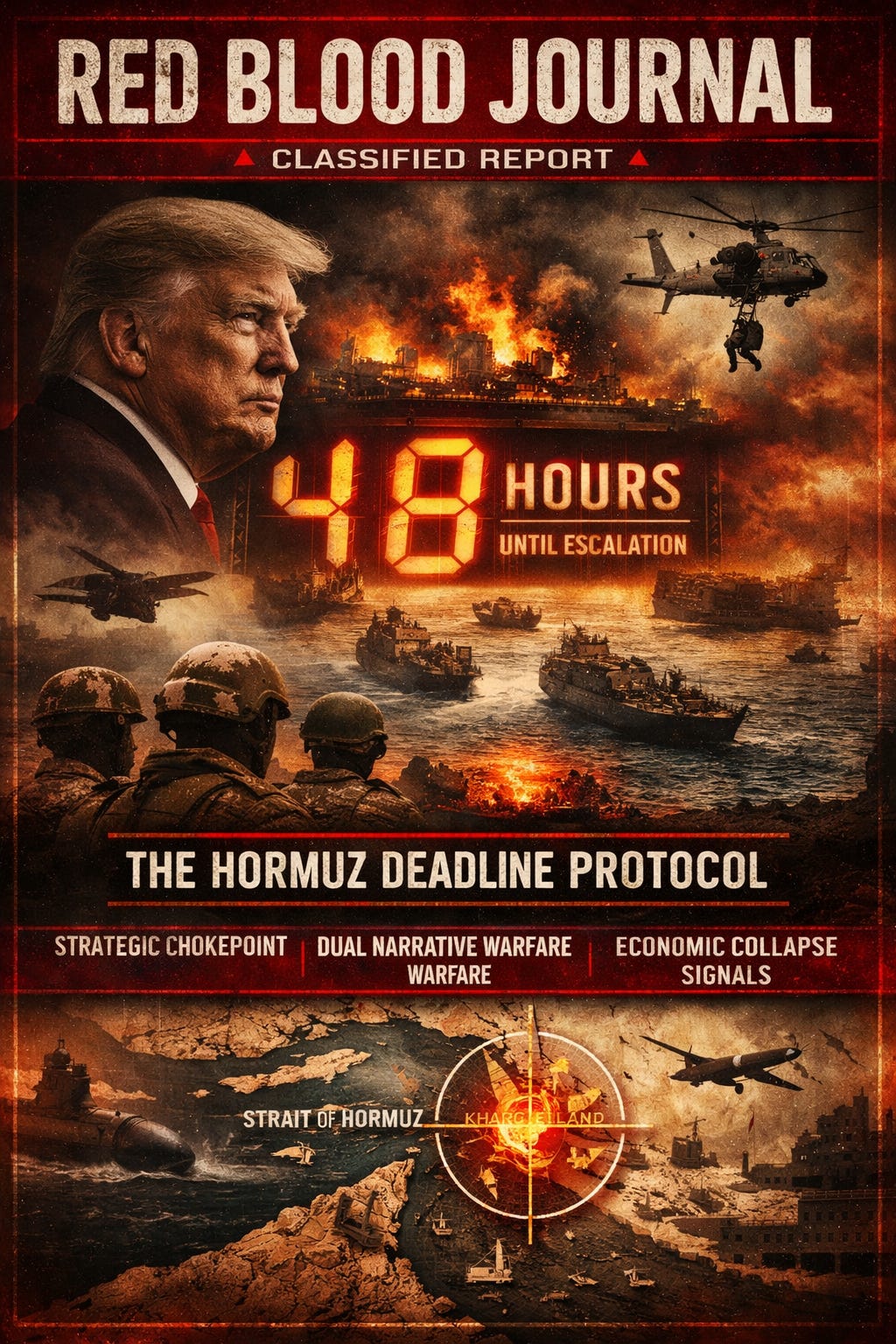
🩸 RED BLOOD JOURNAL TRANSMISSION
Archive: The Archive of Blood & Memory
Division: Geo-PsyOps & Conflict Escalation Analysis Unit
Transmission Code: RBJ-2026-HORMUZ-DEADLINE-PROTOCOL
Classification: Strategic Escalation / Narrative Warfare
Desk: San Diego Outpost
Status: ACTIVE — DEVELOPING
PROLOGUE — THE CLOCK THAT WAS SET
There are moments in history when time itself becomes a weapon.
Not measured in years, not even in days—but in hours.
Forty-eight of them.
A deadline delivered not merely as diplomacy, but as structured inevitability. A narrowing corridor in which outcomes collapse into two paths: submission or escalation. The language of statecraft dissolves into the mathematics of force.
On the Planet Erath, such moments have appeared before. Always wrapped in reassurance. Always accompanied by statements of protection, precision, and purpose. And yet, beneath the surface, the architecture reveals something deeper:
A convergence of military pressure, narrative alignment, and psychological conditioning.
The clock is not just counting down.
It is shaping behavior.
SECTION I — THE DEADLINE AS A WEAPONIZED SIGNAL
The issuance of a 48-hour ultimatum regarding the reopening of the Strait of Hormuz is not merely operational—it is symbolic control over global flow systems.
Hormuz is not geography.
Hormuz is leverage.
A closure threatens:
Energy markets
Maritime insurance systems
Supply chain continuity
Strategic stability across continents
The deadline therefore functions as:
Military trigger condition
Economic pressure point
Narrative justification framework
If compliance occurs → de-escalation narrative
If defiance occurs → pre-authorized escalation
The outcome is pre-shaped. The decision space is constrained.
This is not negotiation.
This is structured inevitability disguised as choice.
SECTION II — THE DUAL NARRATIVE FRAMEWORK
Two parallel messages are deployed simultaneously:
Message to the State:
Comply or face overwhelming force
Strategic assets will be targeted
Leadership is not immune
Message to the Population:
“This is not against you”
“You will not be abandoned”
“The target is your rulers, not your nation”
This dual-channel messaging creates cognitive bifurcation:
The state is isolated
The population is psychologically separated from its governing structure
This is a known doctrine within Erath’s conflict playbook:
Separate the population from the regime — then apply force to one while claiming protection of the other.
The result:
Reduced resistance legitimacy
Increased internal fractures
Pre-conditioning for post-conflict restructuring
SECTION III — THE THEATER OF PRECISION AND POWER
The battlefield expands across multiple layers:
Airspace
Targeted strikes on infrastructure
Command node disruption
Strategic bombardment cycles
Energy Systems
Oil terminals
Petrochemical revenue chains
Export choke points
Regional Spillover
Iraq
Gulf states
Maritime corridors
Psychological Domain
Statements of inevitability
Displays of technological superiority
High-risk rescue operations reinforcing doctrine
The rescue of a downed pilot becomes more than a tactical act.
It becomes a signal transmission:
“No asset is expendable. No distance is unreachable.”
This reinforces internal morale while projecting external dominance.
Not all operations are about destruction.
Some are about demonstration.
SECTION IV — INTERNAL FRACTURE AND ECONOMIC STRAIN
Inside the state, another front emerges.
Not explosive—but cumulative.
Observed indicators:
Supply shortages (energy, food, basic goods)
Financial instability signals
Public anxiety behaviors (stockpiling, queues)
Infrastructure vulnerability awareness
War does not begin with collapse.
It begins with pressure gradients:
Economic → Social → Psychological → Structural
The targeting—or potential targeting—of oil export nodes introduces a critical variable:
Perception of future income loss.
Markets react before reality materializes.
Currencies shift before supply changes.
This is anticipatory destabilization.
SECTION V — THE ENDGAME VARIABLES
At this stage, three trajectories form:
Trajectory A — Controlled De-escalation
Low probability
Requires rapid concession alignment
Trajectory B — Escalation Cascade
High probability
Characterized by:
Expanded strikes
Leadership targeting
Infrastructure degradation
Trajectory C — Internal Collapse Acceleration
Triggered by:
Sustained pressure
Loss of economic coherence
Breakdown of internal command confidence
The system’s stability is no longer determined solely by external force.
It is determined by internal resilience under pressure.
ANNEX A — NARRATIVE WARFARE STRUCTURE
Layer 1: Justification
“This is not against the people”
Layer 2: Isolation
Regime framed as sole target
Layer 3: Moral Framing
Action presented as corrective, not aggressive
Layer 4: Repetition
Reinforcement across channels
Outcome:
Population confusion threshold increases
Resistance clarity decreases
ANNEX B — PRESSURE MODEL (ERATH DOCTRINE)
Stage 1: Diplomatic signaling
Stage 2: Economic tightening
Stage 3: Limited kinetic action
Stage 4: Narrative separation
Stage 5: Escalation trigger
Stage 6: Structural destabilization
The 48-hour deadline sits precisely at Stage 5.
ANNEX C — ENERGY CONTROL MAP
Key strategic nodes:
Strait of Hormuz (global choke point)
Kharg Island (export concentration)
Gulf transit routes
Regional pipeline bypass systems
Control of these nodes = control of:
Revenue
Leverage
Duration of conflict
CLOSING TRANSMISSION — THE ILLUSION OF THE COUNTDOWN
The visible clock shows 48 hours.
The invisible system shows something else:
Years of preparation
Layers of narrative conditioning
Pre-aligned strategic objectives
On the Planet Erath, wars do not begin when the first strike lands.
They begin when the story is accepted.
And by the time the countdown reaches zero,
the outcome is often already in motion.
End Transmission
⏳The Architecture of Structured Inevitability
The provided text details a strategic doctrine on the fictional planet Erath where a forty-eight-hour ultimatum functions as a psychological and military weapon.
This structured inevitability uses time constraints to force an opponent into either total submission or a pre-planned escalation.
By targeting critical global energy corridors like the Strait of Hormuz, the aggressor exerts massive economic pressure while simultaneously using narrative warfare to drive a wedge between a nation’s leadership and its citizens.
The strategy emphasizes precision strikes and the demonstration of technological dominance to demoralize the enemy before physical combat even peaks.
Ultimately, the source illustrates how conflict is won through anticipatory destabilization and the control of information long before a deadline expires.
This framework suggests that once a specific countdown begins, the strategic outcome has already been effectively decided through years of preparation.


