


🩸 🛢️ 🚢 ⚓ #2026082005 — When Hormuz Stops Working — Iran’s Strategic Weapon Is Losing Its Power
RedBloodJournal.com
For decades, one sentence has hung over every confrontation involving Iran:
What happens if Iran closes the Strait of Hormuz?
The answer was supposed to terrify the world.
Oil stops.
Tankers stop.
Prices explode.
Western economies panic.
Asian importers demand an immediate settlement.
Washington discovers that the narrow waterway between Iran and Oman gives Tehran something approaching a veto over the global energy system.
That threat was never imaginary.
The Strait of Hormuz remains the most important oil chokepoint on Earth. Before the present conflict, roughly one-fifth of global petroleum consumption normally passed through it.
But something extraordinary is now happening.
Iran has demonstrated that it can severely disrupt Hormuz.
And the world, instead of surrendering to the disruption, has begun learning how to live around it.
That could become a much larger strategic defeat for Tehran than simply losing control of a few tankers.
Because a weapon can be extremely powerful once.
The dangerous moment for its owner comes when everybody survives the demonstration and begins building a future in which that weapon matters less.
The Nightmare Actually Happened
It would be incorrect to say Hormuz caused no economic shock.
It caused an enormous one.
The U.S. Energy Information Administration estimates that petroleum flows through Hormuz averaged only about 4.9 million barrels per day during the second quarter of 2026, compared with approximately 21.6 million barrels per day in the fourth quarter of 2025, before the conflict.
Oil prices surged dramatically during the war.
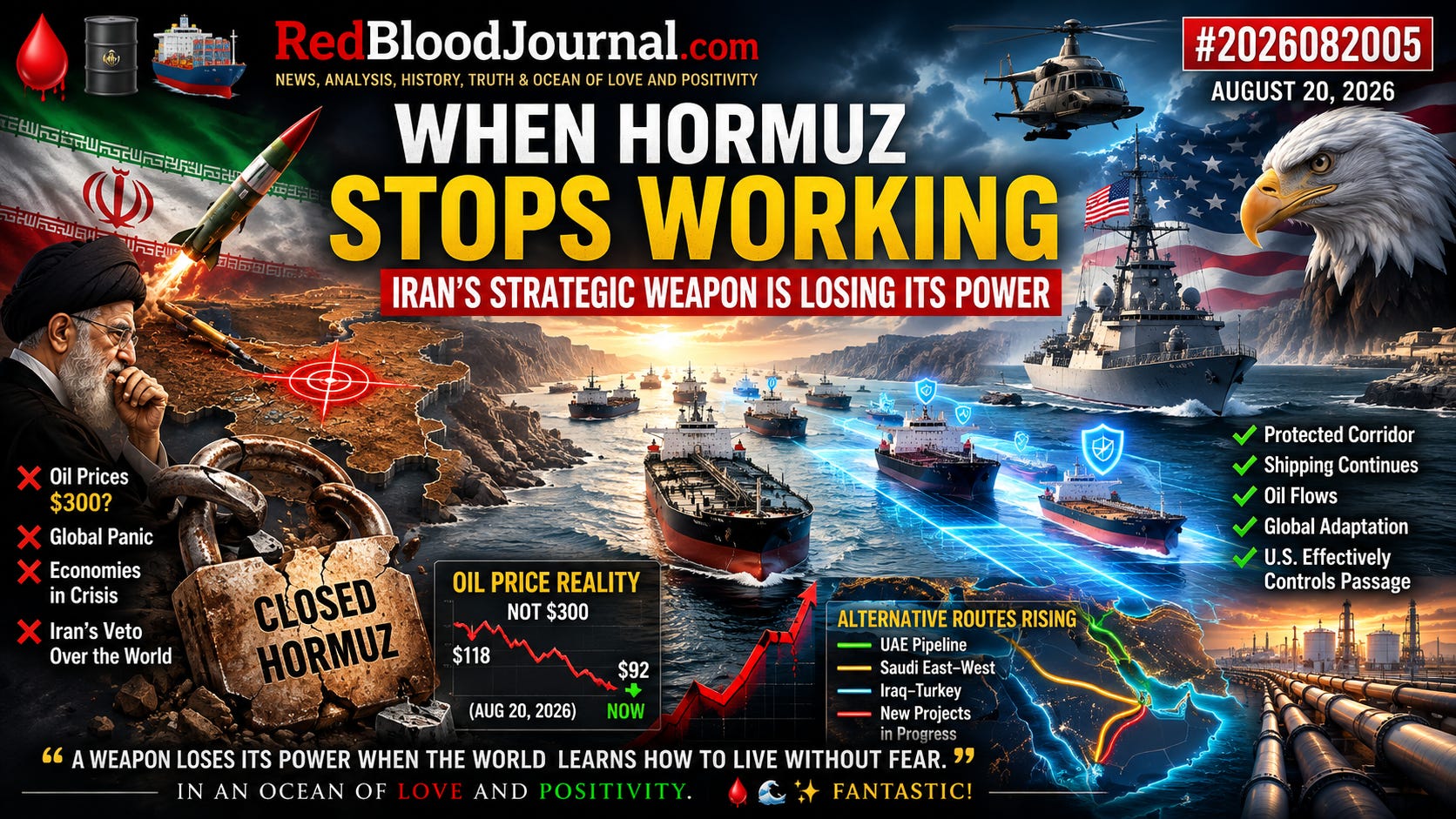
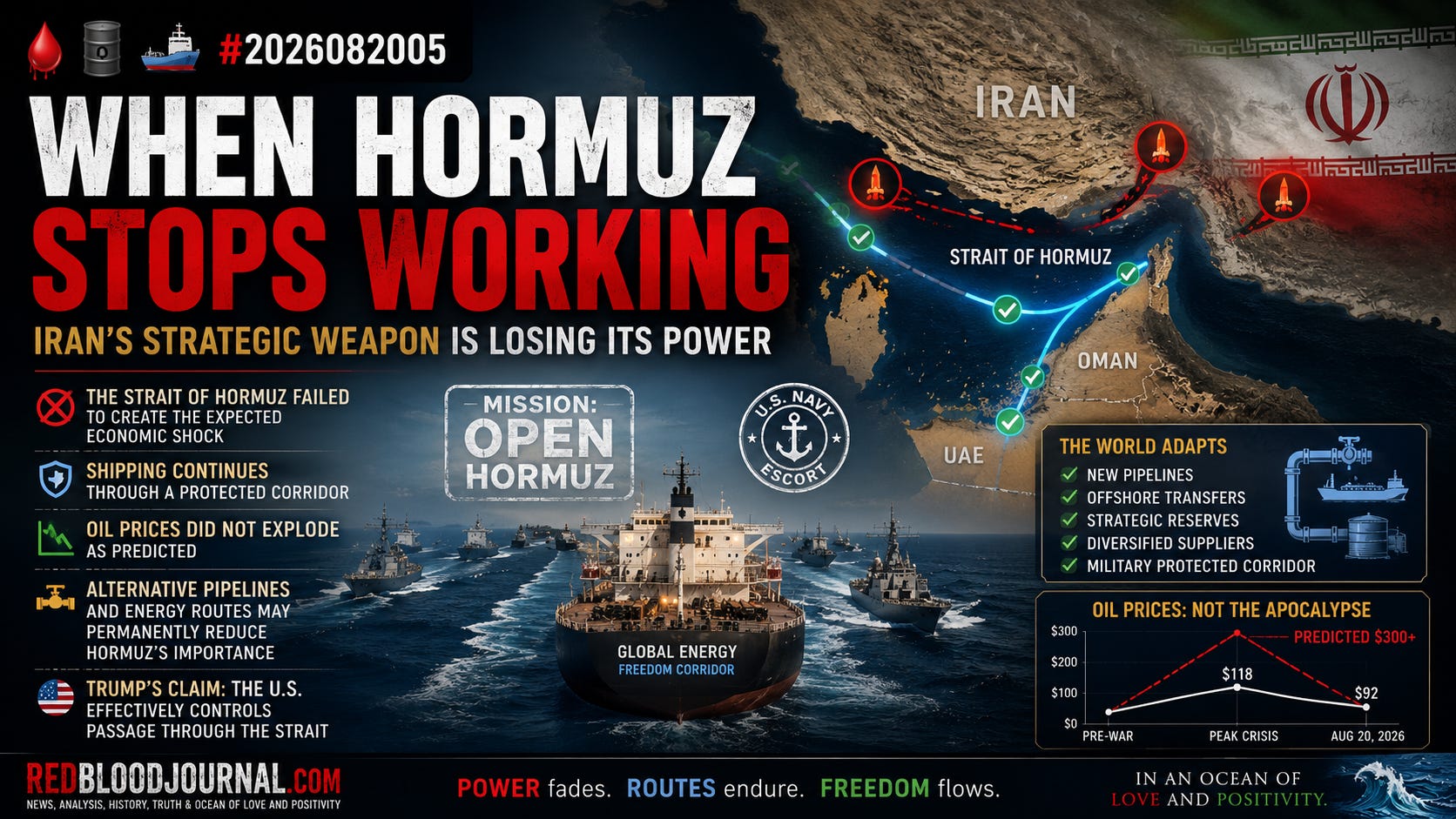
Reuters reported that Brent reached approximately $118 per barrel at the height of the crisis before later retreating.
Refineries, shipping companies, insurers and energy consumers have all absorbed serious damage.
So Iran proved something important:
Hormuz can hurt the world.
But the second part of the experiment may be even more important.
It did not stop the world.
Where Is the $300 Oil?
The uploaded source focuses heavily on this discrepancy.
It cites predictions that oil might reach extraordinary levels if Hormuz were effectively closed, then contrasts those predictions with crude prices that remained dramatically below those apocalyptic scenarios.
The latest numbers reinforce the basic point, although prices are somewhat higher than those quoted in the source.
On August 20, 2026, Brent crude was trading around $91.97 per barrel, while West Texas Intermediate was around $86.
Those are elevated prices.
They hurt.
They contribute to inflation.
They are not economically trivial.
But they are nowhere near $300 or $350 oil.
And that raises the strategic question:
If one of the world’s most important oil chokepoints can remain severely disrupted for months without producing the economic apocalypse once feared, has the meaning of Hormuz begun to change?
Trump Says the Strait Is Open
Donald Trump has repeatedly presented the situation much more aggressively.
His position is essentially that Iran may claim Hormuz is closed, but oil is moving through it anyway.
Reuters reported on August 20 that Trump continued to insist the Strait was open, while Iran continued to claim that it remained closed. Actual vessel-tracking data painted a more complicated picture: commodity-vessel traffic remained drastically below normal levels.
So neither slogan fully describes reality.
Hormuz is not functioning normally.
But neither has Iran successfully sealed it.
That distinction is crucial.
A strategic chokepoint does not have to function normally for the world’s energy markets to survive.
Enough oil simply has to escape.
The Corridor
This may be the most important development.
Axios reported on August 19 that the U.S. military has been quietly supervising an operation designed to move tankers through the Strait despite the continuing conflict.
According to U.S. officials cited by Axios, empty tankers are brought into the Gulf, loaded with crude and then moved back through a protected route, with approximately 15 to 20 tankers reportedly making nighttime passages.
The uploaded source describes the same basic development as a U.S.-created corridor moving millions of barrels through Hormuz despite Iranian attempts to control the waterway.
If those operations remain sustainable, something fundamental has changed.
The old threat was:
Iran can close Hormuz.
The emerging response is:
Then someone will build a protected lane through it.
That does not make passage safe.
It does not restore normal commercial shipping.
It does not eliminate Iranian missiles, drones, mines or naval capabilities.
But it changes the strategic equation.
From Chokepoint to Military Escort Route
Imagine the difference.
In the old model, Hormuz was primarily an economic artery.
Commercial ships entered.
Commercial ships exited.
Iran’s advantage came from its geography.
It sat beside the artery.
Threatening the artery threatened everyone dependent upon it.
But once passage becomes a military operation, geography begins competing with force.
Tankers move with surveillance.
Routes are coordinated.
Threats are detected.
Iranian radar and maritime systems become targets.
Ships change schedules.
Some turn off transponders.
Some operate at night.
Some transfer cargo elsewhere.
Others avoid the Strait entirely.
The waterway remains dangerous.
But Iran is no longer the only actor deciding what happens there.
That may explain Trump’s rhetoric that the United States effectively controls passage.
His description is politically exaggerated compared with the shipping data — traffic remains badly depressed — but there is now enough U.S.-protected movement to challenge Tehran’s ability to claim exclusive control over whether Hormuz functions.
The World Begins Building Around Iran
This is where the longer-term danger to Tehran appears.
Every time Hormuz becomes unreliable, money begins looking for another road.
Saudi Arabia already operates the East-West Pipeline toward the Red Sea.
The United Arab Emirates operates a pipeline carrying crude from Abu Dhabi to Fujairah, outside Hormuz.
The EIA estimates that existing Saudi and UAE pipelines together provide about 4.7 million barrels per day of bypass capacity.
That is nowhere near enough to replace all the oil normally moving through Hormuz.
And this point matters enormously.
Hormuz has not become irrelevant.
Existing alternatives can replace only part of its capacity.
But the direction is unmistakable.
Every crisis gives governments and energy companies another reason to spend billions making the Strait less indispensable.
More Pipelines Are Coming
The UAE is already expanding.
Reuters reported in May that a new UAE pipeline designed to bypass Hormuz was about 50% complete, with operation targeted for 2027. The project is intended to expand the country’s ability to export crude through Fujairah without entering the Strait.
Other routes have received renewed attention as well.
Reuters identified several existing and proposed alternatives:
Saudi Arabia’s East-West system;
the UAE’s Fujairah route;
the Iraq-Turkey pipeline;
Iran’s own Goreh-Jask route;
proposed Iraqi links toward Oman and Jordan.
None can individually replace Hormuz.
Collectively, however, they reveal the direction in which the energy system is moving.
The more often the Strait is weaponized, the stronger the economic incentive to build around it.
Even Tanker Operations Are Changing
Infrastructure is not the only adaptation.
Shipping behavior itself is changing.
Reuters reported that major Chinese state shipping companies have avoided sending their own tankers through Hormuz and instead used ship-to-ship transfers outside the Gulf near places such as Fujairah and Oman.
Saudi Arabia has also used offshore transfers and alternative export points while attempting to restore crude movements.
These methods are expensive.
They are inefficient.
Freight rates rise.
Insurance rises.
Journey times increase.
But that is exactly the point.
The world does not need a perfect alternative.
It needs enough imperfect alternatives to prevent Tehran from possessing an economic doomsday switch.
The Paradox of Using the Weapon
This creates a strategic paradox.
For decades, the power of Hormuz came partly from not closing it.
The possibility itself generated leverage.
Everyone could imagine what might happen.
Iran could threaten disruption without forcing the world to discover how adaptable the global energy system really was.
But once the weapon is actually used, the mystery disappears.
Governments learn.
Military planners learn.
Shipping companies learn.
Oil traders learn.
Refineries learn.
Pipeline operators learn.
Consumers adjust.
Routes change.
Storage patterns change.
New infrastructure becomes economically justified.
The weapon teaches its intended victim how to survive the weapon.
The Source’s Argument
The uploaded material essentially argues that the Islamic Republic expected pressure at Hormuz to create greater leverage than it ultimately produced. It points to continued oil movement, lower-than-catastrophic crude prices and the development of alternative routes as evidence that the Strait may be losing some of its traditional coercive power.
That interpretation has evidence behind it.
But it should not be pushed too far.
Hormuz remains enormously important.
Traffic remains severely constrained.
Energy markets remain under pressure.
And Reuters reported on August 20 that the wider energy crisis is far from over: refined fuels such as diesel and gasoline remain particularly stressed even though crude prices have retreated significantly from their wartime peaks.
So this is not the death of Hormuz.
It may instead be the beginning of something subtler:
the erosion of Hormuz’s monopoly on fear.
What Iran Wanted
The logic behind Iran’s Hormuz leverage has always been understandable.
Iran faces countries with larger economies.
It faces the United States, with overwhelming conventional military power.
It faces sanctions.
It cannot economically outspend Washington.
But geography gave Tehran an asymmetric weapon.
If Iran suffered badly enough, it could threaten to make everyone else suffer too.
That creates deterrence.
Or at least it was supposed to.
The danger for Iran is that prolonged confrontation may transform the equation from:
Attack Iran and the global economy collapses
into:
Attack Iran and the global economy suffers heavily while gradually rerouting around the problem.
Those are very different forms of deterrence.
The $118 Lesson
The oil-price chart may tell the entire story.
Hormuz disruption helped push Brent toward $118.
Then prices retreated.
By August 20 they were around $92.
That does not mean the disruption vanished.
It means markets learned that disruption did not necessarily equal total supply destruction.
Once traders see oil continuing to move, alternatives appearing and military protection emerging, expectations change.
And markets trade expectations as much as physical barrels.
Fear itself becomes less valuable.
But There Is Another Side
There is an important warning against declaring victory too soon.
Shipping through Hormuz remains far below prewar levels.
The EIA still expects the waterway to remain severely constrained and does not expect production and trade patterns to broadly return to pre-conflict conditions until around early 2027.
On August 20, ship-tracking data cited by Reuters recorded only nine commodity vessel transits, unchanged from the previous day.
So Iran has unquestionably demonstrated the ability to inflict tremendous disruption.
The question is not whether the weapon works.
It does.
The question is whether repeated use causes the weapon to depreciate.
Every New Pipeline Is a Vote Against Hormuz
This may become the lasting consequence.
A pipeline takes years to build.
A new export terminal takes years.
New tanker procedures take time.
Alternative suppliers require investment.
Strategic reserves cost money.
But once those investments are made, they do not disappear when the war ends.
That means today’s crisis may permanently alter tomorrow’s energy map.
Iran could eventually discover that the greatest consequence of threatening Hormuz was convincing everyone dependent upon Hormuz that depending upon Hormuz was intolerable.
The Red Blood Perspective
The Strait of Hormuz is not becoming worthless.
That would be an exaggeration unsupported by the evidence.
It remains one of the most important strategic waterways on Earth.
Iran can still disrupt it.
Iran can still frighten markets.
Iran can still impose enormous economic costs.
But strategic power is relative.
If Iran can disrupt 20 million barrels while the world has no alternative, Iran possesses extraordinary leverage.
If Iran disrupts them and the world responds by building pipelines, military corridors, offshore transfers, strategic reserves and alternative sourcing, the leverage begins shrinking.
Perhaps slowly.
Perhaps over decades.
But shrinking nevertheless.
The greatest mistake with a strategic weapon may be assuming that because it worked yesterday, everyone will remain vulnerable to it tomorrow.
Hormuz may still be Iran’s greatest geographic card.
The question now is how many times Tehran can play it before the rest of the table redesigns the game.
Ocean of Love and Positivity Perspective
From the Ocean of Love and Positivity point of view, there is another tragedy hidden inside the strategy.
A waterway does not belong morally to missiles.
It does not belong to warships.
It does not belong to Iran.
It does not belong to America.
It is water through which human beings move the energy that heats homes, transports food, powers hospitals, moves ambulances and keeps entire societies functioning.
When nations convert those necessities into weapons, ordinary people pay for political decisions they never made.
The Iranian citizen pays.
The American citizen pays.
The Asian worker pays.
The European family pays.
The truck driver pays.
The fisherman pays.
The person at the gasoline pump pays.
Perhaps the most positive future is not one in which America defeats Iran’s control of Hormuz.
Nor one in which Iran defeats America’s ability to navigate it.
Perhaps it is a future in which mankind learns that no single government should possess the ability to threaten millions of strangers simply because geography placed a narrow body of water beside its border.
If alternative pipelines, diversified energy supplies and multiple transportation routes reduce that ability, they may do more than weaken a geopolitical weapon.
They may reduce one more opportunity for governments to hold ordinary human beings hostage to their disputes.
The Strait will remain.
The question is whether the threat must remain with it.
In an Ocean of Love and Positivity.
🩸🌊✨ Fantastic!
⚓
The Erosion of the Hormuz Monopoly
Aug 20, 2026
The provided text examines how the Strait of Hormuz is transitioning from an absolute global chokepoint to a manageable strategic challenge. While Iran once held a “veto” over the world economy, recent conflicts have shown that military-protected corridors and alternative pipelines can prevent a total energy collapse. Although oil prices spiked to $118 per barrel, they failed to reach the apocalyptic levels many experts predicted, suggesting the world is learning to bypass the threat. This adaptation by global markets and the U.S. military effectively erodes Tehran’s geopolitical leverage by proving the waterway is no longer indispensable. Ultimately, the sources argue that the more frequently this geographic weapon is used, the more the international community invests in a future where the Strait’s monopoly on fear is permanently diminished. Over time, these structural changes in energy transport may transform the waterway from a strategic doomsday switch into a mere obstacle that the world has learned to navigate.


