


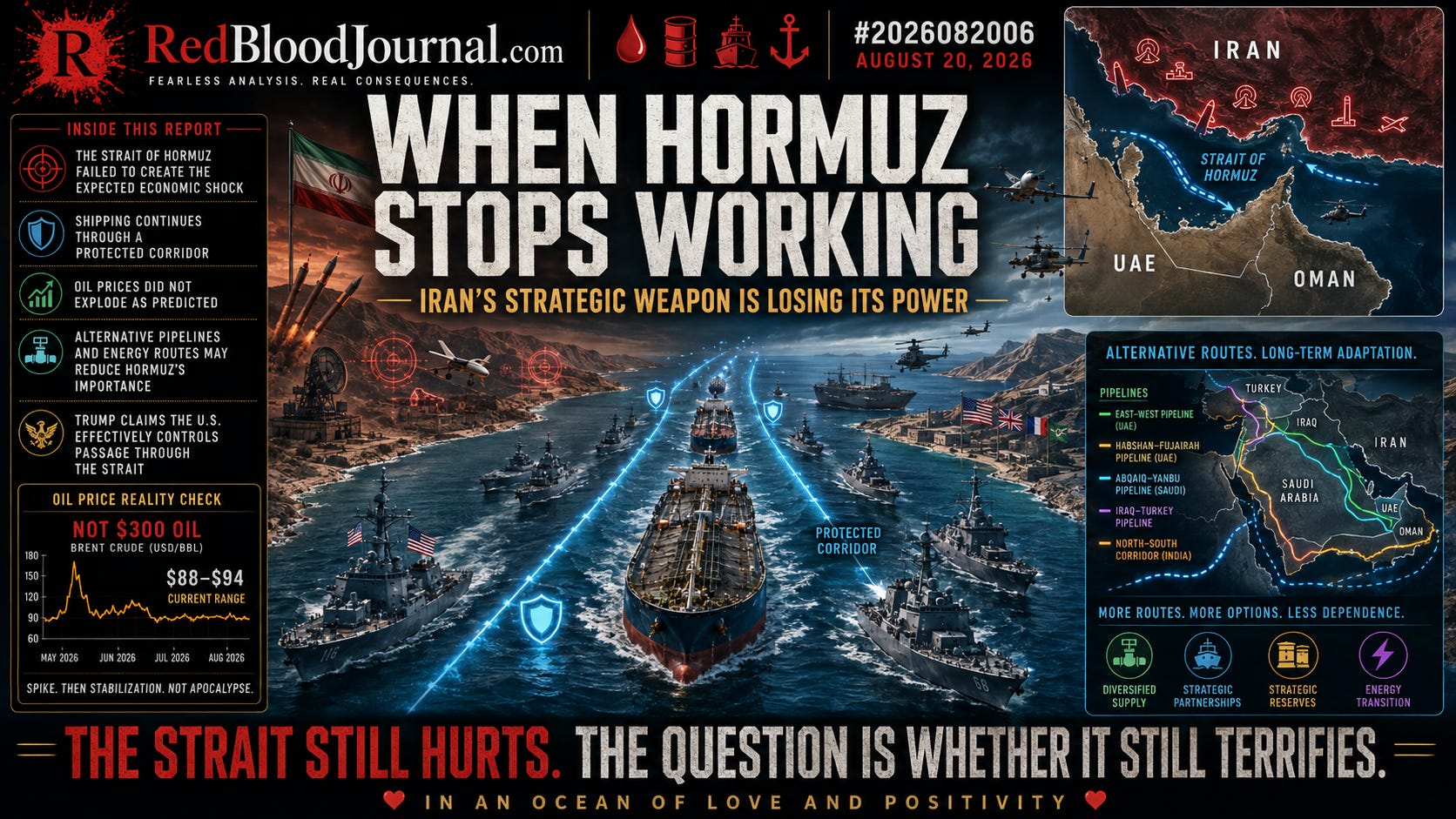
🩸 🛢️ 🚢 ⚓ #2026082006 — When Hormuz Stops Working — Iran’s Strategic Weapon Is Losing Its Power
RedBloodJournal.com
The weapon still hurts. The question is whether it still frightens the world the way it once did.
For decades, the Strait of Hormuz gave Iran something conventional military power could not.
Geography.
Iran did not need to defeat the United States Navy.
It did not need an economy larger than America’s.
It did not need more aircraft carriers, satellites or military bases.
It merely needed the world to believe that if Tehran were pushed too far, the approximately 20% of global petroleum consumption normally passing through the Strait could suddenly be placed in danger.
That possibility became one of the Islamic Republic’s greatest strategic weapons.
But 2026 may be producing an unexpected lesson.
Iran demonstrated that it really could seriously disrupt Hormuz.
The world suffered.
Oil rose.
Shipping collapsed.
Insurance costs exploded.
Energy markets became unstable.
Yet something that was supposed to follow did not happen.
The world did not economically surrender.
And that difference could permanently change the value of Iran’s greatest geographical card.
The Weapon Worked
This point should not be minimized.
Iran did not bluff its way through Hormuz.
The disruption has been enormous.
Reuters reported on August 17 that shipping through the Strait had slowed to extraordinary levels: only five vessels were recorded on one Saturday and none the following Sunday, compared with vastly greater traffic under normal conditions.
Iran therefore demonstrated a capability many analysts had discussed for decades.
It could make Hormuz dangerous enough that ordinary commercial traffic would largely stay away.
That is significant power.
But possessing the ability to interrupt trade and possessing the ability to dictate the political outcome are two different things.
Iran has demonstrated the first.
The second is becoming much less certain.
Where Was the Economic Apocalypse?
Closing Hormuz was often discussed almost as an economic nuclear weapon.
Predictions of $200, $300 and even higher oil prices became part of the mythology surrounding the Strait.
The actual crisis certainly drove prices sharply upward.
But by August 20, 2026, Brent crude was around $91.97 per barrel and West Texas Intermediate around $86.
Those prices hurt consumers.
They affect inflation.
They increase transportation and manufacturing costs.
They are not evidence that Hormuz does not matter.
But they are also nowhere close to the catastrophic scenarios once associated with an extended shutdown.
And that is where the strategic problem begins for Tehran.
The weapon worked.
But perhaps not enough.
Iran Says Closed. Trump Says Open.
The disagreement has become almost surreal.
Iran says Hormuz is closed.
Trump says it is open.
Shipping data says:
Both descriptions are incomplete.
Traffic remains dramatically below normal, which makes Trump’s description of ordinary free navigation difficult to sustain.
At the same time, ships are still moving through.
Reuters reported on August 20 that commodity traffic remained severely restricted despite Trump’s repeated assertion that the Strait was open.
Iran therefore has not restored normal shipping.
But it has also not achieved complete exclusion.
This creates a strange new condition:
Hormuz can be simultaneously closed politically and partially open physically.
And the difference between those two conditions may determine Iran’s future leverage.
The Protected Corridor
Then came perhaps the most consequential development.
Axios reported on August 19 that the U.S. military has been overseeing a quiet operation allowing tankers to move through Hormuz.
According to U.S. officials cited by Axios, approximately 15 to 20 tankers have been making nighttime passages through the southern channel, assisted by an American military operation designed to reduce the danger from Iranian surveillance and attacks.
The uploaded material describes essentially the same development: a corridor allowing substantial quantities of oil to continue moving despite Iran’s effort to control the Strait.
This may be more important than the number of tankers.
Because it introduces a new idea into the strategic equation.
For decades the question was:
What happens if Iran closes Hormuz?
The emerging answer may be:
Then the United States attempts to operate a protected corridor through it.
That is an entirely different strategic environment.
From Chokepoint to Contested Highway
Iran’s traditional advantage came from geography.
The Strait is narrow.
Iran sits beside it.
Missiles, drones, mines, fast boats and coastal defenses can threaten ships passing through a confined area.
But when passage becomes a military operation rather than ordinary commercial navigation, the contest changes.
Now the question becomes:
Who controls the air?
Who controls radar?
Who can suppress coastal launch sites?
Who escorts vessels?
Who detects mines?
Who protects tankers?
Who can keep enough oil moving to stabilize markets?
Iran no longer possesses geography alone.
It must compete against military protection of the geography.
That does not eliminate Iran’s advantage.
But it dilutes it.
Trump’s Claim
Trump has gone even further.
His public message is essentially:
We control passage through Hormuz.
The evidence does not support interpreting that literally as complete American control.
Shipping remains severely disrupted.
Iran still has considerable ability to threaten vessels.
Reuters has documented Iran exercising substantial control through vessel-clearance systems, island checkpoints and political arrangements with individual countries.
So Iran has clearly not lost Hormuz.
But Trump’s claim contains a narrower argument that deserves attention:
Iran can no longer guarantee that saying “closed” means nothing passes.
If Washington can repeatedly move tankers through a militarily protected corridor, Iran’s absolute veto becomes a contested veto.
That is a meaningful change.
The Bigger Threat to Iran Is Not the Navy
There may be something even more dangerous for Tehran than American warships.
Engineers.
Every time Iran threatens Hormuz, governments dependent upon Hormuz receive another reason to reduce that dependence.
Pipelines suddenly become more valuable.
Alternative terminals become strategically necessary.
Strategic petroleum reserves become more important.
Offshore ship-to-ship transfers become worth the inconvenience.
Alternative suppliers become worth higher prices.
New energy infrastructure that previously seemed too expensive begins looking cheap compared with another Hormuz crisis.
The greatest threat to Iran’s Hormuz weapon may therefore not be destroying the weapon.
It may be making the weapon unnecessary.
The Bypass Begins
Some alternatives already exist.
Saudi Arabia possesses its East-West pipeline, allowing crude to travel toward the Red Sea instead of entering Hormuz.
The UAE has its route toward Fujairah, allowing some crude exports to reach the Arabian Sea outside the Strait.
Other routes across Iraq and potentially toward the Mediterranean, Red Sea and Arabian Sea continue receiving attention.
These routes cannot presently replace Hormuz.
That distinction is critical.
Hormuz remains too large and too important for today’s alternatives to simply substitute for it.
But strategic change rarely happens overnight.
It happens pipeline by pipeline.
Terminal by terminal.
Tanker by tanker.
Investment by investment.
The World Is Learning
China has already been adapting.
Reuters reported this week that Chinese state shipping companies were deploying tankers outside the Gulf and using oil transfers that reduce the need to send their own vessels directly through the most dangerous portion of the Strait.
Saudi and Emirati producers have likewise relied on alternative export arrangements.
These methods are expensive and cumbersome.
But that does not necessarily help Iran.
The world does not need a perfect substitute for Hormuz immediately.
It only needs enough alternatives to prevent the shutdown of Hormuz from becoming an automatic global economic catastrophe.
That threshold is much lower.
The Paradox of the Ultimate Weapon
There is a strange problem with possessing an ultimate weapon.
Its greatest power may exist before it is used.
Imagine a weapon everyone believes will destroy the global economy.
Nobody wants to test that theory.
Therefore the threat itself creates enormous leverage.
But once the weapon is used, the world begins collecting data.
How much oil disappeared?
How high did prices actually go?
How much shipping continued?
Which pipelines worked?
Which governments adapted?
How quickly could alternative tankers be arranged?
Which military tactics protected ships?
Which industries suffered most?
Where were the bottlenecks?
The mystery disappears.
The world learns.
And the next time the weapon is threatened, markets react not to imagination but to experience.
That may be what is happening to Hormuz.
Tehran May Have Taught the World How to Survive Tehran
This is perhaps the greatest irony.
Iran spent decades warning:
Do not push us too far because we can close Hormuz.
Eventually the confrontation became severe enough that the threat was tested.
And now governments have an enormous incentive to ensure they are never this vulnerable again.
More pipelines.
More bypass capacity.
More strategic storage.
More diversified suppliers.
More military planning.
More tanker procedures.
More surveillance.
More alternative ports.
Each adaptation removes a small piece of Iran’s future leverage.
Not today.
Perhaps not tomorrow.
But permanently.
Do Not Declare Hormuz Dead
There is also a danger in going too far with this argument.
Hormuz remains one of the world’s most important strategic waterways.
Iran continues to demonstrate significant control and coercive capability there.
Earlier in the conflict, Reuters found Tehran implementing vessel-clearance systems and even obtaining political and economic concessions from countries seeking passage.
And shipping today remains nowhere close to normal.
So the correct conclusion is not:
Hormuz no longer matters.
The better conclusion is:
Hormuz may matter enormously while gradually losing its ability to terrify the world into political submission.
Those are very different statements.
Strategic Power Is Not Destruction
The purpose of strategic leverage is not merely to cause pain.
It is to obtain something in exchange for the threat of pain.
If Iran closes Hormuz and damages the world economy but simultaneously encourages the world to construct permanent alternatives, Iran may win the immediate confrontation while weakening its own future bargaining position.
That is the central question.
Did Iran demonstrate the strength of the Hormuz weapon?
Or did Iran reveal its limitations?
Perhaps both.
The Red Blood Perspective
A gun can become less powerful without becoming harmless.
That may be the best way to understand Hormuz.
Iran still has the gun.
The gun still fires.
The damage can still be enormous.
But everyone standing in front of it has now started building walls.
That is the part Tehran must calculate.
The Islamic Republic’s geography cannot be sanctioned away.
It cannot be bombed out of existence.
The Strait will remain beside Iran.
But dependence on the Strait is a human decision.
Pipelines can change.
Ports can change.
Shipping procedures can change.
Energy sources can change.
Strategic reserves can change.
Military protection can change.
And every one of those changes can slowly transform geography from a monopoly into merely an advantage.
Iran may therefore face one of the strangest consequences imaginable.
The more successfully it demonstrates that Hormuz can be weaponized, the more urgently the world will attempt to make sure Hormuz can never again function as such a powerful weapon.
The Strait remains.
Its monopoly on fear may not.
Ocean of Love and Positivity Perspective
From the Ocean of Love and Positivity point of view, perhaps there is something encouraging hidden inside this frightening story.
Human civilization should not depend on one government being able to threaten millions of unrelated people because a narrow waterway happens to sit beside its coastline.
An Iranian family should not suffer because Washington and Tehran disagree.
An American family should not pay more for necessities because governments exchange missiles.
A worker in India, China, Europe or Africa should not become collateral damage in a conflict he or she had no role in creating.
The more routes humanity builds, the less any government can hold everyone else hostage.
More pipelines.
More ports.
More suppliers.
More redundancy.
More alternatives.
Not because Iran should be defeated.
Not because America should control Hormuz.
But because ordinary people should not have to live beneath economic weapons controlled by governments.
Perhaps the best future for Hormuz is neither Iranian control nor American control.
Perhaps it is a world in which Hormuz remains important but no longer possesses the power to frighten billions of people.
Then the Strait becomes what water should have been all along:
A passage.
Not a weapon.
In an Ocean of Love and Positivity.
🩸🌊✨ Fantastic!
⚓
The Waning Power of the Hormuz Monopoly
1 source·Aug 20, 2026
The provided text examines a shift in global power dynamics regarding the Strait of Hormuz, traditionally considered Iran’s most potent strategic leverage. While Iran successfully disrupted maritime traffic and caused oil prices to rise in 2026, the sources argue that the feared global economic collapse failed to materialize. This resilience is attributed to the United States military establishing protected corridors and international markets adapting through alternative pipelines and diversified shipping routes. Consequently, the “economic nuclear weapon” of closing the waterway is losing its psychological impact as the world learns to bypass the chokepoint. The narrative suggests that by demonstrating its ability to weaponize geography, Iran has inadvertently incentivized a permanent global effort to reduce dependence on the Strait. Ultimately, the text illustrates how a strategic monopoly on fear is being eroded by military protection and infrastructural redundancy.


