


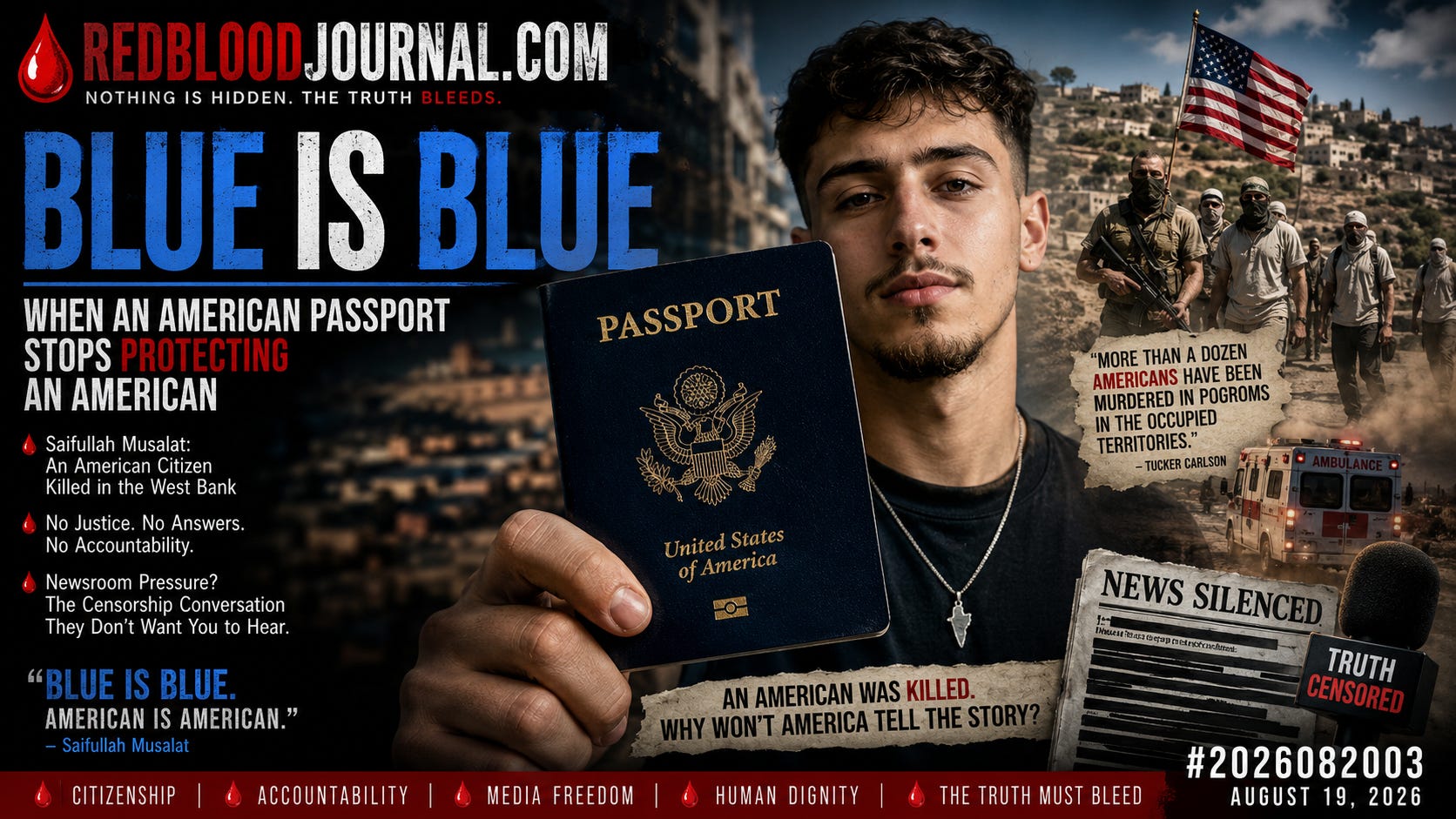
🩸 🇺🇸 🪪 🛂 #2026082003 — Blue Is Blue: When an American Passport Stops Protecting an American
RedBloodJournal.com
Tucker Carlson — August 19, 2026
RedBloodJournal.com
There is a simple idea buried beneath passports, flags, foreign policy, alliances, military aid and political calculations:
An American is an American.
That was apparently how Saifullah Musalat saw it.
His father recalls his son proudly holding his American passport and expressing the idea in three words:
Blue is blue.
It should not matter whether an American is Palestinian-American, Jewish-American, Iranian-American, Mexican-American, Christian, Muslim, Republican, Democrat, wealthy, poor, politically useful or politically inconvenient.
The passport is supposed to mean the same thing.
That belief sits at the center of Tucker Carlson’s August 19, 2026 program.
And the question raised by the program is uncomfortable:
Does the American government protect every American equally — even when protecting one of its citizens creates a problem with one of Washington’s closest allies?
The USS Liberty Shadow
Carlson begins not in 2026, but in 1967.
During the Six-Day War, Israeli forces attacked the USS Liberty, killing 34 Americans and wounding 171.
Carlson’s argument is that the enduring controversy is not simply the attack itself.
His focus is what happened afterward.
He argues that the Lyndon Johnson administration helped suppress or minimize discussion of what occurred, creating what Carlson describes as an extraordinary inversion of the government’s responsibility:
A foreign power harms Americans, and instead of the American government standing unquestionably behind its own citizens, political considerations become entangled with the response.
Carlson then moves forward almost sixty years.
His argument is provocative:
What if the same moral failure is not history?
What if the circumstances are different, but the underlying question remains?
Saifullah Musalat
Saifullah Musalat was not merely someone with distant American connections.
According to his father, Kamel Musalat, Saifullah was born in Port Charlotte, Florida.
He worked at the family’s ice-cream business in Tampa.
Father and son had built the business together.
During the summer of 2025, Saifullah traveled to the West Bank to visit relatives.
According to his father, he had another very ordinary ambition.
He hoped he might meet someone, become engaged and eventually marry.
This was not the story of a soldier entering a battlefield.
It was the story of a young American visiting family.
But the family also owned land there.
And that is where the story changes.
The Land
Kamel describes a Palestinian village with unusually deep ties to the United States.
According to his account, thousands of people connected with the village live abroad, many of them in America.
Many are American citizens.
Many also own land near the village.
Kamel says his family is among them.
But he says Israeli settlers increasingly began entering those areas and preventing Palestinian landowners from reaching their property.
He describes repeated confrontations beginning in the spring of 2025.
The significance is difficult to ignore:
These were not merely Palestinians claiming abstract historical ownership.
In Kamel’s telling, some of the property was legally owned by American citizens.
And those Americans were increasingly unable to safely reach it.
July 11, 2025
According to Kamel, on July 11, Saifullah joined others attempting to reach their land.
He says they encountered a large group of Israeli settlers.
Kamel describes it as an ambush.
He says Saifullah’s friend Muhammad al-Shalabi was shot in the back.
Saifullah was severely beaten.
He later died.
But for the father, the beating is only one part of the story.
The other part concerns the ambulance.
Two and a Half Hours
Kamel says an ambulance attempted to reach the injured men.
According to his account, the first ambulance was attacked with stones and forced to retreat.
Another ambulance was eventually dispatched.
But he says permission was required before it could reach Saifullah.
The resulting delay, according to Kamel, was approximately two and a half hours.
His younger son reached Saifullah during this period.
Saifullah was reportedly still breathing.
He was unconscious.
His face had turned blue.
His family waited for medical help.
Kamel says that when authorization finally came and rescuers reached his son, Saifullah died only minutes before he could be placed in the ambulance.
The father’s conclusion is impossible to prove from the interview alone:
Had the ambulance arrived sooner, his son might have survived.
But his question is entirely legitimate:
Why was emergency medical assistance unable to reach a critically injured man for so long?
That question deserves an answer regardless of politics.
One Year Later
One year after the killing, Kamel returned toward the area with a CNN crew.
This time he took precautions.
An armored vehicle.
Bulletproof protection.
Why?
Because he says reaching his own family’s property had become dangerous.
CNN footage discussed during Carlson’s program reportedly shows settlers intercepting the vehicles, blocking roads and attacking the convoy.
One man appears to attempt to slash a tire.
Kamel’s extraordinary situation becomes difficult to miss:
An American citizen apparently requires an armored vehicle to attempt to visit land he says he legally owns — approximately one year after his American son died there.
Where Is the Investigation?
Kamel says no one has ultimately been punished for killing his son.
He recounts efforts to obtain help from American officials.
One of the most politically uncomfortable sections concerns Florida Senator Rick Scott.
Kamel says he wanted to meet his senator directly.
He says he was able to meet other senators while visiting Washington but was unable to secure the direct meeting he sought with Scott.
Carlson repeatedly highlights this.
Carlson’s framing is simple:
A Florida-born American citizen was killed overseas.
His father is also an American constituent.
Why wouldn’t his own senator personally hear him out?
There is another important detail.
Kamel says U.S. Ambassador Mike Huckabee called Saifullah’s death a criminal and terrorist act.
Yet more than a year later, the family says it still does not have the accountability it is seeking.
That creates a striking contradiction.
If it was a criminal and terrorist act against an American citizen—
where is the criminal prosecution?
Blue Is Blue
Perhaps the strongest moment in the entire interview has nothing to do with geopolitics.
It concerns a passport.
Kamel remembers Saifullah being excited about receiving his new American passport.
His son believed deeply in what that passport represented.
His phrase was essentially:
Blue is blue.
American is American.
It shouldn’t matter where someone’s ancestors came from.
And after losing his son, the father is left confronting something far more painful than political disappointment.
He wonders whether Saifullah’s faith in that passport was misplaced.
Because when the moment came that its protection mattered most, the family believes it offered very little.
Then Carlson Changes the Question
After nearly forty minutes, the program moves from:
What happened?
to:
Why haven’t more Americans heard about it?
That becomes the second half of the episode.
Carlson argues that stories involving Palestinians harmed by Israeli settlers — including Americans — receive far less sustained attention than comparable stories involving Americans harmed elsewhere.
That allegation leads to the second interview.
And this interview may ultimately be the more institutionally important one.
Stephen Harriot and the Newsroom
Stephen Harriot is identified in the transcript as the longtime political editor of Zeal News, associated with CatholicVote.
Harriot says his publication had previously reported extensively on Palestinians suffering abuses by Israeli forces and Israeli settlers.
Some of that reporting involved Palestinian Christians.
One important source was the Vulnerable People Project, which provided contacts and information from communities on the ground.
Then Harriot says something changed.
According to his account, after a gathering associated with the Napa Institute, he was informed that coverage concerning Israel would be substantially restricted.
At one point, he says the policy was presented as essentially:
No Israel coverage until the elections, except under extraordinary review.
That is an allegation from Harriot.
It should be treated as exactly that unless independently documented.
But if accurate, the implications are serious.
Editors normally decide what receives coverage.
Publishers influence editorial direction.
Owners establish institutional priorities.
All of those realities exist throughout journalism.
But Harriot’s allegation goes further.
He says the change was presented to him after meetings involving executives, donors and the U.S. ambassador to the Vatican.
The Ambassador Question
Harriot describes the timing as deeply troubling.
He says executives attended meetings at the Napa gathering involving influential Catholic figures, donors and Brian Burch, whom the transcript identifies as the U.S. ambassador to the Vatican and a former CatholicVote leader.
According to Harriot, management then presented the new Israel-related editorial policy as connected with takeaways from those conversations.
He says he immediately objected on grounds of conscience.
But there is an extremely important evidentiary distinction.
Harriot himself says:
He was not present for the relevant conversation with the ambassador.
He therefore cannot personally testify to precisely what was said.
His information came from executives afterward.
Harriot says three executives independently confirmed that the conversation had occurred and two had reportedly been present.
That leaves a major unresolved question:
Did a government official actually pressure a private American news organization to change its Israel coverage?
The transcript raises that possibility.
It does not independently prove it.
That is exactly the kind of distinction an investigation must preserve.
The Christian Contradiction
There is another layer that makes Harriot’s allegation especially unusual.
This wasn’t simply a Catholic outlet reporting on Middle Eastern geopolitics.
Some of the people involved were Palestinian Christians.
Communities that have existed near Christianity’s birthplace for generations.
Harriot says restrictions prevented him from freely using some local sources.
In one example, he describes publishing a report where direct voices from local residents were absent while an Israeli military statement became the primary quoted authority.
He later says residents told him they remained frightened.
Their own movement was restricted.
Yet according to their accounts, armed settlers continued entering despite an official military-zone designation.
That creates an extraordinary contradiction.
A Christian news organization may have become more cautious about reporting allegations involving harm to Christians living in the Holy Land.
Whether the explanation was donors, politics, diplomacy, election strategy, editorial caution or something else remains unresolved.
But Harriot decided the restriction crossed his personal line.
There May Be No Single Villain
One of Harriot’s more thoughtful observations comes near the end of the interview.
He does not reduce everything to:
“I found the bad people.”
Instead, he describes something perhaps more important.
Institutions exert pressure.
Good people accommodate pressure.
Organizations protect themselves.
Editors become cautious.
Executives anticipate consequences.
Donors influence priorities.
Political relationships create invisible boundaries.
Eventually no individual needs to formally order censorship.
Everyone already understands the boundary.
That is a much more sophisticated form of information control.
No Ministry of Truth is required.
Sometimes institutional fear is enough.
Taybeh: “We Intend to Remain”
The episode concludes with a message attributed to Father Bashar from the Palestinian Christian community of Taybeh.
Its tone is striking because it rejects hatred.
The message asks Americans not merely to feel sympathy for Palestinian Christians but to regard them as brothers and sisters.
It asks for justice.
Dignity.
Peace.
Protection.
And the right to remain in the land where Christianity began.
The message specifically says:
Do not stand against someone.
Stand for human dignity.
Use churches.
Use institutions.
Use relationships with elected representatives.
Visit.
Witness conditions firsthand.
Tell others what was seen.
Then comes perhaps the most important conclusion of the entire episode:
“We intend to remain.”
Fear is answered with faith.
Isolation with solidarity.
Displacement with stronger communities, schools, jobs, health care, families and reasons for children to remain.
The Red Blood Perspective
This story should not require choosing between Israelis and Palestinians.
It should not require choosing Judaism against Christianity or Christianity against Judaism.
It should not require choosing Republicans against Democrats.
Strip every one of those labels away.
An American citizen was killed.
His father says the alleged killers have not been held accountable.
The American government possesses enormous diplomatic, economic and political influence over Israel.
Therefore the simplest question remains:
Did the United States government do everything reasonably within its power to determine exactly what happened to one of its citizens and pursue justice?
If the answer is yes, the government should demonstrate it.
Release the investigation.
Explain the evidence.
Identify the suspects.
Explain the prosecutions or the reasons prosecutions were impossible.
Explain the ambulance delay.
Explain what diplomatic demands were made.
Transparency ends speculation.
But if those answers cannot be produced, then Saifullah Musalat’s story becomes larger than Israel and Palestine.
It becomes an American constitutional question.
What exactly does citizenship obligate the government to do for the citizen?
The Passport Test
A passport is a small booklet.
Its physical value is almost nothing.
Its real value comes from the enormous structure standing behind it.
A nation.
Its laws.
Its diplomatic system.
Its military.
Its courts.
Its political institutions.
Its promise that citizenship means membership.
That promise matters most precisely when honoring it becomes difficult.
Protecting an American when the perpetrator is an enemy is easy politically.
Protecting an American when doing so might embarrass an ally is the real test.
Because equality has very little meaning when it operates only under convenient circumstances.
The Ocean of Love and Positivity Perspective
From the Ocean of Love and Positivity, there should be no hierarchy of human blood.
Israeli blood is red.
Palestinian blood is red.
Jewish blood is red.
Christian blood is red.
Muslim blood is red.
American blood is red.
The Ocean does not inspect passports before recognizing suffering.
Governments must sometimes calculate alliances.
Human beings do not have to surrender their humanity to those calculations.
And perhaps Father Bashar’s message provides the healthiest ending.
He did not ask Americans to hate Israel.
He did not ask Christians to hate Jews.
He asked people to stand for human dignity, justice, peace and protection of innocent people.
That distinction may contain the entire answer.
The objective should not be to transfer injustice from one population to another.
It should be to remove injustice wherever it exists.
Saifullah reportedly believed:
Blue is blue.
Perhaps the larger lesson is even simpler:
Red is red.
Before nationality.
Before religion.
Before ethnicity.
Before government.
Before alliance.
There is a human being.
And whenever governments, media organizations or political movements make that human being invisible because acknowledging him becomes inconvenient, something has gone wrong.
In an Ocean of Love and Positivity.
🩸🌊✨ Fantastic!
🛂
Blue is Blue: The True Weight of an American Passport
Aug 20, 2026
This text explores the moral and legal responsibilities of the American government toward its citizens through the lens of a Tucker Carlson program. It focuses on the tragic death of Saifullah Musalat, a Florida-born American killed in the West Bank, and his father’s subsequent struggle for accountability and justice. The narrative questions whether the U.S. passport offers equal protection to all, or if geopolitical alliances lead the government to overlook harm caused by foreign allies. Additionally, it features allegations from an editor regarding institutional censorship and the suppression of stories involving Palestinian Christians to satisfy political donors. Ultimately, the source argues that human dignity and citizenship should transcend political convenience and religious or ethnic labels.


