


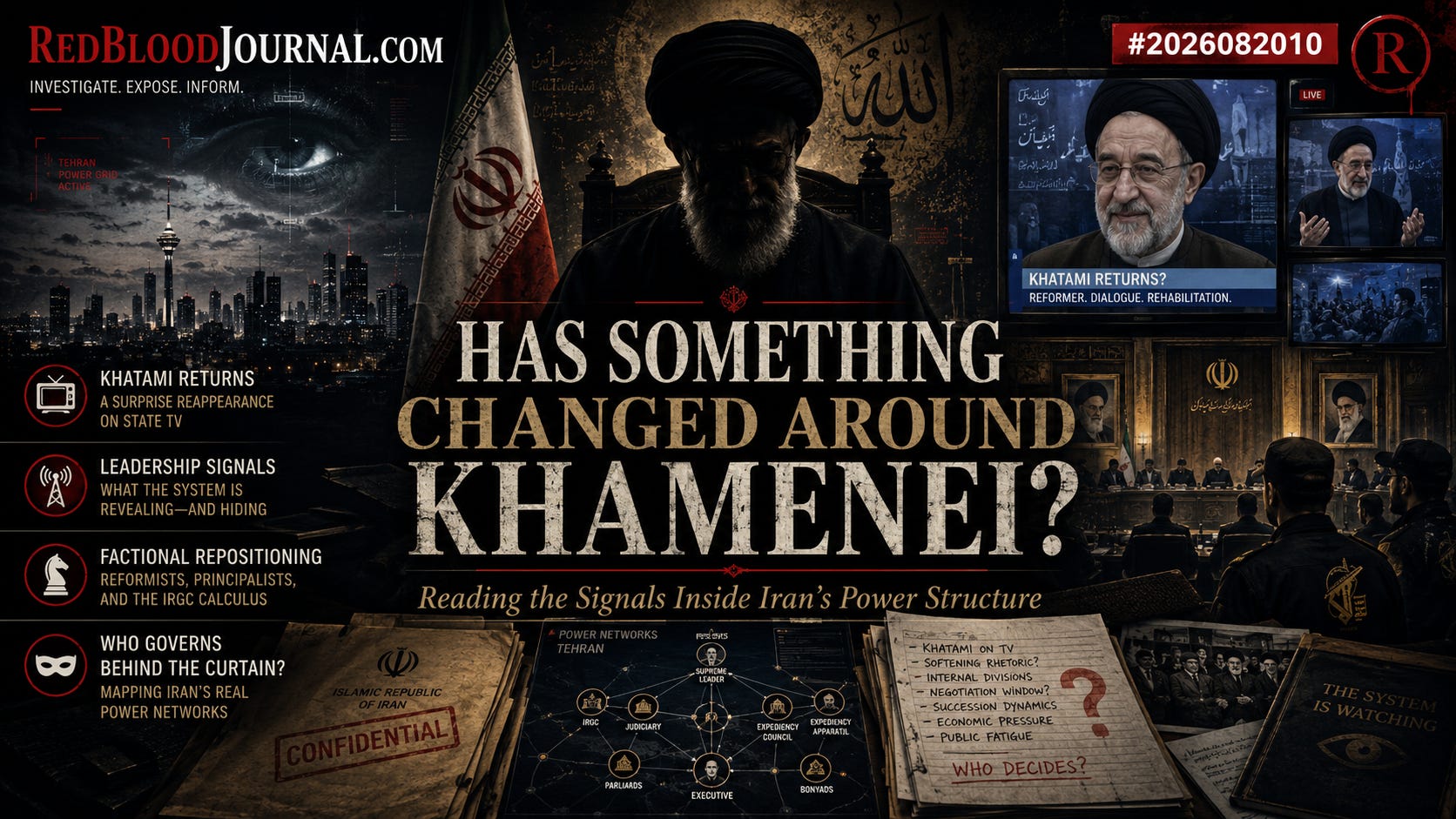
🩸 👁️ 🏛️ 🕵️♂️ #2026082010 — Has Something Changed Around Khamenei? — Reading the Signals Inside Iran’s Power Structure
RedBloodJournal.com
There is something unusual happening inside Iran.
The unusual part is not simply that Mohammad Khatami has returned to public discussion.
It is not simply that state television — which once marginalized him — is suddenly treating him with respect.
And it is not simply that conservatives who once regarded the former reformist president as politically dangerous are rediscovering complimentary things to say about him.
The unusual part is that all of this is happening while another man remains almost invisible:
Supreme Leader Mojtaba Khamenei.
This distinction is important.
Ali Khamenei is not the subject of the present mystery. He was killed on February 28, 2026, during the opening U.S.-Israeli strikes on Iran. His son Mojtaba Khamenei subsequently became Iran’s third Supreme Leader in March.
The question circulating inside the uploaded material is therefore really about Mojtaba Khamenei:
Where is he?
How much authority is he exercising personally?
Why has he remained largely unseen?
And most intriguingly:
Does Khatami’s unexpected rehabilitation tell us anything about what is happening behind the curtain?
First, Separate Fact From Rumor
The uploaded source contains highly provocative speculation.
One political commentator argues that Khatami would never have dared become this visible if Mojtaba Khamenei were fully present and exercising authority in the manner expected of the Supreme Leader.
Others quoted in the source go further, suggesting that Khatami’s reappearance itself is evidence that Mojtaba may be incapacitated or even dead.
That is an allegation.
It is not proof.
And current public evidence does not establish that Mojtaba Khamenei is dead.
In fact, Iranian state media reported that President Masoud Pezeshkian met Mojtaba Khamenei in late July.
Reuters reported on August 9 that the meeting covered military affairs, foreign exchange management, energy, resources and international economic relations.
That is evidence supporting his continued participation in government.
But there is another side.
There has still been extraordinary uncertainty surrounding his visibility.
Iran Has a Supreme Leader Almost Nobody Sees
Mojtaba Khamenei became Supreme Leader in March.
Yet Reuters reported in July that since taking office he had issued written statements but had made no public appearance, voice recording or publicly released image, with his absence attributed to both security concerns and injuries sustained in the February attack that killed his father.
That alone is extraordinary.
Iran’s political system revolves around the Supreme Leader.
He sits above the presidency.
Above parliament.
Above much of the military command structure.
Above the most important national-security decisions.
And yet the individual occupying that position has spent much of his first months in office almost entirely outside public view.
That vacuum inevitably produces rumors.
Then Pezeshkian Made It More Confusing
President Pezeshkian has offered descriptions that appear difficult to reconcile.
On July 21, he said interaction with the Supreme Leader was increasing “day by day.”
Then in early August he said communicating with Khamenei was “very difficult.”
Reuters subsequently reported that state media said the two had nevertheless met in late July.
There may be perfectly reasonable explanations.
Security procedures could make access difficult.
Mojtaba’s injuries could limit meetings.
War conditions could require extraordinary secrecy.
Communication could occur through intermediaries.
But from outside Iran’s opaque leadership structure, contradictory-sounding descriptions naturally create suspicion.
Then the Basij Made a Promise
Perhaps one of the most interesting developments came from the Basij.
On August 9, Basij Organization deputy Qasem Qoraishi said that footage and documentation would eventually be released showing Mojtaba Khamenei:
among the public;
in the streets;
and meeting armed-forces commanders.
Reuters noted that the announcement appeared designed specifically to counter speculation about Khamenei’s health and prolonged absence from public view.
That creates a fascinating question.
If the purpose is to end speculation, why promise future footage instead of simply releasing current footage?
There may be security reasons.
There may be operational reasons.
There may be concerns about revealing his location.
But from an investigative point of view, the promise itself demonstrates something important:
The Iranian government knows the absence has become a political problem.
Now Enter Mohammad Khatami
This is where the uploaded source becomes interesting.
Mohammad Khatami had spent years politically constrained.
Then he reappeared.
The source describes him issuing a video message advocating a return toward negotiation and defending an earlier understanding with Washington.
That alone might be ordinary reformist politics.
But then Iranian state television began talking about him differently.
The uploaded source describes presenters praising Khatami, referring to him as a distinguished political figure and national asset, and replaying older favorable comments about him.
For people familiar with the Islamic Republic’s treatment of Khatami, that reversal was conspicuous.
So the source asks:
Who authorized the change?
That Is the Better Question
It is tempting to jump from:
Khatami is visible
to:
Mojtaba Khamenei must be incapacitated.
But that leap goes beyond the evidence.
There are many other explanations.
Perhaps Mojtaba himself authorized a tactical shift.
Perhaps senior IRGC officials did.
Perhaps the Supreme National Security Council concluded that Khatami’s softer political image is useful.
Perhaps Pezeshkian’s government has gained more maneuvering room.
Perhaps state television has been instructed to prepare the population for negotiations.
Perhaps competing factions are positioning themselves for a possible change in strategy.
Or perhaps several of these things are happening simultaneously.
The important signal is not proof of death.
It is permission.
Someone appears to have expanded Khatami’s political permission.
In Iran, Permission Is Power
Political systems reveal themselves not only through what leaders say.
They reveal themselves through who is suddenly allowed to speak.
Who appears on television.
Who disappears.
Who gets attacked.
Who stops being attacked.
Whose photograph is shown.
Whose name becomes acceptable again.
Khatami’s political rehabilitation therefore functions like a small seismic reading.
It does not tell us exactly what happened beneath the surface.
But it tells us something moved.
Conservatives Are Moving Too
The uploaded source describes something else that makes the development harder to dismiss.
Figures from the conservative or regime-aligned political world are also described as speaking positively about Khatami and recalling praise directed toward his administration.
Again, that does not prove a conspiracy.
Political factions change tactics.
But ask the basic question:
Why now?
Khatami did not suddenly become a former president in August 2026.
He has been one for more than twenty years.
His reformist history did not suddenly change.
His disagreements with hard-liners did not disappear.
What changed was Iran’s situation.
Iran Is Under Severe Pressure
Iran is presently dealing with:
continuing confrontation over Hormuz;
a U.S. naval blockade;
threats of unprecedented economic isolation;
sanctions;
severe domestic economic strain;
a weakened regional network;
a transformed Syria;
uncertainty surrounding Iran-aligned militias in Iraq;
and stalled diplomacy with Washington.
On August 17, Reuters reported that Iran was threatening a more offensive posture if diplomacy failed, while Washington refused to extend the existing arrangement on Tehran’s terms.
Only days earlier, U.S. Treasury Secretary Scott Bessent had described forthcoming measures as potentially unprecedented economic isolation.
Under such circumstances, yesterday’s political enemy can become today’s emergency exit.
Khatami May Be More Useful Than Powerful
This distinction matters.
Khatami does not need to control Iran to be valuable.
He only needs to perform a function.
He can say words that hard-liners find difficult to say.
Dialogue.
Compromise.
Negotiation.
Agreement.
De-escalation.
He can present retreat as prudence.
He can present compromise as reform.
He can communicate with portions of Iranian society that distrust the security establishment.
And internationally, his name remains associated with Iran’s earlier language of “Dialogue Among Civilizations.”
That makes him politically useful even if he possesses very little actual institutional power.
Could Mojtaba Himself Be Behind It?
This possibility should not be ignored.
The source tends to interpret Khatami’s return as evidence against Mojtaba Khamenei’s continued authority.
But the opposite possibility exists.
Suppose Mojtaba is alive, functioning and involved in strategic decisions — as state-media accounts of his meetings suggest.
Then Khatami’s return could represent Mojtaba’s strategy.
A Supreme Leader inheriting:
a war;
a damaged country;
economic crisis;
an injured regional network;
and an unstable relationship with Washington
might decide that the system requires a softer civilian messenger.
Hard-line control and reformist presentation are not mutually exclusive.
The state could maintain control while changing its face.
The IRGC Question
There is also another center of gravity.
The Revolutionary Guards.
Mojtaba Khamenei’s rise to the supreme leadership was widely understood as having strong IRGC support. Reuters reported that his selection reflected the growing weight of the Guards within Iran’s political system.
That raises another possibility.
Perhaps the critical question is becoming less:
What does the Supreme Leader personally want?
and more:
What does the governing security structure collectively need?
If the IRGC believes negotiation is necessary to preserve the Islamic Republic, it does not necessarily need to become reformist.
It needs someone capable of selling negotiation.
Khatami fits that requirement remarkably well.
Watch the Security Institutions
A recent personnel change also deserves attention.
On August 10, former IRGC commander Mohsen Rezaei was appointed secretary of Iran’s Supreme National Security Council.
Mojtaba Khamenei also appointed Rezaei as his representative on the council.
Reuters reported no official explanation suggesting a major policy shift, but the appointment places another veteran Revolutionary Guard figure near the center of national-security decision-making.
This points away from the idea that Iran’s security establishment has simply disappeared.
If anything, the institutional evidence suggests continued — and perhaps strengthened — security influence.
So Khatami’s return may not mean reformists have conquered the system.
It could mean the security system has discovered that it needs reformist language.
The Difference Is Enormous
There are two completely different stories possible.
Story One:
The hard-line center has weakened, and reformists are re-emerging because authority around Mojtaba has fractured.
Story Two:
The hard-line center remains intact and is deliberately using reformists because conditions now require a softer political instrument.
The visible evidence cannot yet tell us conclusively which story is correct.
That is why Khatami should be treated as a signal, not an answer.
Then There Is Mojtaba’s Injury
Another fact complicates the story.
Reuters reported that Mojtaba was seriously injured in the February 28 strike that killed Ali Khamenei, suffering facial and leg injuries.
This provides a straightforward explanation for at least some of his unusual public absence.
A severely injured leader operating during an active war may intentionally remain protected.
Appearance itself can become a security risk.
But physical injury creates another question:
How much authority can be delegated before delegation changes the real structure of power?
A leader can remain constitutionally supreme while day-to-day decision-making migrates toward military commanders, security councils, presidential officials and trusted intermediaries.
That possibility deserves attention even if every rumor about Mojtaba’s death is completely false.
The Real Mystery May Not Be Whether He Is Alive
The more useful question may be:
Who is actually governing?
Mojtaba can be alive.
He can sign documents.
He can meet Pezeshkian.
He can appoint representatives.
And still the practical balance of Iranian power may have changed dramatically since February.
Ali Khamenei ruled for more than three decades.
Personal relationships accumulated around him.
Networks of trust.
Religious authority.
Institutional habits.
Fear.
Loyalty.
Experience.
His death could not simply transfer all of those invisible assets to his son in a ceremony.
Mojtaba inherited the office.
He did not automatically inherit thirty-seven years of accumulated authority.
That difference may explain much of what we are seeing.
A New Supreme Leader Is Not the Old Supreme Leader
Mojtaba’s problem is structural.
His father became Supreme Leader in 1989.
By 2026, Ali Khamenei had outlasted presidents, ministers, generals, reformist waves, protests, sanctions, nuclear negotiations and multiple American administrations.
Mojtaba entered the office under almost opposite circumstances:
his father had just been killed;
he himself had reportedly been seriously wounded;
Iran was at war;
the regional architecture was damaged;
economic pressure was immense;
and the system needed immediate decisions.
He may possess the title.
But political authority is not simply inherited like property.
It must be established.
That Makes Khatami’s Return Even More Interesting
Under Ali Khamenei, Khatami’s boundaries were well understood.
Under Mojtaba Khamenei, those boundaries may be under renegotiation.
Perhaps deliberately.
Perhaps because different factions are testing them.
Perhaps because nobody has yet accumulated enough authority to impose the old rules.
That does not require Mojtaba to be absent.
It requires only a system experiencing transition.
And Iran is unquestionably experiencing transition.
What Should We Watch?
If the goal is to understand whether the internal balance of power has genuinely changed, rumors are less useful than observable behavior.
Watch:
1. Mojtaba’s visibility
Does promised footage actually appear?
Is it clearly current?
Does he speak publicly?
Does he meet large groups rather than only individuals?
2. Khatami’s visibility
Does state television continue treating him favorably?
Or was this a temporary episode?
3. Reformist access
Do other previously marginalized reformists return?
4. Negotiation language
Does language associated with Khatami gradually become official policy?
5. IRGC personnel
Do security veterans continue moving into key decision-making positions?
6. Presidential autonomy
Does Pezeshkian appear increasingly independent or increasingly constrained?
7. Supreme Leader decrees
Are major decisions publicly and visibly attributed to Mojtaba?
8. Military commanders
Who appears to be communicating strategic decisions during major crises?
These signals tell us more than rumors.
The Question of Authenticity
There is another reason future imagery of Mojtaba will receive intense scrutiny.
Once a government allows uncertainty to continue for months, every later photograph or video becomes evidence to be analyzed.
When was it recorded?
Where?
Who appears beside him?
Is there continuous video?
Does he speak?
Is the audio contemporaneous?
Does state media provide independent angles?
The longer the absence continues, the harder it becomes to end speculation with a single photograph.
That is one of the costs of secrecy.
Secrecy Creates Its Own Opposition
Governments often hide information because they believe secrecy creates strength.
Sometimes it does.
But secrecy also creates a vacuum.
And vacuums fill with stories.
If the government does not clearly explain a leader’s health, people invent explanations.
If it does not explain political changes, people connect them themselves.
If Khatami suddenly returns without an explanation, his return becomes evidence for every theory imaginable.
The source itself demonstrates this phenomenon.
Khatami appears.
State television praises him.
Immediately people begin asking whether Mojtaba Khamenei is even capable of stopping it.
Opacity creates conspiracy theories.
But opacity also makes conspiracy theories impossible to dismiss completely.
The Red Blood Perspective
There is not enough evidence to conclude from Mohammad Khatami’s return that Mojtaba Khamenei is dead.
There is evidence pointing the other way.
State media reports meetings.
Appointments are being made in his name.
President Pezeshkian says he has interacted with him.
Reuters continues to describe Mojtaba as Iran’s Supreme Leader.
But there is also something genuinely unusual happening.
Iran has a new Supreme Leader who has spent months almost entirely outside public view.
His president has publicly described access to him in inconsistent-sounding ways.
The Basij has felt compelled to promise future proof of his visibility.
Meanwhile, an old reformist political figure whom the system spent years marginalizing is suddenly being discussed respectfully on state television.
Those facts do not prove the rumor.
But they justify the question.
Perhaps the most important question is not:
Is Mojtaba Khamenei alive?
The evidence currently indicates that he is.
The more interesting question is:
How much has the machinery around the Supreme Leader changed?
And perhaps an even larger one:
After Ali Khamenei, is Iran still governed by one dominant Supreme Leader — or increasingly by a coalition of institutions governing through the office of the Supreme Leader?
That is the question worth watching.
Because if the answer is changing, Khatami’s return may be only the first visible clue.
Ocean of Love and Positivity Perspective
From the Ocean of Love and Positivity point of view, the greatest problem is not whether one powerful man is alive, injured, hidden or politically weakened.
The deeper problem is that the condition of one man can determine the lives of nearly ninety million people while citizens are left guessing about what is happening.
A healthy political system should not require rumors to determine who is making decisions.
Citizens should know.
Who governs?
Who commands?
Who negotiates?
Who authorizes war?
Who controls national wealth?
Who is responsible when decisions fail?
Transparency is not an enemy of national security.
At some point, secrecy becomes an enemy of trust.
And when citizens cannot see the machinery governing them, they begin constructing their own picture from shadows.
Khatami appears.
Someone disappears.
Television changes tone.
A general receives a new position.
A photograph does not appear.
The nation becomes a detective.
That is no way for citizens to live.
The Ocean of Love and Positivity does not ask that Iran become American.
It does not ask that reformists defeat conservatives.
It does not ask that one faction replace another.
It asks something much simpler:
Let the people know who governs them.
Let disagreement be visible.
Let illness be acknowledged.
Let succession be transparent.
Let negotiations be explained.
Let political power belong to institutions accountable to citizens rather than shadows behind curtains.
Because truth removes fear.
And where truth can be spoken openly, rumors lose their power.
In an Ocean of Love and Positivity.
🩸🌊✨ Fantastic!
🕵️♂️
The Shadows of Succession: Iran’s Shifting Power Balance
Aug 20, 2026
The provided source examines the political uncertainty in Iran following the death of Ali Khamenei and the unconventional rise of his son, Mojtaba Khamenei, as the new Supreme Leader. Despite taking office, Mojtaba has remained entirely invisible to the public, leading to intense speculation regarding his health, authority, and potential injuries from the same strike that killed his father. This power vacuum is further complicated by the sudden rehabilitation of former reformist president Mohammad Khatami, who has unexpectedly returned to state media with a message of diplomacy. Analysts are divided on whether this shift signals a fracturing of hard-line power or a calculated strategy by the security establishment to use Khatami as a softer face for necessary negotiations. Ultimately, the text questions if the traditional structure of the Supreme Leader has permanently shifted toward a more complex coalition of military and institutional interests.


