


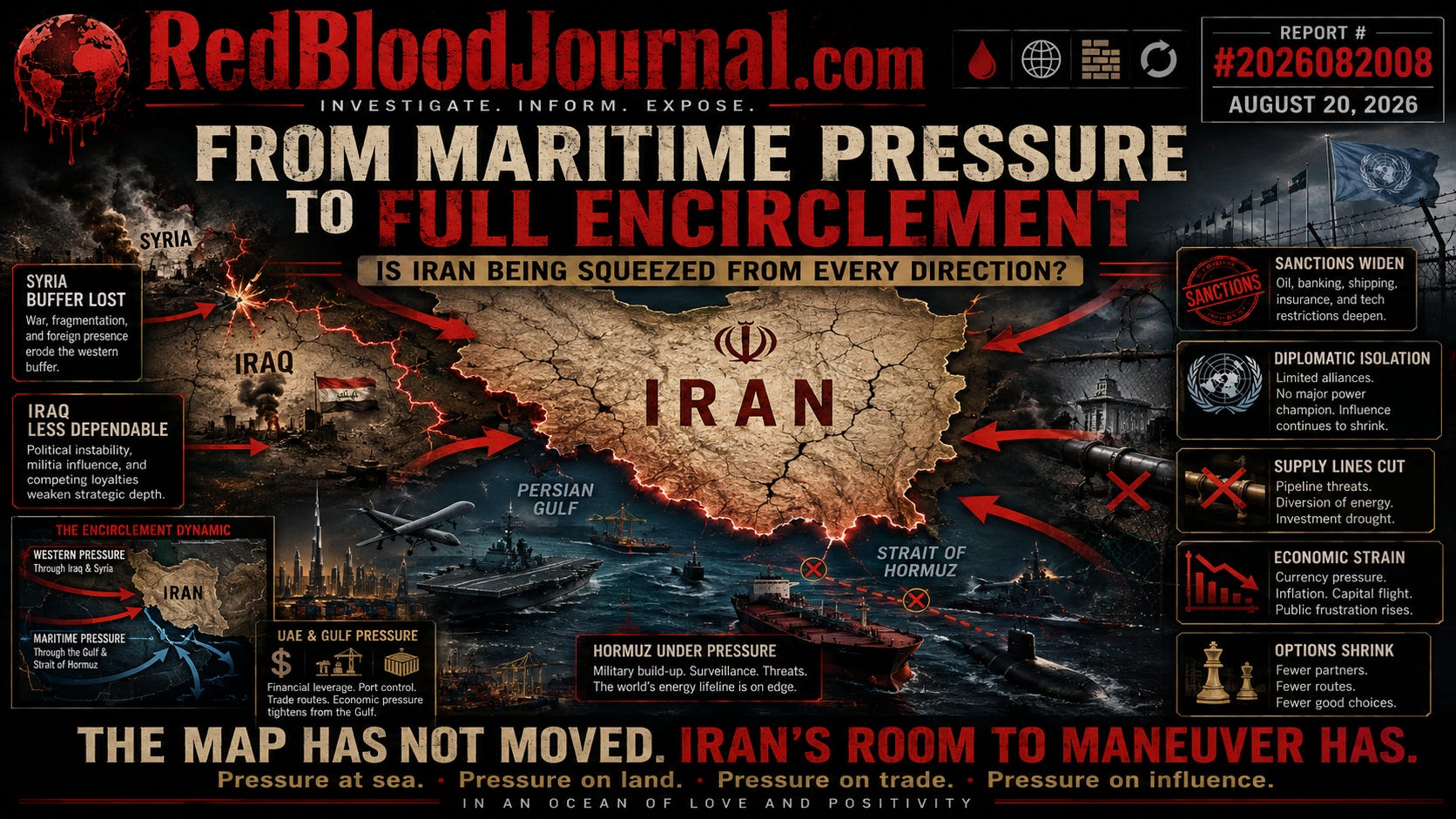
🩸 🌐 🧱 #2026082008 — From Maritime Pressure to Full Encirclement — Is Iran Being Squeezed From Every Direction?
RedBloodJournal.com
For months, the confrontation around Iran could still be described primarily as a maritime crisis.
The Strait of Hormuz.
Tankers.
Oil.
Naval forces.
Missiles.
Blockades.
Then the map began getting larger.
Syria changed.
Iraq became more uncertain.
Iran’s relationships with Gulf states deteriorated.
Washington threatened countries that continued providing Tehran with economic lifelines.
European diplomatic pressure increased.
Alternative pipelines began receiving new urgency precisely because governments wanted routes that did not depend on Hormuz.
Taken individually, each development has its own explanation.
Taken together, they raise a much larger question:
Is Iran moving from maritime pressure toward strategic encirclement?
Not a medieval siege.
Not necessarily a literal blockade of every Iranian border.
But something potentially more sophisticated:
a progressive reduction of Iran’s economic exits, regional buffers, military proxies, diplomatic relationships and strategic alternatives — all at the same time.
The uploaded source makes essentially that argument, describing increasing pressure from the Persian Gulf in the south while Iran’s strategic position in Iraq and Syria deteriorates to the west.
The evidence does not prove that one centrally coordinated master plan controls every development.
But the convergence is becoming difficult to ignore.
Start With the South
The most obvious pressure remains Hormuz.
Iran continues to insist that the Strait is effectively closed under its terms.
The United States insists otherwise.
Reality lies somewhere between those competing declarations.
Shipping remains severely depressed.
Reuters reported on August 20 that only nine commodity vessels were recorded crossing the Strait during the latest reporting period, enormously below normal prewar traffic.
So Iran has demonstrated the ability to cause massive disruption.
But as examined in the previous reports, it has not demonstrated the ability to completely prevent the movement of energy.
Military protection.
Alternative routes.
Offshore transfers.
New pipeline planning.
Strategic reserves.
All are gradually reducing the idea that closing Hormuz automatically gives Tehran an economic veto over the world.
That places Iran in an uncomfortable position.
The Strait can still hurt everyone.
But using it also gives everyone another reason to bypass it.
The Naval Pressure Has Not Disappeared
Iran’s own negotiators are explicitly tying Hormuz to broader economic pressure.
Reuters reported on August 18 that Tehran was demanding an end to the U.S. blockade of Iranian ports, sanctions relief and the release of frozen assets as conditions related to reopening the Strait.
That is important.
It means Hormuz is no longer simply about shipping.
The Strait has become part of a much larger confrontation over:
Iranian exports;
Iranian access to financial systems;
sanctions;
foreign trade;
maritime movement;
and Iran’s ability to convert oil into money.
This is where maritime pressure starts becoming economic containment.
Then Washington Expanded the Threat
On August 20, Trump moved beyond threatening Iran itself.
He warned that countries providing what he described as economic lifelines to Tehran could face severe consequences.
Reuters reported that Washington was threatening “unprecedented” economic consequences against countries supporting Iran financially or logistically.
This potentially changes the architecture of sanctions.
Traditional sanctions say:
We will punish Iran.
Secondary economic pressure says:
We may punish you if you help Iran.
That distinction matters enormously.
Iran can prepare itself to survive sanctions.
It is much harder to survive when foreign companies, banks, shipping firms and governments must decide whether doing business with Tehran is worth jeopardizing access to the American financial system.
The battlefield moves outside Iran.
Every trading partner becomes part of the calculation.
The UAE Was Once an Economic Pressure Valve
For decades, Dubai and the UAE played an especially important role in Iranian commerce.
Trade networks.
Banking relationships.
Re-exporting.
Family connections.
Iranian businesses.
Shipping.
Capital movement.
Even during periods of political hostility, commercial connections remained substantial.
Now that pressure valve has narrowed dramatically.
Reuters reported on August 19 that the UAE had halted financial and economic dealings with Iran following missile-related tensions.
This is strategically important beyond the immediate dispute.
Iran’s ability to withstand sanctions has historically depended partly on neighboring commercial ecosystems.
When those ecosystems close or become hostile, sanctions become harder to evade.
A sanction on paper becomes a sanction in practice.
Pressure From the West
Then look west.
For decades Iran could look beyond its own western border and see strategic depth.
Iraq.
Then Syria.
Then Lebanon.
The Iranian state itself was not necessarily the first battlefield.
That entire structure has weakened.
Assad’s fall removed Syria from the Iranian strategic architecture.
Iraq is now debating the future role and independence of Iran-aligned militias.
And the uploaded source explicitly describes Iranian strategists worrying that losing influence in Iraq after losing Syria would expose Iran much more directly.
This does not mean Iraq has become an enemy.
It has not.
But Iran does not require Iraq to become an enemy for Tehran to suffer a strategic loss.
Iran only needs Iraq to become less usable.
That Is the Difference
A country can remain friendly while becoming less useful as a proxy platform.
Baghdad may continue trading with Tehran.
Religious relations may remain extremely close.
Iraqi Shia political parties may continue maintaining relationships with Iran.
But if the Iraqi government succeeds in establishing stronger control over weapons and reducing the operational independence of Iran-aligned militias, then Tehran loses part of its regional military flexibility.
Iran does not necessarily lose Iraq.
It loses the ability to operate through Iraq as freely as before.
That is strategically significant.
And Syria Has Already Changed
The Syrian question may be even clearer.
Under Assad, Syria provided Iran with a political ally, logistical access, military infrastructure and a route toward Hezbollah in Lebanon.
That architecture is gone.
Syria today is increasingly part of a different regional competition involving Turkey, Israel, Gulf governments and Washington.
Iran remains geographically nearby.
But its former strategic corridor is fractured.
A buffer became a barrier.
Now Imagine the Map
Look at Iran not as a country but as a strategic planner might.
South:
The Persian Gulf and Hormuz are under intense military pressure.
Southwest:
The UAE has suspended economic and financial dealings.
West:
Iraq is under pressure to strengthen control over armed groups historically aligned with Tehran.
Beyond Iraq:
Syria no longer functions as Iran’s old corridor.
Northwest and Mediterranean direction:
Iran’s access toward Lebanon is therefore far less secure.
Internationally:
Washington is threatening states and companies that continue supporting Tehran.
Europe:
Diplomatic relations are deteriorating further.
This is what makes the word encirclement tempting.
Not because tanks are forming a perfect circle around Iran.
But because strategic options appear to be shrinking from multiple directions simultaneously.
France Adds Another Signal
Diplomatic isolation is also increasing.
Reuters reported on August 18 that France planned to expel two Iranian diplomats following a dispute involving French embassy personnel in Tehran.
Iran had previously barred two French embassy employees from returning, accusing them of violating diplomatic rules through activities Tehran characterized as interference. France rejected those accusations.
One diplomatic dispute does not constitute international isolation.
But combined with the larger environment, it demonstrates the direction.
Iran is not merely fighting at sea.
It is losing diplomatic space as well.
Economic Encirclement Is Different From Military Encirclement
The distinction is critical.
Military encirclement means troops.
Economic encirclement can be almost invisible.
A bank refuses a transfer.
An insurer refuses a tanker.
A shipping company changes routes.
A foreign government suspends trade.
A pipeline bypasses Iranian-controlled waters.
A militia is ordered to surrender weapons.
A neighboring state distances itself.
A diplomat is expelled.
A foreign company decides that trading with Iran is no longer worth the risk.
No single event appears decisive.
But each one removes another exit.
Eventually the map may remain open while the economic pathways become closed.
The Pipeline War Returns
This is why the pipeline story cannot be separated from the military one.
Reuters reported this week that Iraq is examining a major crude pipeline through Syria toward the Mediterranean.
The proposed route could eventually transport approximately 2 million barrels per day, although construction would require years and at least an estimated $15 billion.
The project is not operational.
It may change.
It may be delayed.
It may never reach its projected capacity.
But strategically, the motivation matters.
One of its purposes is reducing dependence on Hormuz.
Think about what that means for Iran.
Syria once helped Iran extend power westward.
Now Syria may help Iraq send oil westward around Iran’s strongest maritime leverage point.
The map itself is being repurposed.
Every Bypass Route Has Two Meanings
A pipeline is an economic project.
But in this environment, it is also strategic infrastructure.
Every barrel bypassing Hormuz is:
one barrel less exposed to Iranian disruption;
one barrel less dependent on Tehran’s restraint;
one barrel weakening the psychological power of the Strait;
one barrel giving neighboring countries another option.
One pipeline does not destroy Iranian leverage.
But twenty years of investment triggered by repeated Hormuz crises could.
The strategic danger therefore extends beyond the current war.
Iran may be watching the world construct the infrastructure of its future irrelevance.
The Source Goes Even Further
The uploaded transcript includes speculation that northern ports and eventually land routes could also come under increasing pressure.
That claim is not established by the current public evidence available here.
There is no basis in the source or current Reuters reporting to state as fact that Iran is already under a complete northern and land blockade.
That distinction matters.
But the speculation reveals the fear driving the broader analysis:
What happens if maritime pressure becomes logistical pressure everywhere?
Iran’s coastline is large.
Its land borders are extensive.
A complete physical blockade would be extraordinarily difficult.
But economic restrictions do not require every road to be physically closed.
They require trade to become progressively more expensive, risky and politically dangerous.
China Becomes the Biggest Question
Iran’s most important economic external relationship may ultimately determine whether full economic isolation is even possible.
China remains the central issue.
Reuters noted on August 20 that China is Iran’s largest oil customer and that broader American secondary sanctions would risk a major confrontation with Beijing.
This may represent the natural limit of Washington’s encirclement strategy.
The United States can pressure smaller states heavily.
China is different.
Beijing has its own economic power.
Its own financial instruments.
Its own strategic interests.
Its own relationship with Washington.
If China continues absorbing Iranian exports, Iran retains an important economic artery.
Therefore the most important question in the sanctions war may eventually become:
How far is Washington willing to pressure Beijing over Tehran?
Iran Is Not Helpless
The picture should not become one-sided.
Iran still has substantial capabilities.
It has a large population.
Major energy resources.
Industrial capacity.
Missiles.
Drones.
Military forces.
Relationships throughout the region.
A long coastline.
Land borders with numerous countries.
A central geographical position connecting the Gulf, Central Asia, the Caucasus and South Asia.
It has survived decades of sanctions before.
It has developed networks specifically designed to circumvent them.
And every government participating in pressure on Iran also has interests of its own.
Coalitions fracture.
Economic interests compete with security interests.
Wars become politically expensive.
So “encirclement” should not be mistaken for inevitable collapse.
The More Important Question Is Cost
Iran does not have to become completely isolated for containment to work.
The purpose may simply be increasing the cost of everything Tehran does.
Selling oil becomes harder.
Moving money becomes harder.
Supporting regional allies becomes harder.
Importing technology becomes harder.
Maintaining air links becomes harder.
Operating proxies becomes harder.
Threatening shipping produces more alternative routes.
Diplomatic confrontations produce more isolation.
Each additional difficulty consumes resources.
That is how pressure accumulates.
Not necessarily by delivering one decisive blow.
But by making every action more expensive than before.
The Strategic Compression
Perhaps compression is a better word than encirclement.
Iran’s strategic environment is compressing.
Its regional depth is smaller.
Its economic options are narrower.
Its maritime leverage is increasingly contested.
Its neighbors are becoming more cautious about providing financial pathways.
Its proxies face greater sovereignty pressure.
Its enemies are investing in alternatives.
Its diplomatic room is shrinking.
The borders have not moved.
Yet the space in which Tehran can comfortably maneuver appears to be getting smaller.
What Happens When Pressure Comes From Two Directions?
The uploaded source raises perhaps the most important military question.
Iran may increasingly face pressure simultaneously from:
the south — Hormuz and the Persian Gulf
and
the west — Iraq and Syria.
That matters because strategic depth is partly about concentration.
A government facing one major front can focus.
A government defending multiple political, economic and military fronts must divide attention and resources.
Ships in Hormuz.
Diplomacy in Baghdad.
Militia relationships.
Border security.
Economic sanctions.
Currency stability.
Domestic dissatisfaction.
Missile defense.
Energy infrastructure.
Foreign negotiations.
Every front competes with another.
And Then Comes the Domestic Front
This may be the most important front of all.
The uploaded source does not treat Iran’s economic crisis merely as background.
It connects external pressure directly with ordinary household survival.
A teacher in the transcript describes earning roughly 20 million toman while facing repair costs that can consume more than a month’s entire income.
Later, the source argues that Iran’s middle class is being pushed downward and asks whether shopkeepers, workers and factories could eventually participate in strikes or closures.
This becomes the final layer of the encirclement thesis.
External pressure surrounds the state.
Economic pressure moves inward.
Eventually the citizen absorbs it.
That Is Also the Moral Problem
Sanctions are presented as pressure on governments.
Blockades are presented as pressure on governments.
Financial restrictions are presented as pressure on governments.
But governments do not stand in grocery stores.
Citizens do.
Governments do not repair old cars.
Citizens do.
Governments do not decide whether the refrigerator can be fixed this month.
Families do.
That is why an economic encirclement strategy can weaken a government while simultaneously producing enormous suffering among people who had no role in the decisions that produced the conflict.
Both things can be true at once.
Is There One Master Plan?
Probably not in the simplistic sense.
The evidence does not establish that Washington designed every development as part of one perfectly coordinated operation.
The fall of Assad had its own causes.
Iraqi nationalism has its own causes.
The UAE has its own security interests.
France has its own diplomatic dispute.
Pipeline economics have their own logic.
Shipping companies make commercial decisions.
China follows Chinese interests.
But geopolitics does not require a secret master plan for multiple pressures to reinforce one another.
Independent rivers can still flow into the same ocean.
That may be what is happening around Iran.
The Red Blood Perspective
The important question is not whether Iran is literally surrounded.
It is whether Iran is becoming strategically cornered.
Hormuz is under challenge.
Iraq is becoming less dependable as an extension of Iranian power.
Syria is already gone as the old buffer.
The UAE has closed an important economic door.
Washington is threatening countries providing financial lifelines.
France is escalating diplomatic pressure.
Alternative pipelines are being designed specifically to reduce dependence on the one geographical weapon Iran assumed the world could never bypass.
Each development alone can be explained.
Together they create a pattern.
But the biggest danger for the Islamic Republic may not be the pressure itself.
It may be what happens if the government responds to shrinking options by becoming more aggressive.
More attacks create more sanctions.
More attacks on shipping create more pipelines.
More regional interference strengthens demands for Iraqi sovereignty.
More diplomatic confrontation creates more isolation.
More isolation increases economic pain.
And more economic pain increases domestic instability.
At that point pressure begins generating more pressure.
The circle closes itself.
Ocean of Love and Positivity Perspective
From the Ocean of Love and Positivity point of view, there is something deeply wrong with the language of encirclement itself.
Governments speak of surrounding governments.
But inside those circles are people.
Eighty or ninety million human beings do not become legitimate targets because leaders cannot agree.
An Iranian child does not control Hormuz.
An Iranian teacher does not command the IRGC.
An Iranian shopkeeper does not negotiate nuclear policy.
An American worker does not command aircraft carriers.
An Iraqi family does not decide which foreign power competes for influence in Baghdad.
Yet ordinary people absorb the consequences of every strategic calculation.
The Ocean does not ask whether Iran won.
It does not ask whether America won.
It asks:
How many people suffered while governments tried to prove that the other side could suffer more?
If Iran is being strategically contained, the goal should not be the destruction of Iranian society.
If Washington truly seeks security, there must eventually be a door through which Tehran can walk without requiring its citizens to crawl.
And if Tehran truly seeks sovereignty, it must eventually understand that sovereignty cannot mean denying sovereignty to Iraq, Syria, Lebanon or anyone else.
Perhaps the positive outcome is not encirclement.
Perhaps it is containment of destructive behavior while preserving a path back into peaceful international life.
Pressure with an exit.
Security without collective punishment.
Sovereignty without proxies.
Diplomacy without humiliation.
A Middle East in which borders protect people rather than armies using neighboring countries as buffers.
That would be a strategic map worth drawing.
In an Ocean of Love and Positivity.
🩸🌊✨ Fantastic!
🔄
The Strategic Compression of Iran
Aug 20, 2026
The provided text analyzes the strategic encirclement of Iran, moving beyond simple maritime tensions to a multi-directional pressure campaign. This geopolitical squeeze involves the erosion of Iranian influence in Iraq and Syria, alongside the loss of economic safety valves like the United Arab Emirates. By targeting financial lifelines and developing alternative energy pipelines, international actors aim to reduce Tehran’s ability to use the Strait of Hormuz as leverage. The source argues that this systemic compression isolates Iran diplomatically and economically, forcing the nation into an increasingly narrow operational space. Ultimately, the narrative examines how these combined external forces translate into domestic instability and humanitarian concerns for the Iranian population.


