


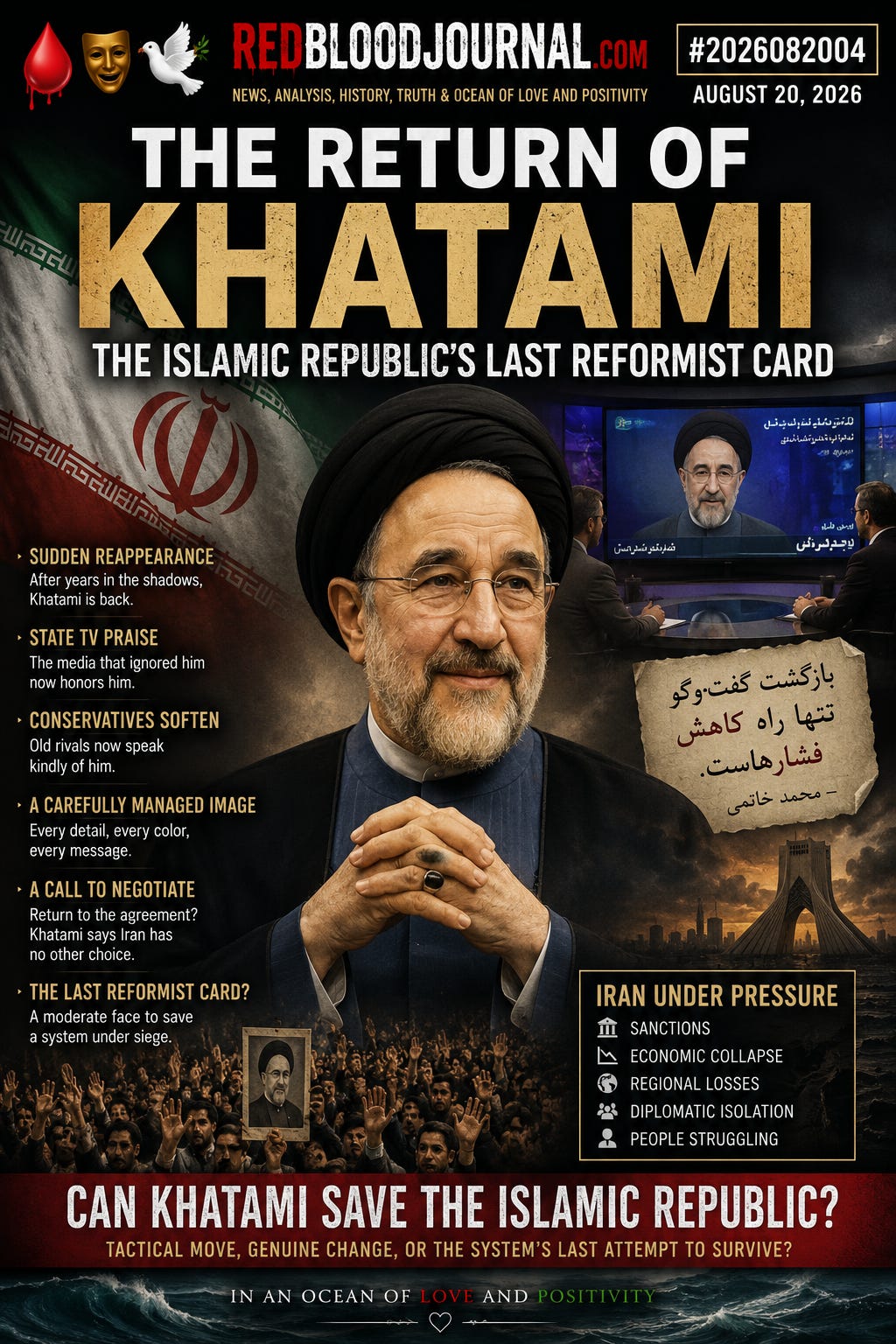
🩸 🎭 🕊️ #2026082004 — The Return of Khatami — The Islamic Republic’s Last Reformist Card
RedBloodJournal.com
For years, Mohammad Khatami occupied an unusual place in the Islamic Republic.
He was a former president, a symbol of the reform era, and a man whose name remained familiar to millions of Iranians — yet politically he had been pushed toward the edges of the system he once led.
Then, suddenly, he appeared again.
Not merely speaking.
Being noticed.
And, more strangely, being treated respectfully by parts of the same state-media machinery that had spent years minimizing him.
That does not prove that Khatami has been assigned a new mission.
But in a political system where visibility itself can be controlled, a sudden change in visibility deserves examination.
The question is no longer simply:
What did Mohammad Khatami say?
The more interesting question may be:
Why is Mohammad Khatami being allowed to say it now?
The Man Who Was Supposed to Stay in the Shadows
The source material describes Khatami emerging after a long period in which he had relatively little presence in official politics or media. It then points to an even more striking development: presenters on Iranian state television speaking positively about him, describing him in complimentary terms and even revisiting earlier praise directed toward him.
That is politically significant regardless of how one interprets it.
Khatami has not suddenly become a new political figure.
He is one of the most recognizable figures of the Islamic Republic’s reformist period.
What has changed is the environment around him.
And in Iranian politics, changes in environment sometimes matter more than changes in rhetoric.
Why Bring Back Khatami Now?
Iran is under extraordinary pressure.
The June 17 U.S.-Iran memorandum of understanding promised an end to military operations, negotiations toward a final agreement, removal of the U.S. naval blockade, restoration of commercial shipping and sanctions relief. But the agreement deteriorated instead of becoming the foundation for a permanent settlement.
By August 17, Trump was publicly rejecting an extension of the interim arrangement. On August 18, he said no negotiations with Iran were underway or scheduled.
Then on August 20, Trump escalated the economic side of the confrontation, threatening severe consequences for countries continuing to support or trade with Iran.
That is the background against which Khatami has reappeared.
And that changes the meaning of his return.
The Old Reformist Suddenly Has a Message
According to the uploaded source, Khatami defended returning to the previous understanding and argued that Iran should not allow the diplomatic opportunity to disappear.
That places him almost exactly where the Islamic Republic may presently need someone positioned.
Not as a revolutionary hard-liner.
Not as an IRGC commander.
Not as the face of confrontation.
But as the familiar Iranian politician who can say:
Perhaps it is time to talk again.
The distinction matters.
A government that has spent months presenting resistance as strength may find it politically difficult to suddenly announce that compromise has become necessary.
Khatami offers another voice.
The system does not necessarily have to say:
We were wrong.
Khatami can say:
There is another path.
And if that path eventually becomes official policy, the transition can appear less like surrender and more like the return of an older political school.
The Last Reformist Card?
This creates one of the most interesting possibilities.
Perhaps Khatami is not returning because reformism has suddenly won.
Perhaps he is returning because the system is running out of cards.
The hard-line card has been played.
Military deterrence has been tested.
Hormuz has been used as leverage.
Regional networks have been placed under increasing pressure.
Economic pressure continues.
And Washington’s current position suggests that simply restoring the June arrangement will not be easy. Reuters reported on August 18 that Trump was publicly saying there were no negotiations scheduled, while Iranian officials continued to insist that the terms of the earlier agreement had to be honored.
So what card remains?
A recognizable reformist.
A former president.
A man internationally associated with dialogue rather than confrontation.
Mohammad Khatami.
The Strange Praise From State Television
This is where the story becomes particularly interesting.
The uploaded source emphasizes that Khatami’s renewed prominence was accompanied by unexpectedly favorable treatment from state television.
That does not establish a coordinated government plan.
There are other possibilities.
Different factions may simply be repositioning themselves.
State-media personnel may anticipate a political shift and adjust early.
The government may be experimenting with public reaction.
Or individual conservative figures may now view Khatami differently because circumstances have changed.
But the reversal deserves attention precisely because Khatami’s political identity has not changed overnight.
The circumstances have.
Even the Conservatives May Need the Reformists
One of the great ironies of the Islamic Republic has always been the relationship between reformists and hard-liners.
They attack each other.
They blame each other.
They present themselves as fundamentally different visions of the country.
Yet both have historically operated within the same constitutional system.
That means that when the system itself comes under extraordinary pressure, yesterday’s internal enemy can become tomorrow’s useful intermediary.
The uploaded material describes conservative or regime-aligned voices speaking approvingly of Khatami and revisiting positive statements about his presidency.
Perhaps this is reconciliation.
Perhaps it is tactical necessity.
Perhaps it is nothing more than factional maneuvering.
But the timing makes it difficult to dismiss.
Then There Is the Image
Politics is rarely only words.
Khatami’s presentation also drew attention.
The source devotes considerable attention to his appearance: the carefully coordinated clothing, restrained colors, white collar, rings and overall softer visual presentation. It interprets the appearance as unusually deliberate.
That interpretation cannot be independently established simply from clothing.
But the broader observation is worth considering.
Political rehabilitation is often visual before it becomes institutional.
A politician does not merely return.
He is reintroduced.
Older memories are activated.
Rough edges are softened.
The public is reminded of a different era.
And Khatami possesses something that today’s hard-line security establishment cannot easily manufacture:
nostalgia.
For some Iranians, his presidency evokes the period when words such as reform, civil society, dialogue and gradual change still seemed politically possible.
Whether that memory is deserved is a separate debate.
Politically, the memory exists.
And memories can be useful.
The Khamenei Question
The uploaded source goes further.
Some commentators cited in it speculate that Khatami would never have been permitted this level of visibility if the previous power structure surrounding the supreme leadership remained unchanged.
That argument must be handled carefully.
Khatami’s reappearance is not evidence by itself that a particular leader is dead, incapacitated or no longer exercising authority.
Political systems can change tactics without changing leadership.
Orders can change.
Factions can gain influence.
Circumstances can force compromises.
And previously restricted figures can be rehabilitated when useful.
But even after removing the speculation, an important question remains:
Has the internal balance of power changed enough that Khatami has become useful again?
That is a much stronger question.
And one that does not require accepting rumors as facts.
The Outside World Has Changed Too
Khatami originally built much of his international identity around dialogue.
But the Washington he would be addressing today is very different from the Washington of his presidency.
Trump is not currently signaling eagerness to simply restore the previous deal.
On August 17 he said Iran was unwilling to make the agreement he considered necessary.
A day later he publicly denied that negotiations were taking place.
And by August 20 the administration’s public emphasis had shifted toward even greater economic isolation of Iran.
That makes Khatami’s possible role more difficult.
He may be able to change the tone inside Iran.
He cannot by himself change Washington’s calculation.
The Real Test
If Khatami’s return is merely symbolic, nothing important may follow.
But several developments would make the story much more significant.
Watch whether:
his access to state television continues;
additional conservative figures publicly defend him;
his language about negotiations begins appearing in government rhetoric;
President Masoud Pezeshkian increasingly echoes his formulation;
hard-line media attacks against him diminish;
official Iranian negotiating demands begin moving closer to the June framework;
Khatami begins meeting politically important figures rather than merely issuing public statements.
Any one of these could be coincidence.
Several occurring together would suggest something larger.
The Red Blood Perspective
The important story may not be Mohammad Khatami himself.
The important story may be why the Islamic Republic suddenly finds Mohammad Khatami useful again.
Governments reveal weakness in unusual ways.
Sometimes weakness appears as military defeat.
Sometimes it appears in currency markets.
Sometimes it appears in demonstrations.
And sometimes it appears when people who were politically inconvenient yesterday suddenly become valuable today.
If the Islamic Republic believed its present strategy was succeeding completely, there would be little reason to rediscover the political usefulness of an aging reformist former president.
But if the leadership is searching for an exit ramp — one that does not look like an exit ramp — Khatami becomes far more interesting.
He provides vocabulary for compromise.
He provides historical distance from the hard-liners.
He provides international familiarity.
And, perhaps most importantly, he provides the government with a way to change direction while pretending that the vehicle never turned.
That does not mean he has been officially chosen for that mission.
It means his sudden return fits the requirements remarkably well.
Ocean of Love and Positivity Perspective
From the Ocean of Love and Positivity point of view, the useful question is not whether Mohammad Khatami deserves to win another political battle inside the Islamic Republic.
The useful question is whether his return can reduce suffering.
If negotiation prevents another missile from being fired, negotiation has value.
If reopening economic channels puts food back within reach of ordinary families, that has value.
If political rivals speaking to one another prevents young people from dying, that has value.
Names matter less than consequences.
Reformist.
Conservative.
Republican.
Democrat.
Iranian.
American.
These are labels worn by the temporary vehicle.
The people trapped beneath political decisions are the ones who carry their consequences.
If Khatami is being brought back simply to rescue a political structure while leaving the citizen exactly where the citizen was before, then the card changes but the game remains the same.
But if his reappearance becomes a bridge toward reducing war, opening communication and allowing ordinary Iranians greater freedom and security, then even an old political card can still produce something positive.
The Ocean does not ask who won the argument.
It asks whether suffering decreased.
Whether freedom increased.
Whether fear retreated.
And whether human beings moved even slightly closer to treating one another as beings sharing the same Ocean rather than enemies trapped behind different flags.
In an Ocean of Love and Positivity.
🩸🌊✨ Fantastic!
🎭
The Return of Khatami: Iran’s Strategic Reformist Card
1 source·Aug 20, 2026
The provided text examines the unexpected political rehabilitation of former Iranian President Mohammad Khatami amidst escalating international pressure and economic isolation. Once marginalized by the state, Khatami has recently received favorable coverage from state-run media, suggesting the Islamic Republic may be utilizing him as a diplomatic tool for future negotiations. As the hard-line approach faces diminishing returns against a firm U.S. stance, Khatami offers a familiar reformist voice that could facilitate a pivot toward compromise without signaling total surrender. His reappearance is interpreted not necessarily as a victory for reformism, but as a tactical move by a leadership seeking an “exit ramp” from its current confrontation. Ultimately, the source suggests that Khatami’s return represents a strategic shift in internal power dynamics aimed at reducing regional tensions and domestic suffering.


