


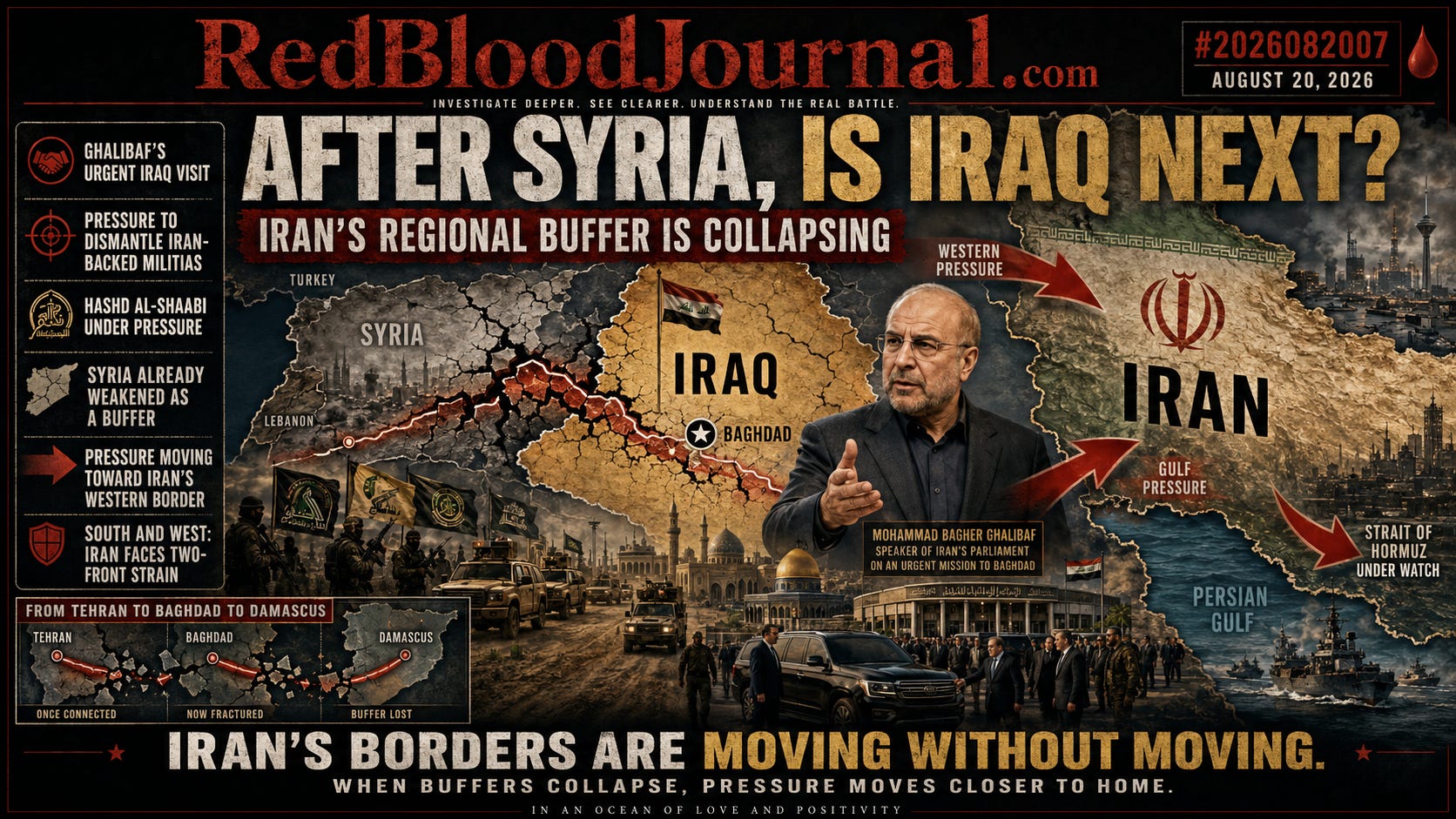
🩸 🗺️ ⚔️ #2026082007 — After Syria, Is Iraq Next? — Iran’s Regional Buffer Is Collapsing
RedBloodJournal.com
For years, Iran’s regional strategy depended on something more valuable than territory.
It depended on distance.
Iran did not want every confrontation with Israel or the United States occurring at Iran’s own borders.
Syria provided depth.
Iraq provided depth.
Lebanon provided reach.
Militias provided deniability.
Political allies provided influence without formal occupation.
Together, these relationships formed the architecture usually called Iran’s Axis of Resistance.
Then Syria changed.
Bashar al-Assad fell in December 2024, tearing away one of Tehran’s most important regional platforms and badly damaging the land bridge connecting Iran to Lebanon and Hezbollah. Reuters described Assad’s fall at the time as a major blow to Iran’s regional influence.
Now another question is becoming unavoidable:
Is Iraq next?
Not necessarily next to collapse.
Not necessarily next to become hostile to Iran.
But next to become less available as an Iranian strategic buffer.
And that distinction could reshape the map around Iran.
Ghalibaf Goes to Baghdad
On August 19, Iranian Parliament Speaker Mohammad Bagher Ghalibaf arrived in Baghdad leading a senior delegation for a three-day visit.
The trip is confirmed.
Iraqi parliamentary officials received him at Baghdad International Airport, and he met Iraqi Prime Minister Ali al-Zaidi. Ghalibaf publicly emphasized regional cooperation and described Iraq as an important country in the emerging regional order.
Visits between senior Iranian and Iraqi officials are not unusual.
But timing changes the meaning of diplomacy.
Ghalibaf did not arrive in an Iraq sitting comfortably inside Iran’s sphere.
He arrived while Baghdad is under mounting pressure to reduce the independence of armed factions closely tied to Tehran.
AFP noted that his visit came precisely as Iraq faced American pressure to disarm Iran-aligned factions.
That makes the trip far more than ceremonial.
Iran is looking west.
And what it sees may be increasingly uncomfortable.
The Problem Called Hashd al-Shaabi
After ISIS swept across large areas of Iraq in 2014, the Popular Mobilization Forces — commonly known as the PMF or Hashd al-Shaabi — became enormously important.
But Hashd is not one simple organization.
It contains numerous factions with different loyalties, ideologies and political relationships.
Some operate primarily within Iraqi national structures.
Others have maintained deep relationships with Iran.
Several of the most powerful have historically been closely aligned with the Islamic Revolutionary Guard Corps.
That gave Tehran something enormously valuable.
Influence inside Iraq without formally occupying Iraq.
Political power.
Military power.
Economic networks.
Access routes.
And, when necessary, armed groups capable of threatening American interests without Iran itself crossing the border.
But Baghdad is now trying to answer an old sovereignty question:
Who is allowed to possess weapons in Iraq?
September 30
The Iraqi government has set a September 30 deadline connected to efforts to bring weapons under state control.
Some armed groups have signaled willingness to integrate more fully into official structures.
Others have resisted.
Kataib Hezbollah, one of the strongest Iran-aligned factions, has rejected demands that it surrender what it calls the weapons of the resistance.
Other groups have also resisted full disarmament.
This creates an extraordinary problem for Baghdad.
If the government does nothing, it risks admitting that the state does not possess a monopoly on organized armed force.
If it acts aggressively, it risks internal armed confrontation.
And if it merely moves militia weapons into the PMF structure without actually breaking the militias’ chains of command, the weapons may technically become “state” weapons without meaningfully reducing Iranian influence.
Critical Threats has highlighted precisely this problem: transferring weapons from militias into PMF custody could satisfy the appearance of disarmament while preserving structures heavily penetrated by Iran-aligned actors.
So the real question is not:
Where are the weapons stored?
It is:
Who ultimately gives the orders?
Iran Is Worried Enough to Send Ghaani
Before Ghalibaf arrived, another important Iranian had already gone to Baghdad.
IRGC Quds Force commander Esmail Ghaani reportedly visited Iraq on August 10 and met militia and political figures as Baghdad debated how aggressively to proceed with disarmament.
According to reporting summarized by Critical Threats, Ghaani urged militia leaders to avoid an armed confrontation with the Iraqi government and seek a political arrangement.
That is revealing.
Iran historically benefited from powerful militias.
But Iran also benefits from a stable Iraqi state friendly to Tehran.
Those two interests can collide.
If Iran-aligned militias fight the Iraqi government, Tehran could lose political influence even while preserving armed influence.
If the militias surrender completely, Tehran may lose one of its most important instruments.
So Iran needs something in between.
Enough Iraqi sovereignty to prevent collapse.
Enough militia independence to preserve leverage.
That balancing act is becoming more difficult.
The Source Saw the Same Pressure
The uploaded material places Ghalibaf’s Iraq visit within precisely this larger struggle.
It portrays Iraq as an increasingly dangerous vulnerability for Tehran and describes Iranian officials as confronting the possibility that the government in Baghdad may move against armed groups historically aligned with the Islamic Republic.
The source goes further and suggests that losing Iraqi influence after losing Syria would force Iran to confront strategic pressure much closer to its actual borders.
That conclusion is interpretation rather than established fact.
But the underlying strategic geography is real.
Syria no longer functions for Tehran as it did under Assad.
And Iraq is openly debating how much armed autonomy Iran-linked organizations should retain.
Syria Was More Than an Ally
To understand Iraq, Syria must come first.
The Assad government gave Iran something extraordinarily difficult to replace.
A friendly state connecting Iraq to Lebanon.
A place from which Iran could sustain Hezbollah.
Military infrastructure.
Intelligence relationships.
Weapons-transfer routes.
Political access to the eastern Mediterranean.
And geographical separation between Iran itself and many of the conflicts in which Tehran was involved.
When Assad fell in December 2024, Reuters reported that the collapse shattered a central component of Iran’s regional influence.
By 2026, Reuters found that the consequences were still being felt inside the Iraqi militia network itself: weakened supply lines, leadership losses and the disappearance of Syria as a reliable operating base had contributed to a hollowing out of the once highly coordinated proxy architecture.
Syria did not merely change governments.
Iran lost strategic depth.
Look at Syria Today
The transformation becomes even clearer when looking at who now exercises influence there.
On August 18, Israel struck the Abu al-Duhur airbase in northwestern Syria.
The political confrontation was not primarily Iran versus Israel.
It was increasingly Turkey versus Israel over Turkey’s growing military relationship with Syria’s new government under President Ahmed al-Sharaa.
That alone illustrates how much the map has changed.
Iran spent years helping decide what happened in Syria.
Today, many of the major external questions surrounding Syria involve Turkey, Israel, Gulf states and Washington.
Iran is no longer sitting where it once sat.
Now Iraq Is the Critical Layer
Iran and Iraq share a long border.
Their populations are deeply interconnected.
Millions of religious pilgrims cross between them.
Trade is substantial.
Iraq imports Iranian goods and has historically depended on Iranian energy.
Major Iraqi Shia political movements have longstanding relationships with Tehran.
So Iraq cannot simply be described as an Iranian proxy.
It is a sovereign country with multiple power centers and its own national interests.
That complexity is exactly why Iraq is so important.
For Tehran, a friendly Iraq provides strategic depth.
A neutral Iraq is manageable.
A hostile Iraq would be enormously dangerous.
And an Iraq increasingly determined to separate its institutions from Iranian armed influence could move the strategic frontier considerably closer to Iran itself.
Washington Understands This
American pressure is not limited to individual militia leaders.
Washington increasingly appears to view Iraqi sovereignty itself as part of the struggle over Iran’s regional power.
Critical Threats reports that U.S. pressure on Baghdad to reduce militia power has increased as Iran-aligned groups conducted attacks against American and regional targets. American economic and political support for Iraq is increasingly intertwined with demands that Baghdad strengthen state control over armed organizations.
That does not mean Washington completely controls Baghdad.
It clearly does not.
Nor does it mean Iraqi leaders necessarily want to become anti-Iranian.
Many do not.
The Iraqi goal may instead be more basic:
Iraq wants to be Iraq.
That itself creates problems for any outside power accustomed to operating armed organizations inside Iraqi territory.
The Militias Are Not Disappearing Quietly
There is another reason this story should not be simplified into “Iran is losing Iraq.”
The Iran-aligned network remains powerful.
Some factions continue refusing disarmament.
Others may simply reorganize under the PMF.
Iranian advisers reportedly remain engaged with the organization.
And there are signs that some armed groups may be preparing for confrontation if Baghdad attempts forced disarmament.
Iran therefore still has considerable influence.
The Iraqi government still faces major limitations.
The militias have political parties, money, fighters, institutional connections and constituencies.
Removing such networks is not the same thing as collecting rifles.
That is why the central question is not whether Iran loses Iraq tomorrow.
It is whether Iran is entering a long process in which its freedom to use Iraq strategically becomes increasingly constrained.
Even Iran’s Iraqi Proxies Are Changing
There is another development Tehran may find troubling.
Some Iraqi militia leaders no longer appear as eager as they once were to sacrifice their organizations for Iran’s wars.
Reuters reported in March that many militia figures who had spent years inside Iran’s regional network were reluctant to enter the current war.
Some had acquired major political and economic interests inside Iraq.
They had businesses.
Government positions.
Networks of patronage.
Money.
Power.
And something to lose.
For some, Iraqi survival had begun competing with ideological loyalty to Tehran.
That may become one of Iran’s greatest long-term problems.
A proxy that becomes wealthy and politically institutionalized eventually develops interests of its own.
Yesterday’s revolutionary militia can become tomorrow’s establishment.
And establishments generally prefer survival.
From Tehran to Beirut — The Corridor Is Breaking
At the height of Iran’s regional expansion, one could roughly trace a connected political-security corridor:
Iran → Iraq → Syria → Lebanon
That route never represented complete Iranian control of every country.
But it provided Tehran with interconnected allies, militias, governments and supply networks.
Assad’s fall broke the Syrian section.
Pressure on Iraqi militias threatens the Iraqi section.
Hezbollah has also endured enormous military and political pressure.
That means Iran’s formerly interconnected network risks becoming a series of separated islands.
And separated islands are much harder to sustain than a corridor.
There Is Also Oil
A second development makes the Syria-Iraq relationship especially interesting.
Iraq is exploring a major new pipeline through Syria to the Mediterranean.
Reuters reported on August 17 that the proposed project could ultimately carry around 2 million barrels per day, although it would take years and billions of dollars to build. The United States supports the concept because it would provide another route reducing dependence on the Strait of Hormuz.
Consider the strategic irony.
Syria once helped Iran project influence westward.
Now Syria could eventually help Iraq export oil around Iran’s greatest geographical weapon — Hormuz.
This is not happening tomorrow.
The pipeline remains a proposed long-term project.
But maps can change meaning without borders changing at all.
South and West
This brings the entire picture together.
Iran is under pressure from the south through the Persian Gulf and Strait of Hormuz.
At the same time, its western strategic environment is changing.
Syria is no longer the Iranian ally it once was.
Iraq is under pressure to strengthen state authority over armed groups close to Tehran.
New Syrian-Iraqi energy infrastructure could increasingly connect Iraq westward toward the Mediterranean rather than southward through Hormuz.
And Iran’s own regional militia network has become less cohesive.
The uploaded source summarizes this danger bluntly: Iran once possessed both Syria and Iraq as buffers, while now Syria has been lost and Iraq could become significantly less dependable.
That may overstate how completely Tehran has “lost” Iraq.
But the directional question is legitimate.
What happens if Iran must increasingly defend its influence at the same time on the Persian Gulf and on its western frontier?
Iran’s Borders Are Moving Without Moving
Borders usually appear fixed on maps.
But strategic borders are different.
When Iran possessed a friendly government in Damascus, the confrontation with Israel could occur hundreds of kilometers away from Iran itself.
When Hezbollah was strong and supplied through Syria, pressure could be projected all the way to Lebanon.
When Iraqi militias operated comfortably inside Tehran’s regional network, Iran possessed another layer of strategic depth.
Remove those layers one by one and Iran’s physical border remains exactly where it was.
But the effective frontier of confrontation moves inward.
That may be what the uploaded source means when it says the borders are getting closer.
Why Ghalibaf Matters
Seen from this perspective, Ghalibaf’s August 19 visit takes on a different meaning.
It may be routine diplomacy.
It may involve trade, parliamentary relationships and general regional affairs.
There is no public evidence proving that his trip is an emergency mission to save Iran’s militia network.
That claim would go beyond what the evidence establishes.
But the context cannot be ignored.
Ghalibaf arrived while:
Iraq is debating militia disarmament;
Washington is pressing Baghdad to reduce Iran-aligned armed influence;
Ghaani has already intervened diplomatically with militia leaders;
Syria no longer provides Iran its old strategic corridor;
regional energy routes are being reconsidered;
and Iran itself is fighting intense economic and military pressure.
That makes Iraq exceptionally important to Tehran.
Perhaps more important than at any time since Assad fell.
Is Iraq About to Leave Iran?
Probably not in the simple sense.
Iraq and Iran are too interconnected for a clean geopolitical divorce.
Trade will continue.
Religious relationships will continue.
Political relationships will continue.
Shia parties with close Iranian ties will remain powerful.
The PMF itself is not likely to disappear.
And Iraqi nationalism does not automatically mean alignment with Washington.
The likely struggle is more subtle.
It is about degrees of independence.
How independent is Baghdad from Tehran?
How independent are Iraqi armed organizations from Baghdad?
How independent are those organizations from Tehran?
How much American pressure will Iraq tolerate?
How much Iranian influence will Iraqi nationalism tolerate?
Those questions will determine whether Iraq remains an Iranian strategic buffer or evolves into something closer to a genuinely independent middle power between Iran, the Arab world and the United States.
The Red Blood Perspective
Syria was never just Syria.
Iraq is not just Iraq.
They are pieces of strategic depth.
For years, Iran’s power rested partly on keeping confrontation away from Iranian soil.
Lebanese fighters.
Syrian territory.
Iraqi militias.
Yemeni missiles.
These mechanisms allowed Iran to project power outward while insulating the homeland.
But buffers only work while they remain buffers.
Syria has already changed sides strategically.
Not necessarily into an American or Israeli satellite — but away from the Iranian architecture that existed under Assad.
Iraq is now testing another boundary:
Can an Iraqi government remain close to Iran while refusing to allow Iran-aligned armed organizations to operate independently of the Iraqi state?
If Baghdad succeeds, Iran will not necessarily lose Iraq.
But it may lose something almost as important:
the ability to use Iraq.
And that could push Iran’s effective defensive frontier much closer to home.
Ocean of Love and Positivity Perspective
From the Ocean of Love and Positivity point of view, there is another way to see the story.
Iraq should not belong to Iran.
It should not belong to America.
It should not belong to militias.
It should belong to the Iraqi people.
Syria should belong to Syrians.
Iran should belong to Iranians.
America should belong to Americans.
The tragedy begins when governments stop seeing neighboring populations as human societies and begin seeing them as buffers.
A buffer is useful because someone else absorbs the explosion first.
But those “buffers” contain families.
Children.
Shopkeepers.
Teachers.
Workers.
People trying to live ordinary lives.
For decades the Middle East has been organized around governments seeking strategic depth inside somebody else’s country.
Iran does it.
America has done it.
Russia has done it.
Israel does it.
Other regional powers do it.
The Ocean asks a simpler question:
What if countries stopped requiring other people’s homes to serve as their battlefields?
If Iraq gains enough sovereignty that no foreign government can use Iraqi territory for its own war, that should not automatically be understood as an Iranian defeat.
It could be understood as an Iraqi victory.
And if Syria eventually becomes sovereign enough that neither Iran, Israel, Turkey, Russia nor America can treat it merely as a square on a geopolitical chessboard, perhaps that would be progress too.
Strategic buffers protect governments.
Sovereignty protects people.
And in the end, Red Blood belongs to the people.
In an Ocean of Love and Positivity.
🩸🌊✨ Fantastic!
🇮🇶
The Inward Frontier: Iran’s Fading Buffer in Iraq and Syria
Aug 20, 2026
The provided text analyzes the deteriorating regional influence of Iran following the collapse of the Assad regime in Syria and increasing pressure within Iraq. Since Syria no longer serves as a reliable strategic buffer or land bridge, Tehran is now facing a critical challenge to its Axis of Resistance architecture. The sources highlight how the Iraqi government is pushing for the disarming of Iran-aligned militias by a September deadline, potentially ending the era of independent proxy operations. This shift is driven by a combination of American diplomatic pressure and a growing sense of Iraqi nationalism that favors state sovereignty over foreign interests. High-level Iranian visits to Baghdad underscore Tehran’s anxiety as its defensive frontier moves closer to its own borders. Ultimately, the narrative suggests that if Iraq succeeds in consolidating its military power, Iran may lose its most vital geopolitical depth.


