


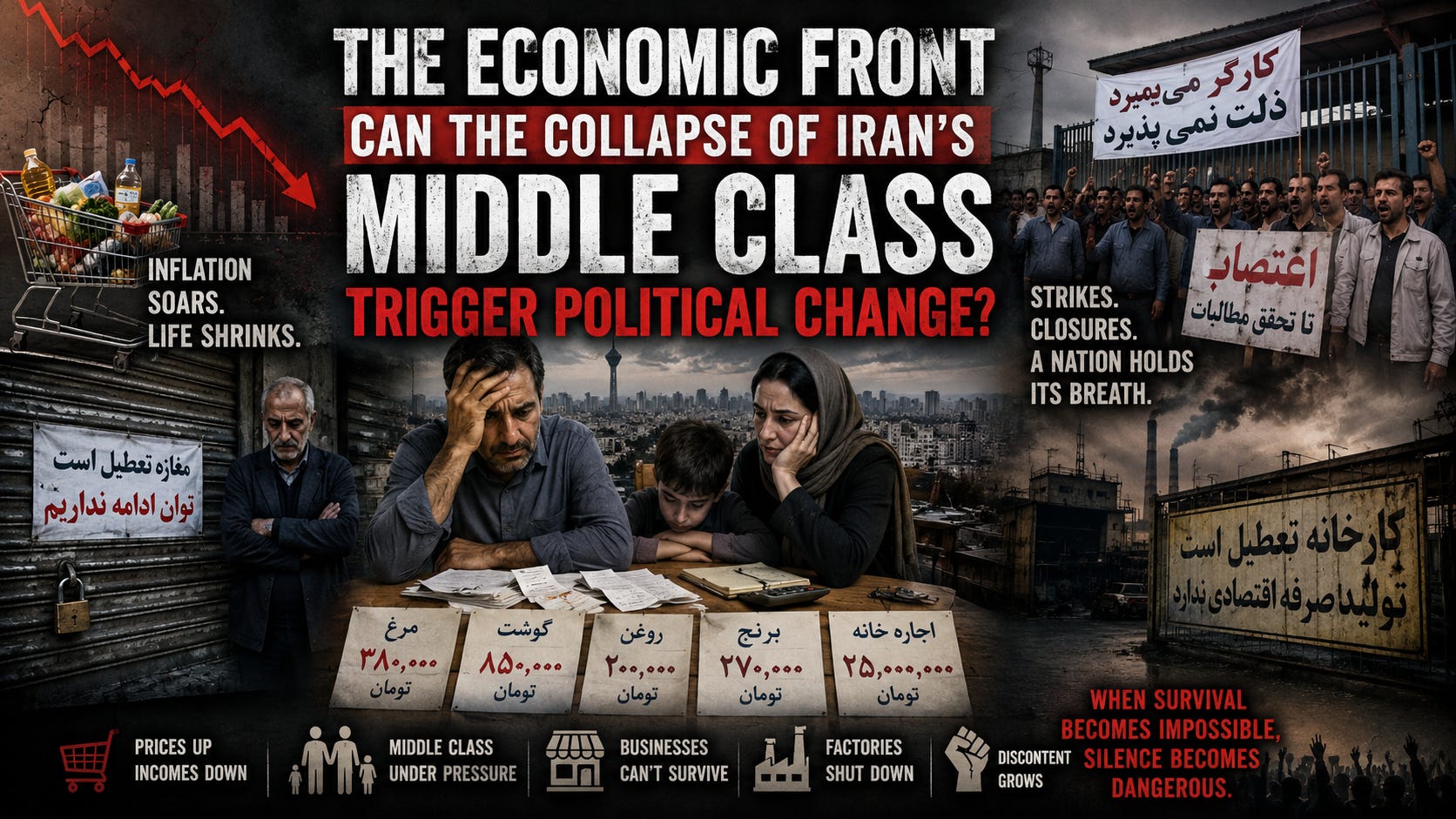
🩸 📉 👥 #2026082009 — The Economic Front — Can the Collapse of Iran’s Middle Class Trigger Political Change?
RedBloodJournal.com
Governments can survive criticism.
They can survive demonstrations.
They can survive sanctions.
They can survive political opposition.
Some can even survive war.
What becomes much harder to survive is a society in which ordinary life itself stops working.
That is the economic question now hanging over Iran.
Not simply:
Is inflation high?
Not simply:
Are people poorer?
But something deeper:
What happens when the middle class can no longer absorb ordinary life?
The uploaded source describes exactly that pressure.
It presents teachers, employees, shopkeepers, factory owners and middle-class families confronting expenses that no longer fit inside their incomes.
Then it asks the more dangerous political question:
At what point does economic exhaustion become political action?
A Broken Appliance Becomes a Crisis
One of the most revealing moments in the source is not about missiles.
It is not about Hormuz.
It is not about Trump.
It is about a household appliance.
A teacher describes how ordinary repairs have become financially overwhelming.
A household motor or appliance repair reportedly costs around ten to twelve million toman.
Then the clutch on the family car fails.
Another approximately twenty-five million toman.
The teacher says the monthly salary is around twenty million toman and asks a brutally simple question:
How is a teacher supposed to pay for an ordinary unexpected expense?
That may describe Iran’s economic problem better than any abstract statistic.
Because poverty is not only the inability to buy something luxurious.
Economic collapse begins when normal problems become financial emergencies.
A broken refrigerator.
A damaged car.
Dental work.
Rent.
School expenses.
A medical bill.
A household repair.
One event that a stable middle-class family would normally absorb suddenly destroys an entire month’s budget.
Or two months.
Or three.
The Middle Class Lives on Predictability
The middle class is not defined merely by income.
It survives on predictability.
A family earns enough to know approximately what tomorrow looks like.
Rent can be paid.
Food can be purchased.
Transportation can be maintained.
Children can be educated.
Small emergencies can be absorbed.
Perhaps some money can be saved.
Perhaps a family can plan one year ahead.
That is what creates psychological stability.
But when prices rise faster than income, predictability disappears.
Then the family no longer plans for next year.
It plans for next week.
Eventually tomorrow.
That is where economic deterioration becomes social deterioration.
The Source Describes the Slide Downward
Later in the uploaded material, the speaker describes the upper middle class being pushed into the lower middle class and increasingly toward economic instability.
This is politically important.
The poorest classes can live under terrible conditions for very long periods because survival itself consumes most of their attention.
The wealthy often have enough assets to protect themselves.
The middle class is different.
It has expectations.
Education.
Skills.
Property.
Businesses.
Professional identities.
Children with ambitions.
Memories of better conditions.
And enough awareness to compare what life is with what life could be.
When that class begins losing what it spent decades building, economic frustration can become politically volatile.
It Is Not Only Poverty
There is a difference between being poor for generations and becoming poor.
The second experience contains loss.
A teacher remembers when the salary was enough.
A shopkeeper remembers when customers could buy.
A factory owner remembers when production made financial sense.
A family remembers when replacing a washing machine did not require a financial summit.
A young professional remembers believing education would create upward mobility.
When those expectations collapse, the emotional response can be stronger than the response to poverty alone.
It produces a sentence governments should fear:
“We did everything we were supposed to do, and life still became worse.”
The Shopkeeper Has a Different Problem
The source then moves from employees to businesses.
Shopkeepers are described as struggling because customers themselves have less money.
That creates a chain reaction.
A worker earns less in real terms.
The worker buys less.
The shopkeeper sells less.
The shopkeeper reduces inventory.
The supplier sells less.
The factory produces less.
The factory may reduce employees.
Those employees then buy even less.
Economic decline begins feeding itself.
The crisis is no longer:
People cannot afford products.
It becomes:
The people selling the products cannot survive either.
When the Storefront Becomes Political
That is where the political question begins.
The uploaded source asks whether shopkeepers who complain about conditions might eventually close their stores in protest.
This matters because Iran has a long historical relationship between bazaars, commerce and politics.
A demonstration can be dispersed.
A slogan can be censored.
An activist can be arrested.
But thousands of businesses simultaneously refusing to operate create a different challenge.
The government cannot easily order commerce into existence.
A closed shop is both an economic event and a political message.
The Factory Owner Faces the Same Choice
The source extends the argument to factories.
What happens when manufacturers say:
We can no longer continue operating?
This can happen for political reasons.
But it can also happen simply because the economics stop working.
Raw materials become too expensive.
Energy becomes unreliable.
Workers demand higher wages because food costs more.
Customers cannot afford higher prices.
Credit becomes difficult.
Currency instability destroys planning.
At some point, closing may not begin as protest.
It may begin as arithmetic.
That distinction is important.
Political movements sometimes begin not with ideology but with a spreadsheet that no longer balances.
Economic Protest Is Harder to Separate From Daily Life
A government can describe political opponents as foreign agents.
It can describe protesters as radicals.
It can claim demonstrations were organized by enemies.
But what happens when the complaint is:
My salary cannot pay for my food.
Or:
My business no longer works.
Or:
My employees cannot survive on what I can afford to pay them.
These grievances are much harder to isolate ideologically.
A conservative can experience them.
A reformist can experience them.
A monarchist can experience them.
A religious person can experience them.
A secular person can experience them.
Economic pain crosses political identities.
That is one reason it can become so powerful.
The Regime Supporter Also Buys Groceries
This may be one of the most important realities.
Economic deterioration does not carefully select opposition households.
A person who supports the Islamic Republic still buys food.
A government employee still pays rent.
A member of a religious family still repairs a car.
A conservative shopkeeper still needs customers.
A retired worker still watches savings disappear.
That means prolonged economic crisis can eventually weaken the distinction between:
people angry at the government
and
people simply trying to survive.
When enough citizens move into the second category, political loyalty becomes more expensive.
The Source Raises the Strike Question
The uploaded material explicitly discusses strikes as a possible accelerant of political change.
It suggests that businesses, factories and workers stopping activity could speed up a transition that otherwise moves slowly.
That is not a prediction that a nationwide strike will occur.
The source does not establish that such a coordinated movement already exists.
But the mechanism is worth examining.
A government functions partly because people continue performing ordinary economic activity.
Factories operate.
Trucks move.
Stores open.
Offices function.
Taxes are collected.
Utilities work.
Workers report to jobs.
Banks process payments.
Once a significant portion of society refuses or becomes unable to participate, political authority can remain formally intact while practical governance begins deteriorating.
There Is a Difference Between Protest and Paralysis
Street protest confronts government authority directly.
Economic paralysis can work differently.
People do not necessarily need to attack the state.
They simply stop producing normality.
A shop remains closed.
A truck does not move.
A factory does not produce.
A worker stays home.
A market shuts down.
If only a few people do this, the effect is small.
If large portions of an economy do it simultaneously, the government faces a completely different problem.
The question becomes not:
How do we disperse them?
But:
How do we restart the country?
External Pressure Meets Internal Exhaustion
This report also connects directly with the previous ones.
Iran is facing pressure at Hormuz.
Regional influence is under challenge.
Syria no longer provides the strategic depth it once did.
Iraq may become less available as a platform for Iranian proxy power.
The government faces sanctions and diplomatic pressure.
All of that matters.
But eventually foreign-policy pressure must travel through the economy.
And once it travels through the economy, it reaches households.
That is where geopolitical strategy becomes personal.
A blocked tanker eventually becomes more expensive fuel.
A sanction becomes a missing component.
A currency problem becomes higher food prices.
A damaged trade route becomes a factory shortage.
A banking restriction becomes unemployment.
That is why sanctions and blockades cannot be analyzed only on maps.
Their final destination is usually someone’s kitchen.
Who Breaks First?
This becomes the central strategic question.
When economic pressure is applied to a government, policymakers often assume the government will eventually change behavior.
But there is another possibility.
The citizens break first.
Savings disappear.
Nutrition worsens.
Young people postpone marriage.
Families stop having children.
Education becomes harder.
Medical treatment is delayed.
Businesses close.
Professionals emigrate.
Hope collapses.
The state may remain.
The society beneath it becomes weaker.
That is why the effectiveness of economic pressure cannot be measured simply by whether GDP declines or currency falls.
The moral question is:
Who actually absorbs the damage?
Economic Pressure Can Strengthen a Government Too
There is another possibility that deserves attention.
Economic hardship does not automatically produce political change.
Governments can use crisis to increase control.
Scarcity can make citizens more dependent on state jobs.
Subsidies can become political tools.
Rationing can increase government authority.
Smuggling networks can enrich politically connected groups.
Sanctions can eliminate ordinary competitors while strengthening insiders who know how to bypass restrictions.
Fear of instability can make some citizens prefer the government they know over uncertainty they fear.
So worsening economic conditions do not guarantee regime collapse.
Sometimes they destroy independent society while strengthening the very networks closest to power.
That is one of the contradictions in using economic suffering as a political weapon.
The Middle Class May Be the Deciding Variable
This is why the fate of the middle class matters so much.
A strong middle class often creates independent institutions.
Private businesses.
Professional networks.
Home ownership.
Savings.
Education.
Civil associations.
A population with enough economic independence to say no.
When that class collapses, two opposite outcomes become possible.
One:
It becomes politically active because it has too much to lose.
Or two:
It becomes too exhausted and dependent to resist anything.
Which path Iran follows cannot yet be known.
But the source is correct to focus attention there.
The economic future of the middle class may matter more politically than another speech by another politician.
Khatami Cannot Fix a Refrigerator
This also brings the previous Khatami report into a different light.
The return of a reformist political figure may matter symbolically.
Negotiations may matter.
Diplomatic language may matter.
But the citizen ultimately judges change through daily life.
Can the salary buy food?
Can the car be repaired?
Can medicine be purchased?
Can a young family afford housing?
Can a small business remain open?
If not, political language eventually loses meaning.
A government cannot indefinitely solve material failure with rhetoric.
Nor can an opposition.
What Would Signal a True Economic-Political Shift?
The uploaded source raises several possibilities worth watching.
Not because they are guaranteed.
But because they would indicate that private hardship is becoming collective political behavior.
Watch for:
coordinated bazaar closures;
factory work stoppages;
strikes crossing several unrelated industries;
government employees joining labor actions;
transportation workers participating;
protests shifting from isolated wage demands toward broader political demands;
business owners openly supporting workers rather than opposing them;
previously pro-government economic groups publicly breaking with official policy.
The importance would not be any one strike.
It would be convergence.
When groups that normally have different interests begin acting together, economic dissatisfaction can become a political coalition.
Bread Before Ideology
History repeatedly demonstrates something simple.
People can tolerate political theories they dislike for a long time.
They tolerate economic instability less easily when it enters the household.
Food.
Housing.
Employment.
Transportation.
Health.
Education.
These are not ideological abstractions.
They are daily requirements.
That is why an economy can quietly become the most powerful opposition movement in a country.
No leader.
No headquarters.
No manifesto.
Just millions of households independently reaching the same conclusion:
This cannot continue.
The Red Blood Perspective
Iran’s most dangerous front may not be Hormuz.
It may not be Iraq.
It may not be Syria.
It may not even be Washington.
It may be the Iranian household.
The teacher earning around twenty million toman who faces a twenty-five-million-toman repair bill does not need a political science degree to understand that something is wrong.
The shopkeeper watching customers disappear does not need an opposition party.
The factory owner unable to make the numbers work does not need foreign propaganda.
Arithmetic is enough.
Governments can defeat political organizations.
They can arrest leaders.
They can censor media.
They can restrict demonstrations.
But an economy failing across millions of individual households creates a problem with no single headquarters to raid.
That does not mean political change is inevitable.
It means the source of instability becomes distributed.
Every kitchen table becomes a small economic referendum.
Every closed business becomes a vote.
Every postponed purchase becomes another signal.
Every family falling from the middle class into survival mode reduces the distance between frustration and political consequence.
The Islamic Republic may therefore face an uncomfortable paradox.
External pressure is supposed to weaken the state.
But if the state survives while society is destroyed underneath it, nobody has really won.
Ocean of Love and Positivity Perspective
From the Ocean of Love and Positivity point of view, economic suffering should never be celebrated simply because it might weaken a government someone opposes.
The person unable to repair the car is not the regime.
The teacher unable to pay an unexpected bill is not foreign policy.
The child whose family cannot afford proper food did not close Hormuz.
The shopkeeper losing a business did not design sanctions.
Human beings become invisible when politics reduces them to pressure points.
One government says:
We will make their economy hurt until their leaders change.
Another government says:
Our people must endure hardship for resistance.
Both sentences place the citizen between governments.
The Ocean asks something different.
Can pressure be directed toward decision-makers without destroying ordinary lives?
Can political change come from awareness rather than starvation?
Can workers and shopkeepers demand dignity without becoming tools for another government’s agenda?
Can a society reform itself without first being economically crushed?
The greatest positive outcome would not be millions of Iranians becoming desperate enough to revolt.
It would be a system becoming responsive enough that desperation is unnecessary.
A healthy society should not require citizens to reach the edge of survival before their voices matter.
And political change that begins with human dignity should not require economic misery as its entrance fee.
In an Ocean of Love and Positivity.
🩸🌊✨ Fantastic!
📉
The Arithmetic of Exhaustion: Iran’s Middle Class Crisis
Aug 20, 2026
The provided text examines the political implications of Iran’s shrinking middle class as ordinary citizens struggle to afford basic necessities. It argues that the government faces a unique threat when daily life stops functioning, moving beyond mere inflation to a state where a single appliance repair can bankrupt a household. This economic exhaustion transforms personal hardships into a shared political grievance that bridges different social and ideological divides. The source highlights how the loss of predictability for professionals and shopkeepers may lead to collective actions like strikes or business closures. Ultimately, it suggests that a failed domestic economy creates a decentralized form of opposition that is harder to suppress than organized political groups. The narrative concludes by questioning whether regime survival is meaningful if the society beneath it is systematically destroyed by financial misery.


