


🩸 RedBloodJournal.com
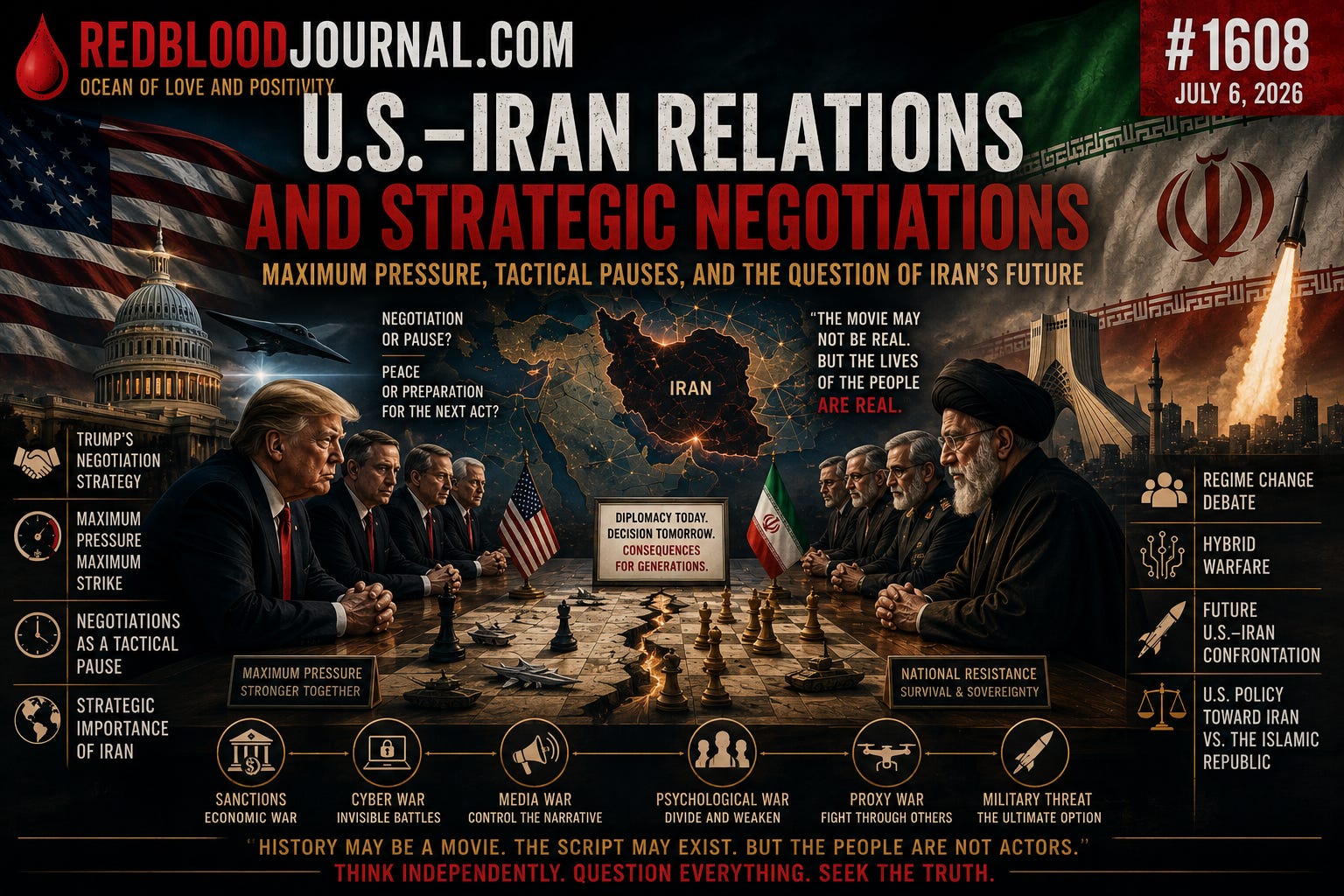
#1608 – U.S.–Iran Relations and Strategic Negotiations
Maximum Pressure, Tactical Negotiations, and the Question of Iran’s Future
An Opinion
By Red Blood
July 6, 2026
Introduction
U.S.–Iran relations have never been only about diplomacy.
They are about power.
They are about timing.
They are about pressure, survival, negotiation, and the question of whether the United States sees Iran as an enemy—or sees the Islamic Republic as the obstacle standing between Iran and a different future.
The attached transcript presents one central idea: negotiations may not always mean peace. Sometimes negotiations may be a pause, a breathing space, or a tactical move inside a much larger confrontation.
That is the heart of #1608.
Trump’s Negotiation Strategy
The report describes Trump’s approach as a combination of threat and invitation.
One day, negotiation is offered.
Another day, pressure returns.
This creates uncertainty for the opposing side. It forces the Islamic Republic to wonder whether the next move is a deal, a strike, a sanction, or a political trap.
In this reading, Trump’s method is not simple diplomacy. It is pressure diplomacy.
He keeps the door open while keeping the sword visible.
Maximum Pressure and Maximum Strike
The old phrase was maximum pressure.
But the transcript suggests something stronger: a possible movement toward maximum pressure plus maximum strike.
Pressure alone damages the economy.
Sanctions weaken internal confidence.
Narrative war divides factions.
Cyber pressure exposes weakness.
Military strikes, or the threat of them, make every negotiation feel urgent.
Together, these tools create a hybrid battlefield where war is not only fought with missiles, but also with money, media, fear, and timing.
Negotiations as a Tactical Pause
One of the strongest ideas in the transcript is that negotiation may be used to buy time.
Not necessarily to build peace.
Not necessarily to create trust.
But to create space between rounds of confrontation.
This means both sides may enter negotiations while still preparing for the next scene.
The Islamic Republic may negotiate to survive.
The United States may negotiate to control escalation.
Israel may watch to see whether the agreement limits Iran enough.
Regional actors may wait to see who is weakening and who is gaining ground.
In this view, the negotiation table is not separate from the battlefield.
It is part of it.
The Strategic Importance of Iran
Iran is not a small piece on the board.
It connects regions.
It touches the Persian Gulf, Central Asia, the Caucasus, Iraq, Afghanistan, and the wider Middle East.
Because of geography, energy, history, and population, Iran matters far beyond its borders.
That is why U.S. policy toward Iran cannot be understood only as a nuclear issue.
Iran is a strategic land bridge.
Iran is a regional balance point.
Iran is also a civilization with a population much larger and older than the government currently ruling it.
That distinction matters.
Iran vs. the Islamic Republic
A major theme in the transcript is the argument that the United States may not be against Iran as a nation, but against the Islamic Republic as a ruling system.
This distinction is powerful.
Iran is the land.
Iran is the people.
Iran is the culture.
Iran is history.
The Islamic Republic is a political structure.
Confusing the two allows the regime to claim that pressure against itself is pressure against Iran. Separating the two allows critics to say the problem is not Iran, but the system that speaks in Iran’s name.
This is one of the deepest psychological battles in U.S.–Iran relations.
The Regime Change Debate
The words “regime change” are often denied publicly, debated privately, and feared constantly.
The transcript reflects this tension.
If the United States says it does not seek regime change, some believe it.
Others see that statement as strategy.
Maybe it is meant to calm markets.
Maybe it is meant to avoid regional panic.
Maybe it is meant to keep negotiations alive.
Maybe it is true.
Or maybe it is simply another sentence in a larger script.
The Islamic Republic’s hardliners appear to fear that negotiation itself may become the path to collapse, because once the system compromises too much, its revolutionary identity begins to dissolve.
Hybrid Warfare
Modern war is no longer only tanks, planes, and missiles.
It is sanctions.
It is banking pressure.
It is cyber operations.
It is media narratives.
It is leaked information.
It is psychological pressure on leaders.
It is the weakening of confidence inside institutions.
The transcript presents the U.S. approach as hybrid: military, political, economic, cyber, and narrative pressure combined into one long campaign.
In that type of conflict, a country can be under attack before war is officially declared.
The people may feel inflation before they hear missiles.
The leadership may feel fear before the first strike.
The system may begin cracking before the final confrontation arrives.
Future U.S.–Iran Confrontation
The question is not whether the United States and Iran have already confronted each other.
They have.
The question is whether another round is coming.
The transcript suggests that many observers believe a full agreement satisfying both the United States and Israel may be difficult, and that renewed confrontation may remain more likely than lasting peace.
If that is true, then every negotiation must be watched carefully.
Not only for what is signed.
But for what is delayed.
Not only for what is announced.
But for what is prepared quietly afterward.
Conclusion
U.S.–Iran relations are not a straight line.
They are a maze of pressure, negotiation, threat, retreat, theater, and strategy.
Trump’s approach, as described in the transcript, appears to combine negotiation with pressure, invitation with intimidation, and diplomacy with the possibility of renewed confrontation.
The Islamic Republic may believe it is negotiating for survival.
The United States may believe it is negotiating from strength.
Israel may believe Iran must be permanently limited.
The Iranian people may simply want to live without being forced into another chapter of someone else’s geopolitical movie.
That is the tragedy of history.
Governments play chess.
Ordinary people become the squares.
And every time leaders speak of strategy, it is the common population that pays the emotional, financial, and human price.
The most important question may not be whether America and the Islamic Republic reach an agreement.
The deeper question is whether the people of Iran will ever be allowed to exist outside the script written by governments, sanctions, wars, and negotiations.
🩸 RedBloodJournal.com
Ocean of love and positivity.
♟️ The Chessboard of Pressure: U.S.–Iran Strategic Confrontation
Jul 6, 2026
The provided text examines the volatile geopolitical struggle between the United States and Iran, framing their interactions as a complex strategic chessboard rather than standard diplomacy. It highlights how the U.S. employs hybrid warfare, combining economic sanctions, cyber operations, and military threats to exert maximum pressure on the Iranian government. A central theme is the distinction between the Islamic Republic’s ruling system and the Iranian people, suggesting that American policy targets the regime’s behavior rather than the nation itself. The source argues that negotiations often serve as tactical pauses for both sides to regroup rather than genuine attempts at establishing lasting peace. Ultimately, the analysis portrays a grim reality where ordinary citizens bear the burden of these high-stakes maneuvers between world powers. This narrative suggests that while leaders engage in psychological and political theater, the future of the region remains caught in a cycle of confrontation and uncertainty.


