


🩸 RedBloodJournal.com
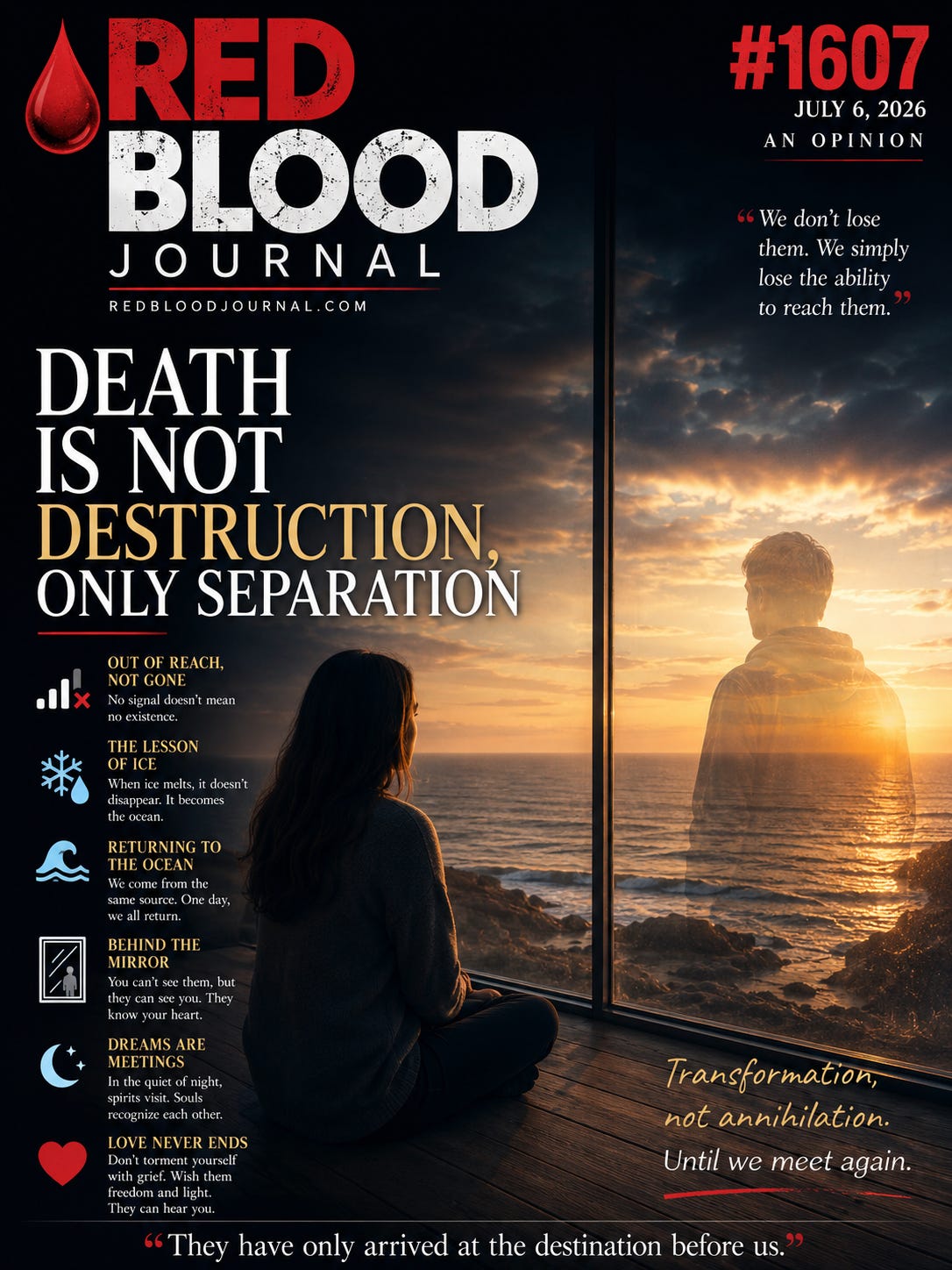
#1607 – Death Is Not Destruction, Only Separation
An Opinion
By Red Blood
July 6, 2026
Introduction
Death is perhaps the greatest mystery every human being eventually faces.
It has inspired religions, philosophies, poetry, science, and countless personal reflections. Some view it as the absolute end. Others see it as the beginning of another journey.
No one living can prove with certainty what lies beyond. Yet throughout history, many people have searched for ways to understand death that replace fear with hope.
One simple analogy captures this beautifully.
Out of Reach Does Not Mean Gone
When our mobile phone loses its signal, we do not conclude that the phone has ceased to exist.
It is simply no longer reachable.
Perhaps death is similar.
Our loved ones may no longer be accessible through our senses, but that alone does not necessarily mean they have been destroyed.
Our inability to communicate is not proof of nonexistence.
It is simply evidence that our current methods of communication have ended.
The Lesson of Ice
Consider a block of ice.
When it melts, we do not say it has disappeared.
The substance remains exactly the same.
Only its form changes.
Eventually that water joins rivers, lakes, or the vast ocean itself.
Nature constantly reminds us that transformation is different from annihilation.
Perhaps human existence follows a similar pattern.
Returning to the Ocean
Many spiritual traditions describe life as a temporary journey.
According to this perspective, we originate from something far greater than ourselves and eventually return to it.
Whether one calls it God, the Creator, universal consciousness, or simply the source of existence, the central idea remains remarkably similar:
We return home.
Death is therefore not viewed as punishment or failure.
It is simply another stage of existence.
Looking Through the Glass
Imagine your loved one standing behind a one-way mirror.
From your side, you cannot see them.
From their side, they can still see you.
Whether this image is literally true or simply a comforting metaphor, it encourages a profound shift in perspective.
Perhaps separation does not mean complete absence.
Perhaps it only means our vision is temporarily limited.
Dreams and Memory
Many people report vivid dreams involving loved ones who have passed away.
Some interpret these as the natural workings of memory.
Others believe they are genuine meetings beyond ordinary consciousness.
No scientific consensus exists on this question.
Yet such experiences continue to occur across cultures, generations, and belief systems.
Each individual must decide what these moments mean.
Grief and Love
Grief is a natural expression of love.
Missing someone is not weakness.
It is evidence that their presence mattered.
But endless suffering may not be the greatest gift we can offer those we love.
If consciousness continues in some form, then perhaps our love is better expressed through gratitude, peace, and wishing them freedom rather than remaining trapped in despair.
Final Thoughts
No one can claim certainty about what follows death.
Yet there is comfort in remembering that throughout nature, endings often become new beginnings.
The caterpillar becomes the butterfly.
The seed becomes the tree.
Ice becomes water.
Perhaps we, too, simply change form.
If that is true, then death is not destruction.
It is transformation.
And one day, every traveler reaches home.
May those we love live on in our memories, inspire our actions, and, if there is indeed another shore beyond this life, may they rest in peace, light, and freedom until we meet again.
🩸🌊✨ Fantastic.
🌊 The Architecture of Transformation:
Death as a New Beginning
Jul 6, 2026
This article presents a philosophical perspective on the nature of mortality, arguing that passing away is a transformation rather than a total end. By utilizing analogies like melting ice or a lost cellular signal, the author suggests that a lack of communication does not equate to a loss of existence. The text frames the conclusion of life as a return to a source, comparing the human journey to natural cycles like a caterpillar becoming a butterfly. Ultimately, the source encourages readers to view grief through the lens of love and hope, fostering the belief that our essence simply changes form rather than being destroyed. This optimistic outlook invites a shift in focus from the pain of separation to the possibility of a new beginning.


