


🩸 RedBloodJournal.com
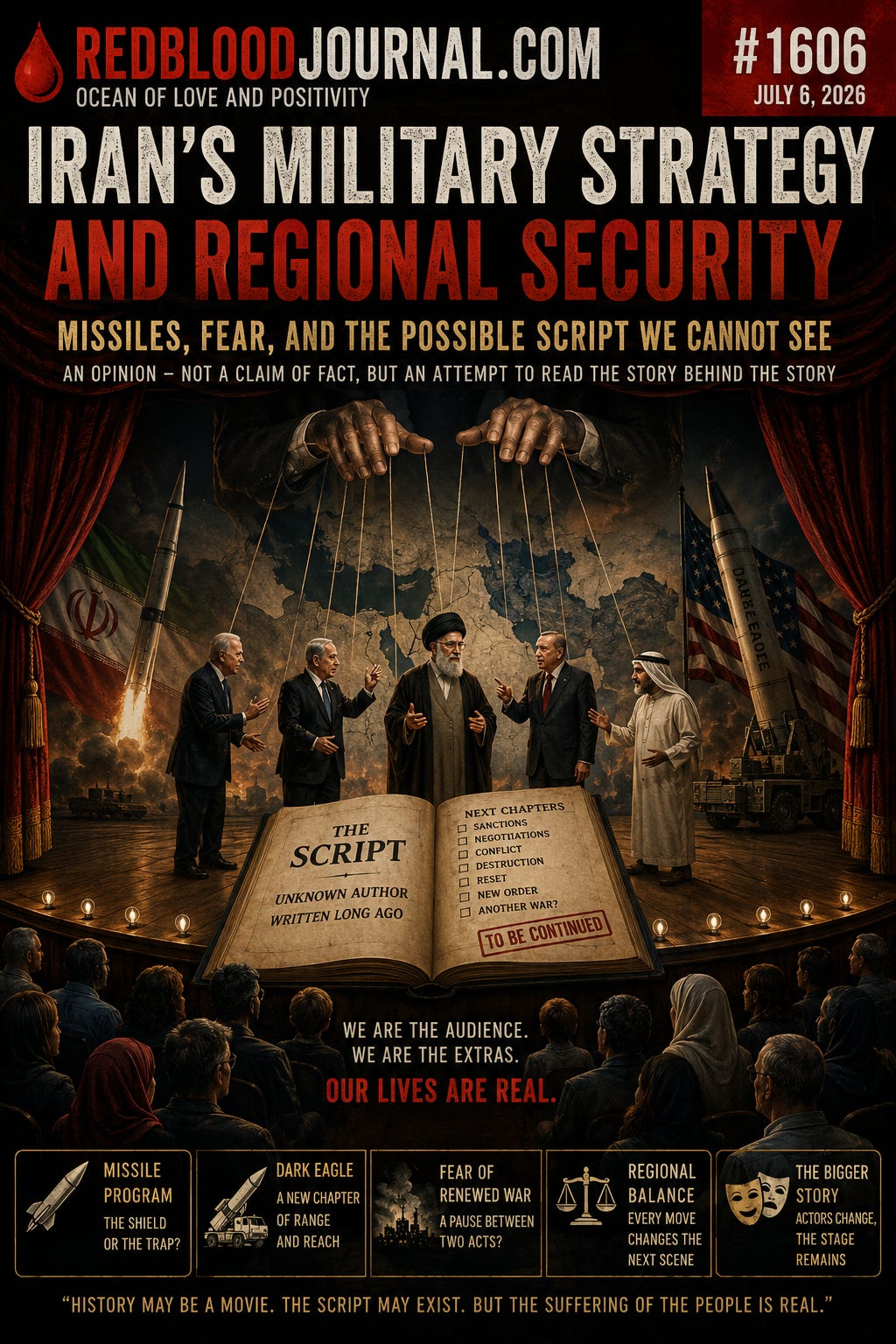
#1606 – Iran’s Military Strategy and Regional Security
Missiles, Fear, and the Possibility That We Are Watching a Script Already Written
An Opinion
By Red Blood
July 6, 2026
Introduction
Suppose, for a moment, that the world is not unfolding exactly as we believe it is.
Suppose history resembles an enormous motion picture whose script was written long before today’s actors entered the stage.
The politicians know only the scenes they must perform.
The generals know only the battles assigned to them.
The media reports only the chapter currently being filmed.
Meanwhile, billions of ordinary people become unwilling extras, believing every scene is unfolding for the very first time.
This report is not claiming that such a script exists.
It is an opinion—a way of looking at history through a different lens.
Perhaps the invisible script is nothing more than repeating human nature.
Perhaps it is the predictable behavior of governments pursuing power generation after generation.
Or perhaps history simply rhymes so often that it appears scripted.
Whatever the explanation, one observation remains difficult to ignore:
The faces change.
The uniforms change.
The flags change.
Yet the story often feels strangely familiar.
If there is an invisible script, the common people never receive a copy.
They only experience one scene after another while trying to guess what comes next.
That is what every political analyst, journalist, intelligence service, and ordinary citizen is doing—attempting to predict pages they cannot see.
This report examines Iran’s military posture from that perspective.
Not as absolute truth.
Not as established fact.
But as one possible interpretation of a story that may have begun long before any of today’s leaders were born.
The Military Stage
Every movie needs tension.
Every story needs an opponent.
Every conflict needs weapons.
In today’s Middle East, Iran’s missile program occupies center stage.
For decades, missiles have represented far more than military hardware.
They have become symbols.
Symbols of resistance.
Symbols of deterrence.
Symbols intended to convince adversaries that attacking Iran would come at an unacceptable cost.
Whether those weapons truly provide security is another question entirely.
Because every weapon that creates fear also creates justification.
The larger the sword becomes, the stronger the argument for someone else to build an even larger shield—or strike first.
When the Shield Becomes the Target
According to the discussion contained in the attached transcript, concern is growing that Iran’s missile infrastructure itself may become the primary objective in any future conflict. Rather than serving only as a deterrent, strategic missile capabilities are portrayed as potential targets should hostilities resume.
From the perspective of our movie analogy, this creates an interesting twist.
The object originally introduced to prevent war gradually becomes one of the reasons war is discussed.
The shield slowly transforms into the target.
Whether that transformation is intentional or simply the consequence of strategic competition is open for debate.
The Dark Eagle Chapter
The transcript repeatedly refers to concerns surrounding the American Dark Eagle missile system and its potential implications for future military planning. It presents these discussions as evidence that some observers inside Iran view newer long-range precision systems as altering the strategic balance.
Whether these assessments ultimately prove accurate is less important than what they reveal psychologically.
Confidence speaks differently than fear.
Confident governments project certainty.
Fearful governments begin imagining every possible scenario.
The discussion itself becomes evidence that uncertainty exists.
Negotiations or the Next Scene?
Perhaps the most interesting question raised by the transcript is whether diplomacy represents genuine peace—or merely the interval between two acts.
History offers many examples where negotiations reduced tensions.
It also offers examples where negotiations bought time.
Sometimes they prevented wars.
Sometimes they postponed them.
If our movie analogy has merit, then negotiations become another scene.
The audience celebrates.
Markets recover.
Headlines change.
Yet somewhere, perhaps, another chapter is already being prepared.
Again, this is not a factual claim.
It is simply one possible way to interpret repeating historical patterns.
The Regional Balance
Military power never exists in isolation.
Iran’s influence has extended beyond its own borders through alliances, partnerships, and regional networks.
The transcript suggests that changing relationships involving Israel, Turkey, NATO, and the United States may gradually reshape that balance. Whether one agrees with that interpretation or not, it reflects a broader concern that the strategic environment surrounding Iran is evolving.
If true, then the story is larger than one country.
Each actor influences every other actor.
Each move changes the next chapter.
The Invisible Audience
There is one group almost never discussed in geopolitical strategy.
Ordinary people.
They are not writing treaties.
They are not selecting military targets.
They are not approving sanctions.
Yet they carry the greatest burden.
Families lose fathers.
Children lose parents.
Businesses collapse.
Savings disappear.
Entire generations inherit problems they never created.
Whether history is spontaneous or partially predictable changes nothing for them.
Their suffering remains real.
That is perhaps the only certainty.
Looking Beyond the Stage
If this report encourages anything, it is not fear.
It is observation.
Whenever emotions run highest...
Whenever governments insist there is only one acceptable interpretation...
Whenever media outlets rush to explain why today’s crisis is completely unique...
It may be worthwhile to pause.
Step back.
Look at previous chapters.
Ask whether similar patterns have appeared before.
Sometimes history surprises us.
Sometimes it repeats itself.
Sometimes it only appears to repeat because human beings rarely change.
Conclusion
Perhaps there is no script.
Perhaps everything is coincidence.
Perhaps every decision is made independently, one day at a time.
Or perhaps humanity is watching another performance built upon patterns that have existed for centuries.
Each reader must decide.
But one lesson seems worth remembering regardless of which conclusion we reach:
Governments rise.
Governments fall.
Weapons evolve.
Alliances change.
Actors leave the stage.
New actors replace them.
The stage itself remains.
The people continue living through every performance, often without understanding why the story unfolded the way it did.
Maybe the greatest freedom is not predicting the next scene.
Maybe it is refusing to become emotionally captive to the performance itself.
Watch carefully.
Question respectfully.
Think independently.
And remember that beyond every headline, every missile, every speech, and every political drama, there are millions of ordinary human beings whose lives are far more real than the roles being played before the cameras.
🩸 RedBloodJournal.com
Ocean of love and positivity.
🎭 The Script of Shadows:
Iran’s Geopolitical Theater
Jul 6, 2026
This text presents a philosophical critique of Middle Eastern geopolitics, framing the escalating tensions between Iran and the West as a predictable, almost scripted theatrical performance. The author suggests that modern military strategies and missile programs, while intended as deterrents, often serve as the very justifications for renewed conflict. By examining specific threats like the Dark Eagle missile system, the source explores how fear and strategic posturing drive historical cycles that repeat regardless of who is in power. Ultimately, the narrative shifts focus away from political actors to highlight the plight of ordinary citizens who bear the consequences of these regional power struggles. The overarching message encourages readers to maintain emotional independence and think critically about whether global events are spontaneous or part of a long-standing historical pattern.


