


🩸 RedBloodJournal.com
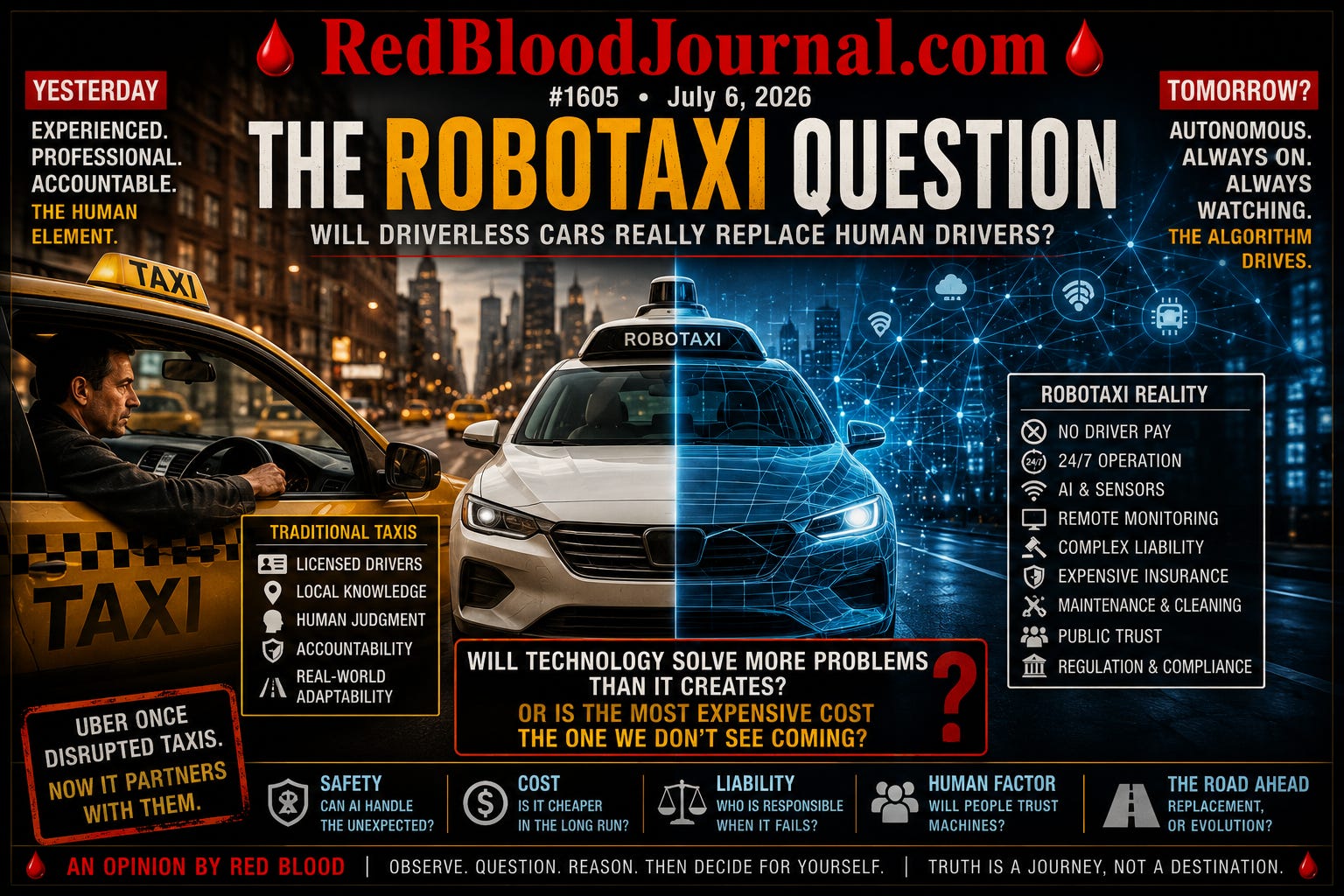
#1605 – The Robotaxi Question: Will Driverless Cars Really Replace Human Drivers?
An Opinion
By Red Blood
July 6, 2026
Introduction
When Uber first appeared, many believed the future of transportation had arrived.
A smartphone replaced the dispatcher.
Independent drivers replaced traditional taxi companies.
Technology disrupted an industry that had existed for generations.
Now another revolution is being promised.
The driver himself is about to disappear.
Robotaxis are presented as the next inevitable step.
But are they?
Every Revolution Promises Lower Costs
The argument sounds simple.
Remove the driver.
Remove wages.
Remove benefits.
Allow the vehicle to operate nearly twenty-four hours a day.
The result should be dramatically lower transportation costs.
On paper, the mathematics appears convincing.
Reality, however, has a habit of introducing costs that spreadsheets cannot fully predict.
The Driver Is Replaced...
But What Takes His Place?
A robotaxi does not simply remove a human being.
It replaces that human with an entirely different set of expenses.
Instead of paying a driver, someone must now pay for:
Artificial intelligence development
Advanced cameras and sensors
High-performance computers
Continuous software updates
Remote monitoring centers
Vehicle cleaning
Battery charging
Maintenance
Cybersecurity
Commercial insurance
Legal liability
Regulatory compliance
The salary disappears.
Many new expenses appear.
The Insurance Question
One of the largest unknowns may not be technology.
It may be responsibility.
When a human driver causes an accident, responsibility often centers on the driver’s actions.
When a robotaxi makes a mistake, questions become more complicated.
Was it:
The software?
The hardware?
The manufacturer?
The fleet operator?
The company that wrote the artificial intelligence?
The company operating the ride service?
One defect affecting thousands of vehicles could become extraordinarily expensive.
A Curious Observation
Recently, Uber has increasingly partnered with traditional taxi companies in many cities.
This is interesting.
If autonomous transportation is just around the corner, why spend resources integrating professional taxi fleets?
No one outside the company knows the answer.
Perhaps it improves service.
Perhaps it satisfies regulators.
Perhaps it reduces costs.
Perhaps it addresses insurance challenges.
Or perhaps it simply reflects the reality that experienced professional drivers still provide value that technology has not yet replaced.
History Rarely Eliminates Everything
Every technological revolution promises replacement.
Yet history often tells a different story.
Television did not eliminate radio.
Email did not eliminate postal mail.
Streaming did not eliminate movie theaters.
Airplanes did not eliminate trains.
Instead, each found its place.
Perhaps robotaxis will do the same.
The Human Element
Driving is more than steering a vehicle.
Professional drivers constantly make judgments that are difficult to measure.
They notice unusual behavior.
They adapt to unpredictable situations.
They assist elderly passengers.
They help children.
They recognize danger.
They exercise common sense.
Artificial intelligence continues to improve.
Whether it can fully duplicate human judgment in every circumstance remains an open question.
My Best Guess
I do not know what Uber, Tesla, Waymo, or any other company discusses behind closed doors.
Neither does the public.
Like every other opinion I publish, this is simply my best attempt to reason from observable facts.
My guess is that robotaxis will become part of transportation.
I am less certain they will completely replace professional human drivers.
The economics, insurance, regulation, public trust, and legal liability are far more complicated than removing a steering wheel.
Sometimes the most expensive employee is not the driver.
Sometimes it is the unexpected problem that replaces him.
Final Thoughts
Technology often solves one problem while creating another.
The future of transportation may not belong entirely to robotaxis.
Nor entirely to human drivers.
It may become a mixture of both.
As always, I do not claim certainty.
I simply observe, question, and reason toward what appears to be the closest approximation of reality.
Tomorrow’s evidence may change today’s conclusion.
And that is exactly how the search for truth should work.
🩸 RedBloodJournal.com
“I do not claim to know the truth. I simply try to move one step closer to it by observing what is visible, questioning what is hidden, and remaining willing to change my conclusions whenever better evidence appears.”
🚕 The Robotaxi Question:
Human Drivers vs. Autonomous Progress
Jul 6, 2026
The provided text examines the financial and practical challenges facing the transition from human-operated vehicles to autonomous robotaxis. While removing human drivers aims to cut labor costs, the author argues that these savings are offset by complex new expenses like high-tech maintenance, cybersecurity, and significant legal liabilities. The source highlights that professional drivers offer nuanced judgment and physical assistance that artificial intelligence currently struggles to replicate. Furthermore, the article notes that major ride-sharing companies continue to integrate traditional taxi fleets, suggesting that human expertise remains vital. Ultimately, the author predicts a future where automated systems and human drivers coexist rather than one where technology entirely eliminates the human element. The piece concludes that the regulatory and insurance hurdles of autonomous transport are far more daunting than the technological development itself.


