


🩸 RedBloodJournal.com
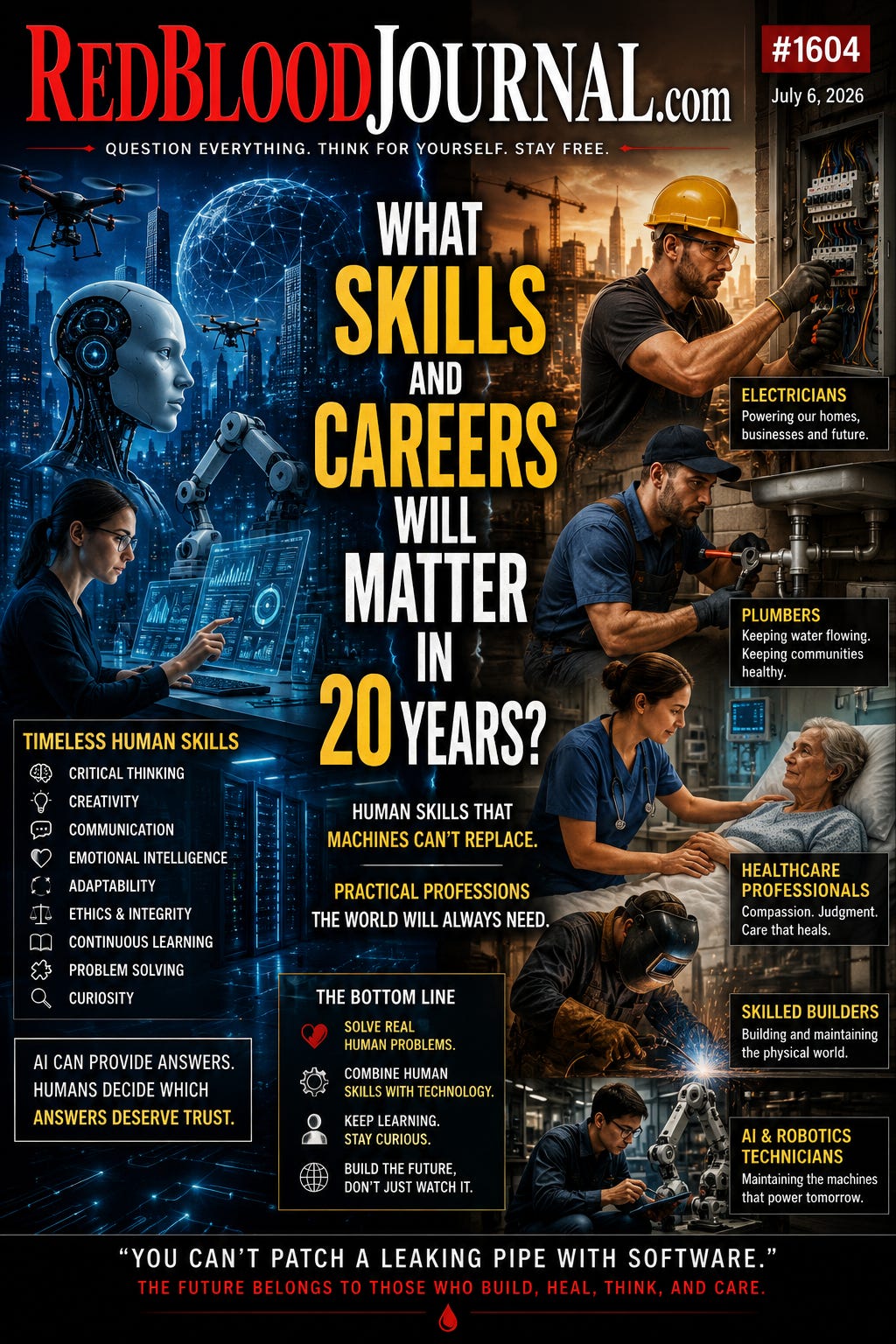
#1604 – What Skills and Careers Will Matter in 20 Years?
Preparing for a Future Where Technology Changes Faster Than Humanity
By Red Blood
July 6, 2026
Introduction
Every generation wonders what the future will demand.
Parents ask what their children should study.
Students ask which careers will still exist.
Workers wonder whether artificial intelligence will replace their jobs.
No one can predict the future with certainty, but history offers an important lesson.
Technology changes rapidly.
Human needs change much more slowly.
No matter how advanced society becomes, people will still need food, water, shelter, healthcare, electricity, transportation, and one another.
Perhaps the better question is not:
“What job is safest?”
Instead, we should ask:
“What skills and professions solve problems that humanity will always have?”
The World Is Becoming More Intelligent
Artificial intelligence can already:
Write reports.
Generate software.
Translate languages.
Analyze data.
Create images and videos.
Assist doctors.
Tutor students.
Answer questions in seconds.
Many office jobs will almost certainly change.
Some may disappear entirely.
Others will become partnerships between humans and intelligent machines.
Knowledge alone is becoming easier to obtain.
The value is shifting toward knowing how to use that knowledge wisely.
The Human Skills That Will Never Go Out of Style
Technology may perform tasks.
People still determine purpose.
The individuals who continue to thrive will likely possess qualities that remain difficult to automate.
Among them are:
Critical thinking
Curiosity
Creativity
Communication
Emotional intelligence
Ethical judgment
Adaptability
Continuous learning
Problem solving
Integrity
Artificial intelligence can produce answers.
Humans must still decide which answers deserve trust.
The Physical World Still Needs Human Hands
While many discussions focus on computers and software, humanity continues to live in physical buildings.
Homes leak.
Pipes burst.
Electrical systems fail.
Roads crack.
Hospitals require maintenance.
Power grids need expansion.
Machines wear out.
No amount of software repairs a broken water pipe by itself.
No chatbot rewires a home.
No algorithm replaces a failed sewer line.
The digital world depends entirely upon the physical world beneath it.
Careers That May Become Even More Valuable
Ironically, some of the safest careers may be the ones that require practical hands-on work.
Electricians
As society becomes increasingly dependent on electricity, electric vehicles, renewable energy, smart homes, robotics, and artificial intelligence, electricians become even more essential.
Someone must install, inspect, maintain, and repair these systems.
Plumbers
Clean water and sanitation are among civilization’s greatest achievements.
Every city, home, hospital, school, and factory depends on functioning plumbing.
These systems operate in unique environments that remain difficult to automate.
Skilled Construction Trades
Carpenters.
HVAC technicians.
Welders.
Heavy equipment operators.
General contractors.
Civil infrastructure workers.
Buildings continually require construction, renovation, and maintenance regardless of advances in artificial intelligence.
Healthcare Professionals
Doctors.
Nurses.
Paramedics.
Therapists.
Caregivers.
Artificial intelligence will likely become an extraordinary medical assistant, but patients still value compassion, reassurance, and human judgment.
Technology may improve medicine.
Human care remains central to healing.
AI and Robotics Technicians
Ironically, the growth of artificial intelligence creates entirely new careers.
Someone will need to install, repair, calibrate, secure, and maintain intelligent machines.
As automation expands, so will the demand for people who understand how these systems function in the real world.
Learning Never Ends
Perhaps the greatest future skill is learning itself.
The most successful individuals may not be those who master one profession forever.
Instead, they may be those who repeatedly learn new tools, adapt to changing industries, and remain intellectually curious throughout life.
Education increasingly becomes a lifelong process rather than something completed in youth.
The Partnership Between Humans and AI
Much of the public discussion assumes that artificial intelligence and people are competitors.
A more realistic possibility is that they become partners.
The most effective electrician may use AI diagnostics.
The best physician may rely on AI to analyze medical images.
The strongest engineer may collaborate with intelligent design software.
The most successful teacher may use AI to personalize lessons.
Technology often changes how people work more than whether people work.
Success in the Next Twenty Years
If a young person asked for advice today, perhaps the recommendation would be surprisingly simple.
Learn a profession that solves a real human problem.
Develop skills that no machine easily replaces.
Continue learning throughout life.
Understand technology rather than fear it.
And remember that every technological revolution still depends upon honest, capable human beings.
Final Thoughts
History reminds us that predicting the future is difficult.
One hundred years ago, few imagined the internet.
Twenty years ago, few imagined artificial intelligence writing articles or assisting scientific research.
Twenty years from now, today’s predictions will almost certainly seem incomplete.
Yet one truth has remained remarkably consistent throughout history.
Civilizations continue to depend on people who can think clearly, act ethically, solve practical problems, and build the physical world upon which every digital innovation rests.
The future may belong not simply to programmers or machines, but to those who combine timeless human character with practical skills that keep civilization functioning.
In a world increasingly shaped by artificial intelligence, the greatest advantage may still be learning how to remain profoundly—and responsibly—human.
🛠️ The Human Advantage in an Automated Age
Jul 5, 2026
This article explores the evolving landscape of labor in an era dominated by rapid technological growth and artificial intelligence. While automation may replace many digital tasks, the author emphasizes that essential human qualities like ethical judgment, emotional intelligence, and critical thinking will remain irreplaceable. Furthermore, the text highlights the enduring necessity of physical trades, noting that infrastructure and healthcare require hands-on expertise that software cannot replicate. Instead of viewing machines as rivals, the narrative suggests a future of partnership where professionals use technology to enhance their work. Success in the coming decades will likely belong to those who prioritize lifelong learning and master skills that address fundamental human needs. Ultimately, the piece argues that the most secure careers are those rooted in practical problem-solving and timeless character traits.


