


🩸 RedBloodJournal.com
Report #1505
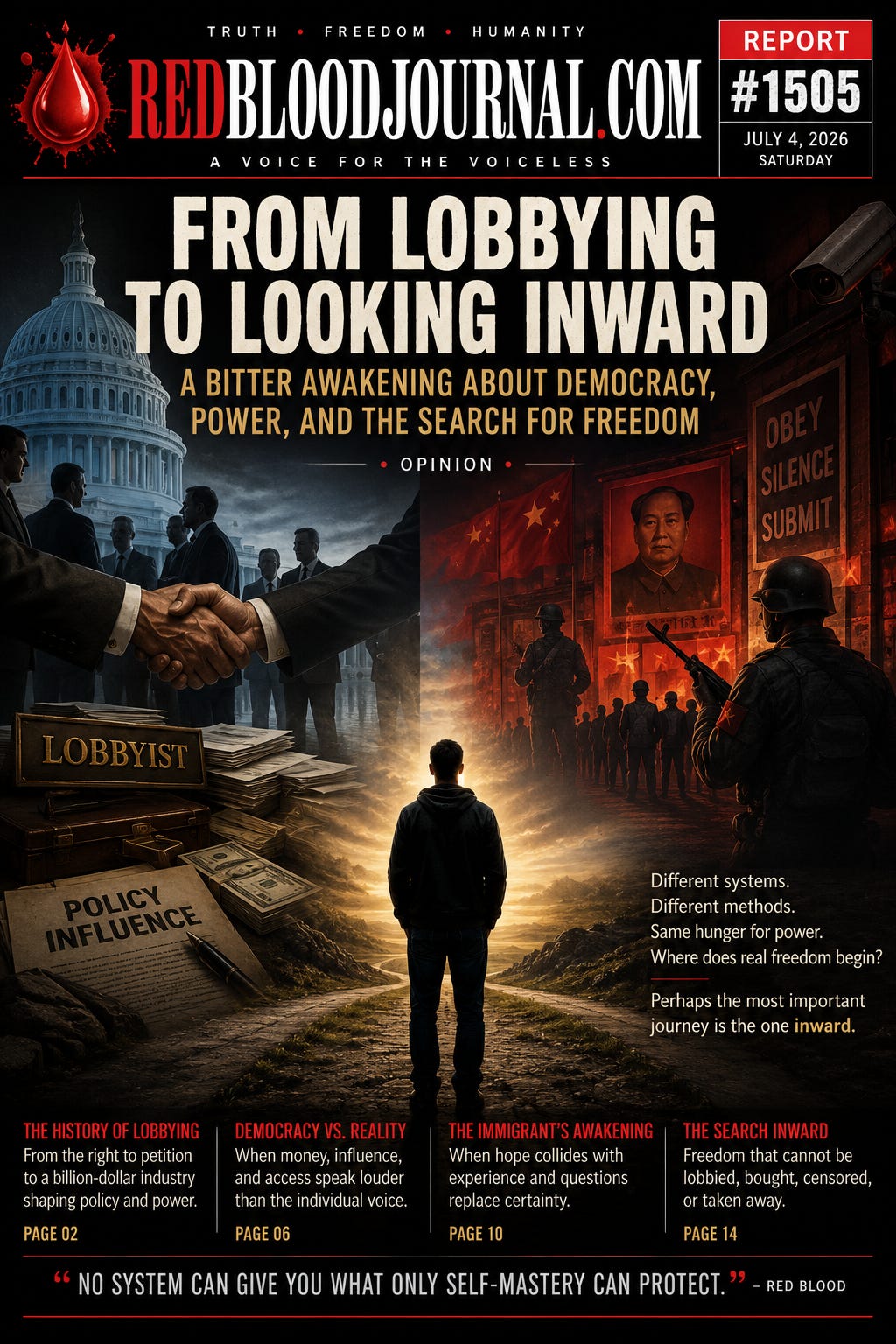
From Lobbying to Looking Inward
A Bitter Awakening About Democracy, Power, and the Search for Freedom
By Red Blood
July 4, 2026
Opinion
Every generation inherits ideas about freedom.
Some inherit them through history.
Some through education.
Others through advertising, politics, films, television, and national identity.
For millions around the world, democracy has long been presented as the highest expression of political freedom—a system where every individual possesses an equal voice and government exists by the consent of the people.
But what happens when personal experience challenges that belief?
The Evolution of Lobbying
Lobbying did not begin as corruption.
Its origins lie in one of democracy’s most fundamental principles: the right of citizens to petition their government.
Merchants, labor organizations, religious groups, businesses, charities, and ordinary citizens all sought opportunities to present their concerns to elected officials. In theory, lobbying represented participation.
Over time, however, participation evolved into profession.
As governments expanded their influence over taxation, healthcare, banking, defense, technology, energy, education, and commerce, lobbying became an industry.
Organizations with significant financial resources gained the ability to maintain permanent access to lawmakers through professional lobbyists, policy experts, campaign contributions, research organizations, and advocacy campaigns.
Supporters argue this is simply democracy at work.
Critics ask a different question.
If access to political leaders increasingly depends upon financial resources, has the individual citizen gradually become less influential than organized wealth?
The legal distinction between lobbying and bribery remains clear.
The philosophical distinction, however, continues to divide public opinion.
The Immigrant’s Awakening
There is a unique disappointment experienced by some immigrants.
Not because they expected perfection.
But because they believed the promise.
Many arrive believing democracy represents the destination where individual freedom reaches its highest expression.
Then life begins.
Reality replaces expectation.
The greatest shock is rarely discovering flaws.
Every nation has flaws.
The shock comes from realizing that the distance between political ideals and political reality may be far smaller than they were led to believe.
Different Systems—Different Methods
One government may openly centralize authority.
Another may celebrate freedom while critics argue that money, lobbying, special interests, and institutional influence play an outsized role in shaping policy.
One governs openly through authority.
Another may rely more heavily on persuasion, public confidence, political branding, and competing narratives.
Neither observation proves superiority.
It simply asks whether labels always describe reality.
When Hope Collides With Experience
For some people, this realization creates something difficult to describe.
The mind attempts to reconcile lifelong beliefs with lived experience.
Questions replace certainty.
Was freedom misunderstood?
Was hope misplaced?
Or was every political system simply created by imperfect human beings who eventually face the same temptations—power, influence, wealth, and self-preservation?
This report offers no final answer.
Only questions.
Looking Inward
Perhaps the greatest disappointment is also the greatest opportunity.
If every outward system eventually leans toward material power...
Perhaps lasting freedom was never meant to begin outward.
Perhaps it begins inward.
Not as an escape from society.
But as the place where integrity cannot be purchased.
Where conscience cannot be lobbied.
Where truth does not depend upon political slogans.
Where character matters more than ideology.
Material progress has transformed civilization.
It has not answered humanity’s deepest questions.
Money cannot purchase peace.
Power cannot manufacture wisdom.
Influence cannot replace character.
Conclusion
This report is an opinion.
It does not argue that one nation is better than another.
It questions whether humanity has placed too much faith in political systems while neglecting the one government every individual truly controls—the government of the self.
Perhaps the outward world will always lean toward materialism because that is where competition lives.
The inward world asks for something entirely different.
Honesty.
Humility.
Compassion.
Self-government.
Perhaps the future of humanity will not be determined by which political system prevails.
Perhaps it will be determined by how many individuals choose to become rulers of themselves before trying to rule others.
That journey begins inward.
🧘 The Architecture of Inner Governance
Jul 5, 2026
This report investigates the growing disillusionment with modern democracy, specifically examining how the professionalization of lobbying has allowed financial influence to overshadow the voices of individual citizens. The author reflects on the immigrant experience, noting the painful realization that political reality often fails to mirror the idealized promises of freedom marketed by many nations. By comparing overt authority with the subtle power of institutional influence, the text argues that external political structures are inherently prone to corruption and material competition. Ultimately, the source suggests that true sovereignty is internal, urging readers to prioritize self-governance and personal integrity over a reliance on external systems. The narrative concludes that the future of humanity depends less on political ideologies and more on the cultivation of individual character and wisdom.


