


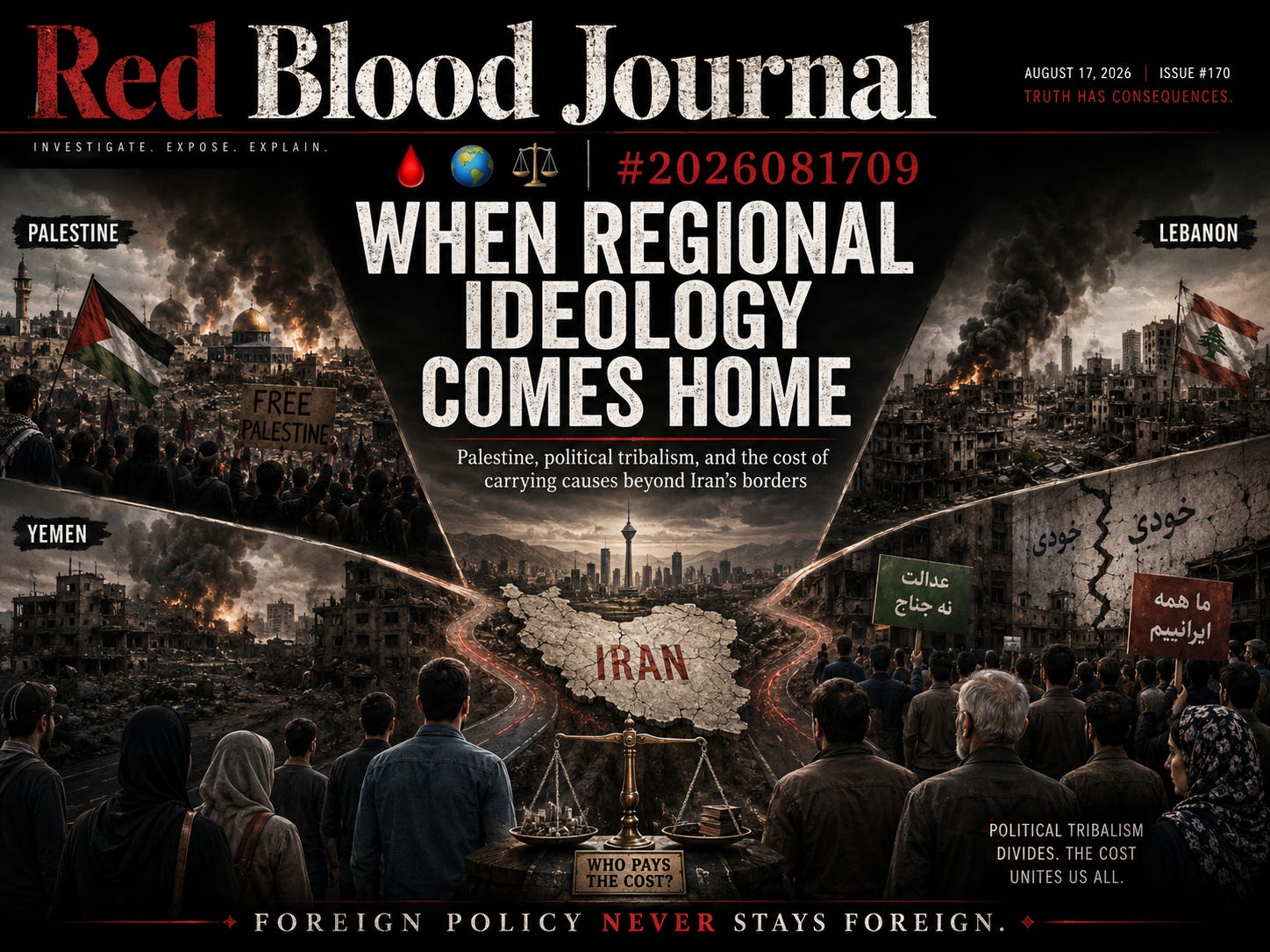
🩸 🌍 ⚖️ #2026081709 — When Regional Ideology Comes Home
Palestine, political tribalism, and the question of what Iran has paid for carrying causes beyond its own borders
For decades, the Islamic Republic has presented support for Palestine and resistance movements across the Middle East as part of Iran’s revolutionary identity.
The argument has been familiar:
Palestine is not merely a foreign issue.
Lebanon is not merely a foreign issue.
Yemen is not merely a foreign issue.
Israel is not merely another regional state.
These struggles are presented as connected to Iran’s security, ideology, religion, and place in the world.
But the material examined for this report raises a different question.
What happens when a government devotes enormous political energy to struggles beyond its borders while its own citizens increasingly feel economically exhausted, politically restricted, internationally isolated, and uncertain about their future?
The source brings this conflict into focus through remarks attributed to actor Navid Mohammadzadeh, criticism of Iran’s involvement in Palestine, Lebanon and Yemen, and an Arabic-language segment blaming the Islamic Republic for helping deepen suffering elsewhere in the region while distinguishing the Iranian people from the Iranian government.
The argument is no longer merely:
Should Iran support Palestine?
It has become:
What happens when a foreign-policy cause becomes part of the internal political identity test of being Iranian?
Navid Mohammadzadeh and the Problem of Political Teams
The source includes comments attributed to Navid Mohammadzadeh expressing continued support for Palestine and saying, in effect, that he does not identify with Israel and would continue choosing Palestine.
But the more revealing part of the passage is not necessarily the position on Palestine itself.
It is his frustration with political tribalism.
He describes being attacked from opposite directions.
One side labels people government supporters.
Another labels them traitors.
Everyone is placed into a team.
Everyone is expected to prove loyalty to one camp or another.
The broader complaint is that public life has become fragmented into mutually hostile identities rather than arguments between citizens.
That deserves attention beyond the specific Palestine debate.
Because once politics becomes tribal, a position on one issue is no longer one position.
It becomes a complete identity.
Support Palestine?
Then someone assumes what you think about the Islamic Republic.
Criticize the Islamic Republic?
Someone assumes what you think about Israel.
Support Pahlavi?
Someone assumes what you think about religion.
Reject monarchy?
Someone assumes what you think about the regime.
The citizen disappears.
The team remains.
Palestine Has Become More Than Foreign Policy
For the Islamic Republic, Palestine has never been treated as an ordinary diplomatic issue.
It is part of the regime’s foundational political story.
The revolution defined itself partly through opposition to Israel and American power.
Support for Palestinian movements therefore became connected to revolutionary legitimacy.
That means criticism of the policy can easily become criticism of the political identity of the system itself.
The result is unusual.
Foreign policy becomes domestic ideology.
A citizen is not merely asked:
What should Iran do abroad?
The citizen is implicitly asked:
Which Iran do you belong to?
That turns policy disagreement into identity conflict.
The Cost Question
The source asks whether Iranian artists and public figures who defend Palestine will continue doing so if the same political system uses expanding restrictions to constrain their own international activity.
It explicitly connects the proposed foreign-contact restrictions discussed in the earlier report with participation in international festivals, foreign institutions, and broader cultural exchange.
That creates an uncomfortable contradiction.
The state tells Iranians that events in Palestine are their concern.
But international contact by Iranians themselves may increasingly be treated as a security concern.
Global political solidarity is encouraged in one direction.
Global personal connection may be restricted in another.
The citizen is expected to think internationally—
but only within approved political boundaries.
A Government Can Internationalize Ideology While Localizing Freedom
This may be one of the strangest features of the system described in the source.
Its ideology has no borders.
Its citizens increasingly do.
The government can discuss Gaza.
Lebanon.
Yemen.
Israel.
America.
Regional resistance.
International revolution.
But a student may worry about contacting a foreign university.
A researcher may worry about collaboration.
A journalist may worry about foreign media.
A citizen may worry about contact with an embassy.
The state moves globally.
The individual moves through checkpoints.
That contradiction deserves more attention.
The Regional Argument
Supporters of Iran’s regional strategy have long made a security argument.
They say influence outside Iran creates strategic depth.
Better to confront adversaries beyond Iran’s borders than inside them.
Allied groups provide deterrence.
Regional networks increase bargaining power.
Support for Palestinians also carries genuine moral and political importance for many Iranians and many people outside Iran.
None of those arguments should simply be dismissed.
A country’s foreign policy is rarely motivated by only one thing.
Security, ideology, religion, deterrence, domestic legitimacy, and geopolitical leverage can all exist at the same time.
But the existence of a strategic rationale does not end the debate.
It begins it.
The next question is:
At what cost?
Lebanon, Gaza, and Yemen
Near the end of the source, the argument becomes much more direct.
It claims that wherever the Islamic Republic has established strong influence or made a location part of its regional strategy, ordinary people have experienced instability and hardship.
Lebanon.
Palestine.
Gaza.
Yemen.
The source presents this as evidence that Iranian regional intervention has produced suffering rather than prosperity.
That conclusion is strongly framed and should not be treated as proof that Iran alone caused the crises in these societies.
Each has its own internal history, factions, foreign interventions, wars, economic problems, and outside actors.
But the criticism contained in the source is still significant.
It reflects a growing political question:
Has the Islamic Republic exported security—or exported its conflicts?
The Arab Voice in the Source
One of the most important moments in the material comes from an Arabic-language segment.
The speaker distinguishes between the Iranian people and the Iranian government while blaming the Iranian regime for contributing to regional hardship and displacement.
That distinction matters.
Foreign-policy conflict often erases populations.
Iran becomes “the Iranians.”
Israel becomes “the Israelis.”
Palestine becomes “the Palestinians.”
America becomes “the Americans.”
Governments, armies, intelligence services, political parties, and ordinary citizens are collapsed into one identity.
The Arabic speaker does the opposite.
The criticism is directed toward the system—
not the population.
That may be one of the healthiest distinctions in the entire source.
People Are Not Their Governments
This principle should work in every direction.
An Iranian citizen is not automatically responsible for the Islamic Republic.
A Palestinian civilian is not automatically responsible for Hamas.
An Israeli civilian is not automatically responsible for every decision of the Israeli government.
A Lebanese civilian is not Hezbollah.
An American citizen is not the CIA.
A Yemeni child is not a militia.
Yet political rhetoric constantly merges governments with populations because collective labels are convenient.
Once that happens, civilian suffering becomes easier to justify.
“They support them.”
“They elected them.”
“They are all part of it.”
“They deserve what happens.”
That logic is one of the most dangerous shortcuts in politics.
What Does Solidarity Mean?
There is a legitimate humanitarian argument for caring about Palestinians.
Civilian suffering does not become irrelevant because Iran’s government also exploits the issue politically.
Likewise, criticizing the Islamic Republic’s regional policy does not require indifference toward Palestinian civilians.
Those positions can coexist.
One can oppose Israeli actions.
One can oppose Hamas.
One can oppose the Islamic Republic’s regional strategy.
One can support Israeli civilians.
One can support Palestinian civilians.
One can support Iranian civilians.
None of those positions logically require hatred of another population.
Political tribalism insists that they do.
Reality does not.
The Binary Trap
This is where Navid Mohammadzadeh’s frustration becomes relevant again.
Modern political discourse repeatedly demands binary loyalty.
Israel or Palestine.
Regime or opposition.
Monarchy or republic.
West or East.
Resistance or surrender.
The problem is not that choices never matter.
They do.
The problem is that binary thinking often removes the ability to criticize one’s own side.
Once a person declares membership in a camp, every action by that camp becomes defensible because admitting wrongdoing feels like helping the enemy.
That is how political judgment deteriorates.
The question changes from:
Is this right?
to:
Who benefits if I say this is wrong?
Iran’s Citizens Have Been Asked to Carry the Region
For decades, ordinary Iranians have heard their country’s destiny explained through regional confrontation.
Palestine.
Israel.
Lebanon.
Syria.
Iraq.
Yemen.
America.
Sanctions.
Resistance.
Strategic depth.
Meanwhile, many citizens experience politics much closer to home.
Currency.
Housing.
Jobs.
Internet access.
Water.
Electricity.
Universities.
Travel.
Censorship.
Prison.
Emigration.
Those are not abstract geopolitical issues.
They are daily life.
That creates the possibility of a widening gap between the state’s definition of national interest and the citizen’s definition of national interest.
The state may define victory as expanding regional influence.
The citizen may define victory as being able to afford rent.
Both use the word Iran.
They may no longer mean the same thing.
The Question of Priorities
Every government faces finite resources.
Money.
Political attention.
Diplomatic capital.
Military capacity.
Institutional energy.
Time.
Priorities therefore matter.
A government that considers regional influence essential may argue that external security ultimately protects domestic prosperity.
Critics may answer that decades of confrontation have instead contributed to sanctions, isolation, military escalation, and economic pressure.
The source clearly takes the second view.
But the important question can be stated neutrally:
Has Iran’s regional strategy improved the long-term security and prosperity of ordinary Iranians enough to justify its costs?
That question should be answerable with evidence.
Not slogans.
The Revolutionary Model Versus the National Model
Under the Islamic Republic, Iran has often behaved not simply as a nation-state but as a revolutionary state.
A conventional nation-state primarily asks:
What serves Iran?
A revolutionary state may also ask:
What serves the revolution?
Those answers can overlap.
They can also diverge.
If preserving an ideological alliance damages Iran economically but strengthens the revolutionary project, which interest wins?
If a confrontation increases regional influence but increases isolation for Iranian citizens, which outcome matters more?
This tension may sit near the center of Iran’s foreign-policy debate.
What Happens If the Revolutionary Identity Weakens?
If Iranian society eventually becomes less ideological, foreign policy could change substantially even without Iran becoming friendly toward every current adversary.
A future Iranian government might still support Palestinian statehood.
It might still criticize Israel.
It might still oppose American policies.
But those positions could become ordinary state policy rather than foundational revolutionary identity.
That distinction is enormous.
Policies can change.
Identity is much harder to change.
When Palestine becomes a policy question rather than a loyalty test, Iranians could debate it without automatically accusing one another of betrayal.
Iran Is Not Required to Hate Anyone
There is a strange assumption built into regional politics.
Peace with one side is interpreted as betrayal of another.
Diplomacy with Israel means abandoning Palestine.
Diplomacy with America means abandoning sovereignty.
Supporting Palestinians means hating Israelis.
Criticizing Iran’s government means supporting foreign intervention.
None of those relationships are logically necessary.
A mature state can negotiate with adversaries.
It can support Palestinian rights while recognizing Israeli security.
It can maintain relations with America without becoming subordinate to America.
It can defend Iranian sovereignty without exporting ideology.
Foreign policy does not have to function as a permanent declaration of friendship and hatred.
It can simply be policy.
The Cost to Regional Populations
The source’s criticism of Iran’s role in Lebanon, Gaza and Yemen also raises another moral question.
If Iranian strategy uses allied movements abroad as instruments of geopolitical competition, what responsibility exists toward the civilians living around those movements?
A proxy may provide strategic depth to Tehran.
But civilians experience the consequences locally.
War does not occur on a geopolitical map.
It occurs inside apartment buildings.
Hospitals.
Schools.
Roads.
Markets.
Families.
This is true regardless of which government or armed organization initiates the violence.
Strategic language can make suffering sound clean.
The ground never is.
The Cost to Iran
The same principle applies at home.
Foreign-policy decisions eventually return domestically.
As sanctions.
Military spending.
Political repression justified by foreign threats.
Internet restrictions.
Intelligence expansion.
Emigration.
International isolation.
Or sometimes greater deterrence and security.
The point is not that every consequence is negative.
It is that foreign policy does not remain foreign.
Eventually it comes home.
That is why citizens have a legitimate interest in debating it openly.
Political Tribalism Prevents That Debate
Once every foreign-policy disagreement becomes a loyalty test, meaningful analysis stops.
Criticize Israel?
You are assigned one team.
Criticize Hamas?
Another.
Criticize the Islamic Republic?
Another.
Criticize American intervention?
Another.
And suddenly nobody is discussing policy.
Everyone is investigating everyone else’s identity.
That may be precisely the fragmentation Mohammadzadeh was complaining about in the source.
The tragedy is that people who may agree on ninety percent of ordinary life can become enemies over symbols produced by governments and political movements.
The Red Blood Perspective
The question is not whether Palestinians deserve concern.
They do.
It is not whether Israelis deserve security.
They do.
It is not whether Iran has legitimate regional security interests.
It does.
The question is whether one government’s ideological interpretation of those concerns should become a permanent burden carried by every citizen.
Iran’s regional policy should ultimately face the same test as any domestic policy:
Does it improve the life, security, dignity, and future of the people whose country is paying for it?
And the same question should be asked of every government in the region.
Not:
Who are our friends?
Not:
Who are our enemies?
But:
What happens to ordinary people because of what we are doing?
That test is much harder.
It is also much more useful.
Ocean of Love and Positivity Perspective
There is another way to look at the Middle East.
Not as Iran versus Israel.
Not Arabs versus Persians.
Not Muslims versus Jews.
Not resistance versus the West.
But as millions of individual human beings trying to live.
An Iranian father wants his child safe.
A Palestinian father wants the same.
An Israeli father wants the same.
A Lebanese mother wants electricity.
An Iranian mother wants medicine.
A Yemeni family wants food.
A Gazan family wants a home that remains standing.
Most ordinary people do not wake up dreaming of geopolitical victory.
They wake up wanting life.
Governments transform them into camps.
Flags.
Strategic assets.
Human shields.
Voting blocs.
Enemies.
Supporters.
History may eventually become kinder when citizens stop accepting those categories as complete descriptions of one another.
Iran can care about Palestinians without sacrificing Iranians.
It can criticize Israel without hating Israelis.
It can protect itself without dominating neighbors.
And it can participate in the world without turning every international relationship into a test of ideological purity.
Perhaps the most radical foreign policy in the region would be the simplest:
Protect your people. Respect other people. Stop using ordinary human beings as pieces on a geopolitical chessboard.
That would not solve every conflict.
But it might finally begin solving the reason so many conflicts never end.
In an Ocean of Love and Positivity.
🩸🌊✨ Fantastic!
⚖️
The Toll of Ideology: Iran’s Regional Identity Crisis
Aug 18, 2026
The provided text examines the growing tension between the Islamic Republic’s revolutionary foreign policy and the domestic needs of the Iranian people. It highlights how decades of prioritizing regional struggles in places like Palestine, Lebanon, and Yemen have fueled political tribalism, forcing citizens into rigid identity camps that stifle genuine debate. This ideological focus often comes at a high cost, leaving Iranians to face economic hardship and international isolation while their government pursues “strategic depth” abroad. By distinguishing between populations and their governments, the source argues for a shift away from binary loyalty tests toward a policy centered on humanitarianism and national interest. Ultimately, the text questions whether a state’s ideological ambitions should outweigh the security, dignity, and daily well-being of its own citizens.


