


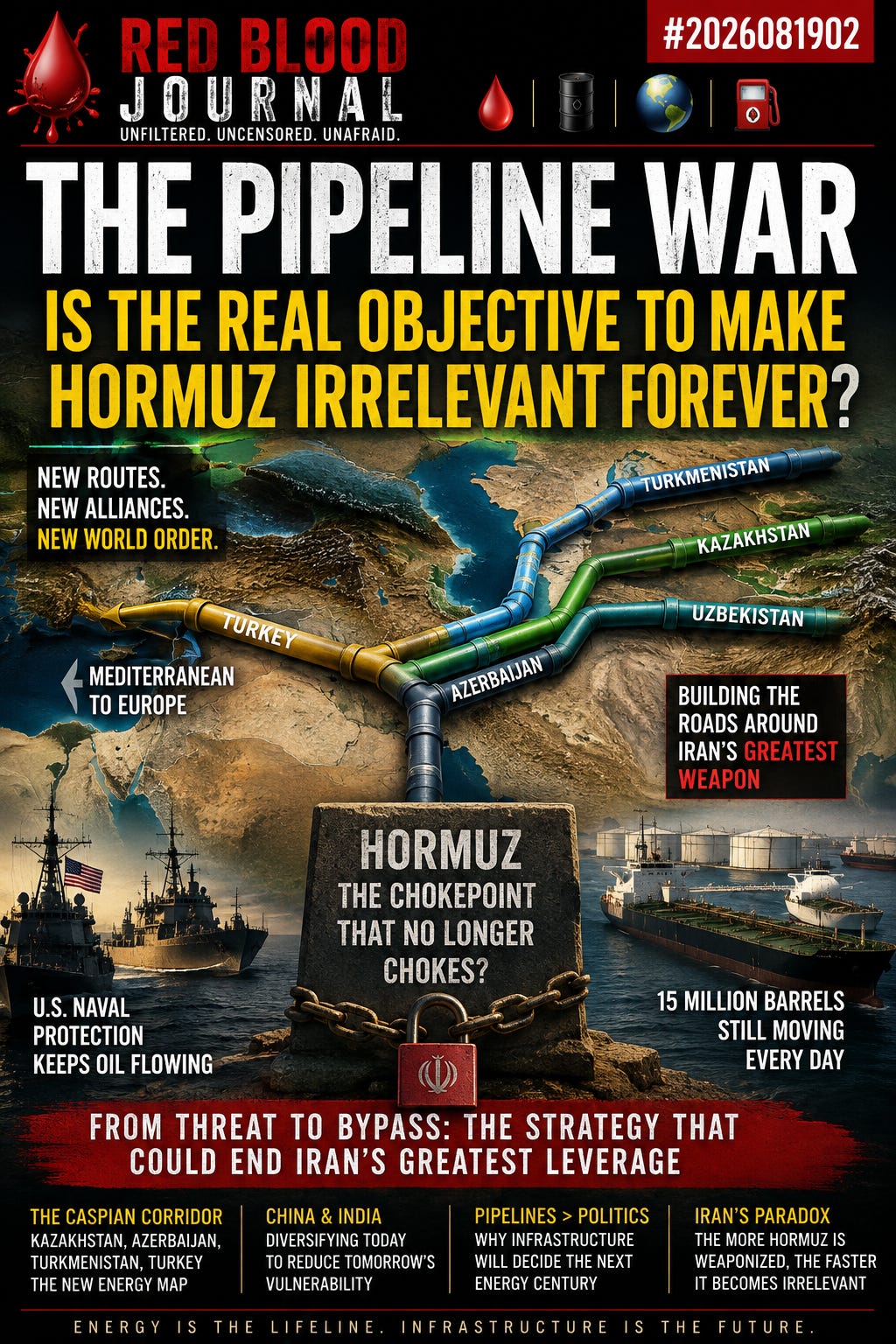
🩸 🛢️ 🗺️ 🚏 #2026081902 — The Pipeline War — Is the Real Objective to Make Hormuz Irrelevant Forever?
For decades, the Strait of Hormuz has been described as one of Iran’s greatest strategic weapons.
The logic was simple.
If Iran were ever pushed too far, Tehran could threaten the narrow waterway through which a massive share of the Persian Gulf’s oil exports travel. Markets would panic. Tankers would stop. Insurance costs would explode. Oil prices would surge. The world economy would begin feeling the consequences almost immediately.
That threat gave Iran leverage far beyond the size of its economy.
But there is another possibility worth examining:
What if the struggle over Hormuz is no longer primarily about keeping the Strait open?
What if the deeper objective is to make sure that, one day, Hormuz does not matter nearly as much as it does today?
The Weapon That Works Only While Everyone Needs It
A strategic chokepoint is powerful because alternatives are limited.
Hormuz matters because Persian Gulf producers historically have had little choice but to move enormous quantities of oil through a narrow maritime corridor.
Iran therefore never needed to permanently close the Strait.
The threat itself could be enough.
Every crisis reminded Washington, Europe, China, Japan, India and the Gulf states of the same vulnerability:
A relatively small geographic point could affect the global energy system.
But every time a weapon is used—or seriously threatened—its target receives another incentive to build defenses against it.
That may be exactly what is happening now.
The New Question
The source material behind this report raises a provocative theory:
Iran may have attempted to weaponize Hormuz only to accelerate the international effort to reduce dependence on Hormuz.
The argument goes further.
Observers cited in the material claim that years of American investment and strategic planning involving energy routes through Kazakhstan, Uzbekistan, Turkmenistan, Azerbaijan and Turkey may eventually create alternatives that weaken both Hormuz and Bab el-Mandeb as energy chokepoints.
If that interpretation is correct, the struggle is no longer simply:
Who controls Hormuz?
The larger question becomes:
Who controls the world after Hormuz becomes less important?
Iran’s Strategic Paradox
Suppose Iran threatens to close Hormuz.
In the short term, that creates leverage.
But the stronger the threat becomes, the stronger the incentive becomes for every oil-producing and oil-consuming country to find another route.
Pipelines.
Alternative ports.
Expanded terminals.
Caspian corridors.
Saudi and Emirati bypass infrastructure.
New tanker routes.
Additional storage capacity.
Alternative suppliers.
Greater production outside the Persian Gulf.
Even electrification and energy diversification become part of the strategic response.
The more credible Iran makes the Hormuz threat, the more money the world has reason to spend destroying the usefulness of that threat.
That produces a strange strategic equation:
Iran’s most powerful weapon may become weaker every time Iran demonstrates why the world should fear it.
What the Current Hormuz Situation Suggests
The source material claims that a large portion of recent shipping has moved through the Omani side of the Strait.
It cites Kpler data suggesting that more than 80 percent of vessel crossings during a recent two-week period used the Oman route, while ships increasingly relied upon promises of American naval protection.
The same material cites U.S. Energy Secretary Chris Wright claiming that oil continues leaving the Gulf at substantial volumes despite the confrontation—roughly 15 million barrels per day when maritime exports and alternative infrastructure are combined.
These are claims that deserve independent verification before being treated as settled facts.
But strategically, the question they raise is more important than any individual number.
If the world discovers that oil can continue moving while Iran attempts to exert pressure over Hormuz, then something fundamental changes.
The perceived power of the threat declines.
Oil Prices Are Part of the Battlefield
The source makes another interesting argument.
If Hormuz were effectively shut down, one would expect an enormous disruption in oil markets.
Instead, the material says Brent crude remained around $91 per barrel on August 18, while U.S. crude was around $84.
The narrator interprets this as evidence that the Strait has not been successfully closed.
But there is a broader implication.
A chokepoint has psychological power because markets believe disruption will be catastrophic.
If markets begin believing that the United States and Gulf producers can maintain substantial energy flows regardless of Iranian action, Iran loses something even before losing physical control.
It loses market credibility.
And strategic weapons depend heavily on credibility.
From Protecting Hormuz to Replacing Hormuz
There are two ways to defeat a chokepoint strategy.
The first is military:
Keep the chokepoint open.
Escort vessels.
Destroy mines.
Suppress coastal missile batteries.
Protect shipping lanes.
The second is structural:
Make the chokepoint unnecessary.
The second strategy takes longer.
But if successful, it is far more permanent.
A missile battery can be rebuilt.
A minefield can be restored.
A naval confrontation can return.
But once pipelines, export terminals and alternative supply networks permanently reroute energy flows, geography itself begins losing its political value.
That is why the pipeline question may ultimately matter more than the naval battle.
Look North: The Caspian Connection
The source specifically points toward years of investment around the Caspian region.
Kazakhstan.
Turkmenistan.
Azerbaijan.
Uzbekistan.
Turkey.
These countries sit within an enormous emerging puzzle of oil, gas, pipelines, transit corridors and competing geopolitical interests.
Much of this infrastructure does not directly replace Persian Gulf production.
But that may not be necessary.
Energy security does not require replacing every barrel passing through Hormuz.
It only requires reducing dependence enough that closing Hormuz no longer produces immediate global panic.
Imagine the difference between:
20 percent of global vulnerability concentrated in one corridor
and
that vulnerability distributed among multiple routes, suppliers, ports and pipelines.
The second system is dramatically harder to blackmail.
China Has the Same Problem
China complicates the story.
Beijing has often benefited from inexpensive Iranian energy.
But China also depends heavily on stable energy imports.
That means China has two competing interests.
It may benefit from maintaining relations with Tehran.
But it also benefits enormously from having alternative energy corridors that cannot be disrupted by Iran, the United States, or any single maritime confrontation.
The source argues that China is already investing in alternative oil infrastructure.
If so, Iran faces an uncomfortable reality.
Even countries considered Iranian partners have incentives to reduce their dependence on Iran’s greatest strategic pressure point.
The Gulf States Have Even More Reason
Saudi Arabia.
The United Arab Emirates.
Qatar.
Kuwait.
These countries live beside the chokepoint.
For them, Hormuz is not an abstract geopolitical issue.
It is an economic artery.
Any credible Iranian threat to close the Strait effectively reminds Gulf governments that their national income depends partly on infrastructure sitting within reach of Tehran.
So every serious Hormuz confrontation makes pipelines that bypass the Strait more valuable.
Alternative export terminals become more valuable.
Red Sea access becomes more valuable.
Strategic storage becomes more valuable.
Cooperation with the U.S. Navy becomes more valuable.
Iran may therefore be strengthening the very strategic architecture designed to reduce Iran’s influence.
The Bab el-Mandeb Connection
The source also connects Hormuz with Bab el-Mandeb, another critical maritime chokepoint.
That connection matters.
If energy routes merely move from one vulnerable Strait to another, very little has been solved.
A truly resilient energy system requires multiple independent routes.
Persian Gulf.
Red Sea.
Mediterranean.
Caspian.
Turkey.
Indian Ocean.
Pipelines crossing land.
Ports facing different bodies of water.
The objective would not necessarily be eliminating maritime trade.
It would be eliminating the ability of one political actor to threaten the entire system from one geographic position.
What If This Is the Real War?
Military conflicts usually attract attention toward explosions.
Aircraft.
Ships.
Missiles.
Casualties.
Territory.
But infrastructure wars move differently.
A pipeline may take years to build.
A port expansion may receive almost no international attention.
New pumping stations are rarely front-page news.
A shipping agreement between two countries may appear economically boring.
Yet these projects can permanently change geopolitical power.
A missile destroys something.
Infrastructure changes what matters.
That distinction may be critical to understanding the Hormuz struggle.
Iran May Have Walked Into the Classic Resource Trap
Countries with extraordinary geographic advantages sometimes begin believing those advantages are permanent.
But strategic geography has an expiration date whenever technology provides alternatives.
The Suez Canal was once practically indispensable.
Railroads changed trade.
Aircraft changed transportation.
Pipelines changed energy.
LNG changed natural-gas markets.
Shale changed American energy dependence.
Renewables are changing electricity systems.
New shipping corridors may change trade again.
Hormuz cannot physically disappear.
But its strategic monopoly can.
The Most Dangerous Outcome for Tehran
The worst outcome for Iran may therefore not be an American victory inside the Strait.
It may be something quieter.
Ships continue sailing.
Alternative routes expand.
Gulf pipelines gain capacity.
Caspian projects expand.
China diversifies.
India diversifies.
American energy production remains significant.
Markets become accustomed to Iranian threats.
Insurance markets learn how to price the risk.
Navies develop permanent escort procedures.
And slowly—
Hormuz stops frightening the world.
At that point Iran could still possess the Strait geographically while having lost much of it strategically.
Did Iran Give Washington the Justification?
This is where the theory becomes especially interesting.
Governments often struggle to justify extremely expensive infrastructure until a crisis demonstrates why it is necessary.
Iran threatening Hormuz may supply exactly that justification.
Every threatened tanker becomes an argument for another pipeline.
Every mine becomes an argument for an alternative terminal.
Every missile becomes an argument for diversified supply.
Every threatened closure becomes another presentation slide explaining why billions of dollars should be spent making Hormuz less important.
If that process accelerates, Iran may ultimately discover that it did not merely fail to close Hormuz.
It helped finance the political argument for replacing it.
But There Is an Important Counterargument
Hormuz cannot easily become irrelevant.
The Persian Gulf contains enormous petroleum reserves.
Major producers have invested trillions of dollars in production infrastructure designed around Gulf export routes.
Building enough pipeline capacity to replace maritime transport would be enormously expensive.
Alternative routes introduce their own vulnerabilities.
Pipelines can be sabotaged.
Ports can be attacked.
Transit countries can become unstable.
And rapidly growing Asian energy demand could preserve Hormuz’s importance even if alternatives expand.
Therefore the more realistic scenario is probably not:
Hormuz becomes irrelevant.
It is:
Hormuz becomes less decisive.
That difference matters.
Iran does not need to lose all leverage for the strategic balance to change.
It only needs to lose enough leverage that threatening the Strait no longer produces immediate global panic.
The Trump Question
The source eventually asks the question directly:
If Trump has stopped seeking negotiations, could it mean Washington believes it has already achieved something strategically important?
The material argues that the United States may now believe it can protect substantial shipping, maintain oil flows and prevent Iran from using Hormuz as decisive leverage.
That interpretation remains a theory.
But it deserves attention.
Because if Washington believes the energy weapon has been neutralized, the negotiating equation changes dramatically.
Iran loses one of the strongest cards it has traditionally held.
The Pipeline War
Perhaps this is why the future of this confrontation should not be measured only by missiles fired or ships sunk.
Watch the pipelines.
Watch the Caspian.
Watch Azerbaijan.
Watch Kazakhstan.
Watch Turkmenistan.
Watch Turkey.
Watch Saudi Arabia’s cross-country infrastructure.
Watch Emirati bypass capacity.
Watch Chinese investments.
Watch new ports.
Watch export terminals.
Watch insurance rates.
Watch tanker routes.
Watch which governments quietly sign long-term energy agreements.
Those may reveal more about the final outcome than tomorrow’s battlefield map.
The Red Blood Perspective
The strongest interpretation is not that America necessarily began a war specifically to eliminate Hormuz’s importance.
The source does not establish that.
But the possibility that the confrontation accelerates an already existing strategic movement toward alternative energy corridors is much more plausible and much more important.
That distinction matters.
There does not need to be one secret master plan.
Governments, corporations and energy consumers all respond to incentives.
If Iran demonstrates repeatedly that Hormuz is dangerous, the world has an incentive to reduce its exposure.
The outcome can resemble a coordinated strategy even when many independent actors are simply protecting themselves.
And that may ultimately be more powerful than conspiracy.
Ocean of Love and Positivity Perspective
There is also a lesson beyond Iran and America.
Power built entirely on another person’s vulnerability is temporary.
The more that vulnerability is exploited, the more determined the other side becomes to escape it.
This applies to governments.
Businesses.
Relationships.
Economies.
And individuals.
Sustainable strength does not come from keeping others dependent.
It comes from becoming valuable enough that others voluntarily remain connected.
Iran possesses extraordinary geography.
Energy.
History.
Human talent.
Culture.
Trade routes.
Access to Central Asia.
Access to the Persian Gulf.
Access to the Caspian.
A democratic and economically integrated Iran would not need to threaten Hormuz to matter.
It could become the bridge connecting the very regions now searching for ways around it.
That may be the greatest irony of the pipeline war.
Iran’s geography could make it one of the world’s greatest connectors.
But geography used as a weapon encourages everyone else to build a road around it.
In an Ocean of Love and Positivity.
🩸🌊✨ Fantastic!
🚏
The Pipeline War: Replacing the Strategic Monopoly of Hormuz
Aug 19, 2026
The provided text explores the shifting geopolitical dynamics surrounding the Strait of Hormuz, traditionally considered Iran’s most potent strategic asset for disrupting global energy markets. It suggests that persistent threats to this maritime chokepoint have inadvertently accelerated international efforts to develop alternative infrastructure, such as pipelines and corridors through the Caspian region and Turkey. By demonstrating the vulnerability of the Strait, Iran provides global powers and regional neighbors with a powerful incentive to invest in bypass routes that diminish the waterway’s importance. Consequently, the true conflict is described as a “Pipeline War” where the ultimate goal is to achieve structural energy security that renders geographic blackmail ineffective. This strategic evolution implies that the power of a chokepoint is not permanent, as technological and infrastructural diversification can eventually neutralize a geographic monopoly. Ultimately, the source argues that Iran’s most formidable weapon may be losing its efficacy as the world learns to function without total dependence on a single narrow passage.


