


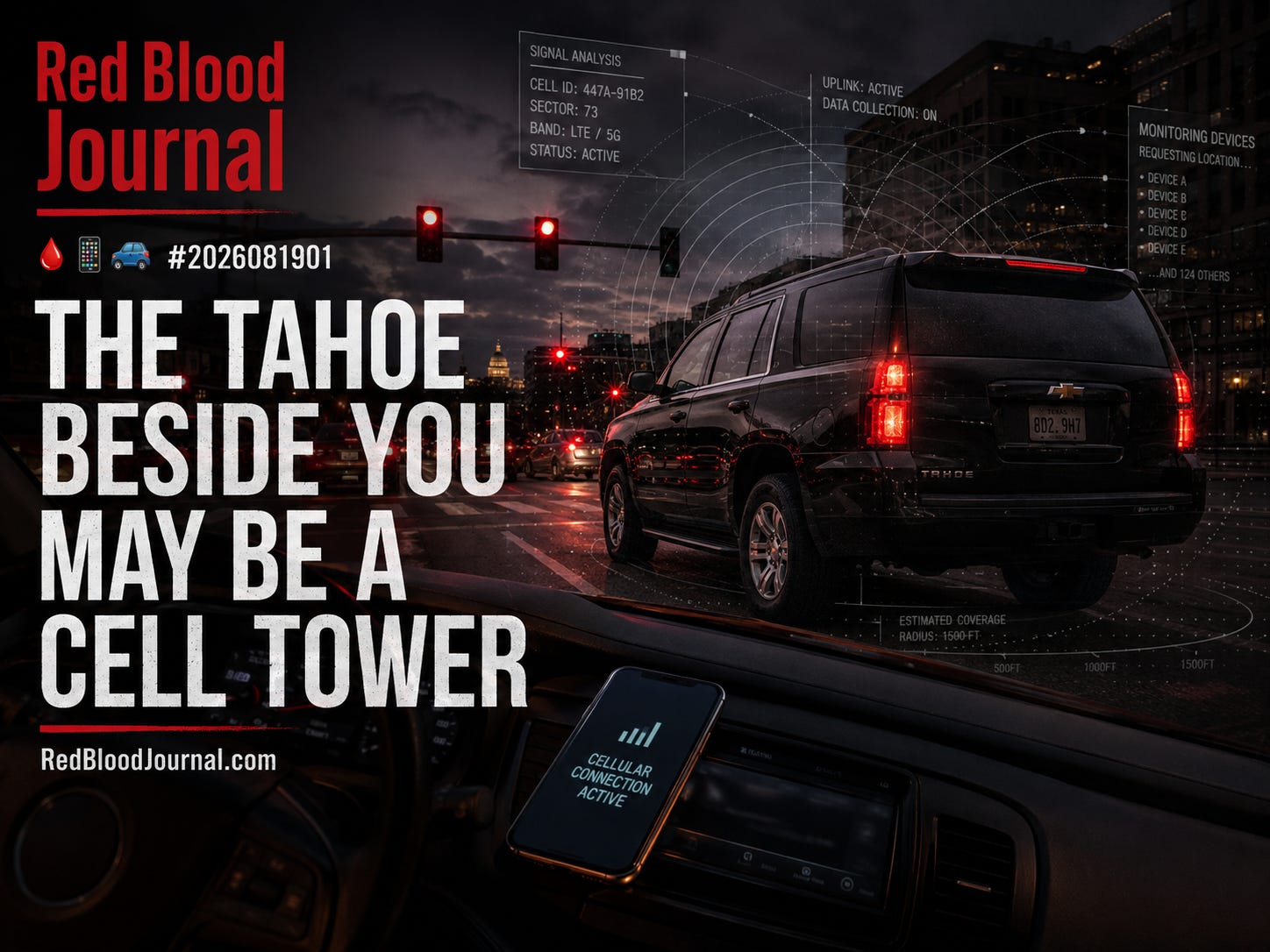
🩸 📱 🚙 🕵️♂️ #2026081901 — The Tahoe Beside You May Be a Cell Tower
When the Police Vehicle Does Not Need to Stop You to Know Your Phone Is There
RedBloodJournal.com
Picture the most ordinary scene imaginable.
A driver is stopped at a red light. Music is playing. A phone is sitting on the center console. Beside the car is an ordinary-looking Chevrolet Tahoe.
Nothing happens.
No officer approaches.
No lights flash.
No one asks for identification.
And yet the phone may have already identified itself.
That is the disturbing scenario described in material reviewed for this report: a vehicle disguised as an ordinary SUV functioning as a mobile cellular-surveillance platform capable of impersonating cellular infrastructure and interacting with nearby phones.
The important part is no longer science fiction.
Texas has actually purchased the equipment.
The $4.4875 Million Purchase
Documents reported in 2026 show that the Texas Department of Public Safety approved a package totaling $4,487,500 involving four 2026 Chevrolet Tahoes and surveillance equipment manufactured by Cognyte.
The itemized purchase included:
Four Chevrolet Tahoes — $600,000
Four FalcoNet Core Systems — $2.85 million
An additional unlicensed FalcoNet core system — $200,000
Four Delta 5G perpetual licenses — $280,000
FalcoNet Backpack Core V2 equipment — $355,500
Antenna equipment — $27,000
Cognyte PA Ranger — $105,000
Additional backpack-system equipment — $70,000
Total:
$4,487,500.
So the sensational part of this story is not that Texas bought four million-dollar Chevrolet Tahoes.
It didn’t.
The vehicles themselves represented about $600,000 of the transaction.
The extraordinary expense was what was going inside them.
The Cell Tower That Drives Around
The central technology is called FalcoNet.
The manufacturer’s purchasing documentation describes equipment capable of operating across 2G, 3G, 4G and 5G, including native 5G software for identifying, capturing and locating devices.
This belongs to a broader family of technologies commonly called cell-site simulators, IMSI catchers, or—after one famous commercial product—Stingrays.
The principle is remarkably simple.
A cellphone must communicate with cellular infrastructure.
A cell-site simulator pretends to be part of that infrastructure.
Traditional systems can induce nearby phones to communicate with the simulator, allowing investigators to identify or locate devices. Privacy organizations have documented this fundamental behavior for years.
The difference now is mobility, sophistication and scale.
The tower doesn’t have to stand on a hill anymore.
The tower can be parked beside you.
And Then There Is the Backpack
Perhaps the most consequential item isn’t mounted in a Tahoe at all.
The Texas procurement includes a FalcoNet Backpack Core V2, described in the purchasing material as supporting multiple cellular technologies including 2G, 3G, 4G and 5G.
The source material imagines what that means operationally:
An officer could leave the vehicle and carry the system into a crowded building, shopping center or demonstration.
That possibility changes the surveillance equation.
A fixed surveillance system watches a location.
A surveillance vehicle follows locations.
A backpack follows people.
The Problem of Everyone Standing Nearby
There is an important distinction between traditional targeted surveillance and a cell-site simulator.
Suppose police have probable cause to investigate one person.
A conventional warrant might authorize authorities to obtain specific information associated with that person or device.
But a radio transmitter cannot necessarily ask:
“Will only the suspect’s telephone please respond?”
Nearby devices may interact with the system too.
That creates what civil-liberties organizations describe as the dragnet problem: information may be collected from devices belonging to people who are not suspected of anything. The Electronic Frontier Foundation argues that this indiscriminate characteristic creates serious Fourth Amendment concerns.
Courts have already confronted versions of the issue.
In State of Maryland v. Andrews, for example, an appellate court held that warrantless use of a cell-site simulator to locate a suspect violated the Fourth Amendment.
The federal government has also operated under policies requiring warrants for cell-site-simulator use in most circumstances, although exceptions and differences between federal, state and local practice remain important.
So the central legal question is not necessarily:
Can police ever use this technology?
They can.
The harder question is:
What happens to everybody else’s phone while they do?
The Emergency Question
There is another part of the Texas transaction worth examining.
Reports based on the procurement documents say Texas DPS processed the acquisition using an emergency purchasing justification, citing risks to personnel safety, public safety, operational readiness and mission success if procurement were delayed.
That does not by itself prove anything improper.
Law-enforcement agencies legitimately acquire technologies rapidly when operational circumstances demand them.
But surveillance equipment produces an unusual governance problem.
The public may not know precisely:
where it is deployed,
how often it is deployed,
what constitutes sufficient authorization,
how incidental data is handled,
how long information is retained,
whether identifiers belonging to innocent bystanders are immediately deleted,
which agencies may access the information,
or whether collected identifiers can later be compared against other databases.
Those questions matter more than the Tahoe.
The Million-Dollar Question Isn’t the Vehicle
The easy headline is:
“Texas buys $1 million spy trucks.”
The deeper story is different.
The United States appears to be entering an era in which sophisticated telecommunications interception equipment can become ordinary mobile law-enforcement infrastructure.
Not a secret room.
Not necessarily a surveillance van covered with antennas.
Not a helicopter hovering overhead.
A Chevrolet Tahoe.
A backpack.
A vehicle parked at a traffic light.
That is a profound change because surveillance becomes increasingly difficult for the ordinary citizen to recognize.
What the Evidence Does Not Establish
There is also a danger of turning legitimate surveillance concerns into claims the documents do not prove.
The procurement documents establish the purchase of powerful cellular-identification and location technology.
They do not, by themselves, establish that Texas police are indiscriminately monitoring every citizen they pass.
They do not establish that every Tahoe equipped with FalcoNet continuously harvests every nearby telephone.
They do not establish that officers can automatically read the contents of encrypted Signal or WhatsApp conversations.
And they do not establish that every deployment occurs without judicial authorization.
Those are separate questions requiring deployment records, operating policies, warrants, retention policies and audit records.
That distinction matters.
The technology is real.
The capability deserves scrutiny.
But capability and documented use are not the same thing.
Encryption Doesn’t Solve the Entire Problem
Modern end-to-end encryption remains extremely important.
Applications using properly implemented end-to-end encryption can protect message content even when communications infrastructure is hostile.
But encryption addresses only one layer.
A surveillance system may be interested not in what was said, but in:
which device exists, where it is, when it appeared, and where it moved.
A sealed envelope can protect the letter.
It does not necessarily make the person carrying the envelope invisible.
That is why metadata and location surveillance deserve their own discussion.
The Constitutional Question Hidden Inside the Tahoe
The Fourth Amendment was written centuries before smartphones:
protection against unreasonable searches and seizures.
The technology changes.
The underlying question does not.
How much information about an innocent citizen should government be permitted to collect while searching for somebody else?
That is where the debate belongs.
Not:
Police versus criminals.
Not:
Technology versus progress.
But:
Targeted investigation versus generalized surveillance.
A society can support legitimate law enforcement while simultaneously demanding that powerful investigative tools remain targeted, documented and subject to meaningful oversight.
Those positions are not contradictory.
They are precisely why constitutional limits exist.
What Should Be Investigated Next
The purchase order is only the beginning of the story.
The more revealing documents would be:
Deployment logs.
How often has FalcoNet been activated?
Warrant records.
What legal authorization is required before deployment?
Retention rules.
What happens to identifiers belonging to innocent phones?
Deletion procedures.
Are non-target devices automatically discarded?
Database integration.
Can captured identifiers be compared against other state or federal systems?
Geographic deployment.
Are the systems used primarily for serious criminal investigations, border operations, missing persons, protests, immigration enforcement or something else?
Audit trails.
Can an independent reviewer determine afterward exactly who activated the system, why, for how long and what happened to the resulting data?
Those answers would tell far more than the price tag.
The Red Blood Perspective
The most remarkable part of this development may be its invisibility.
Twenty years ago, mass surveillance looked like surveillance.
Cameras were visible.
Antennas were visible.
Police vehicles looked like police vehicles.
The emerging generation can disappear into ordinary life.
A family SUV.
A backpack.
A radio signal nobody can see.
There may be completely legitimate reasons for law enforcement to possess such capability. Kidnappings, terrorism, violent fugitives and other emergencies can create circumstances in which rapidly locating a cellphone can save lives.
That argument deserves to be heard.
But extraordinary capability requires extraordinary transparency precisely because the citizen cannot detect when the capability is being exercised.
The question should therefore never be merely:
“Do we trust today’s police officer?”
Institutions outlive individuals.
The better question is:
“Would we be comfortable giving this capability to every future government?”
That is the constitutional stress test.
The Ocean of Love and Positivity Perspective
Technology itself has no morality.
A radio signal does not know whether it is saving a kidnapped child or cataloging innocent citizens.
The morality enters through the consciousness of the people controlling it.
A healthy society should not require blindness from its citizens in exchange for safety.
Nor should it require blindness toward legitimate dangers in the name of privacy.
Both can exist:
security with boundaries,
technology with transparency,
law enforcement with accountability,
and citizens who remain citizens rather than permanently observable subjects.
The Tahoe beside us may simply be another Tahoe.
But now that society knows what can be hidden inside one, the proper response is not paranoia.
It is knowledge.
Because a free population does not need to fear every machine.
It needs to understand the machines powerful institutions are allowed to use.
In an Ocean of Love and Positivity.
🩸🌊✨ Fantastic!
🕵️♂️
Texas Mobile Surveillance and the Rise of Cell-Site Simulators
Aug 19, 2026
The state of Texas recently invested over $4 million in advanced cellular-surveillance technology disguised within ordinary Chevrolet Tahoes and portable backpacks. This equipment, specifically the FalcoNet system, functions as a mobile cell-site simulator that can identify and track mobile devices across 5G and older networks. While these tools assist in legitimate law enforcement operations, they raise significant Fourth Amendment concerns regarding the indiscriminate collection of data from innocent bystanders. The source emphasizes that the true issue is not the cost of the vehicles, but the invisible nature of the surveillance and the lack of public transparency. Ultimately, the text argues for meaningful oversight to ensure that powerful investigative capabilities do not evolve into generalized mass surveillance.


