


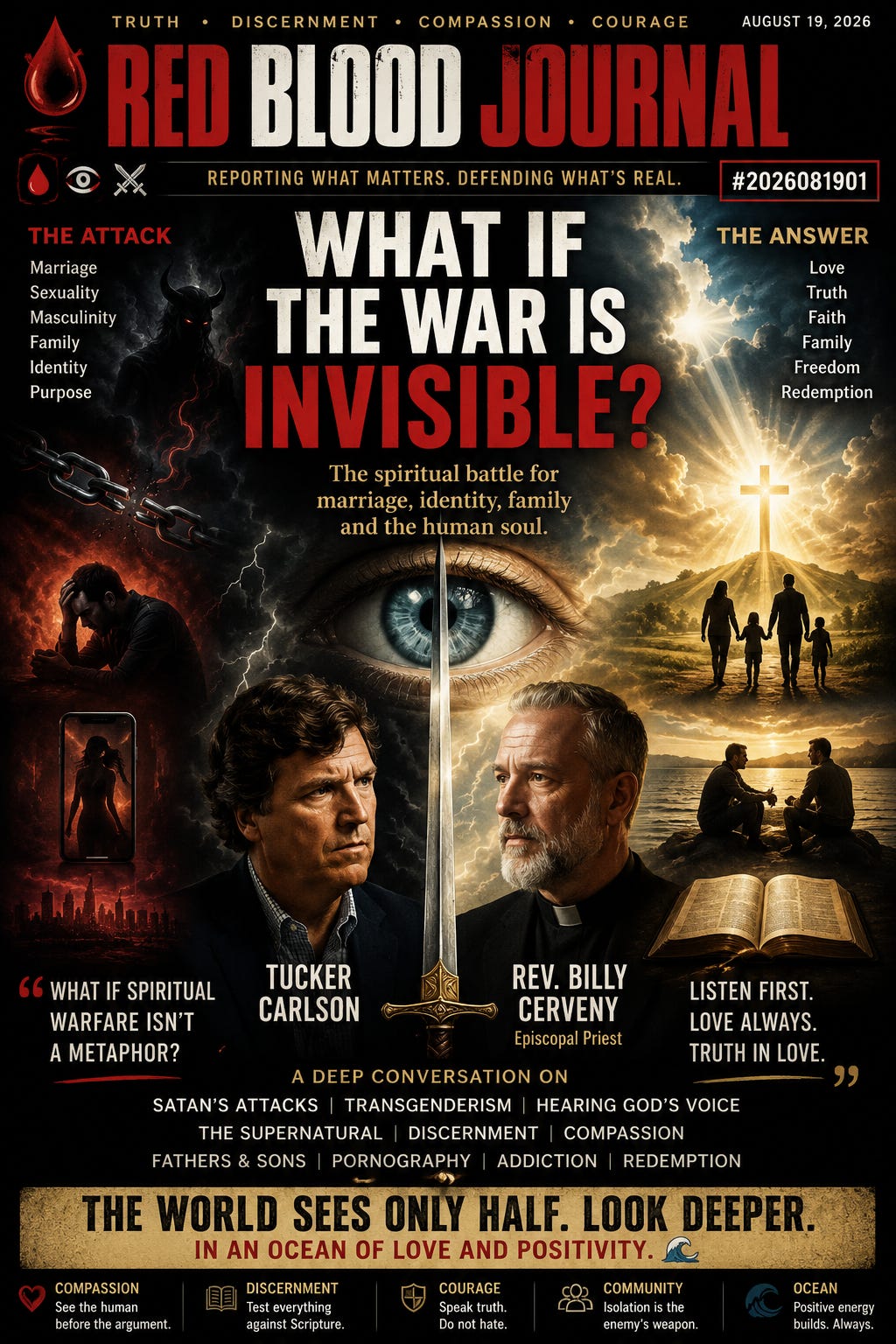
🩸 👁️ ⚔️ #2026081901 — What If the War Is Invisible?
Tucker Carlson, Rev. Billy Cerveny, and the Question Modern Society Rarely Asks
RedBloodJournal.com
Most modern arguments begin with something visible.
A broken marriage.
Pornography.
Addiction.
Gender confusion.
Loneliness.
Depression.
Violence.
Loss of meaning.
Political division.
Cultural collapse.
Then everyone begins arguing about the cause.
Psychology.
Economics.
Trauma.
Technology.
Politics.
Religion.
Social media.
Capitalism.
Government.
Family structure.
But Tucker Carlson’s August 17, 2026 conversation with Rev. Billy Cerveny asks a much older and considerably stranger question:
What if some of what humanity is fighting cannot be seen?
Not metaphorically.
Literally.
That is the doorway through which nearly the entire conversation passes.
And once that doorway opens, marriage, sexuality, masculinity, transgenderism, pornography, addiction, nature, psychedelics, spiritual experiences and even the voice inside one’s own head become parts of a much larger question.
Is human life taking place only in the material world we can see?
Or are we living inside something much bigger?
The Curtain
Cerveny describes human beings as spiritual creatures living on one side of a kind of curtain.
On this side is the visible world:
Bodies.
Buildings.
Jobs.
Families.
Politics.
Money.
Pleasure.
Pain.
The measurable universe.
But in his Christian understanding, another reality exists beyond ordinary perception—God, angels and rebellious spiritual forces.
He describes creation as originally involving an overlap between heaven and earth, with humanity existing in direct relationship with God. He argues that separation entered through the brokenness described in Genesis.
Whether one accepts that theology or rejects it completely, the philosophical consequence is enormous.
Because if Cerveny is right, then human beings may be trying to diagnose some problems using only half the available map.
The Question Tucker Keeps Asking
Carlson repeatedly returns to essentially the same challenge:
What if spiritual warfare is not a metaphor?
The phrase has become common in religious and political conversation.
But Cerveny does not appear to use it figuratively.
He speaks of Satan, demons and demonic forces as actual realities within an unseen spiritual conflict.
That immediately changes the interpretation of ordinary human behavior.
A destructive addiction may still involve brain chemistry.
A failing marriage may still involve communication.
Pornography may still involve technology and commercial exploitation.
Identity crises may still involve psychology.
But Cerveny adds another possible layer.
A spiritual one.
That distinction is central to the entire discussion.
How Would an Invisible Enemy Attack?
Cerveny offers one of the interview’s clearest propositions:
Look at what is being attacked.
According to his theology, the areas experiencing the greatest spiritual assault are often the things God values most.
He points specifically toward:
marriage
sexuality
masculinity and femininity
family
human identity
humanity’s relationship with God
He connects pornography, addiction and marital destruction with this larger spiritual framework.
His reasoning is straightforward.
If something wanted to destroy humanity without visibly attacking humanity, it would not necessarily attack the body first.
It might attack the relationships that hold human beings together.
Marriage.
Family.
Identity.
Meaning.
Trust.
Self-control.
Purpose.
The individual might remain alive while the structure around the individual slowly collapses.
That is the hypothesis.
Not proven fact.
Not scientific conclusion.
A theological interpretation.
But it is the central interpretation being presented.
Marriage as a Battlefield
Marriage becomes one of Cerveny’s most important examples.
He argues that marriage did not originate merely as a social contract invented by civilization.
Within the Genesis framework, he describes it as part of the original design of human existence.
Therefore, if marriage is something God values deeply, Cerveny reasons that it would logically become a major target of spiritual attack.
But the enemy in his description does not necessarily arrive dramatically.
No smoke.
No horns.
No supernatural apparition.
It may arrive through something considerably more ordinary:
Selfishness.
Pride.
Resentment.
Secret lives.
Pornography.
Adultery.
Disconnection.
Silence between two people who once loved each other.
That may be one of the more interesting elements of Cerveny’s position.
The supernatural battle, if it exists, may look completely natural.
The Voice That Sounds Like You
This creates another uncomfortable possibility.
Cerveny suggests deception may not sound foreign.
It may sound familiar.
Like one’s own thoughts.
The temptation does not necessarily announce:
Hello. I am evil.
Instead it may sound like:
You deserve this.
She doesn’t understand you.
He doesn’t appreciate you.
Just once.
Nobody will know.
You need this.
You are the victim.
You should be angry.
If spiritual manipulation exists, the most effective version would presumably be the version that cannot easily be distinguished from one’s own internal dialogue.
That idea makes the question of discernment crucial.
Then How Would Anyone Know It Is God?
This is where the conversation avoids one of the largest dangers created by supernatural thinking.
If everyone simply claims:
God told me.
Then anything becomes possible.
Wars have been justified that way.
Cult leaders have spoken that way.
Political movements have spoken that way.
Individuals have committed terrible acts believing—or claiming—to have received divine instruction.
Cerveny does not present personal feeling as sufficient evidence.
Instead, he argues that purported spiritual guidance should be tested against Scripture.
He explicitly says that pastors themselves are not Scripture and that religious claims should be measured against the biblical text rather than accepted merely because a leader says them.
He asks essentially:
Is this God speaking—or is it culture, ego, desire or something else?
And his answer is that the claim must be tested.
That becomes an important limitation within his own worldview.
Not every voice is God.
Not every feeling is revelation.
Not every spiritual experience should be trusted.
Pornography: Pleasure or Weapon?
Pornography becomes another major example.
Cerveny does not describe sexuality itself as evil.
Quite the opposite.
He argues that sexuality is something powerful and beautiful within its intended setting.
His metaphor is simple:
Sexuality is like fire.
Fire inside a fireplace provides warmth.
Move the same fire into the middle of the living room and the house may burn down.
He argues that pornography turns sexuality into consumption, separating desire from relationship and directing the individual increasingly inward.
From Cerveny’s perspective, the danger is not merely that someone watches explicit material.
The deeper danger is what repeated consumption might train the person to become.
A consumer of people.
A servant of appetite.
Increasingly isolated.
Increasingly dissatisfied.
Increasingly detached from actual intimacy.
He therefore classifies pornography not simply as an industry or moral problem but as one possible instrument within spiritual warfare.
Again, that is his theological interpretation.
But it presents a question worth separating from theology:
What happens when an entire civilization monetizes human appetite?
Even someone who rejects Cerveny’s supernatural explanation can still ask that question.
Then Comes Transgenderism
The transgender discussion could easily have become the predictable political argument.
It does not.
Cerveny clearly believes male and female are part of God’s created order.
When Carlson asks whether freedom from gender constraints is truly liberation, Cerveny describes the condition as confusion rather than liberation.
That is his theological position.
But what follows is considerably more important than the disagreement itself.
Cerveny immediately shifts from ideology to the human being experiencing it.
He talks about people dealing with profound confusion, isolation and pain.
He criticizes Christians who approach such individuals primarily as opponents in a debate.
Because theological arguments are not taking place in empty rooms.
They are landing on human beings.
Winning the Argument and Losing the Human Being
Cerveny imagines a young person wrestling privately with identity and religious fear.
Questions such as:
Am I rejected?
Does God hate me?
Am I going to hell?
His reaction is not triumph.
It is sadness.
He warns that someone may win a theological argument while emotionally destroying the person standing in front of them.
His stated posture is compassion.
When Tucker asks what he would actually do when encountering someone struggling in this way, Cerveny gives perhaps the least politically useful answer possible:
Listen.
Do not immediately lecture.
Do not begin by correcting.
Do not pretend to listen while preparing an argument.
Become trustworthy.
Earn the right to be heard.
He says changing another person’s heart is ultimately God’s responsibility, not the Christian’s.
This creates an important distinction.
Cerveny rejects transgender theology.
But he also rejects using theological disagreement as permission for cruelty.
That distinction is increasingly rare in political conversation.
The Supernatural Gets Stranger
Toward the end, the discussion moves beyond culture and into direct claims about supernatural experience.
Cerveny talks about what older Celtic Christianity called a thin place—a location or experience where the visible and invisible realms appear unusually close together.
Then the conversation turns toward occult practices and deliberately induced altered states.
Cerveny becomes extremely cautious.
He argues that some supernatural experiences may not merely be inventions of the mind.
They may be encounters with something real.
And not necessarily something benevolent.
He refers to biblical warnings against necromancy, magic and similar practices as warnings not because nothing exists there—but because something might.
That is a remarkable inversion.
Modern skepticism says:
Avoid those things because they are nonsense.
Cerveny’s theology says:
Avoid them because they may not be nonsense.
The Most Dangerous Experience Might Feel Wonderful
Cerveny makes another interesting observation.
If deception exists, why would it initially feel terrible?
A successful trap normally contains bait.
He describes people entering certain spiritual or altered states and feeling:
Enlightened.
Special.
Recognized.
Connected.
Powerful.
Awakened.
He warns that those sensations themselves cannot establish whether the experience is beneficial.
In his interpretation, something may feel like spiritual advancement while gradually pulling the individual away from what he considers the source of spiritual life.
That idea extends far beyond religion.
Human beings routinely confuse:
Pleasure with health.
Attention with love.
Information with wisdom.
Confidence with truth.
Intensity with authenticity.
Perhaps spiritual experience deserves the same caution.
Psychedelics: Cerveny Draws a Line
The conversation does not simply declare every psychedelic experience demonic.
Cerveny specifically admits uncertainty regarding medically supervised psychedelic treatment.
He says he knows people with treatment-resistant depression who apparently benefited from medically directed use and says he does not possess enough medical expertise to make a judgment.
His concern is primarily recreational spiritual exploration—deliberately attempting to cross into another realm.
That distinction matters.
Because without it, the conversation could easily be summarized inaccurately as:
Priest says psychedelics equal demons.
That is not quite what the transcript supports.
His position is more cautious:
Medical treatment is an area where he acknowledges uncertainty.
Intentional supernatural exploration is where he becomes strongly warning.
Fathers, Sons, and Imperfect Men
Interestingly, much of this conversation has nothing to do with Satan.
It is about fathers.
Cerveny reflects on growing up with a father who was an Episcopal bishop and only later understanding the man’s struggles, limitations and humanity.
He argues that a father’s job is not to demonstrate perfection to his son.
The father should instead show what an imperfect man trying to live honorably looks like.
Failure included.
Humility included.
Grace included.
That fits the larger theme.
The cure for human brokenness in Cerveny’s theology is not pretending not to be broken.
It is recognizing it.
Isolation May Be One of the Real Weapons
Another theme runs quietly through the interview:
Isolation.
Cerveny discusses male friendship as a safeguard against men becoming trapped inside distorted perceptions of themselves.
Without healthy relationships, he argues, men can enter a kind of personal echo chamber.
They lose perspective.
Shame increases.
Marriage suffers.
Fatherhood suffers.
Identity becomes unstable.
Healthy male friendships act like mirrors, reflecting the individual back to himself.
This raises another interesting question.
If someone wanted to weaken a population, would isolation be useful?
Separate husbands from wives.
Parents from children.
Men from other men.
Neighbors from neighbors.
Citizens from community.
Then replace those relationships with screens.
The supernatural interpretation is optional.
The social consequences are observable.
Two Possible Readings of the Entire Interview
There are at least two ways to interpret everything Cerveny says.
Interpretation One: The Christian Reading
There is genuinely an unseen spiritual realm.
Good and evil exist beyond human psychology.
Satan seeks to corrupt the things God created.
Marriage, sexuality, identity and family therefore become spiritual battlegrounds.
Human beings need discernment because not every spiritual experience originates from God.
Interpretation Two: The Psychological Reading
“Satan” may represent the ancient language humans developed for recognizable destructive tendencies:
Addiction.
Selfishness.
Pride.
Compulsion.
Deception.
Isolation.
Hatred.
Despair.
Whether a literal supernatural entity exists becomes secondary.
The behavioral warning may remain useful.
There may also be a third possibility.
Both.
A psychological process may be the mechanism through which a spiritual process operates.
That possibility cannot be proven from this interview.
But neither can it simply be disproven by declaring the supernatural impossible.
The question remains philosophical and theological.
The Red Blood Perspective
The most interesting part of this conversation may not be whether Rev. Billy Cerveny is correct about demons.
It may be the possibility that modern civilization has become so committed to material explanations that it sometimes refuses even to ask questions that humanity considered obvious for thousands of years.
Perhaps every destructive human tendency is ultimately chemical.
Perhaps every spiritual experience is neurological.
Perhaps the invisible world exists only inside the human brain.
That remains one possibility.
But confidence is not evidence.
Calling the supernatural impossible does not prove that it is impossible any more than believing in it proves that it exists.
The responsible position may be simpler:
Observe.
Question.
Compare.
Do not surrender reason.
But do not confuse the boundaries of current measurement with the boundaries of reality.
Human beings once believed invisible microorganisms were impossible because they could not see them.
Then they built better instruments.
If another dimension of reality exists, perhaps humanity does not yet possess the instrument required to measure it.
Or perhaps the instrument has been present all along.
Consciousness.
Ocean of Love and Positivity Perspective
There is another way to look at the entire conversation.
Remove Satan.
Remove demons.
Remove Christianity.
Remove transgender politics.
Remove every theological label.
Something remains.
Human beings become healthier when they move toward:
Love.
Connection.
Compassion.
Honesty.
Self-control.
Family.
Friendship.
Forgiveness.
Purpose.
Service.
Nature.
Humility.
And they often become more destructive when they move toward:
Hatred.
Isolation.
Compulsion.
Deception.
Exploitation.
Shame.
Addiction.
Self-obsession.
Perhaps religions describe that movement as good and evil.
Psychology describes it differently.
Philosophy gives it another vocabulary.
The Ocean may describe it even more simply.
Positive energy builds.
Negative energy destroys.
The label may matter less than the direction.
And one statement from Cerveny may therefore travel much farther than Christianity:
Do not begin by attacking the person.
Listen.
Understand.
See the human being before the argument.
Because even if there is an invisible war,
the person standing in front of us does not have to become the enemy.
In an Ocean of Love and Positivity.
🩸🌊✨ Fantastic!
👁️
The Unseen Battlefield: Spiritual Warfare in Modern Society
Aug 19, 2026
This text explores a deep conversation between Tucker Carlson and Reverend Billy Cerveny regarding the potential for unseen spiritual warfare in modern society. Rather than viewing social decay, addiction, and broken relationships through a strictly material lens, the dialogue suggests these issues may stem from a literal supernatural conflict. Cerveny argues that traditional structures like marriage and human identity are under strategic assault by invisible forces that mask their influence within ordinary thoughts and desires. The source emphasizes that while these claims are theological, they highlight a civilizational blind spot caused by an exclusive focus on physical science. Ultimately, the overview advocates for compassion and discernment, suggesting that whether one accepts the supernatural or prefers psychological labels, the focus should remain on human connection and restoration.


