


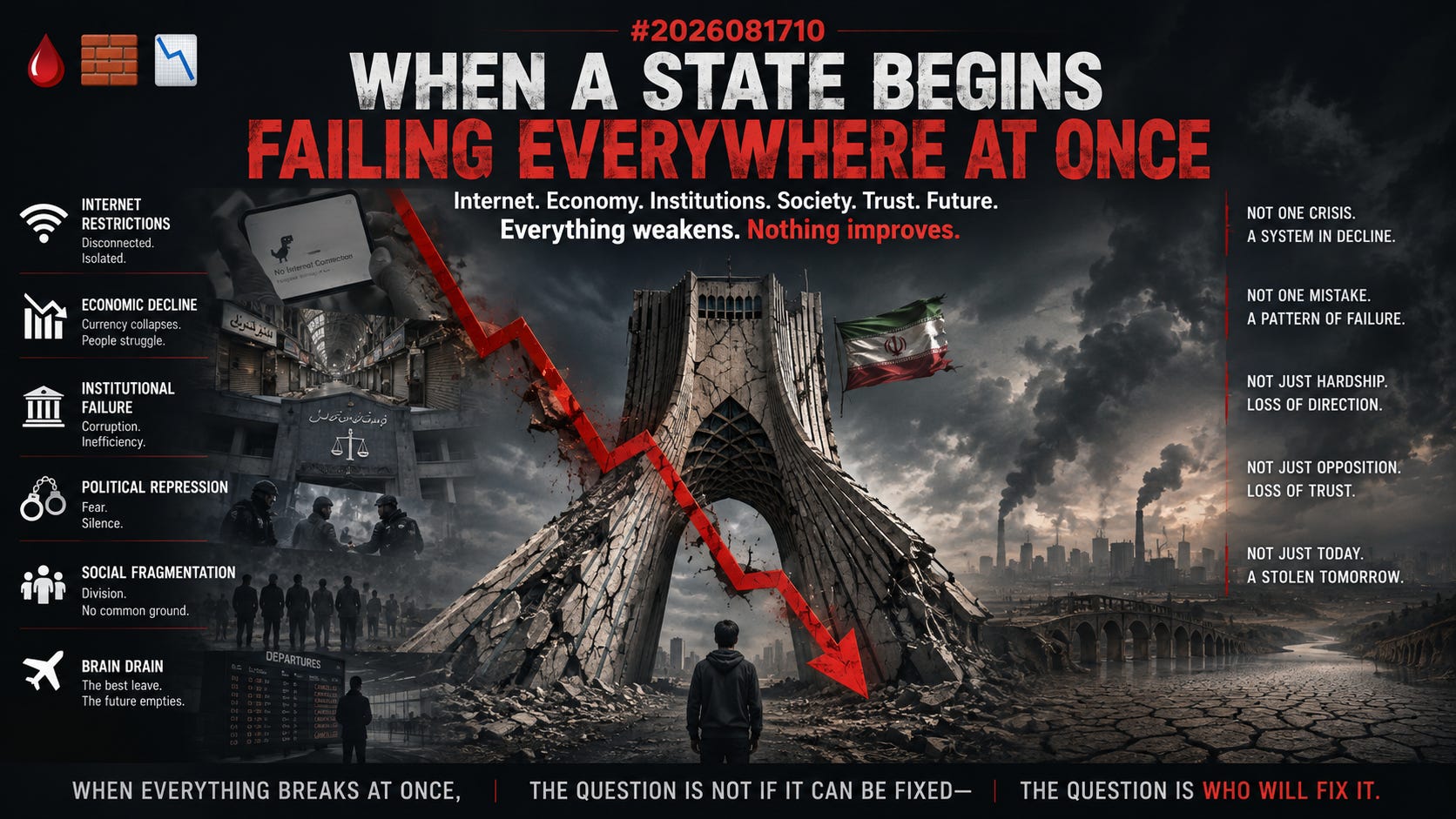
🩸 🧱 📉 #2026081710 — When a State Begins Failing Everywhere at Once
Political repression is dangerous. Economic decline is dangerous. Social fragmentation is dangerous. Institutional exhaustion is something else entirely.
A government can survive a bad economy.
It can survive political protests.
It can survive international isolation.
It can survive corruption.
It can survive censorship.
It can survive public anger.
It can even survive periods in which large parts of the population no longer trust it.
What becomes much harder is surviving when several of those pressures begin appearing at the same time.
The source examined throughout this series ends with an unusually broad diagnosis.
It describes Iran as reaching what the speaker calls a kind of large-scale bankruptcy across nearly every field:
social,
cultural,
political,
economic,
and even sporting life.
More importantly, the speaker says there appears to be little serious capacity or intention to correct the trajectory.
That observation connects nearly every subject examined in the previous reports.
Internet restriction.
Foreign-contact controls.
Academic isolation.
Political repression.
Executions.
Social polarization.
The renewed Pahlavi debate.
Reform versus revolution.
Regional ideology.
Economic survival.
Each may look like a separate crisis.
But perhaps the larger question is whether they are increasingly parts of the same crisis.
What happens when the problem is no longer one failed policy, but a system losing the ability to repair itself?
Countries Rarely Fail in One Place
A functioning state consists of thousands of systems operating simultaneously.
Electricity.
Water.
Telecommunications.
Transportation.
Banking.
Education.
Healthcare.
Law enforcement.
Courts.
Universities.
Trade.
Diplomacy.
Business regulation.
Currency management.
Public trust.
Political legitimacy.
No country performs perfectly in all of them.
Failure in one area does not mean state collapse.
But institutions are interconnected.
When one weakens, others absorb the pressure.
If the economy struggles, families compensate.
If public services decline, private businesses compensate.
If institutions lose credibility, personal networks compensate.
If the currency weakens, citizens hold foreign currency.
If universities weaken, students leave.
If official information becomes unreliable, people seek alternative media.
Society continuously repairs the state around itself.
The danger begins when citizens are being asked to compensate for too many failures simultaneously.
The Internet Is Not Just the Internet
The first report in this sequence examined severe internet disruptions and the possibility of an increasingly isolated Iranian network.
On its own, that is a telecommunications problem.
But telecommunications now touches nearly everything.
Commerce.
Education.
Banking.
Research.
Communication.
Media.
International business.
Family relationships.
Political organization.
When internet reliability deteriorates, the damage spreads outward.
A student cannot simply say:
The internet is slow.
The actual consequence may be:
I cannot apply.
I cannot communicate.
I cannot work.
I cannot publish.
I cannot sell.
I cannot learn.
I cannot leave.
The source describes widespread complaints involving fixed internet, mobile networks and data-center connectivity while also discussing ideas for separating Iran’s internet more substantially from the global network.
That is not merely one broken service.
It touches the infrastructure of modern life.
Then the Law Reaches the Same Border
The second report examined the proposed legislation described as countering foreign infiltration.
The source says the proposal could restrict or regulate interactions involving foreign media, universities, scholarships, research collaboration, embassies and international organizations.
Again, considered alone, that can be classified as national-security policy.
But combined with increasing digital isolation, the pattern changes.
One pressure restricts technical access to the outside world.
Another potentially restricts legal access to the outside world.
Now the same citizen can encounter two borders:
the router,
and the law.
That is where separate failures begin reinforcing one another.
Institutions Can Become Defensive Instead of Productive
Healthy institutions primarily exist to accomplish something.
A university educates.
A court adjudicates.
A telecommunications authority connects.
An intelligence service identifies genuine security threats.
A parliament writes laws.
A ministry administers.
But institutions under prolonged political pressure can gradually change purpose.
Instead of asking:
How do we improve society?
they increasingly ask:
How do we protect the system?
The difference is enormous.
A university becomes a security concern.
An internet connection becomes a security concern.
A foreign conference becomes a security concern.
A social-media comment becomes a security concern.
A protest becomes a security concern.
A political slogan becomes a security concern.
Eventually the government can spend so much energy defending itself that it has less energy left to govern.
The Security-State Paradox
Every government needs security institutions.
But there is a point at which security can begin consuming the state it is designed to protect.
More monitoring requires more personnel.
More restrictions require more enforcement.
More political prisoners require more prisons.
More censorship requires more technical infrastructure.
More foreign restrictions require more approvals.
More prohibited activities require more investigations.
More investigations require more bureaucracy.
Every new control mechanism creates administrative cost.
Meanwhile the ordinary problems remain.
Inflation does not disappear because a social-media user was arrested.
Water does not appear because a journalist was silenced.
Internet infrastructure does not improve because a university collaboration was prohibited.
Economic productivity does not rise because a slogan was criminalized.
The government can become extremely effective at monitoring dissatisfaction while becoming less effective at removing its causes.
The Economy Changes Political Behavior
The source also describes a society dividing according to what people still possess and what they fear losing.
Some become increasingly conservative because their businesses, livelihoods, property or positions make disruption dangerous.
Others become increasingly radical because they believe the current system itself threatens their future.
This is an important symptom of systemic exhaustion.
Economic decline does not merely make people poorer.
It restructures political psychology.
Those still protected become more defensive.
Those excluded become more impatient.
The middle shrinks.
Trust weakens.
Every political event becomes another economic calculation.
The Upper Deck Eventually Gets Wet
The source uses the image of crisis eventually reaching people who previously believed they could remain outside political confrontation.
It describes businesses and people whose interests had encouraged them to prefer stability but who increasingly face danger themselves as conditions worsen.
That is a critical transition.
Systems often survive because deterioration is unequal.
Some neighborhoods suffer first.
Some professions suffer first.
Some generations suffer first.
Some political groups suffer first.
As long as enough people remain protected, they can rationally prefer continuity.
But when deterioration becomes broad enough, the coalition of caution weakens.
The system loses not only opponents.
It begins losing beneficiaries.
When the Past Returns
The renewed Pahlavi debate examined in #2026081706 may also be understood through this framework.
The source describes increasingly visible pro-Pahlavi sentiment and government reactions to likes, comments, slogans and social-media activity associated with Reza Pahlavi.
Why does an old political dynasty become newly relevant?
One possible answer is ideology.
Another is nostalgia.
But there is a third possibility.
Institutional disappointment creates historical comparison.
People begin asking:
Was electricity better?
Was the currency stronger?
Was international access easier?
Was travel easier?
Was economic life more predictable?
Were universities more connected?
Was the country more respected?
Those comparisons may be selective or historically incomplete.
But politically, their reappearance matters.
When citizens begin measuring the present against the system overthrown nearly half a century earlier, the current order has lost control of the historical narrative.
Repression Can Hide Decline Without Fixing It
The source discusses severe punishment of protesters and Saeed Madani’s warning that continued refusal to change could produce a violent revolution.
Repression can reduce visible unrest.
That can create the appearance of recovery.
But consider what repression actually repairs.
Does it strengthen the currency?
Does it improve public services?
Does it improve infrastructure?
Does it restore trust?
Does it persuade young professionals to remain?
Does it reduce brain drain?
Does it improve investment?
Does it rebuild institutions?
If the underlying answers remain no, repression may suppress the indicator while leaving the disease untouched.
A quiet street can coexist with a deteriorating state.
The Emigration Safety Valve
Societies under pressure often possess an unofficial release mechanism:
people leave.
Students leave.
Doctors leave.
Engineers leave.
Entrepreneurs leave.
Researchers leave.
Artists leave.
Families leave.
Political opponents leave.
This reduces immediate pressure.
Someone who might otherwise organize, protest or compete for scarce opportunities disappears from the domestic system.
But emigration also removes exactly the people often needed for recovery.
Human capital.
Entrepreneurial capital.
Professional knowledge.
Scientific expertise.
Tax revenue.
Institutional memory.
A government can therefore become politically safer in the short term while becoming structurally weaker in the long term.
A Country Can Lose Capacity Before It Loses Control
This distinction is essential.
State control and state capacity are not the same thing.
A government may retain strong security control.
It can arrest.
Monitor.
Restrict.
Censor.
Enforce.
But state capacity asks different questions.
Can it provide reliable electricity?
Can it maintain communications?
Can it protect purchasing power?
Can it administer justice efficiently?
Can it retain professionals?
Can it attract investment?
Can it negotiate effectively abroad?
Can it maintain public infrastructure?
Can citizens predict how rules will work tomorrow?
A state may remain powerful in one sense while weakening in another.
That combination can persist for years.
The Government May Still Be Strong
It is important not to confuse broad deterioration with imminent collapse.
The source speaks in highly pessimistic terms, but the material does not establish that the Iranian state is about to disappear.
Governments can survive astonishingly severe economic and social conditions.
They possess institutions.
Security structures.
Revenue.
Patronage.
Administrative systems.
Political networks.
And populations often adapt to circumstances outsiders assume are intolerable.
Therefore words such as “collapse” should be used cautiously.
The more defensible conclusion from the source is narrower:
multiple areas of Iranian life are being described as deteriorating simultaneously, while confidence in internal correction appears weak.
That is different from predicting tomorrow’s collapse.
But it is still serious.
Systemic Failure Is About Feedback
Perhaps the most important feature of a healthy political system is not that it avoids mistakes.
Every government makes mistakes.
The important feature is whether mistakes generate correction.
Bad policy produces criticism.
Criticism produces debate.
Debate produces adjustment.
Elections remove leaders.
Courts block abuses.
Journalists expose failures.
Experts recommend alternatives.
Citizens organize.
Institutions learn.
This is feedback.
A resilient system does not require perfect leaders because it contains correction mechanisms.
A brittle system gradually disables those mechanisms.
Critics are silenced.
Journalists are restricted.
Academics become cautious.
Elections become less meaningful.
Opposition becomes dangerous.
Foreign knowledge becomes suspicious.
Bad news becomes political.
At that point the system may continue receiving information.
It simply becomes increasingly incapable of acting on information that contradicts its preferred story.
When Reporting the Problem Becomes the Problem
This is one of the clearest indicators of institutional exhaustion.
Imagine a water shortage.
A functioning system asks:
Why is water disappearing?
A defensive system may ask:
Who is saying water is disappearing?
Imagine internet failure.
A functioning system asks:
How do we improve capacity?
A defensive system may ask:
Are citizens consuming too much?
Imagine economic anger.
A functioning system asks:
What policy is failing?
A defensive system may ask:
Who is organizing the protest?
The moment criticism itself becomes more threatening than the problem being criticized, correction becomes extremely difficult.
The Blame Cycle
The source’s discussion of internet consumption illustrates this problem.
An AsiaTech executive is quoted arguing that internet is cheap enough that consumers no longer manage usage properly, an explanation the source compares with narratives blaming citizens for excessive water, gas and electricity consumption.
Again, citizens can genuinely waste resources.
Demand management is legitimate.
But repeated blame has political consequences.
If every failing service eventually produces the same explanation—
the people are using too much—
then citizens may begin asking whether they are being governed or blamed.
At some point responsibility becomes circular.
The state manages the system.
The system performs poorly.
The citizen is blamed for the performance.
The citizen becomes angry.
The citizen is blamed for the instability.
The instability justifies more control.
And the cycle repeats.
Regional Policy Comes Back Into the Equation
The previous report examined Iran’s regional strategy and the argument that political resources have been spent on causes in Palestine, Lebanon, Yemen and elsewhere while domestic dissatisfaction grows.
The source explicitly argues that Iranian influence in these regional arenas has contributed to hardship and connects this to broader domestic decline.
That claim is strongly partisan and cannot by itself prove causation.
But it highlights a legitimate systems question.
Every foreign-policy commitment consumes something.
Money.
Attention.
Military capacity.
Diplomatic capital.
Political legitimacy.
When domestic systems are healthy, those costs may be sustainable.
When domestic systems are already stressed, citizens examine foreign commitments differently.
A regional strategy that once looked like strength can begin looking like misallocation.
Bankruptcy Is More Than Money
The word “bankruptcy” used near the end of the source is significant because it is applied beyond economics.
Social bankruptcy.
Cultural bankruptcy.
Political bankruptcy.
The metaphor suggests something broader than financial shortage.
It suggests depleted reserves.
Trust reserves.
Institutional reserves.
Patience reserves.
Legitimacy reserves.
Human-capital reserves.
A country can still function while those reserves decline.
But every new crisis becomes harder to absorb.
That is what reserves are for.
Social Trust Is Infrastructure Too
Roads can be photographed.
Bridges can be measured.
Power plants can be counted.
Trust is invisible.
But trust may be one of the most important infrastructures a country possesses.
Do citizens trust the courts?
Do they trust official statistics?
Do they trust election results?
Do businesses trust regulations?
Do families trust police?
Do researchers trust institutions?
Do political factions trust that losing power will not mean prison?
When trust disappears, everything becomes more expensive.
Contracts require more protection.
Politics requires more force.
Businesses move money abroad.
Families develop exit plans.
Citizens hoard resources.
Rumors outperform official communication.
Trust failure spreads through every institution.
A System Can Become Expensive to Maintain
As trust declines, control becomes more expensive.
More guards.
More surveillance.
More censorship.
More subsidies.
More approvals.
More political patronage.
More enforcement.
More information control.
The state has to actively manufacture behavior that trust once produced voluntarily.
That creates another feedback loop.
More control costs more.
More control creates more resentment.
More resentment requires more control.
Eventually maintaining the political system itself consumes resources that could otherwise improve the society sustaining it.
The Most Dangerous Moment Is Not Necessarily Collapse
The dramatic image is always collapse.
Crowds.
Government buildings.
Leaders fleeing.
Flags changing.
But the more consequential period may occur before that.
Years in which everyone knows something is wrong but nobody knows what replaces it.
Businesses hesitate.
Young people leave.
Officials protect themselves.
Opposition factions fight one another.
Government institutions become defensive.
Investment declines.
Citizens reduce long-term commitments.
This is not collapse.
It is institutional waiting.
A country can lose enormous time inside it.
Can the System Still Correct?
This may be the central unanswered question.
The source’s final speaker says there is no visible serious logic toward reform across the multiple areas of deterioration described.
That is an assessment, not a proven inevitability.
Political systems can change unexpectedly.
Leaders can reverse policy.
Institutions can respond to crisis.
Coalitions can fracture.
External pressure can generate internal adaptation.
The Islamic Republic itself has shown tactical flexibility at many points in its history.
The question is whether tactical adjustment can become structural correction.
That is far harder.
Structural Reform Means Giving Something Up
Real reform requires loss.
Someone loses authority.
Someone loses monopoly.
Someone loses censorship power.
Someone loses economic privilege.
Someone loses immunity.
Someone loses the ability to decide who may participate.
That is why systemic reform is difficult.
Everyone may agree the country needs change.
The disagreement begins when the reform reaches the institution doing the agreeing.
The Difference Between Reform and Survival Reform
There is another possibility.
Governments sometimes reform just enough to survive.
Release some pressure.
Change some officials.
Allow some debate.
Adjust some economic rules.
Negotiate abroad.
Relax a restriction.
Then once danger passes, controls return.
This can extend a system for years.
But survival reform differs from structural reform.
The first asks:
What must we change to remain in power?
The second asks:
What must change for the country to function better, even if we lose power?
That may be the hardest distinction of all.
The Red Blood Perspective
Perhaps the strongest message in this entire sequence is that Iran’s challenges should no longer be examined as isolated headlines.
Internet restrictions are not only about internet.
Foreign-contact laws are not only about espionage.
Executions are not only about punishment.
Monarchist slogans are not only about monarchy.
Economic self-interest is not only about money.
Regional policy is not only about Palestine, Lebanon or Yemen.
Each intersects with the same deeper question:
Does the political system still possess enough flexibility, legitimacy and institutional capacity to correct its own failures?
If the answer is yes, even severe crises can be reversed.
If the answer increasingly becomes no, then every new problem reinforces the others.
That is when deterioration becomes systemic.
A state does not have to collapse to fail its citizens.
Sometimes it simply becomes progressively less able to provide the future they are waiting for.
Ocean of Love and Positivity Perspective
Iran is more than its government.
More than its opposition.
More than its economy.
More than its political history.
A country ultimately survives because millions of people continue repairing it every day.
The engineer who keeps the power on.
The teacher who continues teaching.
The doctor who stays.
The parent who refuses to give up on a child.
The shopkeeper who opens tomorrow.
The researcher who keeps thinking.
The artist who keeps creating.
The citizen who continues imagining something better.
Governments can exhaust institutions.
They cannot easily exhaust an entire civilization.
But rebuilding requires something different from defeating an enemy.
It requires trust.
It requires competence.
It requires humility.
It requires allowing people who disagree to participate.
It requires admitting when something has failed.
And perhaps most importantly, it requires understanding that a government exists inside a country—
the country does not exist inside the government.
Iran’s future will not be saved by proving one faction right.
It will be saved when enough Iranians decide that functioning institutions matter more than winning old arguments.
A nation that has survived empires, invasions, revolutions, sanctions, wars and political upheaval still contains enormous reserves of intelligence, creativity and human strength.
The question is whether those reserves will continue being consumed—
or finally be allowed to rebuild.
In an Ocean of Love and Positivity.
🩸🌊✨ Fantastic!
📉
Systemic Exhaustion and the Paradox of Institutional Failure
Aug 18, 2026
The provided text examines the systemic exhaustion of the Iranian state, arguing that the nation is facing a multifaceted institutional bankruptcy where various social, economic, and political crises are reinforcing one another. Rather than failing in a single area, the government’s capacity to provide basic services and infrastructure is declining while its focus shifts almost entirely toward regime preservation and security control. This defensive posture creates a vicious cycle where the state blames citizens for failures, leading to a loss of public trust and the emigration of vital human capital. The source highlights a critical transition where even previous beneficiaries of the system are affected by the broadening deterioration of modern life. Ultimately, the text suggests that while the state remains powerful enough to maintain security control, it is losing the structural flexibility required to repair itself or meet the needs of its people. Thus, the overarching question is whether the system can transition from tactical survival to genuine reform before its foundational reserves are completely depleted.


