


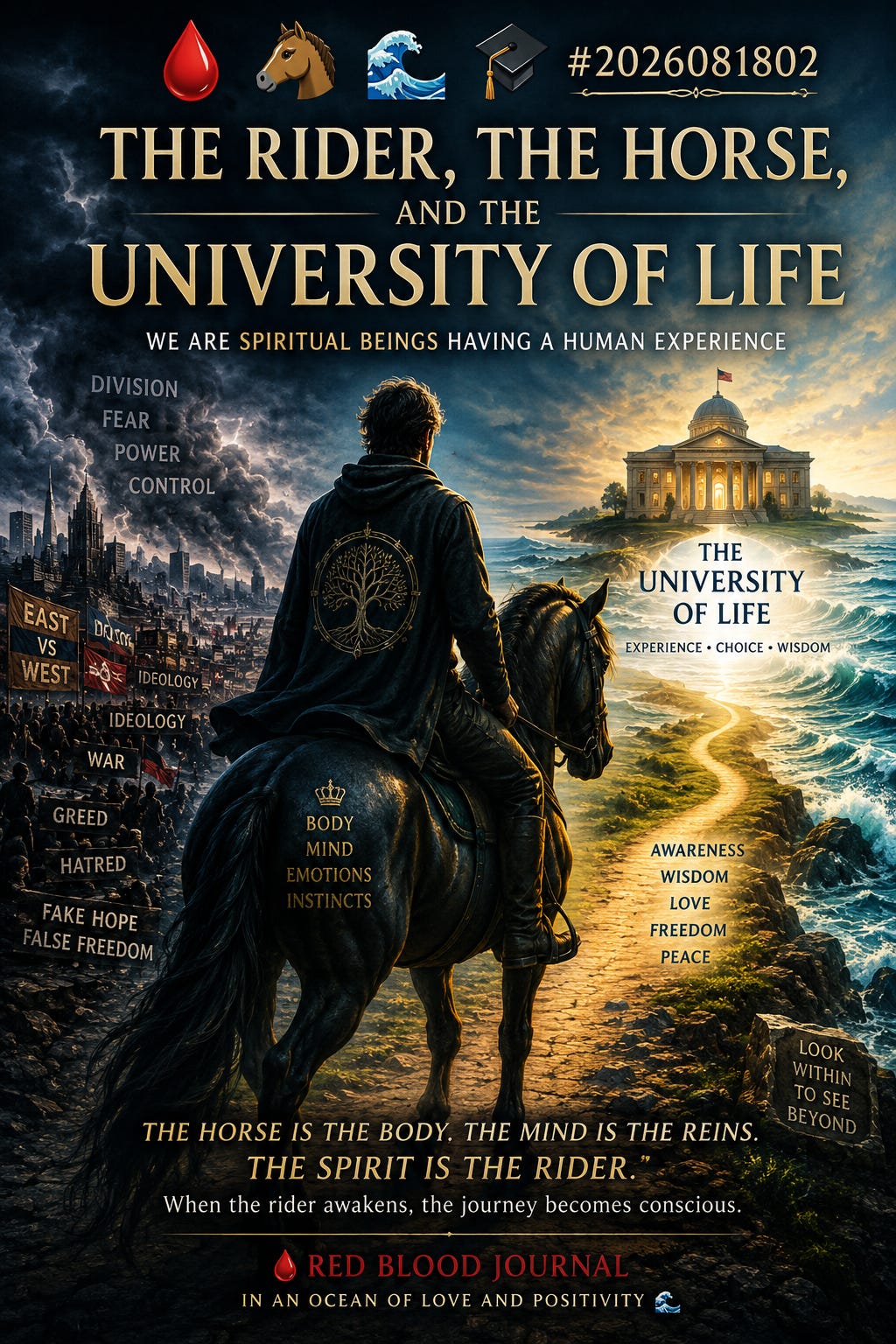
🩸 🐎 🌊 🎓 #2026081802 — The Rider, the Horse, and the University of Life
What if humanity has spent thousands of years trying to fix the classroom instead of understanding why it entered it?
For generation after generation, human beings have carried essentially the same dream.
A better government.
A fairer economic system.
A world without war.
A society without poverty.
A religion without corruption.
A civilization without oppression.
A future where technology removes hardship.
A political system that finally delivers freedom.
A leader who finally brings peace.
The names change.
The flags change.
The ideologies change.
The promises change.
But the underlying hope remains remarkably familiar:
Someday the material world will become good enough that human beings can finally live as spiritual beings.
Perhaps that expectation begins with a misunderstanding.
If the old statement is taken seriously—
We are spiritual beings having a human experience.
—then the material world may never have been designed to become spiritual in the first place.
Perhaps that would defeat its purpose.
The University of Life
Consider ordinary education.
A student enters a university because there are things the student does not yet know through experience.
Reading about courage is not the same as experiencing fear and choosing courage.
Studying forgiveness is not the same as being betrayed and deciding whether to forgive.
Understanding generosity intellectually is not the same as possessing something valuable and voluntarily giving part of it away.
Justice means little experientially if injustice is impossible.
Patience cannot be tested where nothing causes frustration.
Integrity requires the possibility of dishonesty.
Compassion becomes meaningful because suffering exists.
And freedom can only be consciously understood where restriction is possible.
If existence is a university for consciousness, then opposites may not represent defects in the system.
They may constitute much of the curriculum.
The material world supplies resistance.
The spirit encounters it.
Experience produces wisdom.
The Dream of Fixing the University
Human civilization repeatedly attempts something remarkable:
It tries to eliminate the conditions that make the experience possible.
This is not an argument against improving society.
Human beings should oppose cruelty.
They should reduce unnecessary suffering.
They should challenge corruption.
They should cure disease.
They should resist tyranny.
They should build better institutions.
Those actions themselves may be among the most valuable courses offered by the University of Life.
The deeper problem begins when improvement becomes attached to another belief:
If we finally construct the correct external system, humanity will permanently escape conflict.
History has offered this promise under countless names.
Empire.
Kingdom.
Republic.
Revolution.
Communism.
Capitalism.
Nationalism.
Globalism.
Religious government.
Secular government.
Technocracy.
Democracy.
Every generation is presented with another version of the same possibility:
Maybe this one will finally finish the job.
And every generation eventually discovers another problem.
The Necessary Division
After the Second World War, the planet increasingly organized itself around two enormous competing systems.
East and West.
Communism and capitalism.
Soviet power and American power.
Each side presented itself as the path toward a better human future.
Each side warned that the other represented danger.
Each side promised some form of liberation.
For the purposes of history, there are ordinary geopolitical explanations for this division: security, ideology, military power, economics, territory, nuclear weapons, influence and competing national interests.
But the University of Life raises a different philosophical question.
What if division itself serves an experiential purpose?
The political participants would not need to understand that purpose.
A politician can genuinely believe in a cause.
A soldier can genuinely believe in a country.
A revolutionary can genuinely believe liberation is coming.
A citizen can genuinely believe the next election will fundamentally change everything.
Yet the resulting struggle still creates experience.
Choice.
Fear.
Courage.
Loyalty.
Betrayal.
Power.
Resistance.
Hope.
Disappointment.
Compassion.
Hatred.
Sacrifice.
Wisdom.
The classroom continues operating whether or not the students understand why the classroom exists.
Hope May Be Part of the Mechanism
This creates an uncomfortable possibility.
Perhaps external hope has a function.
The student must believe that one more victory might finally solve everything.
One more election.
One more revolution.
One more leader.
One more treaty.
One more ideology.
One more technological breakthrough.
One more political movement.
One more enemy defeated.
Peace always appears close enough to pursue.
Perfect freedom always appears possible enough to fight for.
And when one promised destination disappears, another emerges.
The human being continues moving through the curriculum.
This does not mean hope itself is evil.
It means hope can become a chain when it says:
“I cannot be free until the outside world becomes what I want it to become.”
That form of hope gives the material environment authority over the inner being.
Thousands of Years of the Same Wish
Look across recorded civilization and one pattern repeatedly appears.
Humans want the world to behave according to their highest ideals.
The righteous kingdom.
The enlightened ruler.
The perfect republic.
The workers’ paradise.
Universal prosperity.
Permanent peace.
A final social order.
A final victory over evil.
Perhaps the error is not wanting justice.
Perhaps the error is expecting the material world eventually to lose its material nature.
If this world exists to provide human experience, permanent perfection would create a strange university.
No uncertainty.
No danger.
No difficult choices.
No meaningful temptation.
No sacrifice.
No injustice to oppose.
No fear requiring courage.
No scarcity requiring generosity.
No enemies requiring forgiveness.
No disagreement requiring understanding.
The textbook might remain.
The experience would disappear.
Looking Outside Begins by Looking Inside
There is another paradox.
A person cannot truly see the material world from outside it simply by studying more material events.
More news does not necessarily create distance.
More politics does not necessarily create wisdom.
More ideology may actually strengthen attachment.
Looking from outside requires first looking inward.
The essential question becomes:
Who is experiencing the experience?
There is the body.
There are emotions.
There are desires.
There are political identities.
There is nationality.
There is religion.
There is social status.
There is fear.
There is pride.
There is anger.
And yet something observes all of them.
That observer is the beginning of the distinction.
The Horse and the Rider
Imagine the human body as a horse.
The horse is extraordinary.
It carries the traveler through the material world.
It provides sensation.
Strength.
Sexuality.
Fear.
Pleasure.
Pain.
Hunger.
Instinct.
Movement.
Survival.
Without the horse, the rider cannot experience the terrain.
But an untamed horse follows impulses.
It runs from fear.
It pursues appetite.
It reacts to threats.
It follows the herd.
It fights for territory.
It becomes frightened by noises.
The human body and its conditioned mind can operate similarly.
Society says:
Fear this.
The horse reacts.
Politics says:
Hate them.
The horse reacts.
Advertising says:
You need this.
The horse reacts.
Status says:
You are falling behind.
The horse runs faster.
Pride says:
You must win.
The horse charges.
Fear says:
You are going to lose everything.
The horse panics.
When the rider is asleep, every movement of the horse feels like the decision of the self.
Awakening the Rider
Wisdom changes the relationship.
The goal is not to kill the horse.
The goal is not to hate the body.
The goal is not to abandon society.
The goal is not to become indifferent to injustice.
The goal is not to withdraw from human experience.
A rider needs the horse.
The horse is the vehicle through which the journey becomes possible.
The transformation occurs when the rider awakens.
The rider begins recognizing:
Fear is being experienced, but fear is not necessarily the rider.
Anger is being experienced, but anger is not necessarily the rider.
Political identity is being experienced, but political identity is not necessarily the rider.
Possessions are being experienced, but possessions are not necessarily the rider.
The body is being experienced, but perhaps the body is not the deepest identity of the rider.
At that moment, the reins begin changing hands.
The Mind as the Reins
The mind occupies an unusual position.
An undisciplined mind can amplify every impulse of the horse.
Fear becomes catastrophe.
Desire becomes obsession.
Political disagreement becomes hatred.
Loss becomes identity.
Success becomes superiority.
But a mind that understands the purpose of the experience can become something different.
It becomes the connection between rider and horse.
The reins.
The horse remains alive.
The material world remains material.
The student remains enrolled.
But consciousness no longer has to be dragged behind every impulse produced by the environment.
Freedom Changes Meaning
This produces a radically different definition of freedom.
Ordinary material freedom says:
I will be free when nobody can restrict me.
Political freedom says:
I will be free when the correct government exists.
Economic freedom says:
I will be free when I possess enough resources.
Social freedom says:
I will be free when society accepts me.
The University of Life offers another possibility:
I become free when the material world no longer determines what I am inside.
A government can restrict the body without possessing the spirit.
A person can lose money without losing the self.
A political movement can fail without destroying inner peace.
An enemy can hate without forcing hatred in return.
The world can remain imperfect without requiring the individual to become internally imprisoned by its imperfection.
That is a very different liberation.
Detachment Is Not Indifference
There is an important danger here.
Understanding the material world as a classroom must never become an excuse for cruelty.
One cannot reasonably say:
“Suffering teaches people, therefore suffering should be allowed.”
That would misunderstand the idea entirely.
Perhaps seeing suffering and deciding to help is the student’s examination.
Perhaps confronting tyranny is the assignment.
Perhaps comforting another person is the lesson.
Perhaps creating justice inside an unjust environment is precisely how wisdom becomes experience.
The awakened rider still participates.
The difference is that participation no longer requires captivity.
One can oppose injustice without becoming consumed by hatred.
One can participate politically without worshiping politicians.
One can possess things without allowing things to possess the consciousness.
One can fight for peace without believing peace must arrive before inner peace becomes possible.
Why the World May Never Become Heaven
Perhaps humanity has been asking the wrong question.
Instead of:
When will the world finally become spiritual?
the question may be:
Why would a spiritual being enter a material environment if that environment already behaved like the spiritual realm?
Maybe Earth is not malfunctioning because it contains opposites.
Maybe opposites provide the contrast through which consciousness discovers itself.
Light is understood because darkness can be experienced.
Compassion because cruelty exists.
Truth because deception exists.
Freedom because imprisonment exists.
Love because hatred remains possible.
And wisdom because foolishness has consequences.
The Red Blood Perspective
Political movements frequently promise something larger than government can realistically deliver.
They promise transformation of the human condition itself.
The political slogan changes.
The psychological promise remains.
Give us enough power and we will finally create the world you have always wanted.
History suggests caution toward that promise.
Governments may improve conditions.
Laws may protect rights.
Institutions may reduce suffering.
Technology may dramatically improve material life.
Those achievements matter.
But perhaps no political structure can eliminate the basic contradictions of human existence.
Expecting politics to accomplish that task may be one reason populations repeatedly transfer enormous power to leaders who promise salvation.
The citizen who understands this distinction may become much more difficult to manipulate.
They can demand better government without expecting government to provide meaning.
They can defend freedom without worshiping the political machinery promising it.
They can participate without surrendering consciousness to the struggle.
The Ocean of Love and Positivity Perspective
Perhaps the Ocean does not require the waves to stop moving.
Perhaps tranquility does not require the surface to become motionless.
The material world may continue producing storms.
Political storms.
Economic storms.
Personal storms.
Wars.
Loss.
Success.
Failure.
Birth.
Death.
Hope.
Disappointment.
The wave that believes it is only a wave fears every disturbance.
The wave that remembers the Ocean experiences the same movement differently.
The goal therefore may never have been to eliminate every storm.
It may have been to remember what exists beneath them.
The horse does not need to become the rider.
The road does not need to become heaven.
The university does not need to close.
The student needs to awaken.
And perhaps graduation begins at the moment the rider finally understands:
I came here to experience the journey.
I was never required to become the road.
The world does not have to become spiritual for the spirit to remember itself.
The chains begin breaking when the rider recognizes the horse, takes the reins, and continues the journey consciously.
In an Ocean of Love and Positivity.
🩸🌊✨ Fantastic!
🎓
The University of Life: Awakening the Rider within the Horse
Aug 18, 2026
The text proposes that the material world functions as a University of Life, where hardships and societal conflicts serve as a necessary curriculum for spiritual growth. Humans often mistakenly believe that perfecting external systems like government or technology will bring ultimate peace, yet the source suggests that these struggles are intentional tools for building inner wisdom. By using the metaphor of a horse and rider, the author illustrates the importance of distinguishing between the physical body’s impulses and the observing consciousness. True liberation occurs when an individual stops waiting for the world to become perfect and instead achieves internal freedom regardless of external circumstances. Ultimately, the material realm is not a broken system to be fixed, but a purposeful classroom designed for spiritual beings to experience contrast and discovery.


