


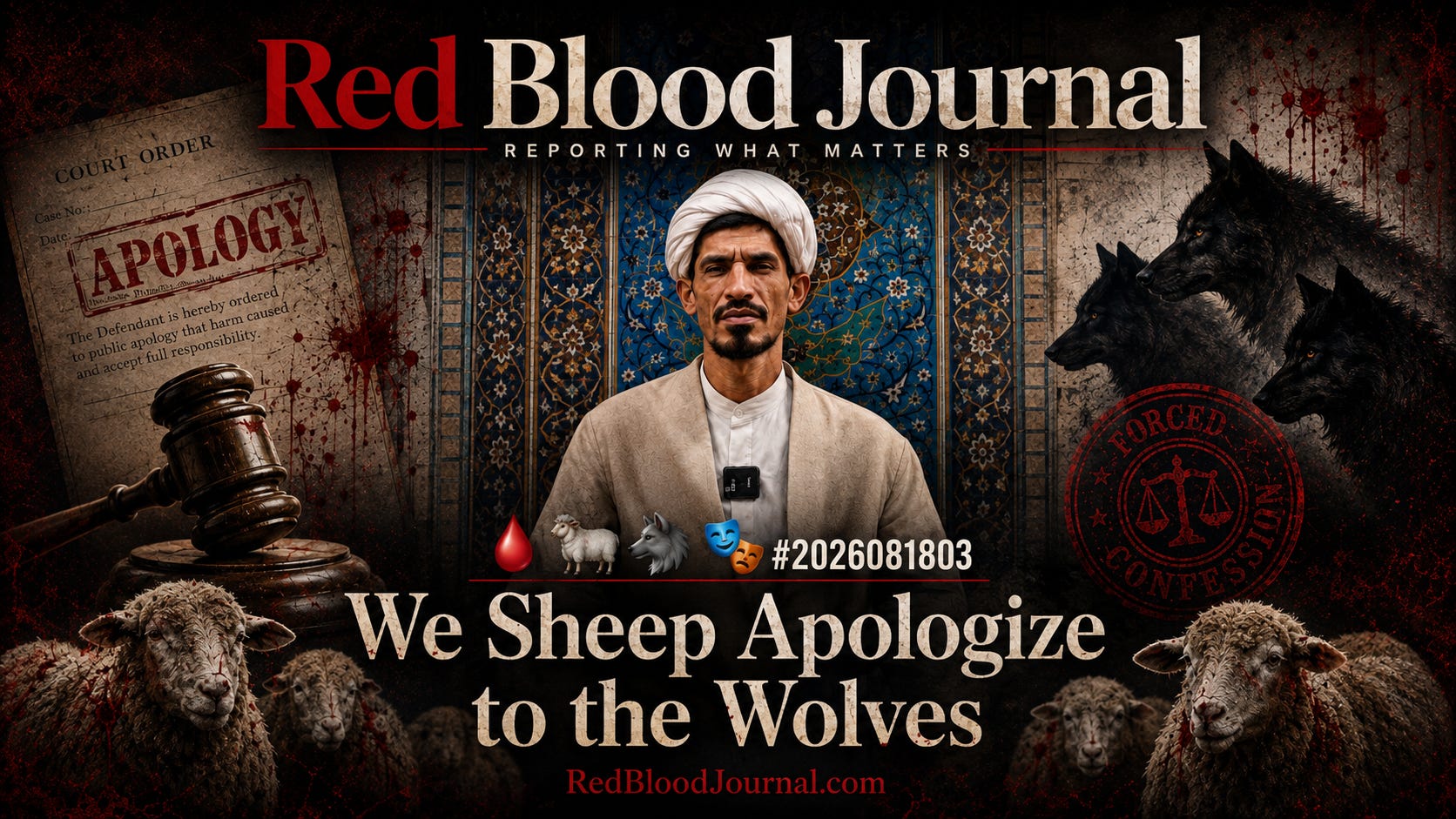
🩸 🐑 🐺 🎭 #2026081803 — We Sheep Apologize to the Wolves
When an Ordered Apology Becomes an Act of Defiance
RedBloodJournal.com
Sometimes opposition arrives carrying banners.
Sometimes it arrives through demonstrations.
Sometimes it arrives through a courtroom.
And sometimes it simply says:
“I apologize.”
Then everyone realizes that it was not an apology at all.
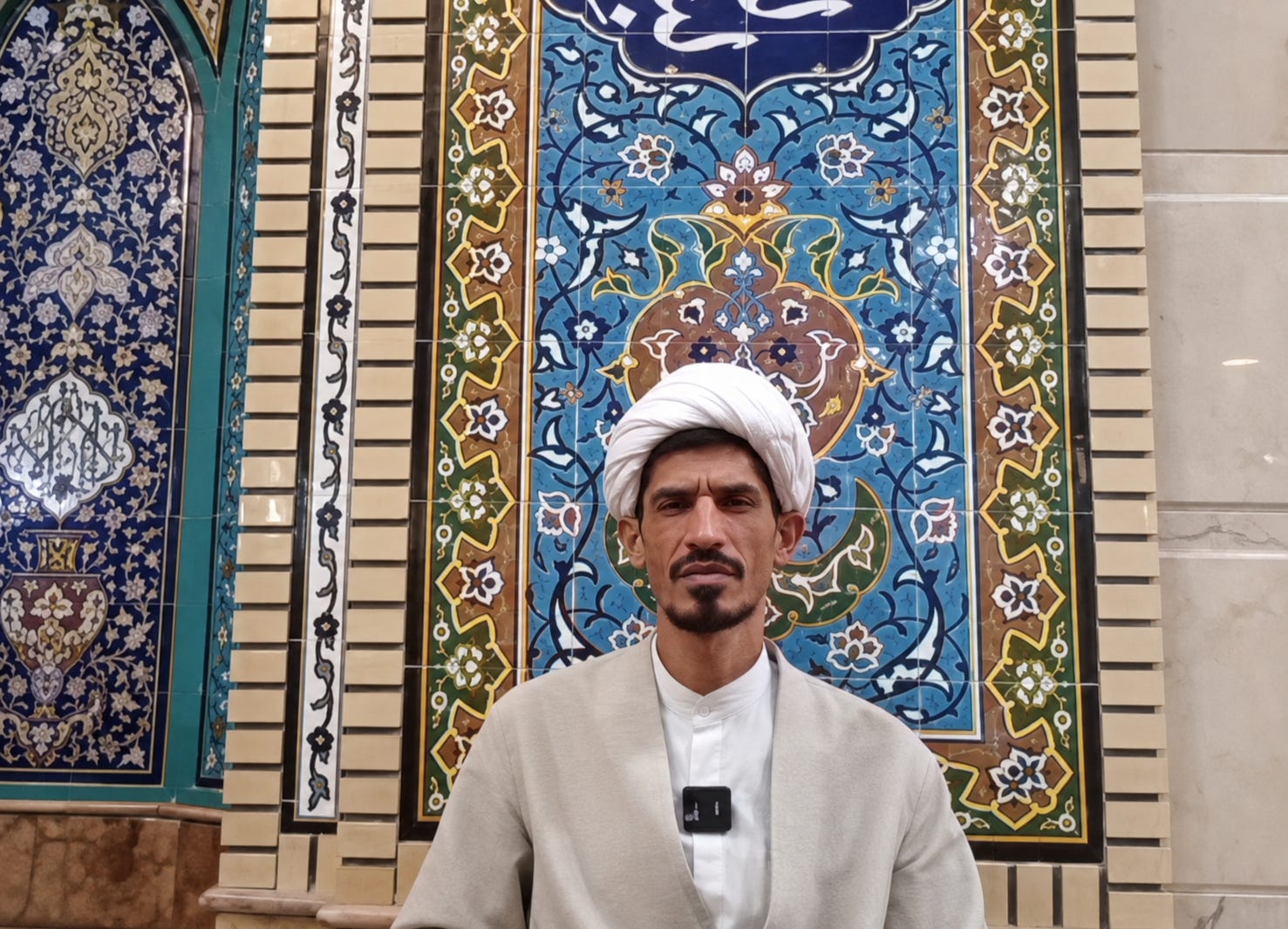
A video circulating in Iran shows the Friday prayer leader of Hajjiabad in Hormozgan Province discussing complaints filed against him following criticism and disclosures concerning local officials. Iranian media reporting on the clip likewise describes him as having been taken to court after officials complained about his criticism.
What followed may be one of the strangest apologies imaginable.
It was simultaneously serious, funny, bitter and remarkably courageous.
Because instead of withdrawing his accusations, he turned the required apology into another accusation.
The Courtroom Problem
In the recording, the cleric explains that complaints had been made against him after criticism and what he describes as disclosures concerning officials.
He says that in most cases he had previously been acquitted.
But in this instance, according to his own account, the court told him that although criticism was his right—and although he says he had supplied documentation—his statements had caused:
تشویش اذهان
roughly:
disturbance of public opinion.
He then asks the obvious question:
What does disturbing public opinion actually mean?
His interpretation is almost comedic in its simplicity.
People were living their lives.
Perhaps they didn’t know that someone’s rights had allegedly been violated.
Perhaps they knew but weren’t talking about it.
Then somebody spoke.
Now people knew.
Their minds became disturbed.
Therefore, according to his sarcastic reconstruction of the situation, the person exposing the disturbing information becomes responsible for the disturbance rather than whatever originally caused it.
That is where the story becomes much bigger than one cleric or one town.
Very Well. I Apologize.
The apparent expectation was straightforward:
You criticized officials.
Complaints followed.
Now apologize.
So he did.
Sort of.
He begins addressing people who had complained against him.
But instead of saying:
“I was wrong.”
his apologies effectively say:
“I am sorry that you allegedly did something wrong and that I mentioned it.”
At one point he sarcastically apologizes to an official while accusing that official of having violated the rights of him and many others.
Then he adds an extraordinary jab—essentially asking forgiveness in case what had allegedly been taken from them had not been enough.
The apology has now become evidence that the speaker has absolutely no intention of withdrawing his criticism.
And then he really gets started.
“I Apologize to the Usurious Banks”
Near the end of the recording comes the line now spreading across Iranian social media:
«من از بانکهای رباخوار، از قاضی ظالم، از مسئول بیکفایت عذر میخواهم که مزاحم کارشان شدم.»
In English:
“I apologize to the usurious banks, the unjust judge and the incompetent officials for interfering with their work.”
There is no ambiguity about the satire.
The grammatical structure says:
apology.
The actual meaning says:
accusation.
And there is almost nothing the listener can do except laugh.
Then Come the Silent Clerics
His next target is his own religious establishment.
He says:
«من از روحانیون ساکت که منفعت خود را مصلحت اسلام میدانند عذر میخواهم...»
He is apologizing to:
“the silent clerics who consider their own interests to be the interests of Islam.”
That sentence may actually be more politically significant than the attack on bureaucrats.
Because this is not an outsider attacking Iran’s clerical system.
This criticism is coming from within the religious structure itself.
It distinguishes between religion and those who may use religion to protect personal or institutional interests.
The accusation is no longer merely:
Officials are failing.
It becomes:
Some of those who are supposed to speak morally have chosen silence because silence benefits them.
That is a considerably more dangerous criticism.
And Then Come the Sheep
Finally comes the masterpiece.
He says:
«ما گوسفندان از گرگهای درنده عذر میخواهیم اگر گوشتی به تن نداریم...»
His metaphor continues by describing sheep whose skin has essentially been reduced to their bones and who therefore no longer make worthwhile prey.
Translated into its political imagery:
The wolves have eaten so much that the sheep apologize for having nothing left to offer.
Think about the inversion.
Normally:
The wolf should apologize to the sheep.
Here:
The sheep apologizes to the wolf.
Not for being eaten.
But for failing to remain sufficiently fat to continue being eaten.
😂
It is comedy.
But it is comedy with teeth.
The Genius of the Non-Apology
There is an old political problem when governments or institutions demand public contrition.
A genuine apology accomplishes several things at once.
The accused accepts wrongdoing.
The authority establishes legitimacy.
The controversy supposedly ends.
The audience witnesses submission.
But what happens when somebody gives the authority the form of submission while removing every bit of its substance?
That appears to be what happened here.
He repeatedly says:
“I apologize.”
But each apology contains another criticism.
So whoever wanted an apology receives the words.
But not the surrender.
The speaker technically performs contrition while politically escalating his argument.
That is what makes the episode so unusual.
The Authorities Win the Sentence
The cleric wins the meaning.
Imagine the conversation reduced to absurdity:
Authority:
You must apologize.
Cleric:
Certainly.
Authority:
Good.
Cleric:
I apologize to the wolves because we sheep no longer have enough meat for them.
Authority:
...
There may be no bureaucratic form for that.
The Bigger Question: Who Disturbed the Public Mind?
The most interesting part of his argument may not actually be the sheep and wolves.
It may be his discussion of تشویش اذهان.
If accurate as he recounts it, the underlying philosophical question is enormous:
When citizens become disturbed after learning something troubling, what caused the disturbance?
Was it the person who told them?
Or was it the condition being described?
Suppose a citizen is unaware that corruption exists.
Someone exposes alleged corruption.
The citizen becomes angry.
Who disturbed the citizen?
The whistleblower?
Or the alleged corruption?
This distinction matters far beyond Iran.
Every political system eventually confronts some variation of the same temptation:
Treat the messenger as the source of the disorder.
It is easier.
Problems can be enormously difficult to repair.
Messengers are considerably easier to silence.
Comedy as Political Armor
Authoritarian environments have always produced unusual forms of humor.
There is a reason.
Direct speech can be dangerous.
Satire creates another layer.
Everyone understands what is being said while the speaker maintains the absurd structure of saying something else.
I did not insult the wolf.
I apologized to him.
That is the beauty of it.
The humor is not separate from the bravery.
The humor is part of the bravery.
A serious accusation invites a serious response.
A ridiculous apology makes the response itself look ridiculous.
Punish him?
For apologizing?
Ask him to apologize again?
That could become even worse.
But One Important Caution
The viral captions accompanying the video frequently say that the cleric was “forced to apologize.” Current Iranian media reports similarly describe the episode as following complaints and a court case.
However, the recording itself gives us something more precise than many social-media captions.
What can be directly established from his own words is that officials had filed complaints, that he discusses a court finding involving تشویش اذهان, and that he then proceeds with these sarcastic apologies.
The exact legal order, complete case file, judgment and precise wording of any mandated apology are not contained in the material reviewed for this report.
That distinction matters.
Because the speech is powerful enough without exaggerating it.
The Final Line Gets Even Darker
After the wolves and sheep, he closes with another image:
“O bones crushed beneath the rubble of discrimination and corruption, apologize to the bulldozers that destroyed you.”
At that point the comedy nearly disappears.
The joke has delivered the listener somewhere else.
The victim apologizes to the perpetrator.
The hungry apologize for being hungry.
The powerless apologize for having insufficient resources left to extract.
The crushed bones apologize to the machine that crushed them.
That is not really comedy anymore.
It is tragedy wearing comedy’s clothes.
The Red Blood Perspective
There is something important here that does not fit comfortably into the usual Iran-versus-government political template.
The man making these statements is himself a cleric.
That matters.
Iran is not composed simply of government supporters on one side and opponents on another.
Institutions contain people.
Religious establishments contain disagreements.
Governments contain factions.
And occasionally someone standing inside a structure attacks the failures of that very structure.
The interesting question therefore is not merely:
Is he pro-regime or anti-regime?
That reduces the event into the same binary classification that destroys almost every useful political discussion.
The more interesting question is:
What happens when an insider’s conscience collides with the institution around him?
Here we appear to see one possible answer:
He apologizes.
And makes the apology more damaging than the original criticism.
There is something wonderfully Iranian about it.
Thousands of years of poetry, metaphor, double meaning, political humor and survival condensed into three minutes:
We sheep apologize to the wolves.
Because apparently we have failed in our civic responsibility to remain delicious.
🐑🙏🐺
Ocean of Love and Positivity Perspective
There is another lesson hidden inside the comedy.
Courage does not always require hatred.
Resistance does not always require violence.
Truth does not always require shouting.
Sometimes intelligence can accomplish what anger cannot.
The speaker could have answered humiliation with humiliation.
Instead, he apparently turned it into humor.
And humor allowed the message to travel much farther than an ordinary political speech probably ever would.
Millions may forget another angry denunciation.
But this?
People will remember:
The sheep apologized to the wolves for being too skinny to eat.
That is how an idea escapes its cage.
Not through violence.
Not through revenge.
Through a sentence.
And perhaps that is one of the most positive forms of resistance available to any society:
Speak.
Think.
Laugh.
Expose contradictions.
And refuse to surrender one’s humanity while doing it.
In an Ocean of Love and Positivity.
🩸🌊✨ Fantastic!
🎭
The Sheep’s Apology: Defiance Through Satire
Aug 18, 2026
This source details a viral video of an Iranian cleric who transformed a court-ordered apology into a scathing political critique. After being accused of disturbing public opinion through his criticism of local officials, the cleric delivered a satirical speech where he apologized to “usurious banks” and “incompetent authorities.” His most famous metaphor involves sheep apologizing to wolves for being too thin to provide a satisfying meal, highlighting the absurdity of blaming victims for their own suffering. The text explores how humor and irony can serve as powerful tools of defiance within an authoritarian system. By adopting the form of submission without the substance of surrender, the speaker exposes institutional corruption from within the religious establishment. Ultimately, the overview emphasizes that this act of non-apology allowed a dangerous truth to bypass censorship through the use of wit.


