


🩸 RedBloodJournal.com
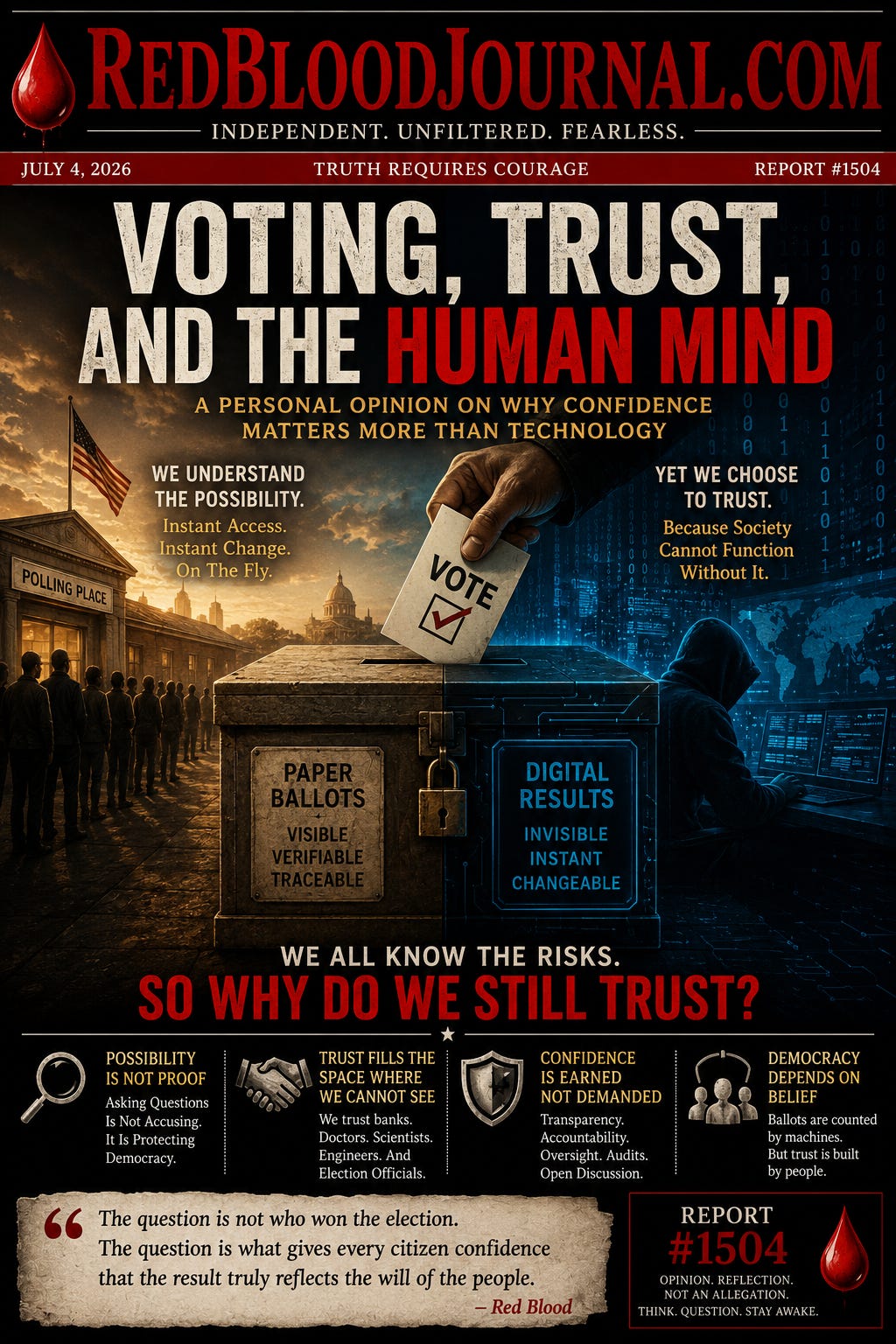
#1504 – Voting, Trust, and the Human Mind
A Personal Opinion on Why Confidence Matters More Than Technology
By Red Blood
July 4, 2026
Opinion
The thoughts in this article are my personal opinions and philosophical reflections. They are not allegations against any election, country, organization, or individual. My purpose is simply to encourage readers to think about trust, transparency, and the foundations upon which democracy depends.
The Question That Never Leaves Me
There is one question that has stayed with me for years.
If someone wanted to manipulate almost any modern system, what would be the easiest way to do it?
My answer has always been the same.
Give someone the ability to change information instantly.
Not tomorrow.
Not after months of work.
But immediately.
That thought naturally leads me to voting.
I am not saying elections are manipulated.
I am saying I understand why many people ask whether they could be.
To me, there is an important difference between possibility and proof.
Why Voting?
Voting is perhaps the most important process in a democracy.
It determines who governs.
It influences laws.
It shapes the future of entire nations.
Because voting carries such enormous importance, public confidence in the process is just as important as the process itself.
Most citizens never inspect election software.
Most never observe every ballot from beginning to end.
Most never verify every stage of counting themselves.
Instead, we place our trust in election officials, observers, procedures, audits, courts, and the institutions responsible for protecting the integrity of the system.
That trust may be justified.
It may also be questioned.
My purpose is not to answer that debate.
My purpose is to reflect on why trust matters so deeply.
Possibility Is Not Proof
One of the greatest challenges of the digital age, in my opinion, is separating possibility from proof.
The fact that something could happen does not mean it did happen.
Yet recognizing that something is possible is not irrational.
Questioning is not accusing.
Asking for transparency is not rejecting democracy.
In fact, I believe the opposite is true.
A democracy should be strong enough to welcome honest questions because confidence grows when citizens know that institutions are willing to explain, verify, and improve.
Trust Begins Where Personal Verification Ends
Every one of us reaches a point where we can no longer personally verify what is happening.
We trust our banks.
We trust medical laboratories.
We trust engineers who design bridges.
We trust historians who preserve records.
We trust scientists who publish research.
And we trust election officials to administer one of the most important responsibilities in a democracy.
Civilization could not function if every individual personally verified every process.
At some point, trust becomes necessary.
The question is not whether we trust.
The question is why we trust.
The Human Side of Trust
Perhaps there is another reason we continue to trust.
Perhaps we understand, somewhere deep inside, that life itself is temporary.
Governments change.
Political parties rise and fall.
Leaders come and go.
Each generation eventually passes the responsibility to the next.
Knowing this, perhaps many of us choose hope over certainty.
Perhaps we accept uncertainty because living in constant suspicion would make society impossible.
But hope should never replace transparency.
Confidence should never replace accountability.
Trust should never be demanded.
It should be earned.
The Real Foundation of Democracy
Technology can count votes.
Technology cannot create public confidence.
Confidence is built through openness.
Independent oversight.
Transparent procedures.
Audits that people understand.
Laws that are applied equally.
And a willingness to answer honest questions without treating every question as an attack.
Whether a person has complete confidence in modern election systems or remains skeptical of aspects of them, I believe everyone benefits when trust is strengthened through verification rather than expectation.
Conclusion
When I think about voting, I am not really thinking about politics.
I am thinking about trust.
Democracy depends on ballots.
But democracy survives because people believe those ballots matter.
In my opinion, the future of democratic societies will depend not only on better technology but on preserving something far more valuable.
Public confidence.
Not confidence that is demanded.
Not confidence based on slogans.
But confidence that is continually earned through transparency, accountability, independent verification, and the freedom to ask difficult questions.
In the end, the question that remains with me is not:
“Who won the election?”
It is:
“What gives every citizen confidence that the result truly reflects the will of the people?”
For me, that question is not a threat to democracy.
It is one of the questions that helps keep democracy alive.
This article reflects the personal opinions of the author. It is intended to encourage thoughtful discussion about trust, transparency, and public confidence in democratic institutions. Readers are encouraged to evaluate evidence, consider multiple perspectives, and reach their own conclusions.
🗳️ The Architecture of Public Trust in Democracy
Jul 4, 2026
The provided text explores the critical role of public trust in sustaining a healthy democracy, emphasizing that transparency is more vital than the technology used to count votes. The author argues that while digital systems allow for the theoretical possibility of rapid data manipulation, questioning these processes is a legitimate exercise of civic engagement rather than an act of subversion. Because citizens cannot personally verify every aspect of an election, they must rely on institutional integrity and independent oversight to bridge the gap between uncertainty and confidence. The narrative suggests that trust must be actively earned through accountability and a willingness to answer difficult questions rather than being demanded by those in power. Ultimately, the source posits that the survival of democratic societies depends on the collective belief that the electoral process accurately reflects the will of the people.


