


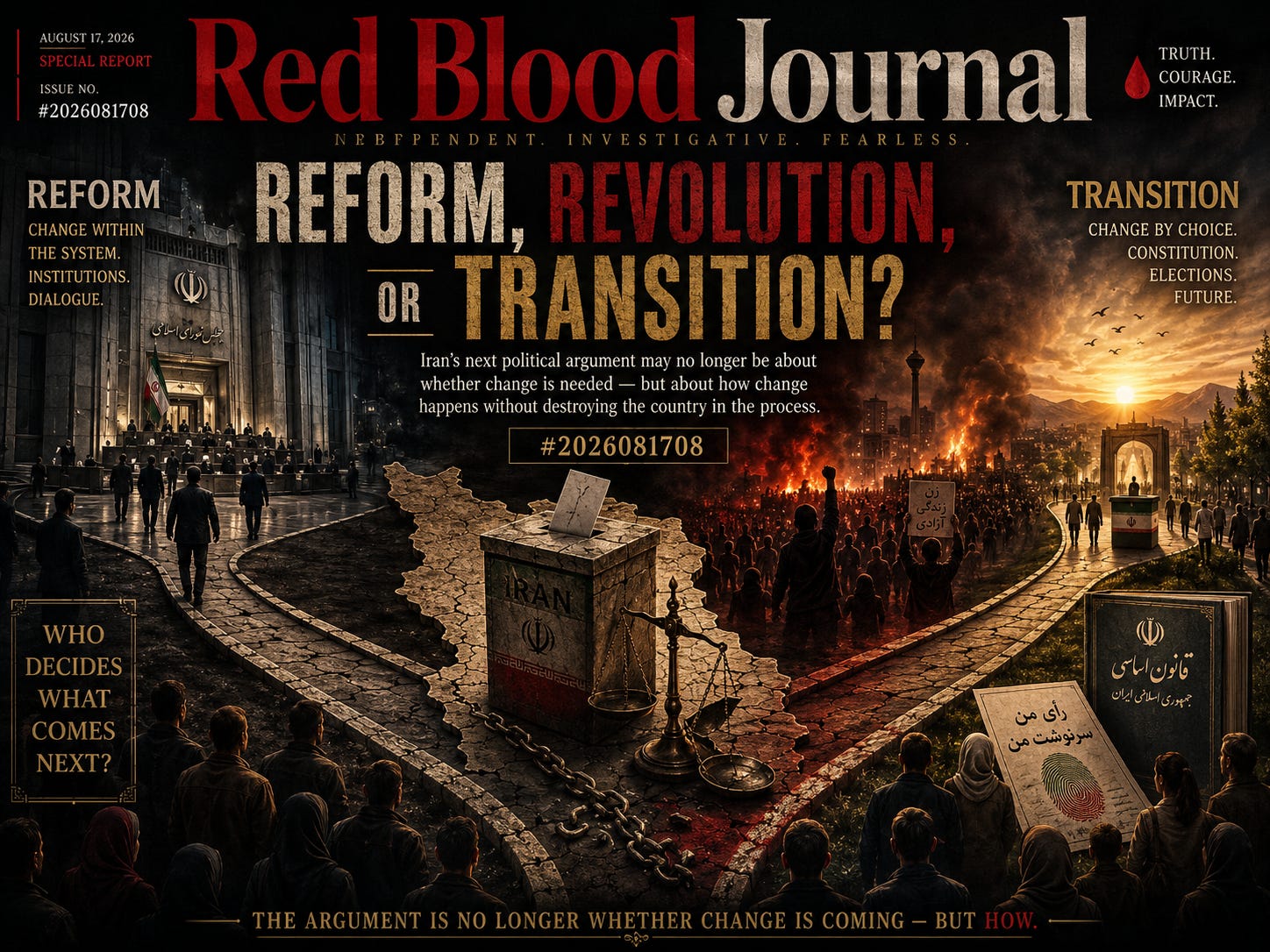
🩸 🔄 🗳️ #2026081708 — Reform, Revolution, or Transition?
Iran’s next political argument may no longer be about whether change is needed — but about how change happens without destroying the country in the process
Political systems often appear permanent until suddenly they do not.
For years, a society can argue over elections, sanctions, corruption, repression, economics, censorship, leadership, and foreign policy while still operating inside the assumption that the existing political structure will remain.
Then something changes.
The argument stops being:
How should the government behave?
and becomes:
What happens if this government is no longer there?
The material examined for this report increasingly reaches that point.
It presents three competing paths for Iran:
reform from within, revolutionary rupture, or an organized political transition toward a new system.
The source includes sociologist Saeed Madani warning that Iran’s economic, social, cultural, and political deterioration could eventually produce a violent revolution if the governing structure refuses meaningful retreat or reform.
At the same time, the material proposes another possibility: Reza Pahlavi acting as a transitional figure leading not necessarily to predetermined monarchy, but toward a free ballot in which Iranians determine what comes afterward.
That creates the central question of this report:
Can Iran move from one political system to another without repeating the destructive logic of 1979?
Option One: Reform From Within
The least disruptive path is theoretically the simplest.
The existing political system recognizes that conditions have become unsustainable and changes itself.
Political prisoners are released.
Legal opposition is permitted.
Censorship is reduced.
Elections become meaningful.
The judiciary gains independence.
Security institutions retreat from civilian life.
Economic policy becomes more accountable.
Foreign policy adjusts.
Citizens are gradually allowed to influence the direction of the state.
This model has obvious advantages.
Institutions remain functioning.
The bureaucracy continues.
Hospitals operate.
Banks remain open.
The military remains organized.
Government employees continue receiving salaries.
No constitutional vacuum appears overnight.
For citizens afraid of chaos, this is the most attractive possibility.
But it has one enormous weakness:
the ruling system itself must agree to surrender some of the power that keeps it ruling.
The Reformist Paradox
Reform becomes most necessary precisely when it becomes most threatening to those who control the system.
Minor reform may be tolerated.
Major reform can change who holds power.
That creates a structural contradiction.
If meaningful reform requires:
independent elections,
an independent press,
independent courts,
open political organization,
and limits on security institutions,
then the institutions being asked to approve reform may also be the institutions that would lose the most from it.
This is why reform movements frequently encounter the same problem.
They are permitted to change the furniture.
They are not permitted to redesign the house.
Saeed Madani’s Warning
The source presents Saeed Madani as arguing that Iran is experiencing serious deterioration across economic, social, cultural, and even religious indicators.
His warning is not simply that the system is performing badly.
It is that continued refusal to change could transform accumulated pressure into revolution.
This distinction matters.
A reformist warning says:
Change because the alternative is worse.
A revolutionary argument says:
The alternative has already arrived.
Those two positions can sound similar because both criticize the existing system.
But they differ fundamentally in their relationship with time.
The reformist says there is still a window.
The revolutionary says the window is closed.
Option Two: Revolution
Revolution offers clarity.
The existing structure goes.
A new one begins.
For people who believe reform has failed repeatedly, revolution becomes psychologically attractive because it avoids another cycle of promises.
No more waiting.
No more controlled elections.
No more internal reform factions that eventually encounter the same institutional limits.
No more hoping the system voluntarily changes itself.
But political clarity before a revolution often becomes political uncertainty immediately afterward.
Removing a government answers only one question:
Who no longer rules?
It does not automatically answer:
Who governs next?
Who controls the military?
Who controls the police?
Who secures prisons?
Who maintains electricity?
Who controls the borders?
Who pays civil servants?
Who guarantees minorities?
Who prevents revenge?
Who writes the constitution?
Who decides when elections occur?
Who decides who is allowed to compete?
That is where revolutions become dangerous.
Iran Already Knows This Story
Iran does not need to study another country’s history to understand revolutionary uncertainty.
It has its own.
In 1979, very different political groups united around one central objective:
the Shah must go.
Islamists.
Marxists.
Liberals.
Nationalists.
Students.
Religious activists.
Secular activists.
Different groups imagined radically different futures.
For a short period, opposition to the monarchy created the illusion of political unity.
But removing the common enemy also removed the force holding that coalition together.
The next political battle became:
Who owns the revolution?
History answered that question brutally.
This should remain one of the most important lessons for any future Iranian transition.
Agreeing on what must end is not the same as agreeing on what should begin.
The Danger of Another Blank Check
Revolutions often ask citizens to sign a political blank check.
First remove the ruler.
Then we will decide everything else.
That sequencing is understandable during emergencies.
It is also dangerous.
Because once power becomes vacant, the most organized faction often acquires an enormous advantage.
The faction with:
organization,
money,
weapons,
communications,
foreign support,
leadership,
and institutional discipline
can move faster than millions of ordinary citizens who simply wanted change.
That is one reason the architecture of transition may matter as much as opposition itself.
Option Three: Managed Transition
The source introduces a third possibility.
Instead of indefinite reform or uncontrolled revolution, Iran could enter a defined transitional period.
The material specifically presents Reza Pahlavi as a possible leader of such a transition, with the eventual destination being a free ballot rather than an automatically restored monarchy.
This distinction is critical.
There is a profound difference between saying:
Reza Pahlavi should become king
and saying:
Reza Pahlavi could temporarily help organize the transfer from the Islamic Republic to a system in which citizens decide what comes next.
The first decides the final political structure before voting.
The second treats leadership as temporary and sovereignty as belonging to the electorate.
Whether such a transition is realistic is another question.
But conceptually, it attempts to solve the central problem of revolution:
the dangerous space between collapse and legitimacy.
What Would a Real Transition Need?
A credible transition cannot depend entirely on one personality.
It needs rules established before victory.
At minimum, the questions would include:
Who participates in the transitional authority?
How long does it exist?
What powers does it possess?
What powers are forbidden?
What happens to the existing military?
What happens to the IRGC?
What happens to the judiciary?
How are political prisoners handled?
How are former officials treated?
How are revenge killings prevented?
When are elections held?
Who administers them?
Who observes them?
How is a constitution written?
Is the final system decided by referendum?
These questions sound boring compared with revolution.
That is exactly why they matter.
Political disasters frequently begin in the gap between emotional victory and administrative reality.
The Reza Pahlavi Question
The source strongly favors the idea that Reza Pahlavi could serve as a leader during a transitional period.
It argues that if reformists and other opposition currents accepted a transition toward a free ballot under his leadership, the dangers facing Iran could be reduced.
That is the source’s position.
But several questions remain unresolved.
Would republican opposition groups accept him?
Would ethnic and regional political movements accept him?
Would the military accept him?
Would parts of the existing bureaucracy cooperate?
Would he commit clearly to leaving office if voters rejected monarchy?
Would monarchists accept a republican result?
Would republicans accept a monarchist result?
Those questions determine whether a transitional figure becomes a bridge—
or simply the next battlefield.
The Most Important Promise May Be the Promise to Leave
History contains many temporary leaders.
Some remain temporary.
Others discover that temporary power is remarkably comfortable.
Therefore any transitional authority requires an exit mechanism stronger than personal promises.
Dates.
Legal limitations.
Independent supervision.
Transparent procedures.
A defined referendum.
A defined election.
A defined end.
A transition becomes credible when the person leading it cannot legally turn transition into permanent rule.
That principle should apply equally to monarchists, republicans, military leaders, reformists, and revolutionary committees.
If democracy depends on the goodwill of one person, it is not yet democracy.
Monarchists Must Answer a Difficult Question
If Reza Pahlavi becomes a transitional leader and a free electorate chooses a republic, will monarchists accept the result?
That question is fundamental.
It is easy to support voting when one expects victory.
Democracy becomes meaningful when one accepts losing.
The legitimacy of the Pahlavi movement would therefore depend not merely on how many supporters it attracts.
It would depend on whether it demonstrates that the citizen’s vote matters more than the dynasty.
If the answer is yes, monarchism can participate democratically.
If the answer is no, the conflict has simply changed uniforms.
Republicans Face the Same Test
The obligation is symmetrical.
If a genuinely free referendum produces a constitutional monarchy, would republicans accept the result?
Would ideological hostility toward the Pahlavi name override the electorate?
Would political groups that have spent decades demanding democracy accept democracy when it produces an outcome they dislike?
Again, this is the real test.
Freedom means citizens may choose incorrectly according to someone else’s ideology.
That is not a flaw in democracy.
That is democracy.
Reformists May Become More Important Than They Appear
The source criticizes reformist currents for continuing to promote reform when the system may be beyond repair.
But reformists could still play an important role during transition.
They know the institutions.
They know the bureaucracy.
They know how the existing political structure functions.
They may have relationships inside the state that revolutionary groups lack.
In a peaceful transition, those connections could become useful.
One of the worst mistakes after regime change is assuming that everyone who worked inside the old system must disappear.
Countries require continuity.
Doctors do not become ideological enemies because they worked in state hospitals.
Engineers do not become enemies because they maintained infrastructure.
Civil servants do not automatically become criminals because they processed documents.
A transition that confuses institutions with leadership can destroy the very machinery required to keep society functioning.
The Iraq Warning
Modern history provides a severe warning.
When political systems collapse and state institutions are dismantled too aggressively, the result can be unemployment, insecurity, armed resistance, institutional vacuum, and long-term instability.
The lesson is not that authoritarian institutions must remain untouched.
It is that removing leadership and destroying the state are not the same thing.
Iran would still need:
a central bank,
ministries,
municipalities,
airports,
hospitals,
universities,
police,
electricity grids,
water systems,
tax offices,
courts,
and border administration
the morning after political change.
The government may change.
Iran cannot disappear for six months while everyone decides what comes next.
The IRGC Problem
Any serious transition discussion eventually reaches one of the hardest questions:
What happens to the Islamic Revolutionary Guard Corps?
The answer cannot simply be symbolic.
The IRGC is not only a political institution.
It has armed personnel, intelligence networks, economic interests, infrastructure, and organizational capacity.
Attempting to eliminate the entire structure instantly could produce resistance.
Leaving it completely unchanged could prevent meaningful transition.
The solution would likely require distinguishing between:
leadership responsible for crimes,
political and intelligence structures,
economic networks,
and ordinary personnel whose future could potentially be integrated into a national military or civilian economy.
That process would be extraordinarily difficult.
But pretending the problem does not exist would be more dangerous.
Revenge Is the Fastest Way to Lose a Transition
After decades of repression, anger is understandable.
Families have memories.
Prisoners have memories.
Exiles have memories.
Protesters have memories.
Government employees also have fears.
If political transition becomes collective punishment, those fears can produce armed resistance.
Justice and revenge must therefore be separated.
Justice asks:
What did this individual do?
Revenge asks:
Which group did this individual belong to?
The difference determines whether a transition produces accountability or another cycle of persecution.
Transitional Justice
A post–Islamic Republic Iran would eventually need some method for addressing serious crimes.
Trials.
Truth commissions.
Document preservation.
Victim testimony.
Compensation.
Institutional investigation.
Perhaps amnesties for lesser participants.
Perhaps prosecution for serious crimes.
None of these choices will satisfy everyone.
But the alternative is often informal revenge.
And informal revenge has no stopping rule.
A justice system must therefore begin functioning quickly enough that citizens do not attempt to become the justice system themselves.
The Opposition’s Current Weakness
The source makes a sharp claim:
that Pahlavi supporters have concentrated on fighting the Islamic Republic while other opposition movements have often concentrated on fighting Pahlavi.
That characterization is partisan and should not be accepted automatically as a complete description of Iranian opposition politics.
But it identifies a real structural problem.
Opposition groups frequently spend enormous energy deciding who is insufficiently pure.
Who supported whom twenty years ago?
Who spoke with which foreign government?
Who prefers monarchy?
Who prefers federalism?
Who is too left?
Who is too right?
Who is too religious?
Who is too secular?
Meanwhile the existing system remains organized.
Fragmentation is not simply a political disagreement.
It is an operational disadvantage.
The Minimum Agreement
Iranian opposition groups do not need to agree on everything before transition.
They may need to agree on only a few things.
No executions without due process.
No political imprisonment.
No religious qualification for citizenship.
No hereditary political entitlement without public consent.
No revolutionary committee above the law.
No militia above civilian authority.
Free political organization.
Independent journalism.
Independent courts.
Free elections.
A referendum or constitutional process.
Acceptance of the result.
That would not solve every political argument.
It would create the arena in which those arguments could occur without violence.
The Constitution Before the Candidate
Iran’s future may benefit from reversing the usual political sequence.
Rather than asking first:
Who should rule?
Ask:
What rules should the ruler be forced to obey?
This is the lesson behind constitutional government.
A good ruler inside a bad system eventually leaves.
A good constitution remains.
The central achievement of transition should therefore not be selecting the perfect leader.
It should be building institutions capable of surviving an imperfect one.
Because eventually every country gets an imperfect leader.
The Referendum Must Be Real
A referendum is often presented as the solution.
But the word itself guarantees nothing.
Authoritarian states also hold referendums.
The meaningful questions are procedural.
Can every political option campaign?
Can citizens criticize every candidate?
Are ballots secret?
Are voters intimidated?
Are opposition media permitted?
Are results independently audited?
Can international observers participate?
Can the losing side challenge irregularities legally?
Can the losing side organize again afterward?
The freedom of the vote matters more than the existence of the ballot box.
What Does Iran Actually Want?
This remains the central unanswered question.
Monarchy?
Republic?
A secular parliamentary democracy?
A presidential system?
A constitutional monarchy?
Something else entirely?
The source strongly suggests growing support for the Pahlavi movement, but it does not provide comprehensive nationwide evidence establishing what a majority of Iranians would choose in a genuinely free political environment.
That uncertainty should be preserved.
Anyone claiming to know exactly what eighty-plus million Iranians want without allowing them to vote is speaking for people who have not yet been permitted to speak for themselves.
The solution to uncertainty is not another political claim.
It is an election.
The Red Blood Perspective
Iran’s next great political question may no longer be whether the Islamic Republic can survive indefinitely.
It may be whether Iranians can prepare for the possibility that it does not.
That preparation matters.
Waiting for collapse before discussing transition is one of the most dangerous strategies available.
The arguments should happen now.
Monarchy versus republic.
Centralization versus federalism.
Religion and state.
Military restructuring.
Economic continuity.
Transitional justice.
Constitutional design.
Election procedures.
Minority protections.
Political amnesty.
These disagreements are not signs of weakness.
Handled peacefully, they are rehearsal for democracy.
The greatest danger is not disagreement.
It is postponing disagreement until weapons decide the answer.
Ocean of Love and Positivity Perspective
Iran does not need another victory in which half the country wakes up terrified of the other half.
It has already lived through that.
A successful transition should allow someone who supported the old system to live peacefully beside someone who opposed it—
provided neither committed crimes.
A monarchist should be able to campaign.
A republican should be able to campaign.
A religious political party should be able to campaign.
A secular party should be able to campaign.
And every one of them should know that losing an election does not mean losing freedom.
That is the transformation Iran ultimately needs.
Not merely replacing one ruler.
Replacing the idea that political defeat requires destruction.
The final destination should not be Pahlavi.
It should not be republicanism.
It should not be reformism.
It should be something simpler and more powerful:
the Iranian citizen gets the final word.
If a transitional leader can deliver that ballot and then obey it, history may remember the transition more importantly than the person who led it.
If all political factions can accept that principle, Iran may finally break the cycle in which every generation must destroy the previous one to claim the future.
A country does not need everyone to agree.
It needs everyone to agree that disagreement is allowed.
In an Ocean of Love and Positivity.
🩸🌊✨ Fantastic!
🗳️
Iran: The Architecture of Political Transition
Aug 18, 2026
This text explores the potential political evolution of Iran, identifying three primary paths: internal reform, revolutionary upheaval, or a managed transition. While the author acknowledges that reform is the least disruptive option, they highlight a structural paradox where the ruling elite is unlikely to surrender the power necessary for true change. Conversely, a revolution offers a clean break but risks the same chaotic power vacuums and institutional collapses seen in 1979. To avoid these extremes, the source advocates for a structured transition potentially led by Reza Pahlavi, acting not as an absolute monarch but as a temporary bridge to a free democratic vote. Ultimately, the material emphasizes that preserving state institutions and establishing procedural rules are more vital for Iran’s stability than the specific identity of a new leader. The overarching goal presented is a system where sovereignty belongs to the citizens and political disagreements are resolved through ballots rather than violence.


