


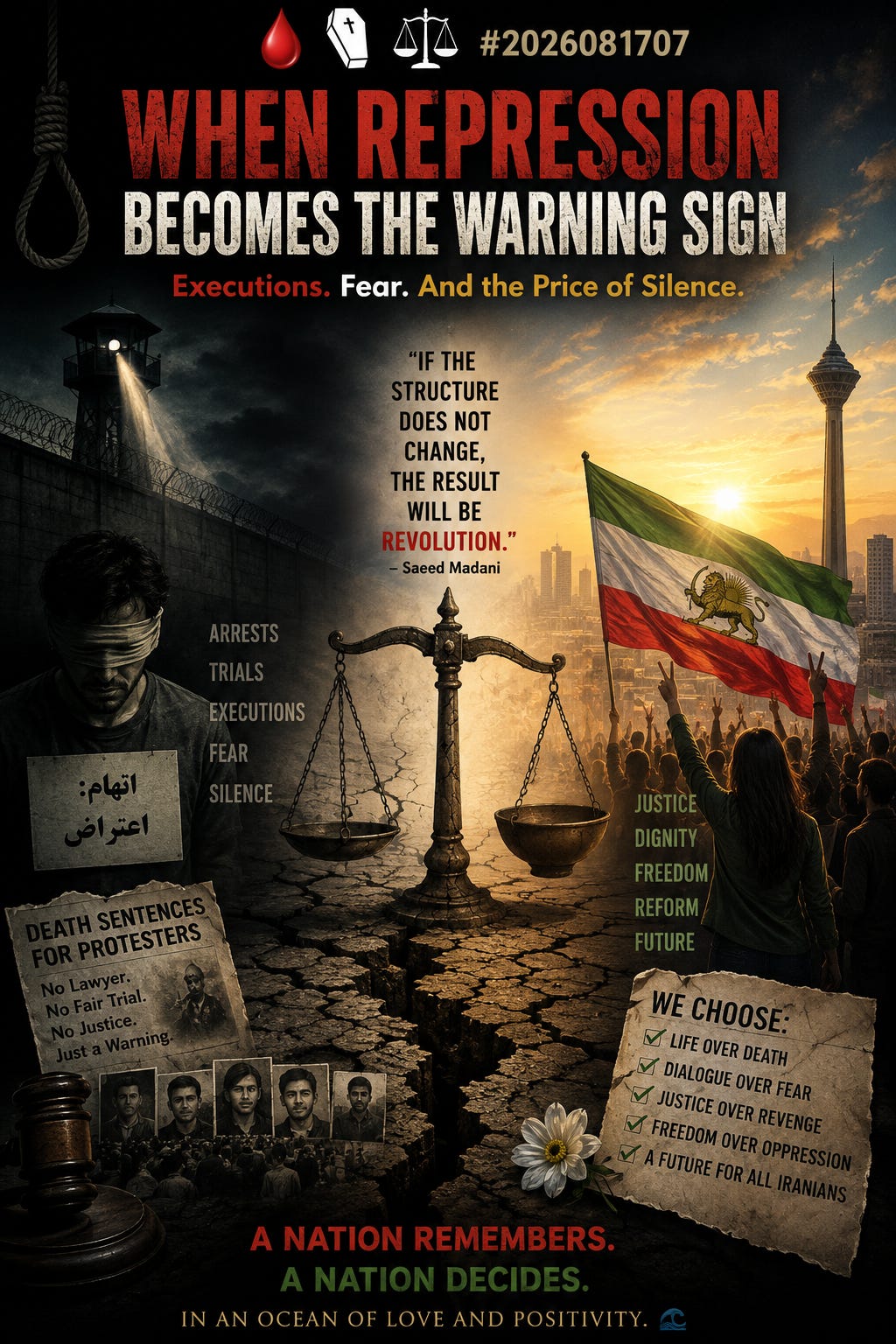
🩸 ⚰️ ⚖️ #2026081707 — When Repression Becomes the Warning Sign
Executions, protest repression, and the possibility that extreme punishment may accelerate the political breaking point it is meant to prevent
A government facing unrest has several choices.
It can listen.
It can reform.
It can negotiate.
It can attempt to outlast the anger.
Or it can increase the price of resistance until citizens become too afraid to resist.
The material examined for this report describes Iran moving increasingly toward that final option.
The source discusses arrests connected to protests, rapid death sentences, allegations of defendants receiving inadequate access to lawyers, and comments from sociologist Saeed Madani warning that continued political rigidity could eventually produce not stability, but a violent revolution.
That creates one of the oldest paradoxes in politics:
Can repression save a political system—or does enough repression eventually become the mechanism that destroys it?
The Logic of Fear
Repression has an obvious short-term logic.
If protesting carries little personal risk, more people may protest.
Increase the penalty, and participation becomes more expensive.
Arrest people.
Lengthen prison sentences.
Remove employment opportunities.
Threaten families.
Control communication.
And at the extreme end:
execute people.
The political calculation is straightforward.
If one person receives an extreme punishment, thousands of others may reconsider whether resistance is worth the risk.
Fear becomes preventative policing.
The government does not have to arrest everyone.
It needs only to make everyone imagine what could happen if they become the next person arrested.
The Cases Described in the Source
The material cites Saeed Madani discussing a protest-related case in which several people were arrested and some were reportedly executed only months later.
The source describes accusations involving participation in protests and stone throwing, and says some defendants lacked adequate legal representation during proceedings that resulted in death sentences.
These are serious claims.
The source presents them as examples of an increasingly punitive approach toward dissent.
The underlying issue is larger than any single case.
When political protest and capital punishment begin appearing in the same sentence, the relationship between citizen and state changes fundamentally.
A protest is no longer merely an act of dissent.
It becomes an encounter with mortality.
What Does an Execution Communicate?
An execution carries more than one message.
The official message may be:
Certain actions have consequences.
But citizens can hear another message:
The state considers resistance an existential threat.
And opponents may hear yet another:
The system believes it cannot survive ordinary dissent.
That interpretation matters.
Because fear and weakness sometimes look similar from the outside.
A confident government may tolerate criticism because it expects to survive it.
A frightened government may treat even minor acts as existential dangers.
The more severe the punishment, the more citizens may ask why the government believes such punishment is necessary.
The Stone and the State
One of the most disturbing elements in the source is the discussion of protesters allegedly receiving death sentences in cases involving throwing stones at security personnel.
The material says multiple defendants were sentenced to death and alleges that some lacked even appointed counsel.
Whatever the exact facts of individual cases, the disparity between act and punishment becomes politically significant.
A stone can injure.
Violence against individuals should not simply be dismissed as protest.
But when capital punishment enters cases tied to street confrontation, proportionality becomes central.
The question is no longer only:
Did the protester commit an offense?
It becomes:
What does the severity of punishment reveal about the state’s objective?
Punishing an individual act is one thing.
Creating a nationwide lesson is another.
Punishment as Political Theater
Every authoritarian system understands the audience.
A prosecution involves a defendant.
A political prosecution involves millions of spectators.
The courtroom may decide what happens to one individual.
But television coverage, official announcements, social-media clips, family testimony, and rumors spread the consequences throughout society.
The real audience may therefore not be the accused.
It may be everyone watching.
The objective becomes:
Do not become this person.
That is why highly visible punishment can be more politically useful than thousands of quiet arrests.
One body can become a warning to a nation.
But Fear Does Not Always Produce Obedience
This is where repression becomes unpredictable.
Fear can suppress resistance.
But fear can also transform into anger.
A person may tolerate economic hardship.
They may tolerate censorship.
They may tolerate corruption.
They may even tolerate humiliation.
But the death or imprisonment of a relative, friend, classmate, coworker, or neighbor can fundamentally change the emotional calculation.
Political grievances are abstract until they acquire a face.
Then politics becomes personal.
A family that once wanted stability may become permanently hostile to the state.
A neighborhood that once avoided politics may remember an execution for decades.
A generation raised around fear may eventually decide it has nothing left to protect.
Saeed Madani’s Warning
The source gives particular attention to sociologist Saeed Madani, described there as a republican and reform-oriented figure who had recently been released after years in prison.
Madani argues that Iran’s economic, social, cultural, and even religious indicators point toward a serious decline.
More importantly, he warns that if the governing structure refuses to retreat from its present course, the result may ultimately be revolution—and potentially a violent one.
The importance of this warning is not that revolution is inevitable.
It is that the warning comes from someone arguing against violent political rupture.
The message is effectively:
reform may be the mechanism that prevents revolution.
That is a very different argument from revolutionary propaganda.
Reform as a Pressure Valve
Political systems sometimes misunderstand compromise.
They interpret concessions as weakness.
But reform can function as engineering.
A pressure vessel has limits.
Pressure rises.
A valve releases enough energy to prevent catastrophic failure.
Political institutions can work the same way.
Elections.
Independent courts.
Free media.
Legal protest.
Political competition.
Accountable government.
These mechanisms allow anger to leave the system without destroying the container.
Remove enough pressure valves and the pressure does not disappear.
It accumulates.
Repression can therefore create the appearance of stability while storing instability underneath.
The Quiet Street Problem
An empty street does not necessarily mean public satisfaction.
It may mean fear.
That difference is extremely important.
A government can look outside and conclude:
There are fewer demonstrations.
Therefore our policy worked.
But the actual sequence could be:
There are fewer demonstrations.
Because the cost became unbearable.
The anger remains.
The grievances remain.
The distrust remains.
The economic problems remain.
The political opposition remains.
Only its visibility changes.
That creates what may be the most dangerous political illusion of all:
mistaking silence for consent.
The Mathematics of Repression
Imagine a society with one million dissatisfied citizens.
Perhaps only 10,000 are initially willing to protest.
Repression reduces that number to 2,000.
The government sees success.
But suppose every one of those arrests affects ten relatives, friends, coworkers, and neighbors.
Suppose executions turn individual cases into symbols.
Suppose stories circulate.
Suppose families lose faith in the possibility of justice.
Then repression may reduce visible resistance while expanding invisible hostility.
The street gets quieter.
The political foundation gets weaker.
Both can happen simultaneously.
When People Stop Expecting Justice
The rule of law depends heavily on expectation.
Citizens need not believe every court decision is correct.
But they must generally believe there is a process.
A lawyer.
Evidence.
Appeal.
Proportional punishment.
Some separation between accusation and conviction.
When political cases are perceived as predetermined, the courtroom stops functioning psychologically as a court.
It becomes another arm of political power.
Once that belief spreads, citizens stop asking:
Will justice protect me?
They begin asking:
How do I protect myself from justice?
That reversal is dangerous for any state.
Because legal legitimacy is one of the strongest barriers between political conflict and political violence.
Martyrs Are Politically Difficult to Control
Execution eliminates an opponent physically.
It may strengthen the opponent symbolically.
History contains countless cases in which states attempted to erase political threats and instead created martyrs.
A living dissident can make mistakes.
They can change opinions.
They can become unpopular.
They can contradict themselves.
They can lose followers.
A dead dissident cannot.
Memory edits differently.
Death freezes a person at the moment of conflict.
That is why executions can have effects far beyond the courtroom.
The state controls the sentence.
It does not control the memory.
The Generation That Watches
There is another audience that matters.
Young Iranians.
A generation watching arrests, prison sentences, executions, economic deterioration, internet restrictions, political division, and emigration faces a different psychological environment from earlier generations.
They are not simply evaluating the government.
They are evaluating whether there is a future inside the system.
If the answer becomes no, three paths usually remain:
leave,
submit,
or resist.
Large-scale emigration represents the first.
Political withdrawal represents the second.
The third is the one governments fear.
And the more difficult the first two paths become, the more attractive the third may eventually appear.
Violence Produces Violence
This does not mean violent resistance is inevitable or desirable.
It means political violence often develops reciprocally.
State violence can radicalize opposition.
Opposition violence can justify additional state violence.
Additional state violence radicalizes more opposition.
A cycle begins.
Each side points to the previous act as justification for the next one.
Eventually both sides claim self-defense.
The original political dispute becomes secondary.
Revenge takes over.
That is precisely the outcome a peaceful political transition should attempt to avoid.
The Reformist Dilemma
Figures such as Saeed Madani occupy an increasingly difficult position.
They can warn the government:
Change before the system breaks.
At the same time, they can warn protesters:
Revolution may become violent and destructive.
This places reformists between two groups that increasingly distrust them.
The government may consider them too oppositional.
Revolutionaries may consider them too cautious.
Yet historically, such middle positions can become essential if a society reaches transition.
Someone eventually has to negotiate.
Someone has to prevent revenge.
Someone has to design institutions.
Someone has to convince armed actors to stand down.
Someone has to persuade enemies that they can coexist.
The middle looks weak until everyone needs a bridge.
What Happens When the Bridge Disappears?
If governments imprison reformers while radicals dismiss reformers, the political center can collapse.
Then only two forces remain:
the state,
and the revolution.
No mediator.
No trusted channel.
No negotiated exit.
No mutually recognized institutions.
The confrontation becomes binary.
One side must win.
The other must lose.
That is precisely when political transitions become most dangerous.
A government that eliminates moderate opposition can therefore unintentionally manufacture radical opposition.
The Breaking Point Cannot Be Predicted Precisely
There is always temptation to predict the moment.
Next month.
Next protest.
Next execution.
Next economic shock.
Political systems rarely collapse on schedule.
They can survive conditions that appear impossible.
Then suddenly fail after an event that seems comparatively small.
The problem is accumulation.
Every arrest.
Every execution.
Every economic disappointment.
Every censorship decision.
Every family leaving the country.
Every political humiliation.
Every broken promise.
Each becomes another layer.
The final event may not be the biggest event.
It may simply be the event that arrives when nothing more can be absorbed.
The Red Blood Perspective
The most important question is not whether repression can stop protests.
It can.
History shows that fear is powerful.
The important question is what repression leaves behind after the street becomes quiet.
If the answer is legitimacy, stability has been restored.
If the answer is buried rage, the silence may be temporary.
A political system should be most cautious precisely when its streets become quiet after extreme punishment.
Because there are two kinds of silence.
The silence of satisfaction.
And the silence of people remembering.
The state can measure arrests.
It can count protests.
It can monitor slogans.
It can block websites.
It can imprison leaders.
What it cannot easily measure is the moment when enough ordinary citizens privately decide:
This can no longer continue.
That is the political breaking point.
And by the time it becomes visible, it may already have occurred.
Ocean of Love and Positivity Perspective
No political disagreement should require another family to bury a child.
No government should need executions to prove its legitimacy.
And no opposition should celebrate violence merely because the victim wears the uniform of the other side.
A country belongs to everyone who must live in it after the conflict ends.
Police officers.
Protesters.
Religious citizens.
Secular citizens.
Government employees.
Opposition activists.
Those who resisted.
Those who remained silent.
The objective cannot be exchanging one cycle of revenge for another.
The highest form of political victory is not defeating an enemy.
It is reaching the day when former enemies no longer need to fear one another.
Iran still has choices.
Repression is one.
Revolution is another.
But somewhere between surrender and bloodshed remains the hardest path:
justice,
accountability,
freedom,
transition,
and reconciliation.
That path requires more courage than execution.
And more strength than revenge.
In an Ocean of Love and Positivity.
🩸🌊✨ Fantastic!
⚖️
The Paradox of Repression and the Breaking Pointof Resistance
Aug 17, 2026
This text explores the dangerous paradox of political repression within Iran, examining how extreme state violence and executions may inadvertently trigger the revolutionary collapse they are intended to prevent. While the government uses fear as a tool for control, the source argues that such measures often transform public grievances into a deep-seated, invisible rage that erodes the state’s legitimacy. Sociologist Saeed Madani warns that refusing to reform eliminates necessary political pressure valves, leaving a binary struggle between the state and radicalized resistance. The analysis suggests that while silencing dissent can create an illusion of stability, it often creates martyrs and radicalizes a new generation that no longer sees a future within the current system. Ultimately, the source advocates for justice and reconciliation as the only sustainable alternatives to a cycle of escalating violence and inevitable political breaking points.


