


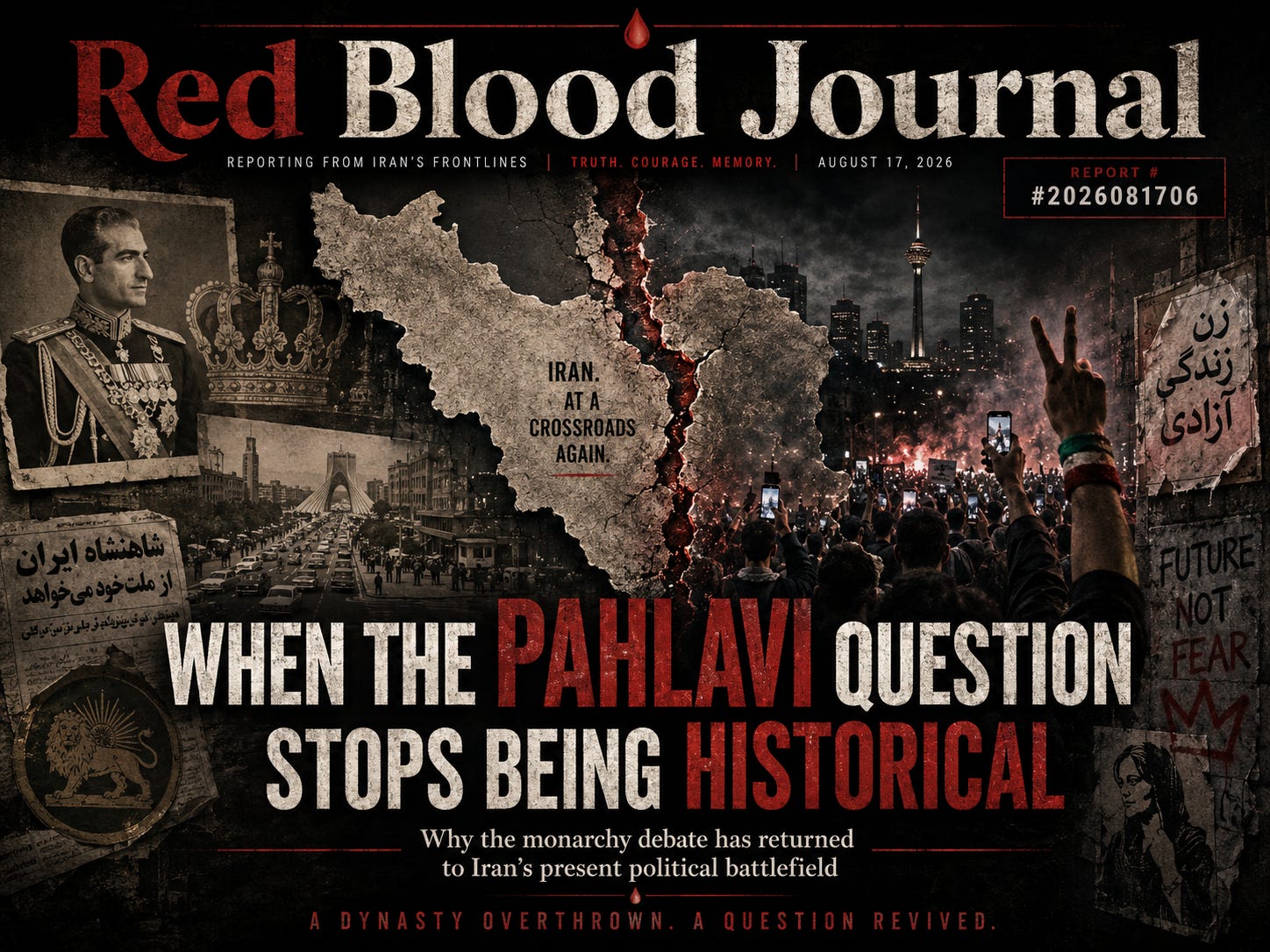
🩸 👑 #2026081706 — When the Pahlavi Question Stops Being Historical
The return of the Pahlavi name to Iran’s political battlefield may say as much about the Islamic Republic as it does about monarchy.
For decades, the argument over the Pahlavi dynasty was largely treated as a debate about the past.
Supporters remembered modernization, stability, secular government, economic development, and a country more connected to the world.
Critics remembered authoritarianism, SAVAK, political repression, inequality, and a monarchy ultimately overthrown by revolution.
The argument seemed historical.
But the material examined for this report describes something different.
It portrays the Pahlavi name becoming an increasingly active part of Iran’s present political conflict.
Not merely in exile.
Not merely among older Iranians.
But through slogans, social-media activity, arrests, forced confessions, public declarations of monarchist support, and what the source interprets as growing anxiety inside the Islamic Republic about the political appeal of Reza Pahlavi.
The central question is therefore no longer simply:
Was the monarchy good or bad?
The more important question may now be:
Why has the Islamic Republic allowed the monarchy it overthrew to become politically relevant again?
A Strange Historical Reversal
The Islamic Republic was born in 1979 through the destruction of the Pahlavi monarchy.
Its revolutionary legitimacy depended heavily on the argument that the old system had failed.
The Shah represented everything the revolution claimed to reject:
monarchy,
Western influence,
elite rule,
political repression,
social inequality,
and dependence on foreign powers.
For the revolutionary system, Pahlavi was supposed to become a closed chapter.
A warning from history.
A defeated dynasty.
A political corpse.
Yet nearly half a century later, the source describes Iranian authorities arresting citizens over something as small as liking or commenting on Pahlavi-related social-media posts.
That raises an unavoidable question.
Why police a dead idea?
When a Like Becomes Political Evidence
The source describes reports claiming that Iranian authorities consider liking, commenting on, or sharing Pahlavi-related material potentially criminal or grounds for arrest.
It cites a report that law-enforcement authorities had publicized cases involving people accused of interacting with posts connected to Reza Pahlavi, Iran International, and images of the Pahlavi family.
The material further describes a case involving a laborer in a small city who was reportedly detained over social-media activity associated with Pahlavi content.
In the recorded exchange cited by the source, questions focus on likes, comments, posts, and even whether a child had access to the phone involved.
If accurate, the significance goes beyond the individual case.
A government usually does not devote security resources to slogans it considers irrelevant.
The very act of criminalizing symbolic support can amplify the symbolism.
A like becomes a political act.
A comment becomes resistance.
A photograph becomes evidence.
And a slogan the government wants buried becomes more powerful precisely because the government is frightened enough to punish it.
“Javid Shah” and the Politics of Forbidden Words
The source describes repeated use of the slogan “Javid Shah” — “Long Live the Shah” and claims that individuals have been arrested or pressured over using it.
It also describes a law-enforcement social-media post that allegedly attracted so many pro-Pahlavi comments that authorities ultimately removed it.
This is politically interesting for a simple reason.
Slogans measure something different from polling.
A poll asks what a person believes in private.
A forbidden slogan measures what someone is willing to risk saying publicly.
That does not prove that the slogan represents a majority.
It does not establish that monarchism dominates Iranian political opinion.
And it certainly does not settle the question of what form of government Iranians would choose in a free election.
But it does establish something else if the reports are accurate:
the Pahlavi name still possesses enough political energy to produce confrontation between citizens and the state.
That alone makes it relevant.
Shahré Aghdashloo Says It Openly
The source places considerable emphasis on actress Shahré Aghdashloo openly identifying herself with the monarchist current during an interview.
The material contrasts her position with a republican interviewer and presents the exchange as evidence that support for the monarchy is becoming less socially taboo among some Iranians abroad.
This matters because political movements often pass through stages.
First they are forbidden.
Then whispered.
Then debated.
Then publicly defended.
Eventually, they may become normalized enough that public figures no longer feel compelled to disguise their position.
Aghdashloo’s declaration does not prove a national political trend by itself.
But it illustrates a broader transformation described throughout the source:
monarchism is no longer functioning only as nostalgia. It is functioning as an active political identity.
Nostalgia Is Not the Same as Political Support
There is an important distinction.
Some older Iranians remember the Pahlavi period through lived experience.
The source describes those memories in terms of peace, stability, prosperity, and economic opportunity.
Those memories may influence political preferences today.
But nostalgia is selective.
Every generation remembers certain parts of its past more strongly than others.
Economic stability may be remembered more clearly than political repression.
Social freedom may be remembered more clearly than inequality.
Likewise, critics may remember repression more clearly than modernization.
So nostalgia should not automatically be treated as proof that restoration is the best political model.
But it can still become powerful when the present becomes unbearable.
A population rarely compares the current system with an abstract ideal.
It compares the current system with whatever alternatives it knows.
For older Iranians, one of those alternatives is lived memory.
For younger Iranians, it may be inherited memory.
The Islamic Republic Created Its Own Comparison
This may be the deeper irony.
The Islamic Republic has spent decades condemning the Pahlavi era.
But every failure of the current system creates another comparison with the system it replaced.
Inflation invites comparison.
International isolation invites comparison.
Social restrictions invite comparison.
Currency collapse invites comparison.
Brain drain invites comparison.
Women’s rights invite comparison.
Foreign policy invites comparison.
Infrastructure invites comparison.
The revolution intended to make the monarchy permanently illegitimate.
Instead, the performance of the Islamic Republic has repeatedly reopened the question:
Was the system destroyed in 1979 actually worse than what replaced it?
That question alone is politically dangerous for a regime built on revolutionary legitimacy.
Reza Pahlavi Is Not His Father
Another distinction is essential.
Reza Pahlavi is not Mohammad Reza Shah.
He has not ruled Iran.
He does not possess his father’s historical record as a head of state.
Therefore support for him today can mean several different things.
For some, it may mean literal restoration of constitutional monarchy.
For others, it may mean support for a transitional figure.
For others, it may simply mean rejection of the Islamic Republic.
Some may admire the Pahlavi family but still want a republic.
Some may view Reza Pahlavi as useful only during a transition.
Some may support him personally while rejecting hereditary rule.
These distinctions matter.
Political movements frequently appear more unified from a distance than they actually are.
A slogan can gather people who want very different final outcomes.
Is Support for Pahlavi Growing?
The source answers this question confidently.
It claims that the monarchist movement is gaining strength and that increased government repression is pushing more people toward it.
That conclusion should be treated carefully.
The material itself does not provide a comprehensive nationwide poll establishing the percentage of Iranians who support monarchy, Reza Pahlavi, a republic, reform of the Islamic Republic, or some other political model.
Therefore the evidence presented here supports something narrower:
There are visible expressions of Pahlavi support.
Authorities appear to treat some of those expressions as politically threatening.
Public figures openly identify with monarchism.
Pro-Pahlavi slogans and social-media activity remain part of Iran’s political confrontation.
That is significant.
But it is not the same as proving majority support.
The difference should remain clear.
Repression Can Manufacture Popularity
There is another possibility worth considering.
Governments sometimes strengthen the very movement they attempt to suppress.
If someone is arrested merely for writing a slogan, the slogan acquires power.
If a photograph is banned, the photograph becomes meaningful.
If a political name cannot be spoken, speaking it becomes an act of courage.
This phenomenon has appeared repeatedly throughout history.
Repression converts ordinary symbols into forbidden symbols.
Forbidden symbols become resistance symbols.
Resistance symbols gain emotional value beyond their original political meaning.
Therefore some current Pahlavi support may not be driven entirely by detailed commitment to monarchy.
It may also function as the clearest available insult to the Islamic Republic.
In that sense, “Javid Shah” can mean more than:
I want a king.
It can also mean:
I reject the revolution that removed him.
Those are not necessarily the same statement.
The Government May Understand This Better Than Anyone
Authorities may therefore be responding not only to monarchism itself, but to what the Pahlavi name represents.
A competing historical narrative.
A competing national identity.
A competing flag.
A competing idea of Iranian modernity.
A competing claim to legitimacy.
And perhaps most importantly:
a political story that begins before the Islamic Republic.
Revolutionary governments often attempt to make themselves the beginning of history.
The return of an older political symbol threatens that monopoly.
If citizens begin imagining Iran without the Islamic Republic by remembering Iran before the Islamic Republic, the revolutionary state loses control over the political timeline.
The Two-Iran Problem
At the symbolic level, two different Irans are competing.
One Iran begins in 1979.
Its political vocabulary is revolution, resistance, Islamic government, anti-imperialism, martyrdom, and regional struggle.
The other Iran reaches backward.
It emphasizes Iranian nationalism, pre-Islamic history, secular identity, modernization, and the Pahlavi period.
These two identities do not merely disagree over policy.
They disagree over what Iran is.
That is why debates involving Pahlavi often become so emotional.
The argument is not simply over a constitution.
It is over national memory.
But There Is a Third Iran
There is also an important constituency often lost in this binary.
Iranians who reject both the Islamic Republic and restoration of monarchy.
Republicans.
Secular democrats.
Constitutionalists.
Leftists.
Liberals.
Federalists.
Nationalists.
Religious democrats.
And people who have no fixed ideological label but simply want accountable government.
The source itself later acknowledges tension between Pahlavi supporters and other opposition groups.
That division cannot be ignored.
If Iran eventually experiences political transition, the central challenge may not be defeating the Islamic Republic alone.
It may be preventing the opposition from turning transition into another battle over who owns Iran.
The Referendum Question
One way out of this conflict is conceptually simple, though politically difficult:
let Iranians decide.
Monarchy.
Republic.
Constitutional monarchy.
Parliamentary republic.
Presidential republic.
Whatever options survive a legitimate constitutional process.
A genuinely free referendum or election would convert political mythology into measurable consent.
That would also change the role of Reza Pahlavi.
Instead of asking whether he should be installed as Iran’s future ruler, the more democratic question becomes whether he can help create conditions under which Iranians freely choose their own system.
That distinction may determine whether the Pahlavi name becomes a bridge—
or another source of division.
What the Islamic Republic May Fear Most
Perhaps the greatest threat is not Reza Pahlavi himself.
It may be the normalization of imagining a post–Islamic Republic Iran.
Once citizens begin openly debating who comes next, something important has already changed.
The government is no longer being treated as permanent.
It has become one political era among others.
That is psychologically significant.
Every durable political system depends partly on the assumption that it will still exist tomorrow.
When society begins discussing transition as a practical question rather than fantasy, permanence weakens.
The future becomes imaginable.
The Red Blood Perspective
The Pahlavi question should not be reduced to propaganda from either side.
The Islamic Republic wants the name associated permanently with tyranny and foreign dependence.
Some monarchists want the name associated almost entirely with prosperity and national greatness.
Neither simplified picture is sufficient.
The more important development is happening in the present.
Iranian citizens are again using the Pahlavi name as a political symbol.
Authorities appear sufficiently concerned about that symbol to police online interaction around it.
Public figures increasingly discuss monarchism openly.
Opposition groups are fighting over Pahlavi’s role.
And Reza Pahlavi remains part of almost every serious conversation about a possible transition.
That does not prove Iran wants a king.
It proves something more basic:
the revolution has failed to bury the dynasty it overthrew.
Forty-seven years later, the argument has returned.
And history has stopped behaving like history.
Ocean of Love and Positivity Perspective
Iran does not need another political system imposed upon it.
Not by clerics.
Not by monarchists.
Not by foreign governments.
Not by opposition organizations.
Not by nostalgia.
And not by fear.
The ultimate question should not be whether the Shah returns.
It should be whether the Iranian citizen finally becomes sovereign.
If Iranians freely choose monarchy, that choice belongs to them.
If they freely choose a republic, that choice belongs to them.
If they design something entirely different, that choice belongs to them too.
A political symbol becomes dangerous when people are forbidden from discussing it.
A political movement becomes legitimate only when people are free to reject it.
The strongest future for Iran would therefore not require destroying one political identity to save another.
It would create a country confident enough to place every idea before its citizens and ask the simplest democratic question of all:
What do you choose?
Then count every vote.
Protect every voter.
Accept the result.
And allow Iran’s future to belong to Iran.
In an Ocean of Love and Positivity.
🩸🌊✨ Fantastic!
👑
The Pahlavi Question: From History to Political Frontline
Aug 18, 2026
The provided text explores how the Pahlavi dynasty has evolved from a historical memory into an active political force within modern Iran. It suggests that the Islamic Republic’s systemic failures have inadvertently revitalized the monarchy’s appeal, transforming forbidden slogans and social media “likes” into potent acts of civil resistance. While the report acknowledges that nostalgia for past stability drives some of this momentum, it emphasizes that support for Reza Pahlavi often serves as a symbolic rejection of the current regime rather than a uniform desire for restoration. The narrative highlights a profound clash of national identities, where the government’s attempt to criminalize monarchist symbols only amplifies their perceived power. Ultimately, the text argues that the true challenge for Iran’s future is moving beyond these binary conflicts toward a democratic process where citizens can freely choose their own governance. This resurgence signifies that the 1979 revolution failed to permanently bury the era it replaced, making the Pahlavi question a central element of contemporary political discourse.


