


🩸 RedBloodJournal.com
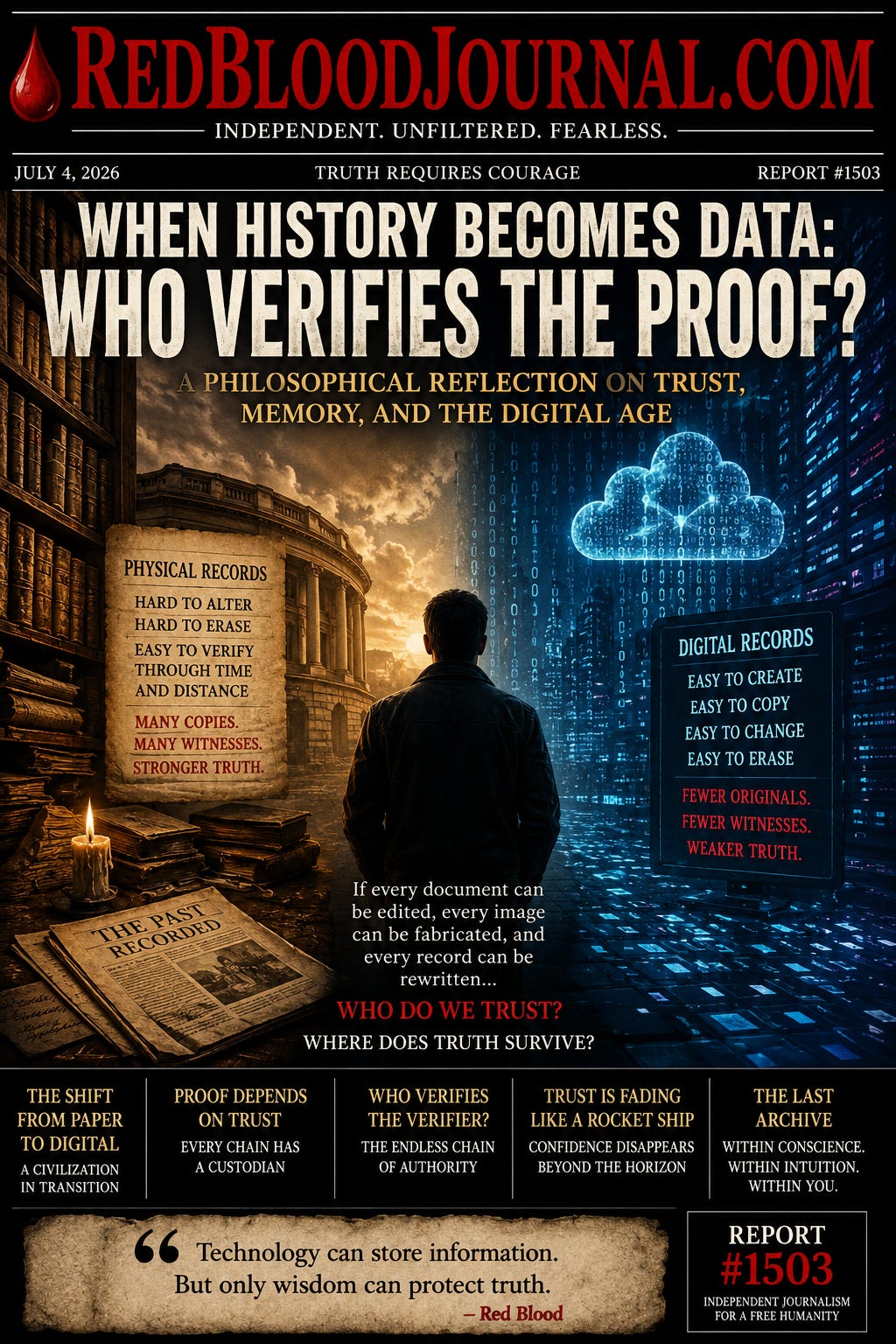
#1503 – When History Becomes Data: Who Verifies the Proof?
A Philosophical Reflection on Trust, Memory, and the Digital Age
By Red Blood
July 4, 2026
Introduction
Every civilization is built upon memory.
Without memory, there is no history. Without history, there is no experience. Without experience, each generation begins again, unable to learn from those who came before.
For thousands of years, humanity preserved its collective memory on paper, stone, parchment, photographs, maps, letters, journals, and books. These physical records allowed future generations to compare evidence from multiple independent sources. Although history has never been perfect, physical documents created a natural system of verification because countless copies existed in libraries, museums, private collections, universities, and family archives throughout the world.
Today, humanity is quietly entering a different age.
Our memory is becoming data.
This essay does not claim that history is being rewritten. Instead, it asks a question about the future: What happens when nearly all of humanity’s historical memory exists only in digital form?
History Is More Than Information
When we strive to be logical, wise, and honest with ourselves, we naturally turn to documented history.
Documents become evidence.
Evidence becomes knowledge.
Knowledge shapes civilization.
Yet every document ultimately depends upon trust.
Someone created it.
Someone preserved it.
Someone archived it.
Someone verified it.
Every chain of evidence rests upon a chain of human stewardship.
For centuries, the existence of countless independent physical copies made widespread alteration extraordinarily difficult. If one archive changed a document, another archive could reveal the difference. History protected itself through redundancy.
The Digital Transformation
Digital technology has transformed civilization in extraordinary ways.
Knowledge is more accessible than at any other time in history.
Entire libraries can be stored inside a device.
Research crosses continents in seconds.
Digital preservation has rescued countless documents that might otherwise have disappeared forever.
Yet digital information possesses a unique characteristic.
It can be copied perfectly.
It can also be modified perfectly.
Unlike aging paper, fading ink, handwritten notes, or physical artifacts, digital files often leave no visible indication that they have changed.
As original paper documents gradually disappear and digital versions become the primary historical record, future generations may find themselves increasingly dependent upon the integrity of the systems that preserve those records.
The issue is not technology itself.
The issue is dependence.
Proof Depends Upon Trust
Most people believe they rely on proof.
But proof has never existed independently.
Every photograph has a source.
Every archive has a custodian.
Every scientific paper has authors.
Every database has administrators.
Every historical record passes through human hands before reaching ours.
Proof has always depended upon trust in those preserving it.
The digital age does not eliminate this reality.
It simply makes it easier to forget.
Who Verifies the Proof?
As artificial intelligence advances, computers can generate convincing photographs, voices, videos, documents, and even historical-looking records.
These technologies offer remarkable benefits while also introducing new philosophical questions.
Not simply:
“Is this authentic?”
But:
“How do I know?”
And perhaps even more importantly:
Who verifies the proof?
Every answer ultimately leads to another person, another institution, another archive, another algorithm, or another system asking for our trust.
Trust Is Fading Like a Rocket Ship
Perhaps the greatest transformation is not technological.
It is psychological.
Trust is fading away like a rocket ship disappearing into the distance.
Across much of the world, confidence in governments, media, corporations, financial institutions, technology companies, and many traditional authorities has weakened.
Whether every criticism is justified is not the central issue.
The perception itself changes society.
Once trust begins to erode, rebuilding it is often far more difficult than losing it.
As direct experience becomes increasingly replaced by digital information, people naturally begin asking who controls the information they receive.
The Last Archive
Suppose a future arrives where every photograph can be fabricated.
Every recording synthesized.
Every document edited.
Every historical record exists only as data.
Where does certainty remain?
Perhaps nowhere outside ourselves.
This is not a rejection of science.
It is not a rejection of history.
It is not an invitation to abandon evidence.
Rather, it is an invitation to recognize that every external source has limits and that genuine wisdom requires more than passive acceptance.
When external certainty becomes increasingly difficult to verify, each individual may become more responsible for developing discernment.
Reason.
Conscience.
Reflection.
Intuition.
Intuition should never replace evidence.
Evidence should never silence conscience.
Wisdom may emerge from allowing both to work together.
Conclusion
Technology should preserve humanity’s memory—not become its only memory.
The more independently history can be verified through physical archives, digital preservation, distributed records, and open examination, the stronger civilization becomes.
Yet perhaps the greatest lesson of the digital age is that proof itself rests upon trust.
When trust begins to disappear, evidence alone may no longer satisfy the human search for certainty.
At that point, the responsibility returns to every individual—not to believe everything, nor to reject everything, but to think critically, compare evidence honestly, remain willing to change one’s mind, and preserve the integrity of one’s own conscience.
Perhaps the final archive has never been stored in paper or silicon.
Perhaps it has always existed within the quiet conversation every human being has with themselves.
The future may depend not only on preserving information, but on preserving the wisdom to ask one timeless question:
Who verifies the proof?
This article presents a philosophical perspective intended to encourage reflection on trust, historical preservation, and the nature of evidence in the digital age. Readers are encouraged to examine multiple viewpoints, evaluate evidence carefully, and reach their own conclusions.
📜 The Custodians of Memory:
Who Verifies the Proof?
Jul 4, 2026
This philosophical essay examines how the transition from tangible artifacts to digital data fundamentally alters the way humanity preserves and verifies its collective history. While physical records provided a natural system of redundancy and proof, digital information is uniquely susceptible to perfect modification without leaving a trace. The author argues that as artificial intelligence complicates our ability to distinguish fact from fabrication, the traditional chain of stewardship becomes increasingly fragile. Ultimately, the text suggests that because all evidence relies on human trust, the erosion of institutional confidence places a new burden on individual discernment. Future generations must therefore rely on their own critical reasoning and conscience to navigate a world where external certainty is no longer guaranteed.


