


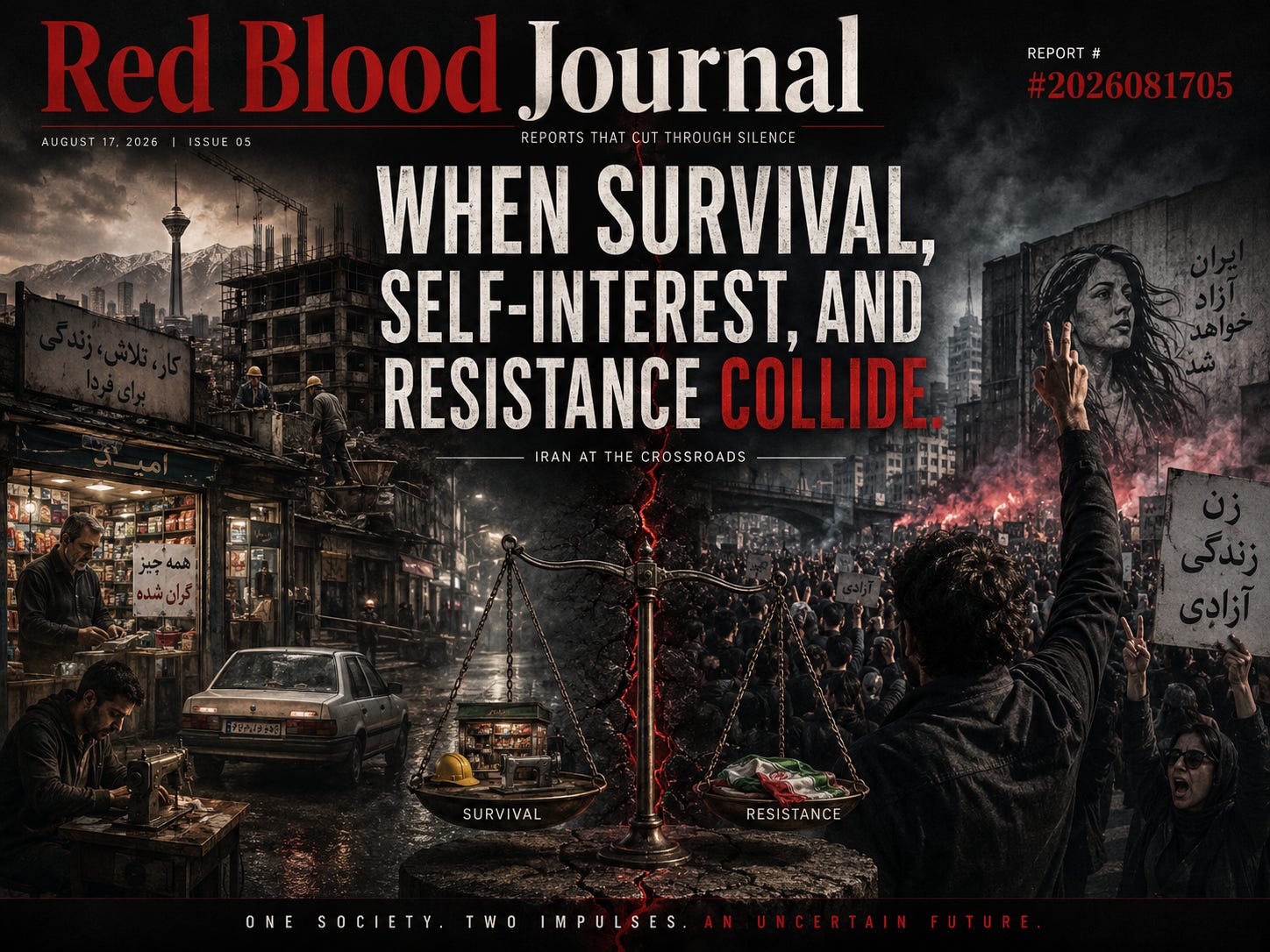
🩸 ⚖️ #2026081705 — When Survival, Self-Interest, and Resistance Collide
Iranian society is not divided only by ideology. It is increasingly divided by what people believe they must protect.
A business.
A paycheck.
A family.
A political conviction.
A memory of the past.
A hope for a different future.
The source material examined for this report describes an Iranian society being pulled apart by a conflict more complicated than simply government versus opposition.
It portrays one group becoming increasingly cautious as conditions worsen, holding more tightly to whatever stability, income, property, or position remains.
Another group becomes more impatient and concludes that preserving the existing order merely extends the suffering.
The first asks:
What will happen to our lives if everything collapses?
The second asks:
What will happen to our lives if nothing collapses?
That may be one of the deepest political divisions in Iran today.
The Politics of Having Something to Lose
Political analysis often assumes that people choose sides because of ideology.
Conservative.
Reformist.
Monarchist.
Republican.
Religious.
Secular.
But daily life introduces another political force that can be more powerful than ideology:
self-preservation.
Someone operating a business may fear prolonged strikes.
A property owner may fear unrest.
A professional may fear losing a position.
A parent may fear instability.
Someone whose income depends directly or indirectly on the existing system may fear what comes after it.
None of this necessarily means that person loves the government.
They may dislike it intensely.
But disliking a political system and being willing to risk everything to remove it are two entirely different calculations.
That is where politics meets survival.
“I Just Want to Get Back to Work”
The source includes a discussion involving actress Shahré Aghdashloo in which she recalls disputes with people frustrated that political unrest and protests were interfering with business and ordinary life.
One example describes someone effectively asking why protests had to continue when a construction project and livelihood were being disrupted.
That complaint sounds simple.
It is not.
Behind it sits an enormous political question.
At what point does the desire for normal life become support for the conditions preventing normal life?
Consider the contradiction.
A citizen may say:
Stop protesting so the economy can function.
The protester may answer:
We are protesting because the economy and society no longer function.
Both may believe they are protecting ordinary life.
They simply disagree about what is destroying it.
The Person Protecting the Shop
Imagine a shopkeeper.
He may hate corruption.
He may complain about inflation.
He may distrust officials.
He may privately believe the political system has failed.
But he also has inventory.
Rent.
Employees.
Debt.
Children.
If demonstrations close the street for two weeks, his political analysis becomes immediate.
It arrives as unpaid bills.
The protester outside sees political paralysis.
The shopkeeper inside sees tomorrow’s payroll.
One sees resistance.
The other sees insolvency.
Neither necessarily understands why the other seems unable to see what is obvious.
That is how political polarization becomes personal.
The Person Outside the Shop
Now imagine the protester.
Perhaps there is no business to protect.
No career worth preserving.
No realistic path to a home.
No confidence in the future.
Maybe university brought no opportunity.
Maybe wages cannot keep up.
Maybe someone was arrested.
Maybe a friend emigrated.
Maybe an entire generation feels that normal life has already disappeared.
To that person, the shopkeeper’s demand for stability may sound almost absurd.
Stability for what?
If the future looks closed, preserving the present loses its value.
The political cost-benefit calculation reverses.
The person with something to lose fears disruption.
The person who believes everything has already been lost may fear continuity more.
This Is Why Economic Conditions Become Political
A political system does not survive only because people believe in it.
Sometimes it survives because enough people still possess something that could be damaged by its disappearance.
Jobs.
Licenses.
Businesses.
Property.
Pensions.
Access.
Status.
Connections.
Predictability.
The source describes this divide directly: one part of society becomes more conservative as conditions worsen because it clings more tightly to its interests, while another becomes angrier and increasingly concludes that the government must go regardless of the cost.
That observation deserves more attention.
Because it means worsening conditions can initially produce two opposite political reactions.
One person radicalizes.
Another becomes more cautious.
The same crisis produces resistance in one citizen and fear of resistance in another.
Until the Water Reaches the Upper Deck
The source then introduces another important idea.
People who once could afford to distance themselves from political confrontation may eventually discover that economic deterioration reaches them too.
The report’s imagery is essentially that the water eventually rises to the upper levels of the ship: businesses and people previously insulated from the crisis begin encountering the same instability that others had experienced earlier.
That changes political behavior.
As long as the system works adequately for someone personally, reform or even silence can appear rational.
But when the system begins threatening that person’s property, career, mobility, business, education, communications, or children, neutrality becomes harder to maintain.
The political equation changes from:
What might I lose if the system falls?
to:
What will I lose if the system remains?
That is a dangerous moment for any government.
Shahré Aghdashloo and the Emotional Memory of Another Iran
The source uses Shahré Aghdashloo as part of a larger generational and political argument.
It portrays people who experienced Iran before the Islamic Republic as comparing today’s conditions with memories of greater stability, economic opportunity, peace, and social normality.
For some of them, support for a return toward the Pahlavi political tradition is connected not only to ideology but to remembered experience.
That distinction matters.
A younger Iranian may encounter the monarchy principally as history.
Someone older may compare two lived systems.
That does not make either interpretation automatically correct.
Memory can idealize the past.
History contains contradictions that nostalgia can erase.
But personal memory remains politically powerful because it provides a comparison.
A citizen who has experienced only the Islamic Republic asks:
Could something else work?
A citizen who remembers another political period may answer:
I have already seen something else.
Those are psychologically different political positions.
Monarchy Versus Republic Is Only Part of the Story
The source moves increasingly toward a monarchy-versus-republic argument.
But underneath that argument is another division that may be more fundamental.
People are not only debating who should rule.
They are debating what kind of risk is acceptable in changing rulers.
One faction may consider a dramatic transition necessary.
Another may fear that abrupt change could produce chaos.
Some believe Reza Pahlavi provides continuity and a recognizable transitional figure.
Others reject monarchy and want a republic.
Others still may oppose the present government while fearing both revolutionary upheaval and restoration of the old order.
So Iran’s political landscape is not simply:
Islamic Republic versus Pahlavi.
There are multiple questions hidden inside it:
Who governs?
How does transition occur?
Who guarantees order?
Who protects property?
Who protects minorities?
Who controls the military?
Who organizes elections?
What happens the morning after?
Those questions matter because revolutions are not lived as slogans.
They are lived as Tuesdays.
People still need electricity, hospitals, food distribution, banking, transportation, schools, salaries, police, and courts.
The Opposition Has Its Own Civil War
The source argues that political opposition itself has become deeply fragmented.
It claims that while supporters of the Pahlavi movement have focused on confronting the Islamic Republic, other opposition groups have often devoted significant energy to confronting Pahlavi supporters.
Whether that framing captures the entire opposition is debatable.
But the underlying problem is unmistakable.
Opposition movements frequently discover that agreeing on what they oppose is easier than agreeing on what should replace it.
Republican versus monarchist.
Secular versus religious.
Left versus right.
Federalist versus centralist.
Reform versus revolution.
Foreign assistance versus rejection of foreign involvement.
Each division creates another reason not to cooperate.
And every faction fears that helping remove the existing government might empower the wrong successor.
That produces a strange political paralysis:
Everyone wants change, but not everyone wants everyone else’s change.
When Politics Becomes Identity
The material also captures the emotional consequences of this fragmentation.
Friendships break.
People insult one another.
Families divide.
Political disagreement becomes a test of moral character.
The question stops being:
What do you believe?
It becomes:
What kind of person are you?
That transformation is dangerous.
Once political affiliation becomes identity, compromise begins to feel like betrayal.
Listening becomes weakness.
Changing one’s mind becomes humiliation.
And disagreement becomes evidence that the other person is evil, stupid, corrupt, traitorous, or selfish.
At that point society is no longer merely politically divided.
It becomes socially partitioned.
Self-Interest Is Not Always Corruption
There is an important distinction worth preserving.
Protecting one’s livelihood is not automatically corruption.
Someone worried about a restaurant, construction project, medical practice, pension, or children’s education is responding to legitimate responsibilities.
Political movements can make a serious mistake when they dismiss such people as cowards or collaborators.
Most human beings do not live principally as political activists.
They live as parents, workers, shopkeepers, teachers, engineers, drivers, nurses, students, and grandparents.
A successful political transition therefore has to answer the cautious person’s question:
What happens to my life?
Not only:
What happens to the regime?
Without that answer, fear becomes one of the strongest allies of the status quo.
But Self-Interest Can Become a Political Blindfold
The opposite is also true.
There is a point at which protecting personal comfort can require ignoring the suffering of others.
If repression occurs elsewhere, it is easy to demand stability.
If another family’s child is arrested, silence costs little.
If another neighborhood is suffering economically, normality can still feel normal.
If censorship affects someone else’s profession, it may remain abstract.
The moral calculation changes when the consequences reach one’s own door.
That is one of the uncomfortable themes running through the source.
Some people may tolerate a deteriorating political system because the deterioration has not yet reached the part of society they inhabit.
But political failure rarely respects economic boundaries forever.
Resistance Also Has a Cost
The resistance side should not be romanticized either.
Political upheaval can destroy lives.
Businesses collapse.
Capital leaves.
Supply chains break.
Violence escalates.
Government institutions can stop functioning.
Competing armed factions can emerge.
Foreign powers can intervene.
The history of revolutions is filled with examples in which removing one injustice did not immediately produce justice.
So when cautious citizens fear revolution, their fear is not necessarily propaganda.
There are real historical reasons to fear uncontrolled political collapse.
The responsible question is therefore not:
Resistance or stability?
It is:
Is there a path to change that preserves society while changing the political structure?
That may be the central challenge facing Iran.
A Transition Needs More Than Anger
Anger can begin a revolution.
It cannot run a water system.
A slogan can unite a crowd.
It cannot write a constitution.
A protest can weaken authority.
It cannot by itself guarantee an independent judiciary.
Removing a government is one problem.
Building legitimate institutions afterward is another.
This is why the debate between reform, revolution, monarchy, republic, and transitional leadership becomes so consequential.
The stronger the plan for what follows, the less frightening change becomes for the people still protecting something.
And the less frightening change becomes, the weaker the argument for preserving failure merely because the alternative is unknown.
The Red Blood Perspective
Perhaps Iran’s most important division is not between monarchists and republicans.
Not between religious and secular citizens.
Not even between supporters and opponents of the Islamic Republic.
It may be between two calculations of danger.
One side fears what happens if the system falls.
The other fears what happens if it does not.
Both calculations can contain legitimate concerns.
The political turning point arrives when enough people decide that continuity has become more dangerous than transition.
That threshold cannot easily be measured in polls.
It appears in behavior.
People stop protecting their silence.
Businesses stop assuming neutrality will protect them.
Professionals stop believing politics can remain outside the office.
Families stop believing they can wait for someone else to solve the problem.
The greatest threat to an entrenched political system is not necessarily when its enemies become angrier.
It is when the people who once preferred stability begin asking:
Stability for whom?
Ocean of Love and Positivity Perspective
A healthy society should not force citizens to choose between bread and dignity.
Between livelihood and conscience.
Between stability and freedom.
Between protecting one’s family and protecting someone else’s.
Political systems become dangerous when they turn neighbors into enemies and disagreement into identity.
But opposition movements can reproduce the same mistake when they demand ideological purity instead of building trust.
Iran’s future will ultimately belong to Iranians who disagree with one another.
Monarchists will still have to live beside republicans.
Religious citizens beside secular citizens.
Business owners beside workers.
Those who protested beside those who were afraid to protest.
Those who stayed beside those who left.
The purpose of political change cannot simply be deciding which group finally defeats the others.
It must be creating a country in which defeating one another is no longer necessary.
The strongest revolution may eventually be the one that makes room for the shopkeeper and the protester to realize they were both trying to save the same country.
In an Ocean of Love and Positivity.
🩸🌊✨ Fantastic!
⚖️
The Calculation of Change in Modern Iran
Aug 18, 2026
This text explores the profound internal fractures within Iranian society, moving beyond simple ideological clashes to examine the tension between self-preservation and political resistance. It highlights a critical divide between citizens who fear the economic chaos of a collapse and those who believe that maintaining the status quo is the greater threat. Through the perspectives of business owners and protesters, the analysis illustrates how financial stability often dictates political caution, even among those who dislike the government. The narrative suggests that a significant shift occurs only when the rising costs of continuity begin to outweigh the risks of a transition. Ultimately, the source emphasizes that a successful future depends on reconciling these competing fears and bridging the gap between fragmented opposition groups. Decisions in Iran are increasingly driven by the fundamental question of what is truly being protected or lost in the struggle for change.


