


🩸 RedBloodJournal.com
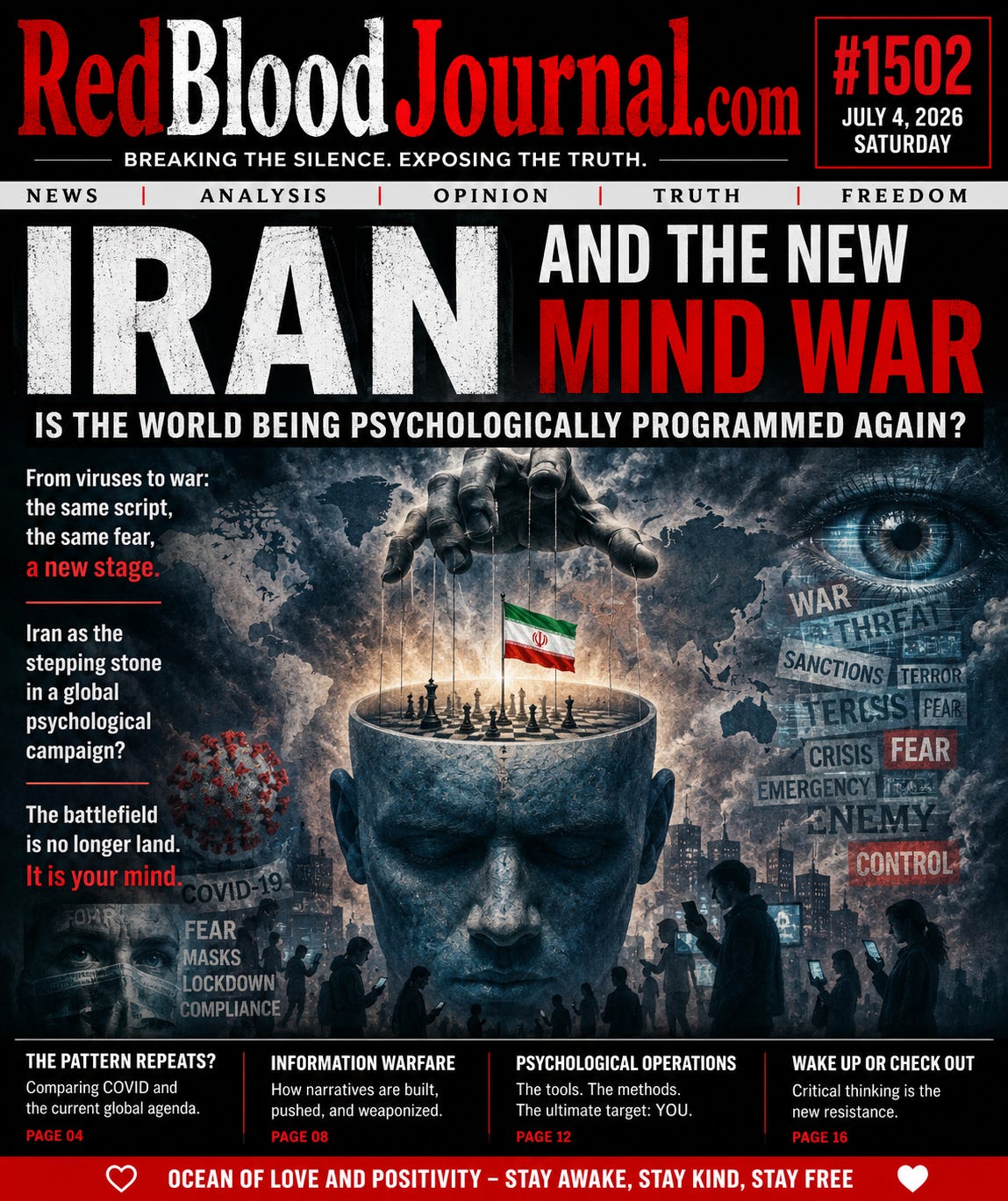
#1502 – Iran and the New Mind War: Is the World Being Psychologically Programmed Again?
By Red Blood
July 4, 2026
Editorial Opinion
This report represents the author’s opinion and analysis. It is not presented as established fact. Readers are encouraged to research multiple perspectives and draw their own conclusions.
Introduction
History has shown that wars are fought on many battlefields. Some are physical, involving soldiers, weapons, and territory. Others are economic, involving sanctions, trade, and financial pressure. Increasingly, however, the most important battlefield may be the human mind.
Military strategists and researchers now openly discuss concepts such as cognitive warfare and information warfare, where the objective is not simply to defeat an enemy’s military, but to influence how entire populations think, react, and make decisions. (NATO ACT)
From this perspective, one question emerges:
Is Iran becoming the next stepping stone in a global psychological campaign?
From Health Crisis to Geopolitical Crisis
During the COVID-19 pandemic, billions of people experienced unprecedented changes to daily life. Fear, uncertainty, emergency measures, media saturation, and rapidly changing information became part of everyday existence.
Many people believe those years permanently changed public behavior and demonstrated how quickly societies could adapt under conditions of sustained crisis.
Whether one believes those events unfolded naturally, through policy decisions, or through broader strategic forces, the psychological effects were undeniable.
Today, another global crisis dominates headlines—not a pandemic, but geopolitical conflict centered on Iran and the Middle East.
The Battle for Perception
This opinion proposes that the true battlefield may no longer be physical territory alone.
Instead, the objective may be perception itself.
Every breaking headline, military announcement, social media trend, leaked document, political speech, and emotional image competes for one resource:
Human attention.
The question is no longer simply:
“What happened?”
The deeper question becomes:
“How are people expected to interpret what happened?”
Iran as a Psychological Center of Gravity
In this interpretation, Iran becomes more than a nation involved in regional conflict.
It becomes a focal point through which global audiences experience fear, uncertainty, division, and emotional polarization.
Every new development creates another opportunity for competing narratives.
Every narrative creates another opportunity to influence public opinion.
Whether intentional or simply the consequence of modern media ecosystems, the effect is similar:
People increasingly react emotionally before carefully examining evidence.
The Permanent Crisis
Perhaps the greatest concern is not any single conflict.
It is the possibility that humanity is becoming accustomed to permanent crisis.
When every month introduces a new emergency, fear gradually becomes normal.
If crisis becomes permanent, extraordinary measures can begin to feel ordinary.
Whether this outcome is planned or simply emerges from modern technology and global politics is a question each reader must answer independently.
Final Thought
Modern wars may no longer begin with the first missile.
They may begin with the first narrative.
If the greatest battlefield is the human mind, then critical thinking, intellectual humility, and the willingness to question every source—including those that confirm our own beliefs—become essential forms of defense.
This article does not claim to possess definitive answers. It offers one perspective on a changing world and invites readers to examine the evidence, challenge assumptions, and reach their own conclusions.
Ocean of Love and Positivity
Regardless of politics, governments, or global conflicts, our greatest freedom remains the ability to think independently, seek truth honestly, and treat one another with humanity. A mind guided by curiosity rather than fear is difficult to control, and a society grounded in compassion is stronger than one driven by hatred.
🧠 Iran and the Architecture of Modern Cognitive Warfare
Jul 4, 2026
This editorial explores the concept of cognitive warfare, suggesting that modern conflicts are increasingly fought within the human mind rather than on physical battlefields. The author posits that the ongoing geopolitical tensions involving Iran serve as a strategic focal point to trigger emotional polarization and public uncertainty. By comparing current events to the psychological shifts seen during the COVID-19 pandemic, the text argues that global audiences are being conditioned to accept a state of permanent crisis. This environment allows narrative control to take precedence over factual reporting, making human attention the ultimate resource at stake. Ultimately, the source encourages readers to practice independent thinking and intellectual humility to defend against sophisticated psychological manipulation.


