


🩸 RedBloodJournal.com
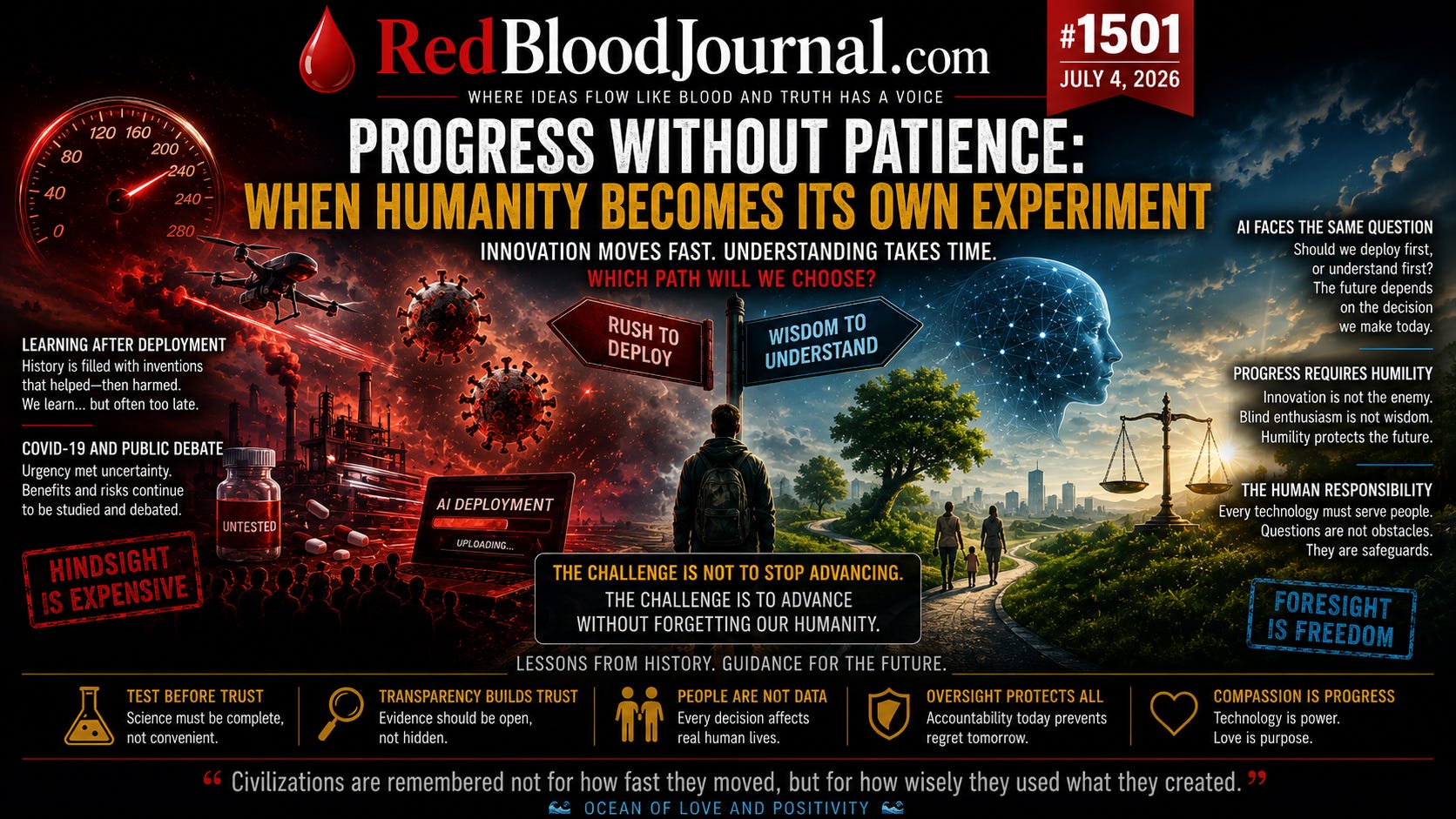
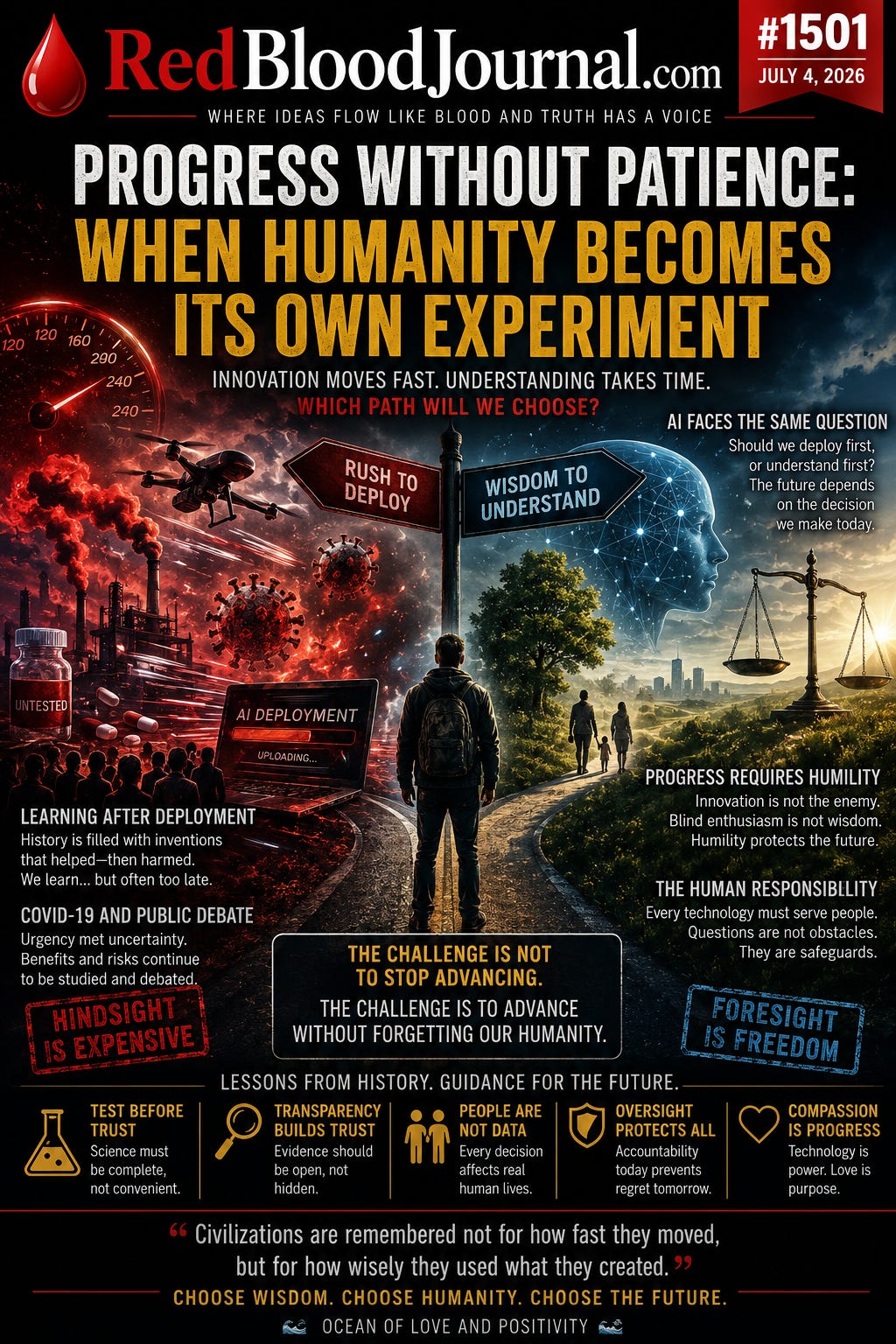
#1501 – Progress Without Patience: When Humanity Becomes Its Own Experiment
By Red Blood
July 4, 2026
Introduction
History repeatedly reminds us that humanity possesses an extraordinary ability to invent.
The greater challenge has always been learning when to pause.
From medicine to industry, from nuclear technology to artificial intelligence, many of history’s greatest breakthroughs have improved millions of lives. Others have revealed unforeseen consequences only after years or decades of widespread use.
The question is not whether progress should continue.
The question is whether wisdom can keep pace with innovation.
The Race to Be First
Modern civilization often rewards speed.
The first company.
The first discovery.
The first government.
The first investor.
The first nation to deploy a new technology.
Success is frequently measured by who arrives first rather than who understands the destination.
Yet history suggests that moving faster than our understanding can create problems that are difficult—or impossible—to reverse.
Learning After Deployment
Many technologies have initially been celebrated before later evidence revealed risks that were not fully appreciated during their early adoption.
History includes examples involving industrial chemicals, environmental pollutants, pharmaceuticals, and medical devices whose long-term effects became clearer only after years of use.
Those experiences shaped today’s systems of clinical trials, safety monitoring, environmental regulation, and engineering standards.
They also remind us that scientific knowledge evolves.
Understanding grows over time.
COVID-19 and Public Debate
The COVID-19 pandemic demonstrated how difficult decision-making becomes during a global emergency.
Vaccines were developed and deployed in record time while governments attempted to reduce illness and death.
Since then, researchers and health authorities have continued monitoring outcomes, identifying both benefits and rare adverse effects, updating recommendations as additional evidence accumulated.
Public debate continues over whether certain decisions balanced urgency, uncertainty, individual risk, and public benefit appropriately.
These discussions remain important because they influence how future public health emergencies may be managed.
Artificial Intelligence Faces the Same Question
Artificial intelligence now presents society with similar philosophical challenges.
Should powerful systems be deployed as quickly as possible?
Or should society first understand their long-term effects?
Will AI become humanity’s greatest educational tool?
Or will it introduce consequences that future generations wish had been considered more carefully?
No generation has possessed technology quite like this.
That makes thoughtful oversight more important than ever.
Progress Requires Humility
Innovation is not the enemy.
Fear is not the solution.
Blind enthusiasm is not wisdom.
Every generation inherits discoveries from those who came before it.
Every generation also inherits their mistakes.
The challenge is not to stop advancing.
The challenge is to advance while remaining willing to question, measure, test, and revise.
Humility is not an obstacle to progress.
It is one of its greatest safeguards.
The Human Responsibility
History shows that human beings are capable of remarkable compassion and remarkable error.
Because of that reality, every powerful technology deserves careful examination.
Questions should not be viewed as obstacles.
They are part of responsible progress.
Healthy skepticism, transparent evidence, open scientific discussion, and accountability help strengthen public trust rather than weaken it.
When innovation moves faster than understanding, society risks discovering the consequences only after millions have already been affected.
The lesson is not to fear discovery.
The lesson is to remember that every new technology ultimately serves human beings—and human beings should never become an afterthought in the pursuit of progress.
Final Thought
Civilizations are remembered not only for the technologies they created, but also for the wisdom with which they used them.
Perhaps the greatest achievement is not inventing something first.
Perhaps it is knowing when to slow down long enough to understand what has been created before placing it into the hands of the world.
🌊 Ocean of Love and Positivity
Knowledge is one of humanity’s greatest gifts. Wisdom is learning how to use that knowledge with humility, compassion, and respect for every human life. Progress becomes truly fantastic when innovation and conscience advance together.
⚖️ The Velocity of Innovation and the Mandate of Wisdom
Jul 4, 2026
This article examines the tension between rapid technological advancement and the essential need for human wisdom. The author argues that while innovation drives society forward, the competitive drive to be first often outpaces our understanding of long-term consequences. By referencing historical examples like pharmaceuticals and artificial intelligence, the text highlights how unforeseen risks frequently emerge only after widespread adoption. The narrative emphasizes that responsible progress requires a foundation of humility, transparent debate, and ethical oversight to protect public safety. Ultimately, the source concludes that a civilization’s true legacy is defined not just by its inventions, but by the conscience and care used to implement them.


