


🩸 RedBloodJournal.com
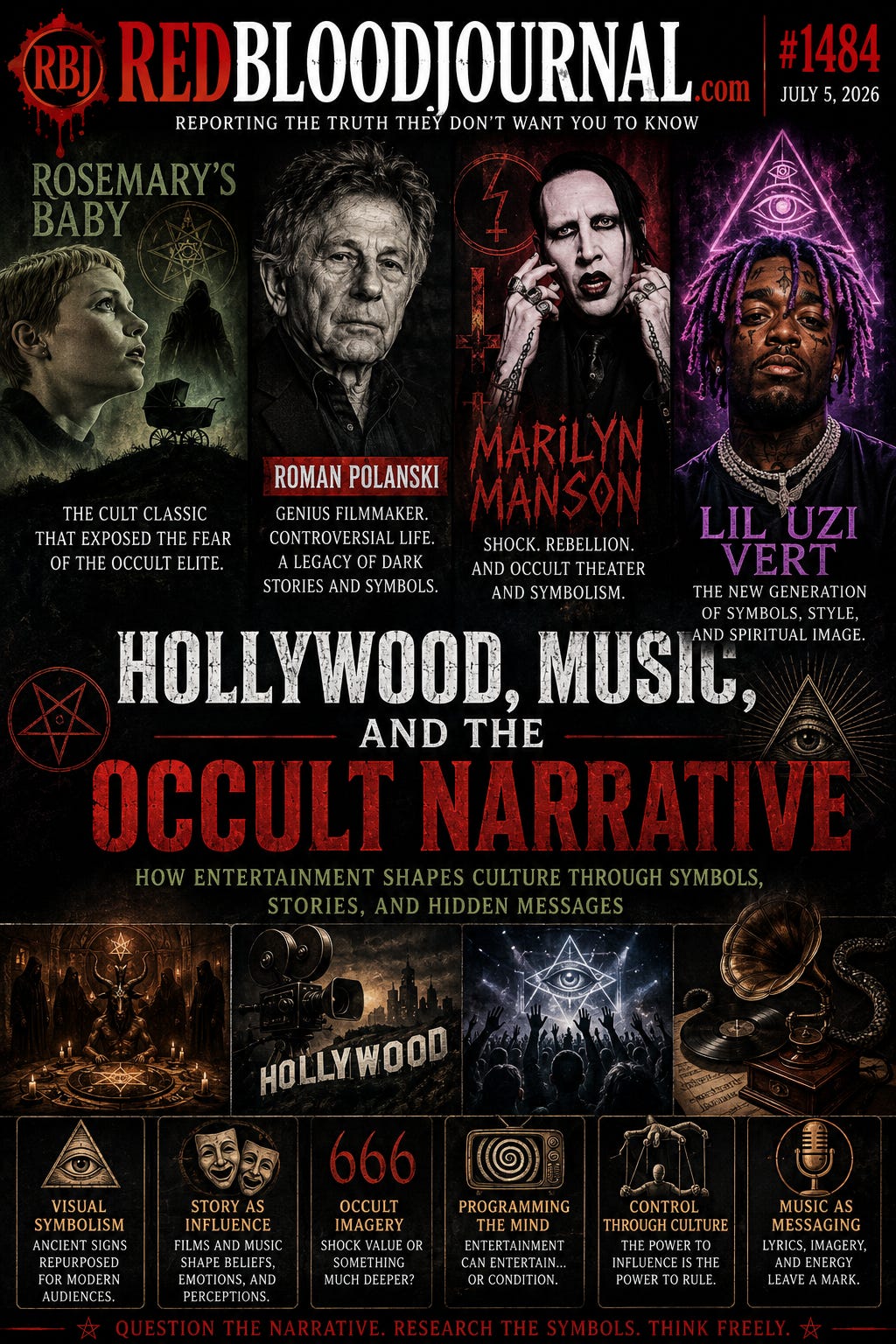
#1484 – Hollywood, Music, and the Occult Narrative
Entertainment, Symbolism, and the Stories Behind the Symbols
By Red Blood
July 5, 2026
Introduction
For more than a century, Hollywood has shaped global culture through film, music, and television. Entertainment has the unique ability to influence imagination, fashion, language, beliefs, and even the symbols that societies recognize.
Alongside that influence has emerged a long-running debate. Some researchers argue that recurring occult imagery in films, music videos, stage performances, and celebrity branding represents nothing more than artistic expression designed to provoke curiosity or generate publicity. Others believe these recurring themes reflect deeper cultural influences, historical symbolism, or even intentional messaging.
This report does not claim that hidden coordination exists across the entertainment industry. Instead, it examines several well-known examples that have fueled public discussion and asks why certain symbols continue to reappear throughout popular culture.
Hollywood and Symbolism
From its earliest silent films to today’s billion-dollar franchises, Hollywood has relied on symbols more than words.
A single image can instantly communicate:
power
innocence
rebellion
temptation
fear
mystery
transformation
Filmmakers frequently draw upon mythology, religion, folklore, and ancient history because these stories already exist within the public imagination.
As a result, audiences often recognize symbolic themes even when they cannot consciously explain them.
Rosemary’s Baby
Released in 1968, Rosemary’s Baby became one of the most influential horror films ever produced.
The story centers on a young woman who gradually realizes she may be part of a sinister ritual involving occult practices and hidden manipulation.
The film introduced audiences to themes including:
secret societies
ritual symbolism
hidden conspiracies
psychological manipulation
loss of personal autonomy
Regardless of one’s interpretation, the film profoundly influenced later horror cinema and helped establish occult symbolism as a recurring theme within mainstream entertainment.
Roman Polanski
Director Roman Polanski remains one of the most controversial figures in modern cinema.
His career includes critically acclaimed films, while his personal life has been marked by tragedy and legal controversy.
Some independent researchers connect Polanski’s work, personal experiences, and public image to broader discussions surrounding symbolism and occult narratives.
Others argue these connections rely heavily on speculation rather than documented historical evidence.
The contrast between artistic achievement and personal controversy has made Polanski a frequent subject of public debate.
Marilyn Manson
Few musicians deliberately embraced controversial symbolism as openly as Marilyn Manson.
Throughout his career, his stage performances incorporated imagery drawn from:
religious iconography
horror films
industrial aesthetics
theatrical shock performance
Supporters viewed the imagery as social criticism and artistic expression.
Critics argued it normalized disturbing symbolism and deliberately challenged cultural boundaries.
Whether interpreted as performance art or cultural provocation, Manson demonstrated how symbolism itself can become part of an artist’s identity.
Lil Uzi Vert
More recently, rapper Lil Uzi Vert has attracted attention for imagery used in fashion, music videos, concerts, and jewelry.
Public discussion has centered on symbols associated with:
occult imagery
futuristic aesthetics
altered identity
rebellion
mythology
As with many modern performers, much of the debate reflects audience interpretation rather than confirmed intent.
The widespread circulation of images through social media allows symbolic discussions to spread globally within hours.
Shock as Entertainment
Hollywood has long understood that controversy generates attention.
Over the decades audiences have witnessed:
horror symbolism
ritual imagery
inverted religious symbols
masks
secret ceremonies
supernatural themes
In many cases these elements function simply as storytelling devices.
In others they serve marketing purposes by creating mystery around a performer or production.
Shock has become a commercial product.
Why Occult Imagery Persists
Ancient symbols remain visually powerful.
Goats...
Serpents...
Eyes...
Pentagrams...
Labyrinths...
Masks...
Candles...
Temples...
These images immediately evoke mystery because they have accumulated centuries of cultural meaning.
Directors and musicians often borrow such imagery not necessarily because they endorse its historical significance, but because audiences instinctively react to it.
Cultural Symbolism
Symbols rarely remain confined to one culture.
A symbol originating in ancient Egypt may later appear in:
Greek mythology
medieval Europe
Renaissance art
modern architecture
corporate branding
popular music
Its meaning changes while its visual identity survives.
This continual transformation explains why discussions surrounding symbolism often become so complex.
The Audience’s Role
Entertainment is never interpreted identically by every viewer.
One person sees fantasy.
Another sees psychology.
Another sees religion.
Another sees hidden messages.
Our own experiences influence what we perceive.
Consequently, symbolic interpretation often reveals as much about the observer as it does about the work itself.
Art or Hidden Meaning?
One of the central questions surrounding popular entertainment is whether repeated symbols indicate coordinated messaging or simply reflect shared artistic traditions.
There is no universal answer.
Some creators openly explain the symbolism behind their work.
Others deliberately leave interpretation to the audience.
Still others employ imagery purely for visual impact.
Separating artistic choice from historical influence remains an ongoing challenge for researchers.
The Power of Repetition
Psychologists have long observed that repeated exposure increases familiarity.
Symbols seen repeatedly across films, music videos, advertisements, and social media gradually become normalized.
Whether this process represents ordinary marketing, cultural evolution, or deliberate psychological influence depends largely upon one’s interpretation.
What remains beyond dispute is that repetition increases recognition.
Recognition builds familiarity.
Familiarity often shapes culture.
Final Thoughts
Hollywood and the music industry occupy a unique position in modern civilization.
They do not merely entertain.
They introduce symbols, shape narratives, influence fashion, and help define cultural memory for billions of people.
Whether occult imagery appears because of artistic inspiration, historical borrowing, commercial marketing, or deeper symbolic traditions remains open to debate.
The more valuable question may not be whether every symbol hides a secret, but why certain symbols continue returning across generations, cultures, and forms of entertainment.
Understanding those recurring patterns encourages viewers to engage more thoughtfully with the images that surround them every day.
Research Themes
Symbolism in cinema
Rosemary’s Baby and cultural influence
Roman Polanski’s filmmaking and public legacy
Shock rock and symbolic performance
Marilyn Manson’s artistic imagery
Lil Uzi Vert and modern visual branding
Symbolism in popular music
Psychology of repeated visual symbols
Entertainment as cultural communication
🩸 RedBloodJournal.com
“Entertainment reflects culture—but it also helps create it. The symbols repeated on our screens often become the symbols carried into the next generation.”
👁️ The Occult Narrative:
Symbolism and Influence in Modern Entertainment
Jul 5, 2026
This article examines the persistent use of occult imagery and ancient symbols within the modern entertainment industry, specifically focusing on Hollywood and popular music. The text explores how filmmakers and musicians, such as Roman Polanski and Marilyn Manson, utilize provocative icons to evoke psychological reactions or generate commercial controversy. While some observers view these recurring themes as coordinated messaging, the author suggests they often stem from artistic traditions and the marketing power of visual storytelling. By analyzing specific examples like the film Rosemary’s Baby, the report highlights how repetition across media platforms helps normalize complex symbols in the public consciousness. Ultimately, the source argues that the interpretation of symbolism reveals as much about the audience’s own beliefs as it does about the creators’ original intentions. This overview encourages a more thoughtful engagement with the influential images that shape global culture and collective memory.


