


🩸 RedBloodJournal.com
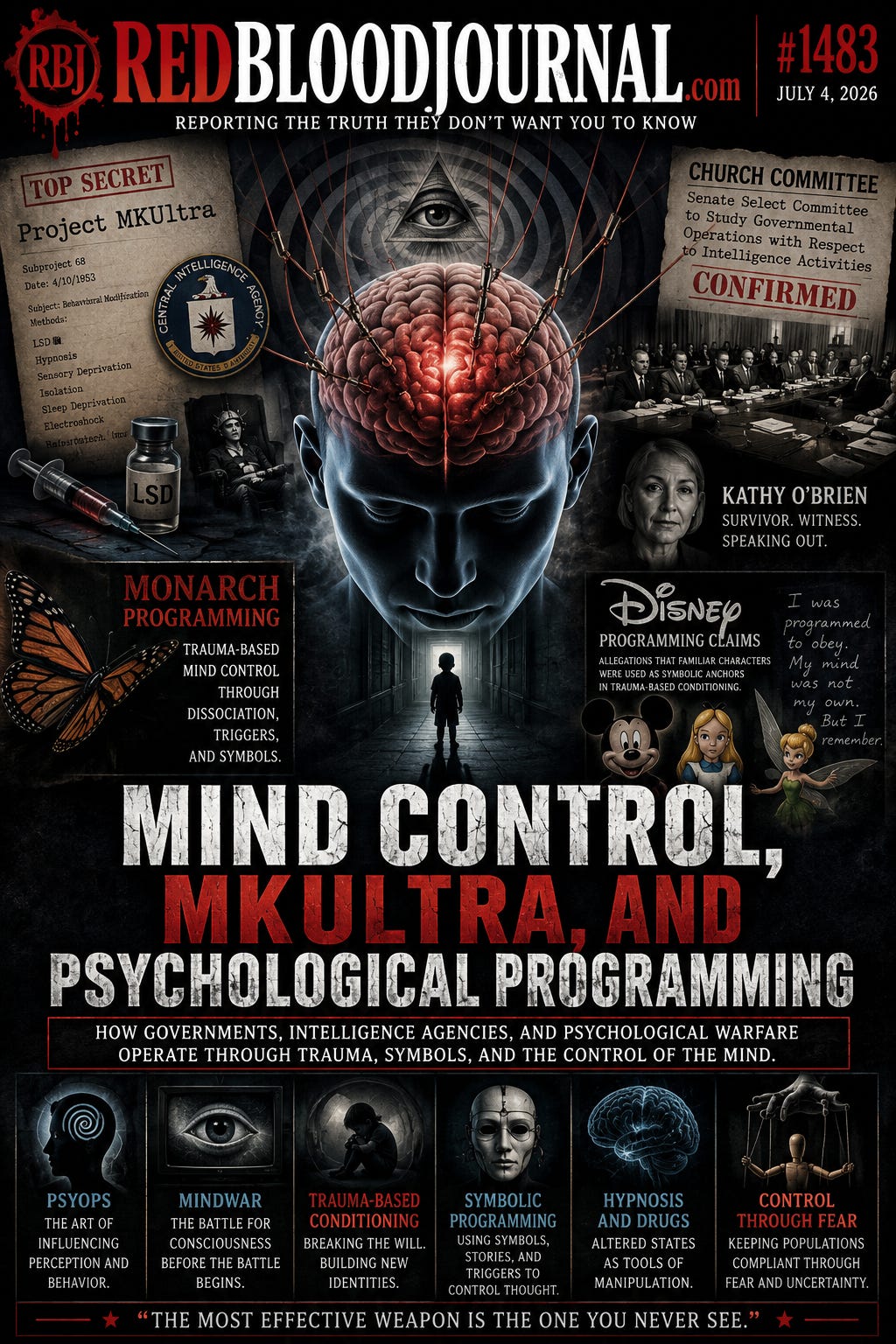
#1483 – Mind Control, MKUltra, and Psychological Programming
Examining Government Programs, Psychological Warfare, and Claims of Trauma-Based Conditioning
By Red Blood
July 4, 2026
Introduction
Few subjects generate more controversy than allegations of government-sponsored mind control.
Since the public exposure of the MKUltra program during the 1970s, questions surrounding psychological experimentation have remained the subject of documentaries, congressional investigations, books, lawsuits, and decades of public debate.
While the existence of MKUltra itself is well documented through declassified records, many claims that have emerged over the years—including Monarch programming, symbolic conditioning through entertainment, and large-scale psychological manipulation—remain disputed and are supported by varying degrees of evidence.
This report distinguishes between documented history and claims made by former participants, researchers, and authors, allowing readers to evaluate the available information for themselves.
The Birth of MKUltra
Following World War II, intelligence agencies became increasingly concerned that rival nations might develop techniques capable of influencing memory, behavior, or interrogation resistance.
In 1953, the Central Intelligence Agency initiated Project MKUltra, a classified research program directed by chemist Sidney Gottlieb.
The program explored numerous methods intended to influence human behavior, including:
hypnosis
sensory deprivation
sleep disruption
psychoactive drugs
isolation
electroshock
interrogation techniques
Many of these experiments were conducted without informed consent, a fact later confirmed during congressional investigations.
What the Public Learned
For years, MKUltra remained hidden.
That changed during the 1970s when investigations by the U.S. Senate Church Committee and the Rockefeller Commission revealed portions of the program.
The investigations established several documented facts:
MKUltra existed.
Numerous subprojects were conducted.
Human subjects were sometimes unaware they were participating.
Many records had been intentionally destroyed in 1973.
Because of the destruction of records, historians acknowledge that the complete scope of MKUltra may never be fully reconstructed.
Psychological Warfare Beyond the Laboratory
The military has long recognized that influencing perception can be as important as influencing the battlefield.
Psychological Operations (PsyOps) seek to affect:
beliefs
morale
decision-making
behavior
Historically, psychological warfare has included:
radio broadcasts
leaflets
propaganda
rumor campaigns
strategic messaging
cultural influence
Modern information technology has expanded these capabilities far beyond traditional military operations.
The Concept of MindWar
During the late twentieth century, military thinkers introduced the concept of MindWar.
Rather than targeting enemy soldiers alone, MindWar proposed influencing entire populations through carefully coordinated information campaigns.
The theory emphasized shaping perceptions before physical conflict occurred.
Supporters viewed it as a strategic communication doctrine.
Critics argued it blurred the line between military operations and public opinion.
Regardless of interpretation, the concept illustrates the increasing importance of information itself as a strategic resource.
Monarch Programming
Among the most controversial claims associated with MKUltra is the alleged program commonly referred to as Monarch programming.
According to various authors and self-described survivors, Monarch involved creating extreme psychological dissociation through severe trauma, allowing multiple identities or behavioral responses to be conditioned under specific triggers.
Commonly alleged methods include:
prolonged abuse
sensory overload
hypnosis
symbolic triggers
repetitive conditioning
It is important to note that no declassified government documents have confirmed the existence of a formal CIA program officially named “Monarch.”
Most information comes from survivor testimony, independent researchers, and investigative authors.
As a result, the subject remains highly controversial.
Kathy O’Brien’s Testimony
One of the best-known public figures associated with Monarch allegations is Kathy O’Brien.
In her books and interviews, O’Brien describes experiences she attributes to government mind-control programs.
Her claims include allegations involving:
trauma-based conditioning
hypnosis
political figures
intelligence operations
symbolic programming
Her testimony has attracted both supporters and critics.
Supporters argue her account deserves serious consideration.
Critics note that many allegations have not been independently verified.
Her work remains one of the most widely discussed narratives within this field.
Disney Programming Claims
Some former MKUltra and Monarch claimants have asserted that Disney films and characters were used during psychological conditioning.
According to these accounts, familiar stories, songs, and characters allegedly served as symbolic anchors within trauma-based programming.
Examples commonly mentioned include:
Cinderella
Alice in Wonderland
Peter Pan
Tinker Bell
Mickey Mouse
These allegations remain unverified.
No publicly available documentation confirms that Disney participated in or knowingly supported any such activities.
Researchers who discuss these claims generally distinguish between survivor testimony and independently established historical evidence.
Symbolic Programming
Regardless of the disputed claims surrounding Monarch programming, psychologists widely recognize that symbols influence human thought.
Advertising, religion, politics, education, and entertainment all rely heavily upon symbolic communication.
Examples include:
national flags
corporate logos
uniforms
music
colors
slogans
mascots
Whether symbolic programming extends beyond ordinary psychology into deliberate behavioral control remains an area of ongoing debate.
Trauma and Human Psychology
Modern psychology acknowledges that severe trauma can profoundly affect memory, identity, and behavior.
Conditions such as post-traumatic stress disorder (PTSD) and dissociative identity disorder (DID) have been extensively studied.
Researchers continue investigating how trauma influences:
memory formation
emotional regulation
perception
learning
suggestibility
These established findings are sometimes cited by both supporters and skeptics when discussing broader mind-control theories.
Information as a Battlefield
Today’s battlefield increasingly extends beyond physical territory.
Social media...
Artificial intelligence...
Mass communication...
Recommendation algorithms...
Behavioral analytics...
Digital advertising...
Each possesses the ability to influence public attention on a scale unimaginable during the early Cold War.
Whether viewed as marketing, strategic communication, or psychological influence, the struggle for attention has become one of the defining characteristics of the modern age.
Separating Evidence from Allegation
The study of psychological programming requires careful distinction between verified history and unresolved claims.
Documented:
Project MKUltra existed.
Human experimentation occurred.
Psychological operations are a recognized military discipline.
Governments have historically used propaganda.
Disputed:
Monarch programming as an official government project.
Specific survivor allegations.
Symbolic programming through entertainment media.
Large-scale behavioral control through popular culture.
Responsible research requires recognizing both categories without confusing one for the other.
Final Thoughts
The history of MKUltra reminds us that governments are capable of conducting secret research that later becomes public knowledge.
At the same time, the existence of one verified program does not automatically validate every subsequent allegation.
The challenge for readers is to approach the subject with both curiosity and critical thinking—remaining open to documented evidence while exercising caution toward claims that have yet to be independently substantiated.
Ultimately, the greatest defense against manipulation may not be certainty, but the willingness to question information, examine evidence, and distinguish between confirmed history, informed speculation, and unresolved mystery.
Research Themes
Project MKUltra
Church Committee investigations
Psychological operations (PsyOps)
MindWar doctrine
Trauma psychology
Dissociation and memory research
Kathy O’Brien’s published testimony
Symbolic communication in media
Information warfare in the digital age
🩸 RedBloodJournal.com
“The most effective form of influence is often the one people never recognize. Understanding history begins by distinguishing documented facts from unresolved questions.”
🧠 Architects of the Mind: MKUltra and the Mechanics of Control
Jul 4, 2026
This report investigates the history and controversies surrounding government-sponsored mind control, specifically focusing on the declassified CIA project known as MKUltra. The text clarifies the distinction between documented human experimentation, which involved drugs and sensory deprivation, and more speculative theories like Monarch programming and the use of media symbolism for conditioning. It examines the evolution of psychological warfare, moving from traditional propaganda to modern information operations designed to influence entire populations. Through the testimony of figures like Kathy O’Brien, the source explores allegations of trauma-based dissociation while acknowledging a lack of official verification for such claims. Ultimately, the article emphasizes using critical thinking to separate proven historical facts from unverified survivor accounts and modern psychological theories. Finally, it suggests that understanding the mechanisms of influence is essential for navigating today’s complex digital and strategic communication landscapes.


