


🩸 RedBloodJournal.com
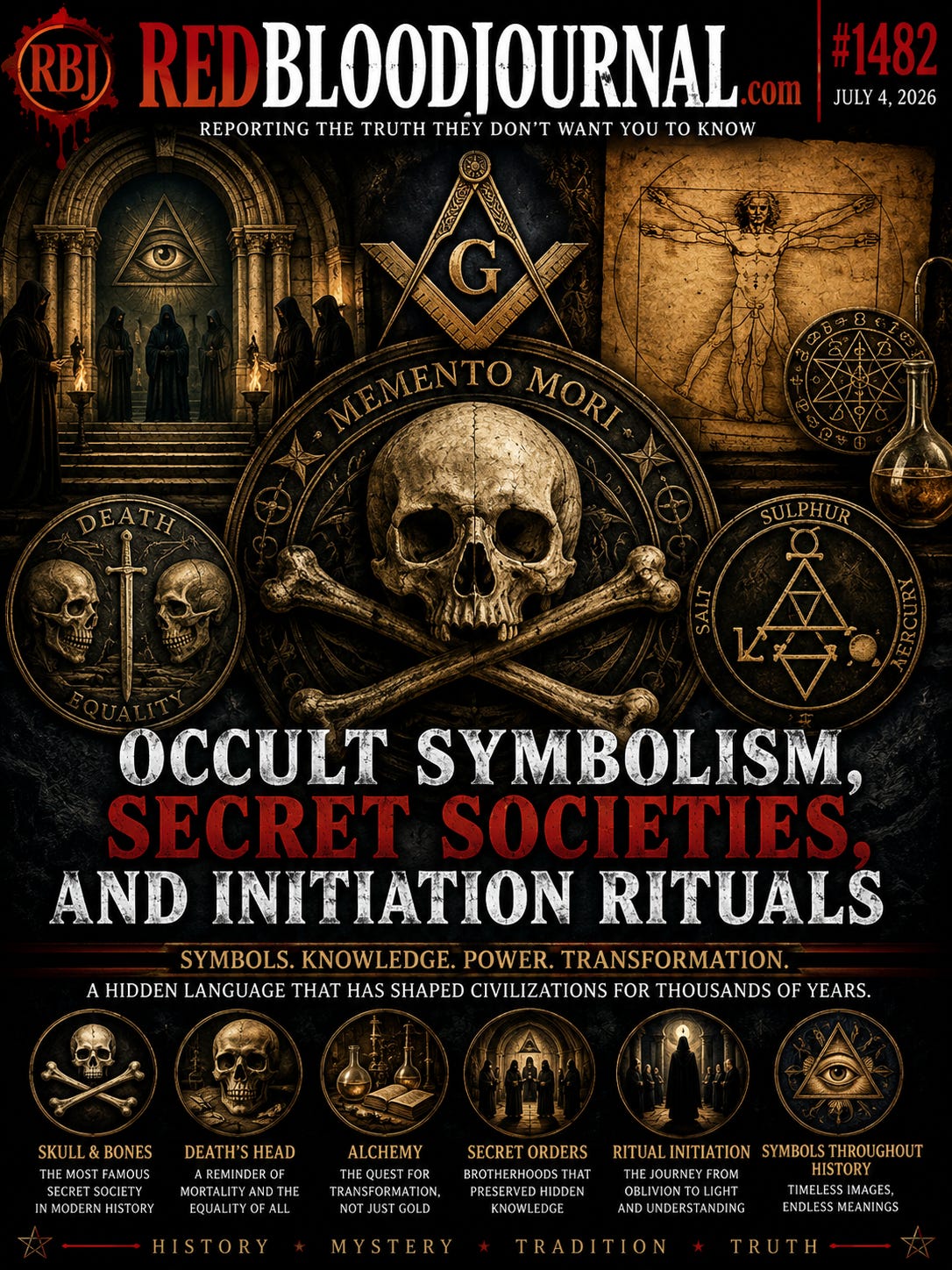
#1482 – Occult Symbolism, Secret Societies, and Initiation Rituals
How Symbols, Ceremonies, and Hidden Traditions Have Shaped Organizations Throughout History
By Red Blood
July 4, 2026
Introduction
Throughout history, nearly every civilization has created symbols that represented authority, knowledge, transformation, or membership. Some remained public, while others became known only to select groups through initiation ceremonies and private traditions.
From ancient mystery schools to medieval knightly orders, from alchemical manuscripts to modern fraternal organizations, symbols have served as a language understood by those within a particular tradition while remaining mysterious to outsiders.
Because many organizations deliberately preserved secrecy, myths have often grown around them. Over time, history, speculation, documented facts, and popular imagination became intertwined, making it difficult to separate one from the other.
This report examines several of history’s best-known symbolic traditions without assuming hidden conspiracies or dismissing legitimate historical questions.
Symbols: Humanity’s Oldest Language
Long before written language became widespread, civilizations communicated through symbols.
A single image could represent:
authority
life
death
wisdom
transformation
protection
divine power
Unlike spoken language, symbols can survive thousands of years.
The same image may appear in different civilizations while carrying completely different meanings depending on its cultural context.
Understanding that evolution is essential before assigning modern interpretations to ancient designs.
Secret Societies Throughout History
Secret societies are not unique to any one civilization.
Historical examples include:
Ancient Egyptian priesthoods
Greek mystery schools
Roman religious orders
Medieval guilds
Military brotherhoods
Philosophical societies
Fraternal organizations
Many required initiation before members could access higher levels of knowledge.
In many cases, secrecy served practical purposes:
preserving teachings
protecting members
maintaining political independence
ensuring loyalty
Not every secret society was political or religious.
Many functioned as educational or charitable organizations.
The Purpose of Initiation
Initiation ceremonies appear in nearly every culture.
Anthropologists identify them as rites of passage marking a transition from one stage of life to another.
Examples include:
adulthood
military service
priesthood
royal succession
professional guild membership
These ceremonies often included symbolic acts designed to represent personal transformation rather than literal death or rebirth.
The language of initiation frequently employed metaphors involving darkness, light, silence, knowledge, and renewal.
The Death’s Head
One of history’s most enduring symbols is the death’s head, commonly represented as a human skull.
Across civilizations it has symbolized:
mortality
equality in death
impermanence
remembrance
transformation
During the medieval period, skull imagery appeared in churches, tombs, military orders, and works of art.
Later it became associated with pirates through the Jolly Roger, although skull imagery existed centuries before piracy adopted it.
The same symbol has therefore represented both spiritual reflection and intimidation, depending upon its context.
Skull and Bones
Among the most widely discussed modern organizations is Skull and Bones, founded at Yale University in the nineteenth century.
The society has long maintained private membership traditions and confidential ceremonies.
Because many prominent political, business, intelligence, and legal figures have belonged to the organization, it has attracted significant public curiosity.
Some observers view it simply as an elite collegiate fraternity.
Others speculate that it represents part of a broader network of influence.
Its internal rituals remain largely private, contributing to its enduring mystique.
Alchemy: More Than Turning Lead into Gold
Alchemy is frequently misunderstood.
Popular culture often portrays it as an attempt to transform lead into gold.
Historically, alchemy also represented:
personal transformation
purification
spiritual development
balance
harmony between opposites
Its symbols filled medieval manuscripts with mysterious illustrations that continue to fascinate historians today.
Many later philosophical traditions adopted alchemical imagery as symbolic language rather than literal chemistry.
Hidden Knowledge
Throughout history, knowledge itself has often been restricted.
Ancient mathematics...
Sacred geometry...
Astronomy...
Navigation...
Medicine...
Military strategy...
These disciplines were sometimes taught only to carefully selected individuals.
The idea that knowledge should be earned through stages rather than freely distributed became one of the defining characteristics of many historical orders.
This concept contributed greatly to the symbolism of hidden doors, secret passwords, and ceremonial advancement.
Why Symbols Persist
Organizations change.
Governments rise and fall.
Religions evolve.
Yet symbols often survive.
A single emblem may outlive the civilization that created it by thousands of years.
Later generations frequently adopt ancient symbols while assigning entirely new meanings.
This process explains why identical imagery can appear within:
churches
military insignia
universities
corporations
governments
artistic movements
The symbol remains.
Its interpretation changes.
Public Fascination
Modern audiences often associate symbols with hidden conspiracies.
Sometimes those suspicions arise because organizations intentionally preserve secrecy.
Other times they arise because the human mind naturally searches for patterns.
Historians generally caution against assuming that repeated symbols automatically indicate direct organizational continuity.
Similar imagery may result from:
shared artistic traditions
universal human experiences
independent cultural development
conscious borrowing
coincidence
Determining which explanation applies requires careful historical evidence rather than assumption.
The Language Beyond Words
Symbols communicate instantly.
Unlike language, they cross borders and generations.
A child recognizes a skull before understanding mortality.
A soldier salutes a flag before fully understanding patriotism.
A religious believer recognizes a sacred emblem long before reading theological texts.
This universal visual language explains why powerful institutions have always invested enormous effort into creating recognizable symbols.
Final Thoughts
The history of occult symbolism and secret societies is neither as simple nor as sensational as popular culture often portrays.
Some organizations unquestionably preserved secret ceremonies.
Some symbols genuinely trace back thousands of years.
Some traditions clearly borrowed from earlier civilizations.
Others evolved independently or acquired entirely new meanings.
The challenge for modern researchers is not merely collecting symbols but understanding the historical context in which they were used.
Symbols do not possess fixed meanings.
They are living ideas, constantly reinterpreted by each generation that inherits them.
Whether viewed through the lens of religion, philosophy, politics, psychology, or history, the study of symbols reminds us that images often shape civilizations long after the people who first created them have disappeared.
Research Themes
Ancient mystery schools
Medieval knightly orders
Historical initiation ceremonies
The symbolism of the skull throughout history
Skull and Bones and collegiate secret societies
Alchemy and symbolic transformation
Sacred geometry and symbolic communication
The evolution of symbols across civilizations
The psychology of symbolic interpretation
🩸 RedBloodJournal.com
“Symbols rarely command people by themselves. Their influence comes from the meanings that generations choose to give them—and the stories they carry forward.”
💀 The Silent Language:
Symbols, Societies, and the Initiation Ritual
Jul 4, 2026
This article examines how visual symbols and secret societies have functioned as a universal language throughout human history. It explores the role of initiation rituals in marking personal transformations and granting access to restricted knowledge within various elite or private organizations. By analyzing icons like the death’s head and traditions such as alchemy, the text illustrates how meanings evolve over time across different cultural contexts. The author highlights that while groups like Skull and Bones maintain a modern mystique, many historical traditions used secrecy for practical education or preservation rather than conspiracy. Ultimately, the source argues that symbolic imagery remains a powerful tool for communication because it can survive long after the civilizations that created it have vanished. The report encourages a contextual historical approach to understanding these living ideas rather than relying on modern speculation.


