


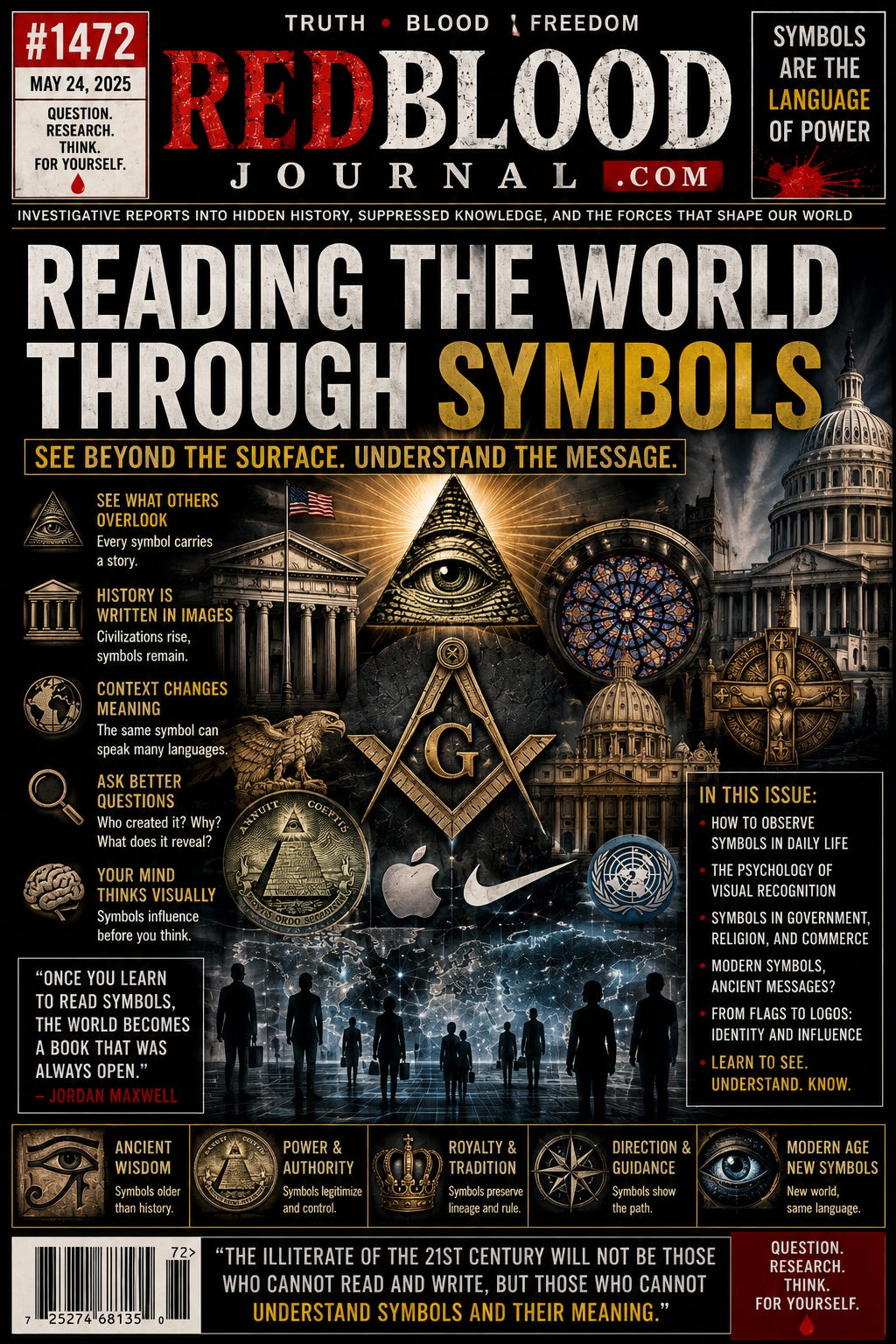
#1472 🩸 RedBloodJournal.com 🩸
Reading the World Through Symbols
By Red Blood
Introduction
Most people walk through life surrounded by symbols without consciously noticing them.
They pass government buildings, corporate logos, monuments, advertisements, flags, uniforms, architecture, road signs, religious imagery, and countless visual messages every day.
The images become so familiar that they disappear into the background.
Yet every symbol was created for a reason.
Some identify.
Some inspire.
Some warn.
Some persuade.
Some preserve history.
Others simply communicate an idea without using a single word.
Learning to observe symbols does not require believing that every image hides a secret message. It begins by recognizing that symbols have always been one of humanity’s most efficient forms of communication.
This report explores how developing symbolic awareness can help people better understand history, culture, institutions, and the visual language that surrounds modern society.
Looking Without Seeing
Human beings quickly become accustomed to familiar surroundings.
A clock hanging on a wall eventually disappears from conscious attention.
The same happens with symbols.
A national flag.
A courthouse.
A company logo.
A religious monument.
A police badge.
A currency design.
Because we see them repeatedly, we often stop asking why they look the way they do.
Yet every design involved choices.
Every choice reflected an intention.
Every Civilization Leaves Symbols Behind
Historians often reconstruct ancient civilizations through their surviving symbols.
Egypt left pyramids and hieroglyphics.
Rome left eagles, columns, and imperial standards.
Medieval Europe left coats of arms, cathedrals, and royal seals.
Modern civilization leaves corporate logos, national emblems, digital icons, and branding.
Long after languages change, symbols often remain.
They become visual records of history.
Asking Better Questions
Reading symbols begins with curiosity.
Instead of asking, “What does this mean?” consider asking:
Who created this symbol?
When did it first appear?
What did it originally represent?
Has its meaning changed?
Why has it survived?
Why is it displayed here?
Who benefits from its continued use?
These questions encourage investigation rather than assumption.
Context Changes Meaning
A symbol rarely exists by itself.
Its surroundings matter.
A torch may represent enlightenment in one setting and remembrance in another.
A bird may symbolize peace, freedom, empire, or religion depending upon the culture.
Even colors change meaning.
White represents mourning in some cultures.
Celebration in others.
Purity in many traditions.
No single interpretation applies everywhere.
Understanding requires historical and cultural context.
Modern Symbols Are Everywhere
Many people think symbolism belongs only to ancient history.
In reality, modern society constantly creates new symbols.
Corporate logos.
Social media icons.
Verification badges.
Political campaign imagery.
Military insignia.
Sports emblems.
Even smartphone application icons function as symbolic language.
Most are recognized instantly across national borders.
The Human Mind Thinks Visually
Neuroscientists have long observed that the human brain processes visual information extremely quickly.
Images frequently create emotional responses before analytical thinking begins.
That is one reason advertisers invest heavily in visual identity.
Governments carefully design official seals.
Religious traditions preserve sacred imagery.
Military organizations emphasize uniforms, medals, and ceremonial displays.
Visual recognition creates familiarity.
Familiarity often creates trust.
Jordan Maxwell’s Observation
Jordan Maxwell encouraged people to pay closer attention to the symbols that appear throughout everyday life.
He argued that understanding symbols provides another way of examining history, religion, government, and commerce.
Many of his specific interpretations remain disputed and are not generally accepted as established historical conclusions.
However, his broader recommendation remains valuable regardless of one’s opinion about his theories:
Observe first.
Research second.
Reach conclusions only after examining evidence from multiple sources.
Observation Before Conclusion
One of the greatest mistakes in studying symbolism is assuming every symbol possesses a hidden meaning.
Sometimes a design is simply decorative.
Sometimes it preserves historical tradition.
Sometimes it serves a practical purpose.
Other times it genuinely carries religious, political, or cultural significance.
The challenge is learning the difference.
Good investigation begins with observation rather than immediate certainty.
Becoming a Better Observer
Reading the world through symbols is similar to learning another language.
At first, very little is recognizable.
Gradually patterns begin to appear.
History becomes more connected.
Architecture tells stories.
Flags reveal identity.
Logos communicate values.
Public ceremonies preserve traditions.
The world itself becomes a historical document.
Final Thought
Symbols neither speak nor remain silent.
They communicate through recognition.
Some preserve civilization.
Some build communities.
Some represent hope.
Some advertise products.
Some inspire loyalty.
Others simply remind us where we came from.
The important question is not whether every symbol hides a secret.
The important question is whether we have trained ourselves to notice the language that has always been speaking around us.
Understanding begins not with certainty...
but with observation.
The investigation continues.
🩸 RedBloodJournal.com 🩸
👁️ The Visual Language: Decoding the Symbols Around Us
Jul 4, 2026
The provided text introduces the concept of symbolic literacy, arguing that the visual icons surrounding us in modern life are often ignored despite their profound communicative power. Symbols found in architecture, government, and corporate branding serve various purposes, ranging from preserving history to influencing consumer behavior and building social trust. By moving beyond mere familiarity, individuals can use observation and historical research to decode why specific designs were chosen and how their meanings shift across different cultural contexts. The author emphasizes that the human brain processes imagery faster than words, making symbols an incredibly efficient tool for conveying complex ideas instantly. Ultimately, the source encourages a disciplined investigation of visual language to better understand the foundations of history, religion, and commerce. Training oneself to notice and question these signs transforms the everyday environment into a readable historical document.


