


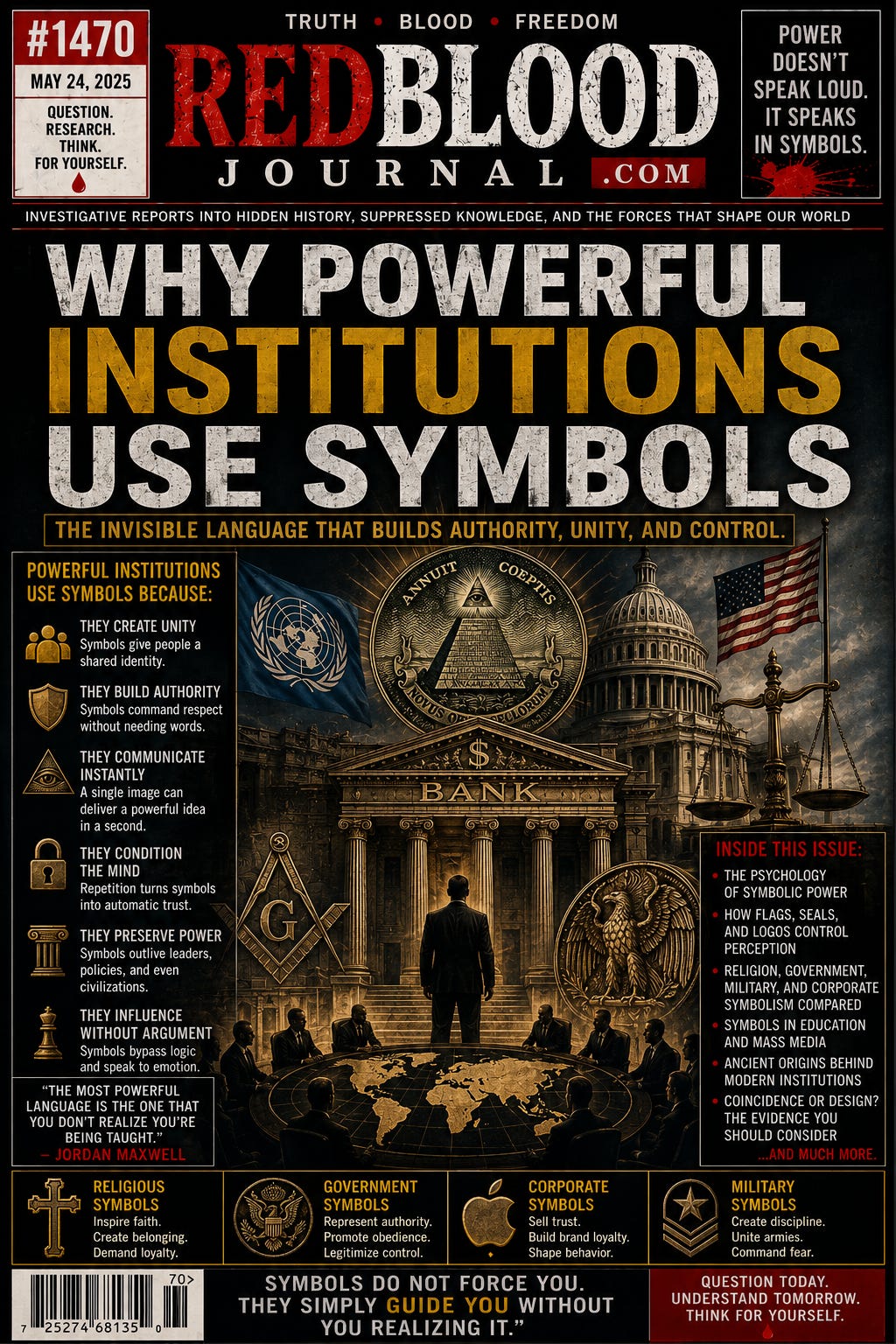
#1470 🩸 RedBloodJournal.com 🩸
Why Powerful Institutions Use Symbols
By Red Blood
Introduction
No major institution operates without symbols.
Governments have flags, seals, and official emblems.
Religions preserve sacred icons, ceremonial clothing, and architecture.
Corporations invest billions in logos and brand identity.
Universities maintain coats of arms and ceremonial traditions.
Military organizations use uniforms, medals, insignia, and rank.
The question is not whether powerful institutions use symbols.
They all do.
The more important question is why.
This report examines the practical, historical, and psychological reasons symbols have become an essential part of institutions throughout human civilization. It also considers interpretations offered by independent researchers, including Jordan Maxwell, while distinguishing documented historical practices from broader speculative claims.
Symbols Create Identity
Every organization must answer one fundamental question:
Who are we?
Symbols answer that question instantly.
A national flag identifies a country.
A police badge identifies authority.
A university crest represents its history.
A company logo identifies a brand.
Before a single word is spoken, a symbol establishes identity.
That identity allows millions of people to recognize an institution immediately.
Symbols Build Unity
Human beings naturally organize into groups.
Families.
Communities.
Religions.
Nations.
Businesses.
Sports teams.
Every group develops visual identifiers that strengthen a sense of belonging.
Uniforms.
Flags.
Colors.
Badges.
Shared symbols encourage people to recognize themselves as part of something larger than the individual.
Symbols Communicate Quickly
Visual communication is efficient.
A stop sign requires no paragraph.
A medical cross immediately identifies healthcare.
A recycling symbol communicates environmental purpose.
An emergency exit sign can save lives regardless of language.
Institutions rely upon symbols because they communicate across cultures and literacy levels.
Symbols Preserve Continuity
Governments change.
Leaders retire.
Companies merge.
Religious leaders succeed one another.
Yet institutions often preserve the same symbols for generations or even centuries.
The symbol becomes larger than any single individual.
It represents continuity.
Stability.
Tradition.
Memory.
For many institutions, preserving familiar symbols reinforces public confidence that the organization continues despite changes in leadership.
Symbols and Authority
Throughout history, authority has frequently been expressed visually.
Crowns represented monarchy.
Scepters represented royal authority.
Military medals represented service.
Judicial robes represented the office of the court rather than the individual judge.
Modern institutions continue this tradition.
A uniform often communicates authority before a conversation even begins.
The symbol itself helps define the role.
The Psychology of Recognition
Psychologists have long studied the power of visual recognition.
Repeated exposure creates familiarity.
Familiarity often increases trust.
This principle helps explain why corporations consistently display their logos, why governments prominently exhibit national flags, and why institutions carefully preserve recognizable visual identities.
Recognition reduces uncertainty.
People generally feel more comfortable with what they recognize.
Jordan Maxwell’s Perspective
Jordan Maxwell argued that symbols do more than identify institutions.
He believed many modern emblems preserve ideas inherited from ancient religious, political, and economic systems.
Some researchers agree that historical influences can often be traced through architecture, ceremonial traditions, and institutional design.
Others caution that visual similarities alone do not establish direct historical continuity.
In many cases, symbols are reused because they have become culturally familiar or aesthetically effective rather than because they secretly preserve ancient meanings.
Understanding that distinction is essential to responsible historical investigation.
Power Without Words
One of the greatest strengths of symbolism is that it often communicates without debate.
People rarely analyze a familiar flag every time they see it.
Few examine the history of a company logo before making a purchase.
Most citizens do not research the origin of a government seal before entering a public building.
Symbols operate quietly.
They become part of everyday life through repetition.
That familiarity makes them extraordinarily effective communication tools.
Looking Beyond Assumptions
The existence of symbolism does not automatically prove hidden agendas.
Nor does it mean symbols are meaningless.
Reality usually lies between those extremes.
Some symbols possess well-documented historical origins.
Some evolve naturally through culture.
Some are intentionally designed to inspire confidence or unity.
Others simply survive because generations continue using them.
The task of the investigator is to separate evidence from assumption.
Final Thought
Powerful institutions use symbols because symbols work.
They communicate quickly.
They preserve history.
They strengthen identity.
They reinforce continuity.
They inspire loyalty.
They simplify complex ideas into instantly recognizable images.
Whether one studies governments, religions, universities, corporations, or military organizations, the lesson remains the same:
Symbols are not decorations alone.
They are one of humanity’s oldest communication systems.
Understanding them does not require accepting every theory about them.
It requires observation.
Historical research.
Critical thinking.
And the willingness to ask not only what a symbol represents today—but why it was chosen, when it first appeared, and how its meaning has changed through time.
The most enduring institutions understand that while words may be forgotten...
symbols are often remembered for centuries.
The investigation continues.
**🩸 RedBloodJournal.com 🩸
👁️ The Silent Language of Power:
Why Institutions Use Symbols
Jul 4, 2026
This report explores how prominent organizations utilize visual emblems to establish authority, identity, and unity without relying on spoken language. Because symbols communicate across cultural boundaries, they serve as essential tools for historical continuity and public recognition in sectors ranging from government to commerce. Beyond simple decoration, these icons are designed to instill trust and simplify complex institutional roles into easily digestible imagery. The text also addresses the perspectives of researchers like Jordan Maxwell, who suggest that modern insignias may carry meanings inherited from ancient systems. Ultimately, the author emphasizes that while symbols are efficient communication systems, understanding them requires a balance of historical research and critical observation. These enduring visual markers ensure that even when leadership changes, the legacy and influence of an institution remain recognizable for generations.


