


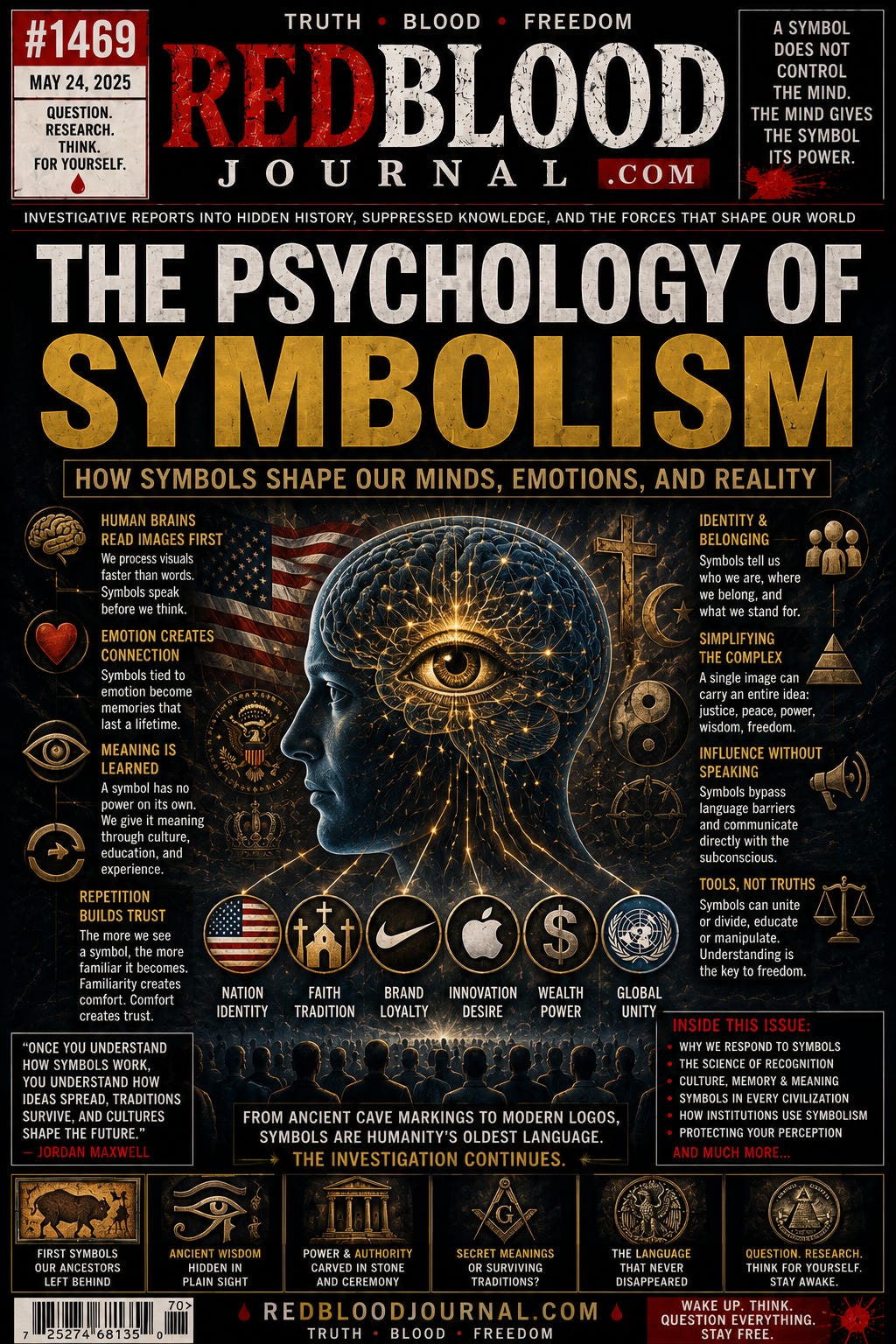
#1469 🩸 RedBloodJournal.com 🩸
The Psychology of Symbolism
By Red Blood
Introduction
Why does a flag inspire patriotism?
Why does a wedding ring represent commitment?
Why can a simple logo instantly identify a global corporation?
Why does a single image sometimes affect us more deeply than an entire page of words?
The answer lies not in the symbol itself, but in the human mind.
Symbols possess no inherent power. Their influence comes from the meanings people attach to them through experience, culture, memory, and emotion.
This report examines the psychology of symbolism—how the brain interprets symbols, why they shape perception, and why every civilization has relied upon them to communicate ideas across generations.
The Brain Thinks in Patterns
Long before humans learned to read, they learned to recognize patterns.
A footprint could mean danger.
Smoke could signal fire.
Dark clouds could announce a storm.
Recognizing visual patterns quickly became essential for survival.
Over thousands of years, the human brain evolved to process visual information with remarkable speed.
That ability remains one of humanity’s greatest strengths.
Images Before Words
Children recognize faces before they learn language.
They recognize expressions before they understand grammar.
A smile communicates safety.
A frightened face communicates caution.
Visual recognition develops naturally.
Reading must be taught.
This is one reason symbols often produce immediate emotional responses.
The brain processes images rapidly, often before conscious analysis begins.
Meaning Is Learned
A symbol is not born with meaning.
People give it meaning.
A national flag becomes meaningful because generations learn what it represents.
A graduation cap symbolizes education because society collectively accepts that association.
A company logo gains recognition through repeated exposure.
Without shared understanding, even the most carefully designed symbol becomes only a shape.
Symbols work because communities agree upon their meaning.
Memory and Emotion
Psychologists have long observed that emotion strengthens memory.
When an image becomes associated with pride, grief, celebration, fear, or hope, that emotional connection makes it easier to remember.
This is why symbols often appear during life’s most significant moments.
Birth.
Marriage.
Military service.
Religious ceremonies.
Graduation.
National commemorations.
The symbol becomes permanently connected to the experience itself.
Repetition Creates Familiarity
One of the most powerful psychological principles is repetition.
The more often people encounter an image, the more familiar it becomes.
Familiarity often creates comfort.
Comfort can lead to trust.
For this reason, organizations repeatedly display their symbols in advertising, public buildings, uniforms, ceremonies, products, and official documents.
The repeated image gradually becomes part of everyday life.
Identity Through Symbols
People naturally seek belonging.
Symbols help answer questions such as:
Who am I?
What community do I belong to?
What values do I share?
National emblems.
Religious symbols.
Sports team logos.
Professional uniforms.
Military insignia.
Academic seals.
Each reinforces identity by connecting individuals to something larger than themselves.
Symbols Simplify Complexity
Many ideas are difficult to explain.
Justice.
Peace.
Freedom.
Wisdom.
Compassion.
Authority.
Instead of lengthy explanations, societies often represent these ideas visually.
A single symbol can summarize concepts that might otherwise require pages of text.
This efficiency explains why symbolic communication appears throughout history.
Jordan Maxwell’s Observation
Jordan Maxwell frequently argued that symbols influence people because they communicate directly with the subconscious through repeated exposure.
While psychologists generally agree that symbols can shape perception and emotional response, Maxwell extended this idea into broader interpretations involving religion, government, commerce, and history. Many of those wider conclusions remain debated and are not established historical consensus.
Regardless of one’s position on his interpretations, his central encouragement remains worthwhile:
Observe carefully.
Question assumptions.
Study the historical origins of symbols before assigning meaning.
Symbols Are Neither Good Nor Evil
A symbol is a tool.
Its value depends upon how it is used.
The same psychological principles can educate or manipulate.
They can unite communities or divide them.
They can preserve history or promote advertising.
They can inspire compassion or reinforce conflict.
Understanding symbolism is therefore not about fearing symbols.
It is about recognizing how they function.
Final Thought
The psychology of symbolism begins with a simple truth:
People do not react to shapes alone.
They react to meaning.
Every civilization has understood this.
Every generation teaches symbolic language to the next.
Every institution relies upon it.
Every individual interprets it through personal experience.
Learning how symbols influence perception does not require suspicion of every image.
It requires awareness.
When we understand how symbols become meaningful, we also better understand how ideas spread, how traditions survive, and how cultures preserve their identities across centuries.
The symbol does not control the mind.
The mind gives the symbol its power.
The investigation continues.
**🩸 RedBloodJournal.com 🩸
🧠 The Mind Behind the Symbol:
The Psychology of Meaning
Jul 4, 2026
This text explores the psychology of symbolism, arguing that visual icons derive their power from human interpretation rather than inherent traits. Our brains are biologically wired to prioritize patterns and images over written language, allowing symbols to trigger immediate emotional responses. These meanings are not innate but are collectively learned through cultural exposure, repetition, and shared history. By simplifying complex concepts like justice or identity, symbols help individuals find a sense of belonging within larger social structures. Ultimately, the source emphasizes that while symbols can be used to unite or manipulate, their influence depends entirely on the meanings assigned to them by the human mind.
🧠 The Mind Behind the Symbol:
The Psychology of Meaning
Jul 4, 2026
This text explores the psychology of symbolism, arguing that visual icons derive their power from human interpretation rather than inherent traits. Our brains are biologically wired to prioritize patterns and images over written language, allowing symbols to trigger immediate emotional responses. These meanings are not innate but are collectively learned through cultural exposure, repetition, and shared history. By simplifying complex concepts like justice or identity, symbols help individuals find a sense of belonging within larger social structures. Ultimately, the source emphasizes that while symbols can be used to unite or manipulate, their influence depends entirely on the meanings assigned to them by the human mind.


