


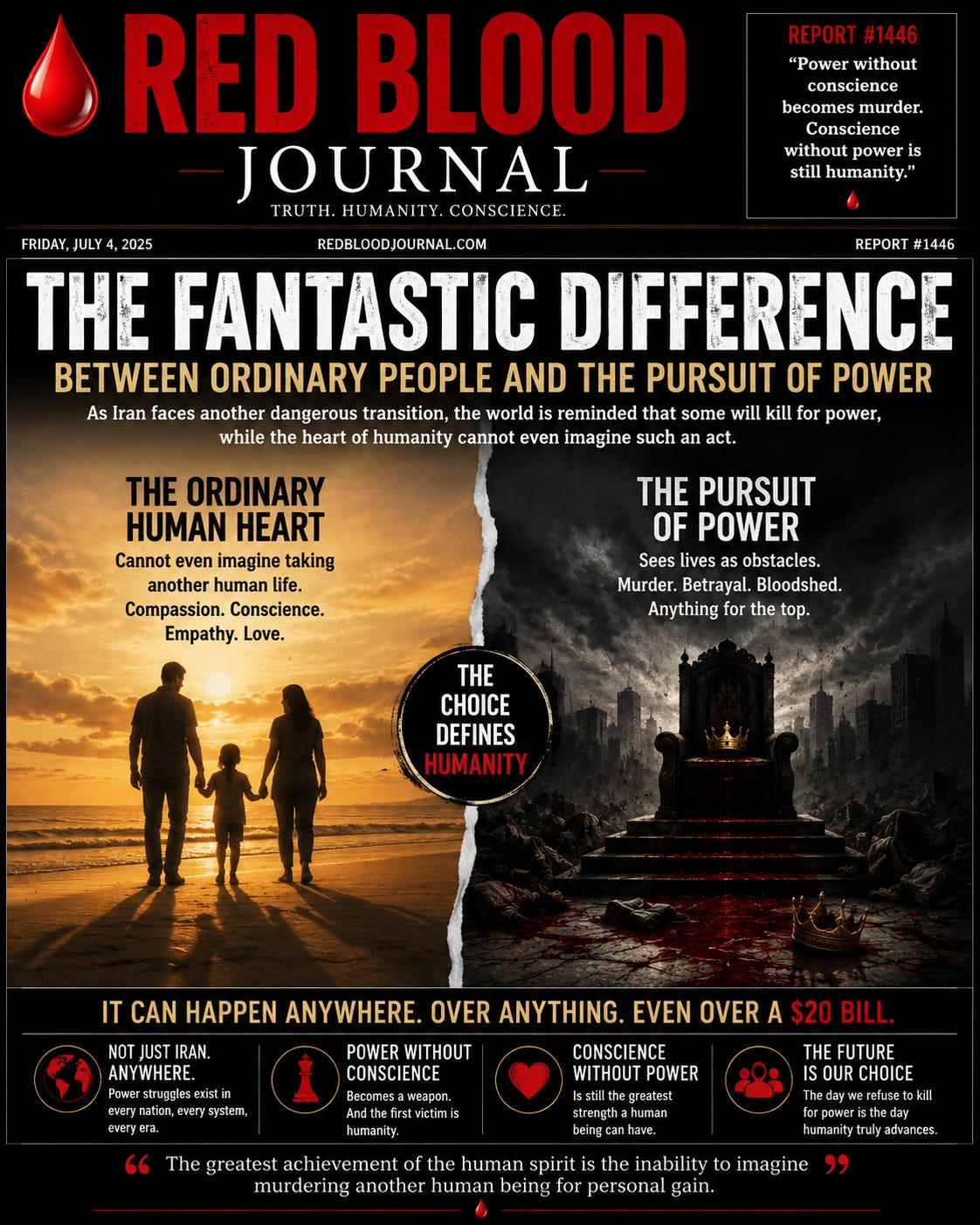
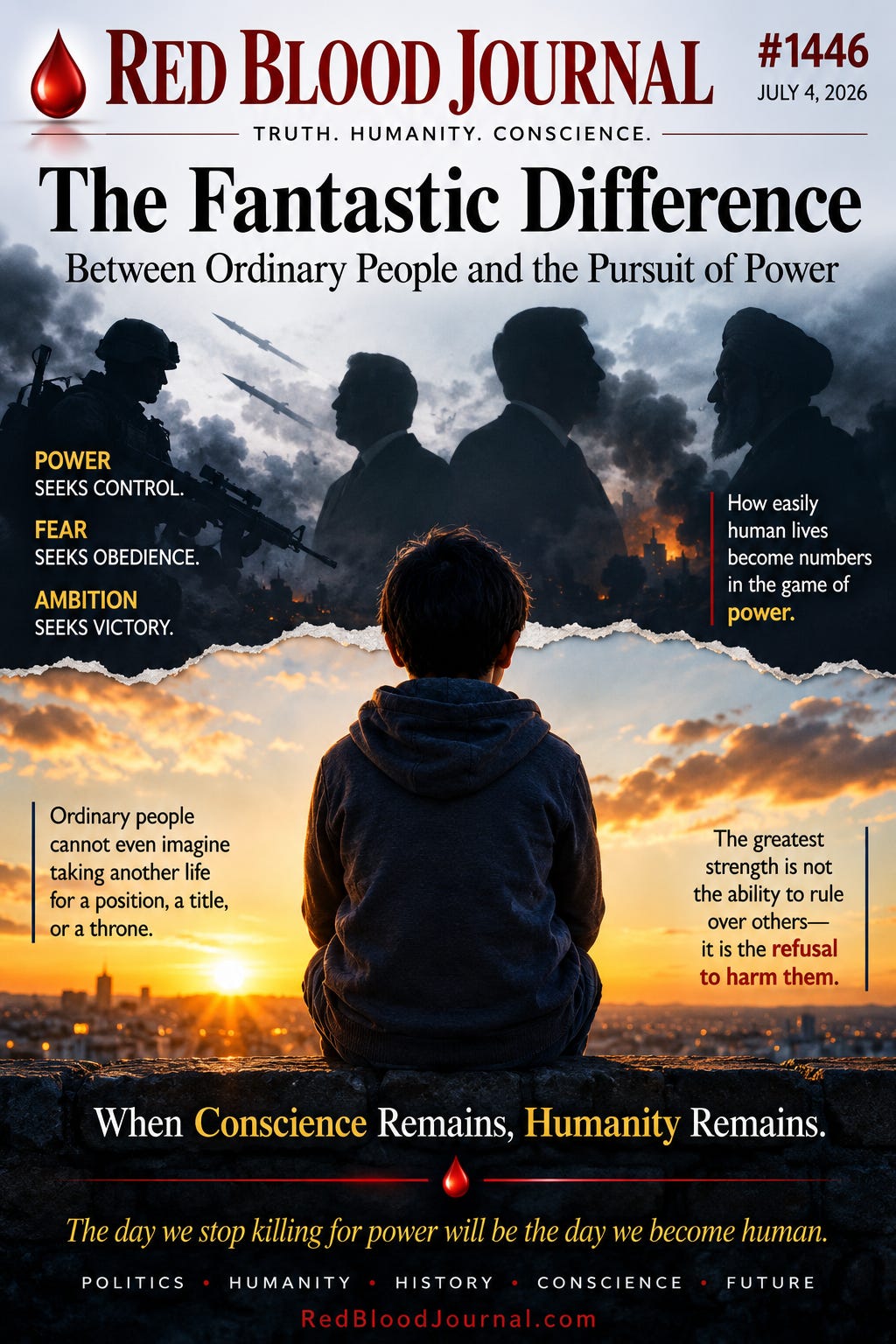
#1446 — The Fantastic Difference Between Ordinary People and the Pursuit of Power
🩸 By Red Blood
🩸 RedBloodJournal.com
Today, as Iran moves through another dangerous political transition, one question becomes larger than the names, titles, funerals, factions, and military uniforms:
What kind of mind can even imagine taking another human life in order to rise higher?
Reports describe Iran under heavy security, with funeral ceremonies for Ali Khamenei beginning July 4 and burial planned for July 9, while Mojtaba Khamenei’s public absence continues to raise questions during a fragile succession period. (Reuters)
But this report is not only about Iran.
It is about the fantastic difference between a normal human conscience and the mind that sees murder, betrayal, intimidation, or bloodshed as tools for power.
A normal, logical, realistic human being cannot even think of killing another person to gain a chair, a title, a position, or control over others. Most people would feel guilt over hurting someone by accident. Yet in the world of power, human lives can become stepping stones.
This mentality does not only appear in governments. It can appear anywhere: in politics, gangs, business, inheritance fights, personal jealousy, or even over a twenty-dollar bill.
That is the frightening lesson.
The ordinary person may not have wealth, office, army, or authority, but the ordinary person still holds something far greater: a conscience that refuses to murder for gain.
That is not weakness.
That is fantastic.
The real advancement of humanity will not come when one faction defeats another faction. It will come when the thought of killing for power becomes unthinkable to everyone.
Until then, Iran, America, and every nation on earth remain inside the same classroom.
The lesson is simple:
Power without conscience becomes murder.
Conscience without power is still humanity.
🩸🌊✨ Fantastic
🕊️ The Fantastic Conscience:
Power, Murder, and the Human Spirit
Jul 3, 2026
This text explores the fundamental moral gap between the average individual and those who view violence as a strategic tool for achieving dominance. Using the current political instability in Iran as a backdrop, the author reflects on how the pursuit of authority can lead to the abandonment of basic human empathy. While ordinary people possess a conscience that prevents them from harming others for personal gain, some leaders and ambitious figures treat human lives as stepping stones. This disparity is not limited to government regimes but extends to any scenario where status is prioritized over morality. Ultimately, the source argues that true human progress is achieved only when the desire for control no longer outweighs the sanctity of life. The author concludes that while power often leads to corruption, a steadfast conscience remains the highest form of humanity.


