


https://t.me/s/RedBloodTransmission/3257
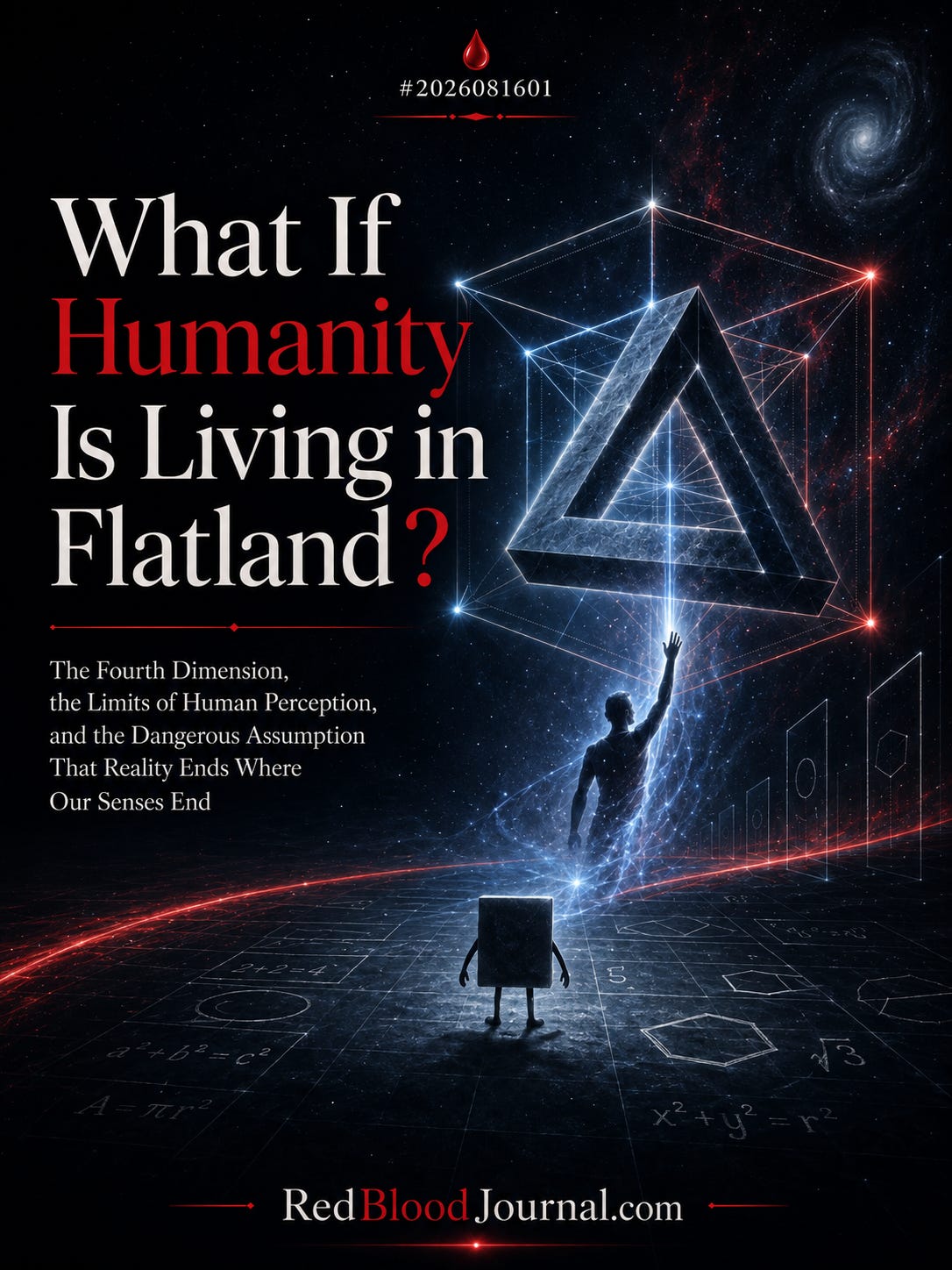
🩸 🧭 🌌 #2026081601 — What If Humanity Is Living in Flatland?
The Fourth Dimension, the Limits of Human Perception, and the Dangerous Assumption That Reality Ends Where Our Senses End
RedBloodJournal.com
There is a wonderfully arrogant sentence humans rarely say aloud:
If I cannot see it, measure it easily, or imagine it clearly, it probably isn’t there.
Humanity has been saying some version of that sentence for centuries.
Then reality keeps embarrassing us.
Invisible microorganisms existed before microscopes.
Radio waves crossed rooms before radios.
Atoms existed before anyone saw evidence convincing enough to build modern atomic theory.
The Earth kept moving while almost everyone standing on it felt perfectly stationary.
And now Rudy Rucker’s The Fourth Dimension presents an uncomfortable intellectual possibility:
What if the human mind is not observing reality itself?
What if it is observing only the portion of reality our biological equipment is capable of displaying?
That is where this strange journey begins.
This report is Rudy Rucker’s The Fourth Dimension, presented as a work combining geometry, relativity, philosophy, thought experiments and speculative questions about realities beyond ordinary three-dimensional perception.
Meet the Flatlander
Imagine a creature living on a perfectly flat sheet.
Not standing on it.
Living inside it.
It has length.
It has width.
But “up” does not exist in its universe.
Tell the creature:
“There is another direction.”
The creature responds:
“Which way?”
You point upward.
It sees nothing.
You explain:
“It is perpendicular to every direction you know.”
The Flatlander understandably concludes that you need professional help.
From its point of view, every possible direction already exists.
North.
South.
East.
West.
Problem solved.
There is nowhere else to go.
And that is precisely where Rucker’s argument becomes dangerous.
Because humans may be making exactly the same mistake.
The Fourth Direction
We understand three spatial directions.
Left and right.
Forward and backward.
Up and down.
Now imagine another direction perpendicular to all three.
The sentence can be understood mathematically.
The image cannot easily be produced mentally.
Our brains simply do not appear designed to visualize it naturally.
But inability to visualize something is not the same thing as demonstrating that it cannot exist.
A Flatlander cannot visualize “up.”
Yet we are sitting in it.
That distinction forms the intellectual foundation of the book’s dimensional argument.
The Sphere That Becomes a Miracle
Suppose a three-dimensional sphere passes through Flatland.
What does the Flatlander see?
Not a sphere.
First:
A point.
Then:
A small circle.
Then a larger circle.
Then the circle becomes smaller.
Then it disappears.
From Flatland’s perspective:
Something appeared from nowhere.
Changed size mysteriously.
Then vanished into nowhere.
A priest might call it a miracle.
A scientist might search for a new law.
A politician would probably establish a committee.
But we know what happened.
Nothing supernatural occurred.
The Flatlander simply observed two-dimensional cross-sections of a three-dimensional object.
Rucker uses Edwin Abbott’s Flatland as one of the book’s central teaching devices precisely because dimensional ignorance can transform perfectly ordinary events into apparent impossibilities.
Now reverse the experiment.
What would we see if a four-dimensional object passed through our three-dimensional world?
Perhaps:
an object appearing,
changing shape,
splitting,
merging,
and disappearing.
We would see only the three-dimensional slices available to us.
And we might confidently announce:
“Impossible.”
The Flatlander would be proud.
The Locked Room Problem
Put a Flatlander inside a completely sealed square.
No doors.
No openings.
No escape.
To another Flatlander, the prisoner is trapped.
To us?
Pick him up.
Move him above the plane.
Put him outside.
No wall was broken.
No tunnel was dug.
The prisoner simply traveled through a direction unavailable to everyone living in his universe.
Now extend the analogy upward.
A hypothetical four-dimensional being could potentially perform the same operation on a person inside a sealed three-dimensional room.
From our perspective:
The person disappears from the room.
Then appears outside.
Impossible.
From the hypothetical higher-dimensional perspective:
Tuesday.
Inside and Outside May Be Local Concepts
A higher-dimensional observer produces another uncomfortable consequence.
Imagine looking down at a drawing of a Flatlander.
You can see inside shapes that are completely enclosed from his perspective.
The Flatlander cannot.
His concept of “inside” is absolute.
Yours is not.
Likewise, a four-dimensional observer might hypothetically have access to what we consider the interior of three-dimensional objects without opening them in the way we understand opening.
This does not establish that four-dimensional creatures are secretly examining the contents of refrigerators.
It does establish something more interesting:
“Inside” and “outside” may depend upon the dimensional perspective of the observer.
Suddenly a philosophical problem has emerged from a geometry lesson.
The Mirror Problem
Consider your left hand and your right hand.
They are mirror versions of one another.
You cannot rotate your left hand through ordinary three-dimensional space and transform it into a genuine right hand.
But imagine a two-dimensional arrow drawn on transparent material.
Within its plane, it cannot be turned into its mirror image.
Lift it into the third dimension.
Flip it.
Return it.
Done.
Therefore, mathematically, a three-dimensional object could potentially be transformed into its mirror image through a suitable four-dimensional rotation.
Once again:
What appears impossible from within a dimension may be trivial from above it.
Then the Book Becomes Stranger
Rucker eventually asks an intentionally provocative question:
Could historical descriptions of spirits or supernatural beings resemble how higher-dimensional entities would appear to us?
The geometry makes the analogy attractive.
A three-dimensional being interacting with Flatland could:
appear suddenly,
disappear suddenly,
see inside enclosed areas,
remove objects from sealed rooms,
and seem to violate every law the Flatlanders believed governed reality.
A four-dimensional being could therefore seem similarly extraordinary to us.
But an essential boundary must remain.
Geometry does not prove the existence of spirits.
A mathematical analogy is not experimental evidence.
The importance of the discussion lies elsewhere.
It shows how quickly the word supernatural can arise when an observer encounters something outside the observer’s conceptual framework.
Today’s miracle may simply be yesterday’s missing dimension.
Or it may actually be nothing at all.
The mathematics does not decide that question for us.
Then Space Itself Goes on Trial
The book eventually turns from:
“What is the fourth dimension?”
to the much stranger question:
“What is space?”
Humans intuitively imagine space as an enormous empty container.
Objects exist inside it.
Stars float inside it.
Planets move through it.
Simple.
Except physics stopped being simple a long time ago.
Ideas such as the ether attempted to explain what supposedly filled empty space and carried light.
Then experiments challenged the classical ether picture.
Relativity transformed our understanding of space and time.
Gravity became connected to geometry.
And suddenly space was not merely the empty stage.
The stage itself had entered the play.
What Shape Is the Universe?
Stand on Earth.
Walk forward long enough.
Assuming oceans, mountains and airline security are removed from the experiment, you could eventually return to where you began.
The Earth’s surface has finite area.
But no edge.
There is no sign reading:
END OF EARTH
PLEASE TURN AROUND
So something can be:
finite
without being
bounded by an edge.
This becomes extraordinarily important when thinking about the universe.
Perhaps asking:
“Where does space end?”
is based on the wrong geometry.
Maybe space does not require a wall.
Maybe it can curve back through itself.
Maybe “finite” does not mean “contained inside something bigger.”
Once again the Flatlander analogy returns.
A Flatlander living on a sphere could travel forever without encountering an edge while still inhabiting a finite surface.
The Universe May Not Be a Box
The human imagination loves boxes.
Inside.
Outside.
Beginning.
End.
Center.
Boundary.
Everything neatly packaged.
But higher-dimensional geometry repeatedly tells us:
Reality is under no obligation to satisfy the architecture of the human imagination.
A universe could theoretically possess:
positive curvature,
zero curvature,
or negative curvature.
Distances and straight lines could behave differently depending upon the geometry of the underlying space.
“Straight” itself becomes a local concept.
The Shortcut Through Reality
Now imagine two points on opposite ends of a sheet of paper.
Travel across the surface and they are far apart.
Fold the sheet.
Now they touch.
Nothing moved faster.
The geometry changed.
This is the conceptual basis behind ideas such as wormholes and hyperspace shortcuts.
Perhaps the quickest route from A to B is not traveling rapidly through conventional space.
Perhaps it involves altering what A and B being far apart even means.
Science fiction normally shows spaceships accelerating dramatically.
Geometry quietly replies:
“Why travel the distance if you can change the distance?”
Then Time Enters the Room
The fourth dimension is often identified with time, particularly in discussions of spacetime.
Now imagine your existence not as:
you today,
then you tomorrow,
then you next year,
but as a single extended structure through spacetime.
Baby-you.
Ten-year-old-you.
Today’s-you.
Eighty-year-old-you.
Instead of separate versions replacing one another, these could be imagined as different sections of one spacetime history.
This produces one of the book’s most philosophically unsettling ideas:
Perhaps we do not simply exist in the present and move through time.
Perhaps our entire history belongs to a larger spacetime structure.
Consciousness may experience the slices sequentially.
But the geometry may describe the complete object.
Where Did “Now” Go?
Human consciousness treats the present as sacred.
Past is gone.
Future has not happened.
Now is real.
Relativity makes that picture considerably less comfortable.
Observers moving differently do not necessarily agree on what events are simultaneous.
So whose “now” is the official one?
The universe does not appear to provide a giant cosmic clock hanging above the galaxies saying:
CURRENT TIME: NOW
That opens the door to the block-universe idea:
past, present and future may belong to a larger spacetime structure, even though human consciousness experiences events sequentially.
Whether this interpretation captures reality is a philosophical and physical question.
But it attacks another deeply intuitive assumption:
Perhaps “the present” is partly a property of the observer.
And Then Comes Time Travel
Once spacetime becomes geometry, somebody inevitably asks:
“Can I go backward?”
This is where the mathematics becomes entertainment.
Travel into the past.
Prevent yourself from making the trip.
Congratulations.
The Human Resources Department of Causality would like a meeting.
Rucker explores the familiar problems:
What happens if the traveler alters the cause of the journey?
Can information have no original source?
Could history branch?
Could a causal loop exist in which an event causes itself?
Possibilities include:
Fixed history:
Whatever happened always happened, including the time traveler.
Branching histories:
Changing the past creates another history rather than rewriting the original.
Causal loops:
A sequence of events forms a closed circle of cause and effect.
The book explores rather than settles these possibilities.
Telepathy, Spirits and Speculation
At several points Rucker moves beyond established physics into speculative territory.
That distinction is worth emphasizing because it may be the most intellectually responsible way to read the book.
Four-dimensional geometry:
mathematics.
Relativistic spacetime:
physics.
Curved-space models:
physics and mathematics.
Spirits as hyperspace beings:
speculation.
Telepathy through unusual spacetime relationships:
speculation.
Certain forms of time travel:
mathematical or theoretical possibilities with major unresolved physical difficulties.
The fascinating part is not pretending these categories are equivalent.
The fascinating part is placing them next to one another and asking:
Where exactly does mathematical possibility stop and physical reality begin?
The Real Subject Was Never the Fourth Dimension
Near the end, a different interpretation of the entire book becomes possible.
The book may appear to be about dimensions.
But perhaps its deeper subject is:
The Observer
Human beings construct reality using limited equipment.
Eyes.
Ears.
Touch.
A nervous system.
A brain evolved for survival.
Not necessarily a biological laboratory designed to display every feature of the cosmos.
We see only a narrow band of electromagnetic radiation.
We hear only certain frequencies.
We experience certain spatial dimensions.
We perceive time in a particular manner.
And then we quietly make the greatest assumption of all:
What we experience must be what reality is.
The Flatlander made exactly the same mistake.
Plato’s Cave With Mathematics
Plato imagined prisoners watching shadows on a wall.
The shadows were their world.
Rucker’s Flatlanders do something similar.
Their plane is their universe.
Anything outside it sounds ridiculous.
From our perspective, their certainty is almost comical.
Then the book turns the mirror around.
What exactly gives humans permission to assume we are standing outside the cave?
Maybe we are simply inhabiting a more sophisticated wall.
The Five Categories We Constantly Confuse
One of the most useful conclusions from the book is that five ideas should never be casually merged:
1. Impossible
Logically or mathematically contradictory.
2. Unimaginable
Our brains cannot form an intuitive picture of it.
3. Mathematically possible
A coherent mathematical structure can describe it.
4. Physically possible
Known physics permits it.
5. Demonstrated
Evidence shows that it actually occurs.
Human discussion constantly jumps from one category to another.
“I cannot imagine it.”
becomes:
“It cannot happen.”
Or:
“The mathematics permits it.”
becomes:
“Therefore aliens are entering my refrigerator through hyperspace.”
Neither conclusion follows.
The disciplined position lies between them.
The Red Blood Perspective
The most important lesson of The Fourth Dimension may have nothing to do with hypercubes.
It is intellectual humility.
Every generation inherits a model of reality and is tempted to mistake the model for reality itself.
Then someone finds another layer.
The danger comes from two opposite directions.
One side says:
“We cannot currently explain it, therefore anything is possible.”
The other says:
“We cannot currently explain it, therefore nothing unusual is possible.”
Neither is serious reasoning.
The healthier position is much simpler:
Observe.
Measure.
Question.
Separate evidence from speculation.
And never confuse the limitations of the observer with the limitations of existence.
Because somewhere in an imaginary Flatland, there is probably a very confident square explaining to everyone:
“There is absolutely nothing above us.”
Ocean of Love and Positivity Perspective
Perhaps the most beautiful implication of dimensional thinking is not that hidden beings or secret worlds must exist.
It is simply that reality may be larger than the window through which each observer sees it.
That applies not only to geometry.
It applies to human beings.
Every person observes existence from a different location, history, body, language and perspective.
Two people can stare at the same event and experience different cross-sections of it.
Maybe wisdom begins not when everyone sees the same thing, but when each person recognizes:
My view can be real without necessarily being complete.
A Flatlander does not need to understand the entire third dimension before treating the possibility with curiosity.
Neither do we.
In an Ocean of Love and Positivity.
🩸🌊✨ Fantastic!
🌌
Beyond the Three-Dimensional Cave
Aug 16, 2026
This text explores the concept of the fourth dimension by examining Rudy Rucker’s work and the historical allegory of Flatland. It argues that human perception is limited by biological equipment, often leading people to mistake their narrow experience for the totality of reality. Using geometric thought experiments, the source explains how higher-dimensional objects would appear miraculous or impossible to observers confined to fewer dimensions. The narrative transitions from mathematical theory to physics, discussing how curved space and the block-universe model challenge intuitive ideas about time and boundaries. Ultimately, the text advocates for intellectual humility, reminding readers that the limitations of the observer do not define the limits of existence. It suggests that recognizing our incomplete perspective is the first step toward a deeper understanding of a potentially vast and complex universe.


