


https://t.me/s/RedBloodTransmission/3270
https://t.me/s/RedBloodTransmission/3270
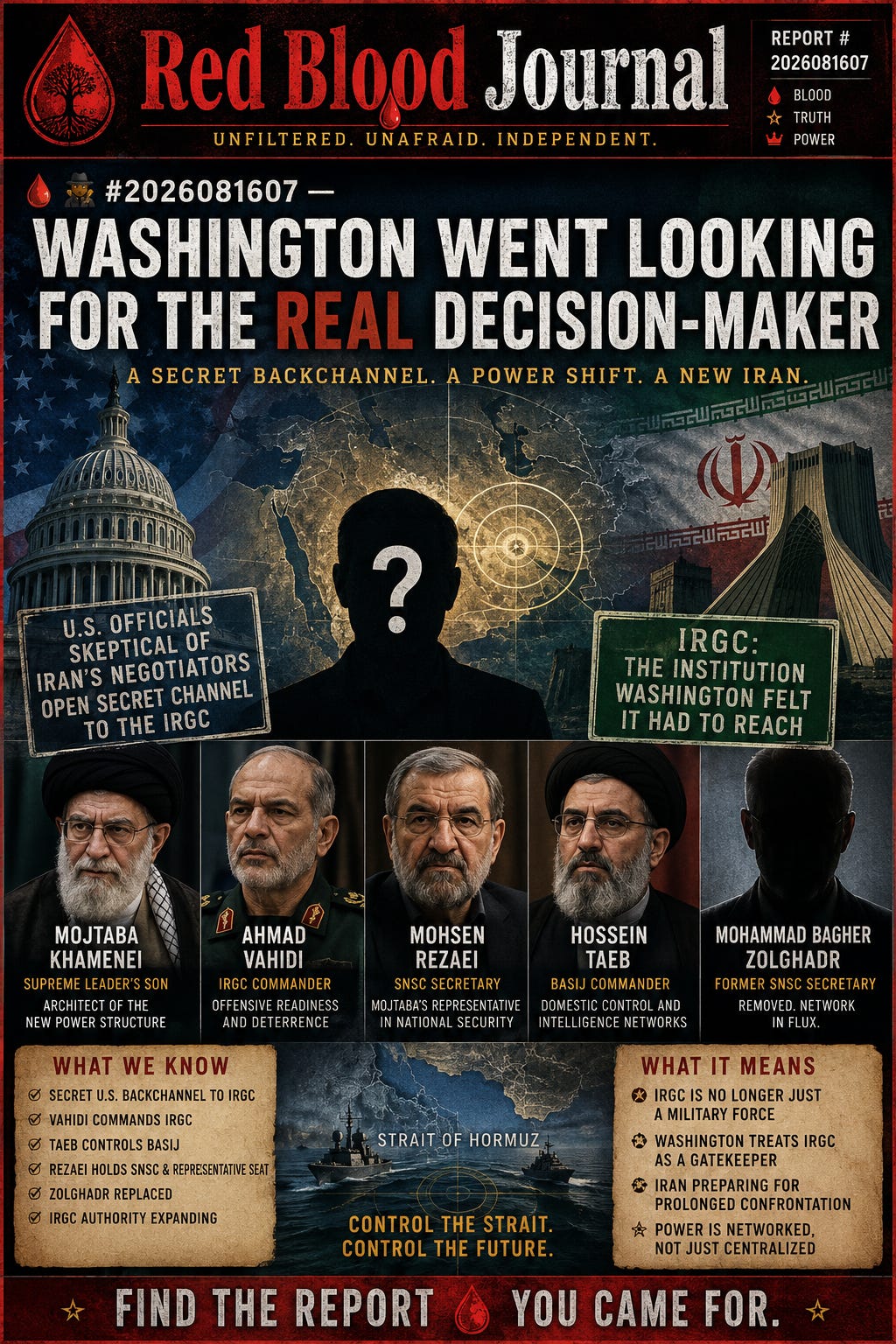
🩸 🕵️#2026081607 — Washington Went Looking for the Real Decision-Maker
When the Backchannel Tells Us More Than the Negotiating Table
RedBloodJournal.com
For months, one question has hovered over Iran’s new political order:
Who actually controls the Islamic Republic?
Mojtaba Khamenei?
The Islamic Revolutionary Guard Corps?
Ahmad Vahidi?
Hossein Taeb?
Mohsen Rezaei?
Or some combination of them?
A new report provides an unusually revealing clue—not because Tehran answered the question, but because Washington apparently started asking it too.
Axios reported on August 16 that the Trump administration secretly established a backchannel to Iran’s Revolutionary Guard during negotiations because American officials were uncertain whether Iran’s official negotiators could actually deliver the organization possessing much of the country’s military power.
That changes the investigation.
The question is no longer merely:
Who does Iran say is in charge?
It becomes:
Who does the United States believe it must speak to when it needs an agreement that will actually be obeyed?
The Secret Door
According to the Axios report, the Trump administration turned to Iraqi Kurdish leadership as an intermediary for reaching the IRGC.
The office of Iraqi Kurdistan President Nechirvan Barzani subsequently confirmed that Barzani had participated in relaying messages between Washington and Tehran and efforts to reduce tensions.
That distinction is important.
Washington already had Iranian negotiators with whom it could communicate.
Yet according to the reporting, American officials still wanted another channel.
Why?
Because they apparently needed to determine whether the people negotiating for Iran could speak for the Revolutionary Guard.
That is an extraordinary institutional question.
The Negotiator and the Man With the Guns
Diplomacy normally operates under a basic assumption.
A government sends representatives.
The representatives negotiate.
They reach an agreement.
The government implements it.
But what happens when another institution possesses enough independent power that foreign negotiators need reassurance that it too accepts the agreement?
That appears to have been Washington’s concern.
Axios reports that the secret contact ultimately produced reassurance from the IRGC side that it supported Iran’s negotiators.
At first glance, that sounds reassuring.
Look at it from another direction.
If Washington needed the Revolutionary Guard to confirm that it supported the negotiators, then the Revolutionary Guard’s position mattered independently.
That does not prove that the IRGC controls Iran.
But it demonstrates something important:
The United States apparently did not consider formal diplomatic representation alone sufficient to answer the question of Iranian authority.
The Vahidi Factor
This makes the rise of Ahmad Vahidi considerably more interesting.
Mojtaba Khamenei formally appointed Vahidi commander-in-chief of the IRGC during the recent command restructuring.
The instructions accompanying the appointment called for strengthening deterrence and maintaining readiness for powerful offensive operations.
Vahidi is therefore not simply another general inside the structure.
He commands the institution Washington reportedly felt compelled to contact separately from Iran’s diplomatic establishment.
That places him at the intersection of two forms of power:
military implementation and diplomatic veto power.
Again, that does not establish that Vahidi outranks Mojtaba politically.
But it tells us that understanding Vahidi may be essential to understanding what agreements Iran can actually execute.
Mojtaba’s Strange Position
This creates an apparent paradox.
The evidence simultaneously points toward greater Mojtaba Khamenei authority and greater IRGC authority.
Those ideas initially seem contradictory.
They may not be.
Mojtaba has recently formalized a sweeping restructuring of the military-security establishment. Reporting identifies six senior appointments made within roughly 48 hours, including Ahmad Vahidi at the IRGC and Hossein Taeb at the Basij.
He has also moved to integrate major military command structures more tightly.
Meanwhile, former IRGC commander Mohsen Rezaei has returned to the center of national-security decision-making as secretary of the Supreme National Security Council, replacing Mohammad Bagher Zolghadr. Reuters describes Rezaei as a close Mojtaba ally with decades inside Iran’s military and political establishment.
So perhaps the wrong model is:
Mojtaba versus the IRGC.
The emerging structure could instead be:
Mojtaba through the IRGC.
The Old Guard Returns
Look at the names.
Ahmad Vahidi.
Mohsen Rezaei.
Hossein Taeb.
These are not inexperienced revolutionaries suddenly appearing from nowhere.
They are veterans of the Islamic Republic’s security establishment.
Rezaei commanded the Revolutionary Guard during the Iran-Iraq War.
Taeb previously headed IRGC intelligence and has now returned to lead the Basij.
Vahidi is a veteran IRGC figure now formally commanding the organization.
This does not look like a young ruler replacing the old establishment with a new generation.
It looks increasingly like a young Supreme Leader surrounding himself with experienced operators from the old security establishment.
That could be a sign of strength.
It could also be a sign of dependence.
And those two possibilities lead to very different futures.
Hossein Taeb and the Internal Front
Taeb’s return remains particularly significant.
The Basij is not merely another military formation.
It reaches deeply into Iranian society.
Under the new appointment, Taeb has been tasked with strengthening the organization’s intelligence capabilities and technological capacity.
That means Iran’s emerging structure appears to contain two complementary security directions.
Vahidi and the IRGC face outward toward war and external enemies.
Taeb and the Basij possess enormous relevance to the internal battlefield.
One watches beyond Iran’s borders.
The other can watch inside them.
Whether that arrangement is intended primarily for war preparedness, suppression of unrest, counterintelligence—or all three—remains an important question.
Mohsen Rezaei: The Bridge
Then there is Mohsen Rezaei.
His appointment may be the institutional bridge connecting the different pieces.
The Supreme National Security Council sits where military strategy, foreign policy, domestic security and presidential government meet.
Putting a former IRGC commander in that position matters.
Rezaei is not simply being asked to command troops.
He is positioned where political decisions become national-security decisions.
And this happens precisely as Washington is discovering that negotiations may require reassurance from the Revolutionary Guard itself.
The parallel is difficult to ignore.
The New Evidence Goes Further
There is now another important development.
The Wall Street Journal reports that Iran has used the negotiating period not merely to talk, but to prepare itself for the possibility of a broader conflict.
According to the report, Tehran has tightened military command around the IRGC, increased missile and drone production, strengthened counterintelligence and installed veteran security figures in important positions.
This changes how the recent appointments can be interpreted.
They may not simply represent bureaucratic reconstruction after wartime losses.
They may form part of a larger strategic preparation for prolonged confrontation.
If that reporting is correct, the reshuffle is not simply about who governs Iran.
It is also about:
What kind of Iran is being constructed for the next phase?
Diplomacy on the Surface, Preparation Underneath
This creates perhaps the most consequential contradiction.
Iran is negotiating.
At the same time, according to current reporting, Iran is preparing for a wider conflict.
Those activities are not necessarily incompatible.
Governments routinely negotiate while preparing for negotiations to fail.
But the institutional architecture matters.
If the people gaining power during negotiations are overwhelmingly drawn from military, intelligence and internal-security backgrounds, then the appointments themselves tell us something about what the leadership considers its most important problems.
Not economic modernization.
Not political liberalization.
Not civilian administration.
The priorities appear to be:
survival,
security,
military readiness,
intelligence,
internal control,
and bargaining power.
The Question From #202608114 Returns
In 🩸 #202608114, Red Blood Journal asked:
Who controls Iran?
The newest evidence does not provide a simple name.
Instead, it suggests that the question itself may need modification.
Iran may no longer be best understood as a pyramid with one person sitting at the top and everybody else obeying downward.
The emerging structure may resemble a network.
Mojtaba provides constitutional and religious authority.
Vahidi provides IRGC command.
Taeb provides Basij and internal-security reach.
Rezaei connects military power to the Supreme National Security Council.
Other military commanders control the integrated armed forces.
And the diplomatic establishment communicates externally.
The important question becomes whether Mojtaba commands this network—or whether his power exists because the network supports him.
Follow the American Behavior
This is where the secret backchannel becomes so revealing.
Intelligence analysts can speculate.
Iranian opposition figures can speculate.
Journalists can speculate.
Red Blood Journal can examine competing theories.
But governments negotiating wars cannot afford to rely entirely on organizational charts.
They need to know who can actually deliver.
According to Axios, Washington went looking for the IRGC.
That does not prove the IRGC secretly rules Iran.
But it is behavioral evidence.
The United States apparently behaved as though the Revolutionary Guard possessed enough independent authority that its approval had to be established separately.
Sometimes the best clue to where power resides is not what a government says about itself.
It is who its adversary believes it must call.
Three Models Now Fit the Evidence
Model One — Mojtaba Is Consolidating Personal Power
Mojtaba has survived the succession crisis and is deliberately surrounding himself with experienced loyalists.
Under this interpretation, the growing power of Vahidi, Taeb and Rezaei actually demonstrates Mojtaba’s strength because he selected them.
The IRGC is powerful because the Supreme Leader wants a powerful IRGC.
Model Two — Mojtaba and the Security Establishment Rule Together
This increasingly deserves serious consideration.
Mojtaba provides legitimacy.
The IRGC provides force.
Taeb provides domestic intelligence and mobilization.
Rezaei provides institutional coordination.
No individual completely dominates the others because each component needs the others.
This would resemble a governing coalition of security institutions more than conventional one-man rule.
Model Three — The Security Establishment Is Becoming the State
This is the most consequential possibility.
Under this interpretation, Mojtaba retains enormous symbolic and constitutional authority, but practical decisions concerning war, diplomacy and internal security increasingly require approval from the military-security apparatus.
The Axios revelation is relevant precisely because Washington apparently worried about this possibility.
But the available evidence still does not prove that Mojtaba has become a figurehead.
What Is Confirmed
Several developments can now be placed on firmer ground.
Mojtaba Khamenei has formalized a major restructuring of Iran’s senior military-security command.
Ahmad Vahidi commands the IRGC and has been instructed to maintain offensive readiness.
Hossein Taeb has returned to command the Basij.
Mohsen Rezaei has replaced Mohammad Bagher Zolghadr as secretary of the Supreme National Security Council.
And the Trump administration reportedly established a separate channel to the IRGC because it wanted assurance concerning who possessed the authority to implement an agreement.
Those facts together represent substantially stronger evidence of the structure than rumors about secret coups.
What Is Still Not Proven
There is no publicly established evidence that Hossein Taeb controls Mojtaba Khamenei.
There is no demonstrated evidence that Vahidi has displaced Mojtaba as Iran’s ultimate political authority.
There is no confirmed evidence that the recent appointments constitute a coup.
And there is not yet enough evidence to establish whether Zolghadr’s removal represents a purge of his network or simply a redistribution of responsibilities.
Those possibilities should remain questions rather than conclusions.
🩸 The Red Blood Perspective
Something important has changed.
Previously, the argument that the Revolutionary Guard had become the decisive center of Iranian power could easily be dismissed as outside analysis.
Now there is a different kind of evidence:
American behavior.
Washington reportedly had Iranian negotiators sitting across the table and still went looking for another door.
That door led toward the IRGC.
That does not tell us that Mojtaba Khamenei is powerless.
It may tell us something more complicated.
Perhaps Mojtaba is constructing a system in which his authority and the Revolutionary Guard’s authority are becoming inseparable.
If so, asking whether Mojtaba or the IRGC controls Iran could eventually become like asking whether the brain or nervous system controls the body.
One cannot operate effectively without the other.
The evidence is not yet sufficient to declare that transformation complete.
But the architecture is becoming visible.
And the most revealing evidence may have come from Washington itself:
When America needed to know whether Iran could keep its word, it reportedly went looking for the men who could enforce it.
That is worth watching.
The reader should decide.
🌊 Ocean of Love and Positivity Perspective
There is an uncomfortable simplicity underneath all of this complexity.
While governments search for the people powerful enough to authorize wars and agreements, ordinary people rarely receive the same invitation.
An Iranian shopkeeper does not sit at the Supreme National Security Council.
An American sailor does not design Middle East strategy.
An Iranian mother does not choose the commander of the Revolutionary Guard.
An American mother does not choose which missile will fly.
Yet these are the people who eventually pay when political systems fail to find another solution.
Perhaps the most important backchannel is therefore the one governments almost never create:
a channel between ordinary human beings who have no desire to kill one another.
Power determines who signs agreements.
Humanity determines whether those agreements are worth anything.
In an Ocean of Love and Positivity.
🩸🌊✨ Fantastic!
RedBloodJournal.com
Find the report
you came for.
(under construction)
RedBloodJournal.com
🕵️
Iran’s Shadow Hierarchy: Washington Seeks the Real Decision-Makers
Aug 16, 2026
The provided text examines the shifting power dynamics within Iran’s leadership, specifically focusing on the influence of Mojtaba Khamenei and the Islamic Revolutionary Guard Corps (IRGC). It highlights reports of a secret U.S. backchannel to the IRGC, suggesting that American officials question whether formal diplomats possess the actual authority to enforce international agreements. The analysis details a significant restructuring of security forces, noting the appointment of veteran hardliners like Ahmad Vahidi and Mohsen Rezaei to pivotal roles. These developments suggest that Iran is transitioning into a network-based governance model where religious legitimacy and military force are increasingly inseparable. Ultimately, the source argues that American diplomatic behavior serves as a key indicator that the IRGC has become a decisive center of power. This strategic realignment may signal that the regime is prioritizing military readiness and internal control over civilian administration.


