


https://t.me/s/RedBloodTransmission/3271
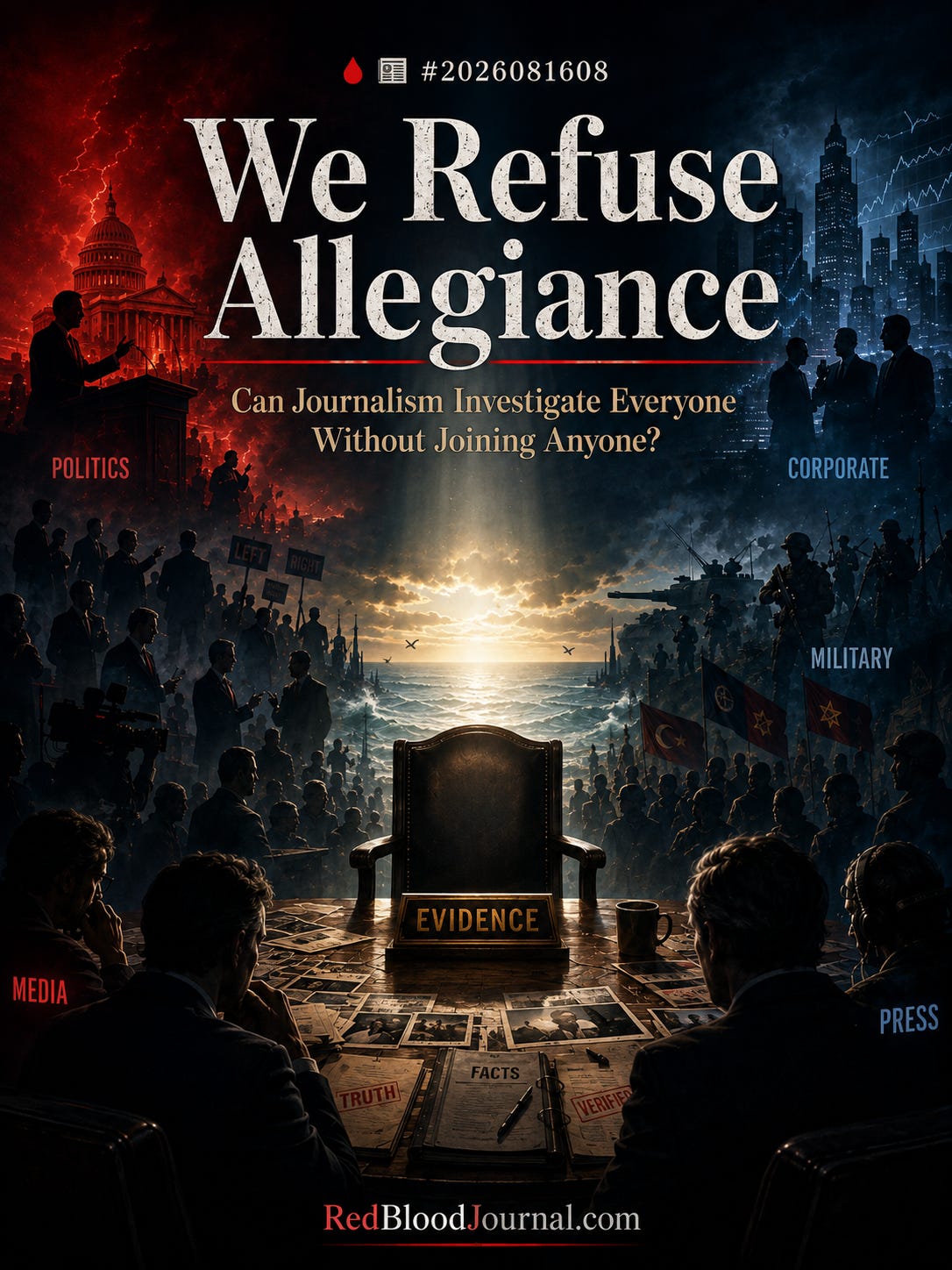
🩸 📰 ⚖️ #2026081608 — We Refuse Allegiance
Can Journalism Investigate Everyone Without Joining Anyone?
RedBloodJournal.com
There is a strange assumption built into modern journalism.
If a publication investigates Donald Trump, somebody immediately wants to know whether it is anti-Trump.
If it investigates the Democratic Party, somebody asks whether it is Republican.
If it investigates Israel, it is accused of supporting Iran.
If it investigates Iran, it is accused of supporting Israel.
If it investigates the United States government, somebody calls it anti-American.
Apparently, the possibility that a journalist might simply be investigating what happened has become almost revolutionary.
That raises a larger question:
Is there still such a thing as reporting without allegiance?
The answer appears to be yes.
But it is increasingly difficult.
And perhaps the more important question is whether journalism can go one step further:
Can it investigate the darkest things human beings do without teaching its audience to hate human beings?
That is where the experiment becomes more interesting.
Reuters: Report It and Stop
Among major international news organizations, Reuters remains one of the strongest examples of traditional institutional neutrality.
Its published standards emphasize independence, integrity and freedom from bias.
The Reuters model is relatively simple.
Something happened.
Who says it happened?
What evidence supports it?
Who disputes it?
What can independently be verified?
What remains unknown?
Then stop.
There is enormous value in that discipline.
The journalist does not need to become the prosecutor, philosopher, activist and executioner simultaneously.
Sometimes the most powerful sentence in journalism is simply:
We do not yet know.
The Associated Press
The Associated Press follows a similar philosophy.
It describes its journalism as independent, nonpartisan and fact-based.
Yet AP also demonstrates something important about neutrality:
Declaring neutrality does not guarantee that everyone experiences the journalism as neutral.
Independent media-bias organizations have repeatedly found disagreements about where AP sits politically.
That does not necessarily mean somebody is lying.
Bias can enter reporting through much subtler doors.
Which story was selected?
Which fact appeared in the headline?
Which expert was interviewed?
Which historical starting point was chosen?
Which information was considered relevant?
Which information never entered the article?
A journalist can write every individual sentence accurately and still construct an incomplete picture.
That is why simply declaring:
“We are unbiased.”
is probably insufficient.
The More Interesting Model
The Christian Science Monitor provides another approach.
Its journalistic tradition includes the idea of reporting truth while attempting to elevate rather than merely inflame.
That introduces something largely absent from conventional hard-news journalism:
What does journalism do to the person reading it?
This question matters.
A perfectly accurate article can still leave a reader furious.
Afraid.
Hopeless.
Obsessed with enemies.
Convinced half the population is evil.
Addicted to another outrage tomorrow morning.
And perhaps none of those emotional consequences were necessary for understanding what happened.
Ground News and AllSides Admit Something Important
Two other organizations approach the problem from a completely different direction.
Ground News and AllSides effectively acknowledge an uncomfortable reality:
Perhaps nobody can completely escape perspective.
Their answer is therefore not necessarily to find the magical unbiased narrator.
Instead:
Expose the narrators.
Show how the Left reports the event.
Show how the Right reports it.
Show how center-oriented organizations report it.
Compare headlines.
Compare omissions.
Compare framing.
Allow the reader to see the machinery.
This may ultimately be healthier than pretending journalism can become mathematically neutral.
Because human beings choose what to investigate.
Human beings choose words.
Human beings decide what matters.
Perspective cannot simply be removed with an editorial screwdriver.
Maybe “No Bias” Is the Wrong Goal
This brings Red Blood Journal to an interesting conclusion about itself.
Perhaps the promise should never be:
“We have no bias.”
That promise is almost impossible for any human publication to prove.
The better promise may be:
We refuse allegiance.
That is different.
A journalist can care deeply about human beings while refusing loyalty to the institutions being investigated.
Trump does not receive immunity because Republicans like him.
Biden does not receive immunity because Democrats like him.
Iran does not receive immunity because America opposes it.
America does not receive immunity because Iran opposes it.
Israel does not receive immunity because antisemitism exists.
Palestinians do not lose scrutiny because they have suffered.
Corporations are not automatically villains.
Governments are not automatically villains.
Governments are not automatically heroes either.
Nobody receives permanent moral immunity.
Nobody receives permanent guilt.
Each investigation begins again.
The Evidence Gets Its Own Chair
Imagine the reporting table.
Trump has a chair.
Iran has a chair.
Israel has a chair.
Democrats have a chair.
Republicans have a chair.
Corporations have a chair.
Governments have a chair.
Opposition movements have a chair.
Then there is another chair.
It belongs to nobody.
That chair belongs to:
The evidence.
And that chair should have veto power over everybody else.
If evidence contradicts the preferred theory, the theory must move.
Not the evidence.
Allegation Is Not Evidence
This distinction has almost disappeared from everyday political conversation.
Someone makes an accusation.
Within minutes:
ACCUSATION BECOMES HEADLINE.
Headline becomes repetition.
Repetition becomes assumed fact.
Assumed fact becomes history.
Then ten years later someone quietly discovers that the original evidence was considerably weaker than everybody remembered.
A healthier reporting structure keeps the categories visible:
Documented fact.
Claim.
Allegation.
Inference.
Contradictory evidence.
Unknown.
Those words are not weaknesses.
They are warning labels protecting the reader.
There Can Be Several Explanations
Suppose a government takes a mysterious action.
The ordinary political article often produces one explanation.
The government says:
National security.
The opposition says:
Corruption.
A conspiracy theorist says:
Secret global control.
The truth may be one of those.
It may be several simultaneously.
It may be something nobody has discovered.
Good investigative journalism should therefore be willing to say:
Explanation A fits these facts.
Explanation B fits these other facts.
Explanation C remains possible but currently lacks evidence.
Here is what would distinguish them.
Then allow reality to continue producing evidence.
That is considerably more useful than pretending every developing story needs a verdict before dinner.
But There Is Another Problem
Suppose journalism becomes excellent at exposing corruption.
Every day:
Corruption.
War.
Manipulation.
Fraud.
Propaganda.
Murder.
Secret programs.
Corporate exploitation.
Political deception.
Eventually journalism may succeed brilliantly at documenting everything wrong with civilization while accidentally convincing its audience that civilization is hopeless.
That is not necessarily enlightenment.
It can become paralysis.
The reader begins believing:
Everybody lies.
Everybody steals.
Everything is controlled.
Nothing can change.
Trust nobody.
Hate everybody.
Congratulations.
The investigation discovered corruption and accidentally manufactured despair.
This Is Where Positivity Becomes Serious
“Positivity” can sound childish when discussing war, corruption or death.
It should not mean:
Everything is wonderful.
It should not mean:
Ignore injustice.
It should not mean:
Forgive criminals before discovering what happened.
And it certainly should not mean covering unpleasant evidence with inspirational quotations.
The stronger meaning is almost the opposite.
Investigate without surrendering humanity.
Expose corruption without becoming consumed by hatred.
Recognize wrongdoing without declaring entire populations evil.
Separate governments from their citizens.
Separate religions from governments claiming to represent them.
Separate individuals from political tribes assigned to them.
Separate evidence from vengeance.
The Citizen Is Usually Missing
Governments argue with governments.
Political parties argue with political parties.
Corporations negotiate with governments.
Armies fight armies.
Television analysts explain who is winning.
Meanwhile someone rarely receives a chair at the table.
The ordinary person.
The Iranian mother buying groceries.
The Israeli father worrying about his children.
The Palestinian child who did not design foreign policy.
The American worker whose taxes finance policies he never personally approved.
The Russian conscript.
The Ukrainian family.
The Venezuelan shopkeeper.
They inherit consequences from decisions made thousands of miles above their lives.
Journalism supposedly exists partly for them.
Yet citizens increasingly appear as statistics underneath arguments between institutions.
Red Blood Should Stand There
If Red Blood Journal has a bias worth admitting, perhaps this is it:
The citizen deserves the benefit of investigation before the institution receives the benefit of assumption.
That does not mean citizens are always correct.
It means power deserves scrutiny.
Because the greater the power, the greater the consequences when the story being told is wrong.
The Red Blood Perspective
There are reputable organizations attempting nonpartisan reporting.
Reuters is real.
AP’s commitment to fact-based reporting is real even when its perceived neutrality is disputed.
The Christian Science Monitor has a longstanding constructive dimension.
Ground News and AllSides offer mechanisms for comparing competing political frames.
Red Blood Journal therefore should not claim to have invented neutral journalism.
Something more interesting may be developing instead.
A journalism built around four refusals:
Refuse allegiance.
Refuse premature certainty.
Refuse to hide contradictory evidence.
Refuse hatred as the final product.
Investigate everybody.
Defend nobody automatically.
Condemn nobody automatically.
Follow the evidence.
And when the investigation finishes, remember that underneath governments, ideologies, armies, corporations and religions are billions of human beings trying to make it through another day.
Ocean of Love and Positivity Perspective
Truth does not require hatred.
Justice does not require hatred.
Investigation does not require hatred.
Disagreement does not require hatred.
The ability to expose wrongdoing while still recognizing the humanity of everyone involved may actually require more strength than choosing a tribe.
The Ocean of Love and Positivity does not ask journalism to close its eyes.
It asks journalism to open both of them.
One eye toward the evidence.
The other toward humanity.
In an Ocean of Love and Positivity.
🩸🌊✨ Fantastic!
⚖️
We Refuse Allegiance: Journalism Without Institutional Loyalty
Aug 17, 2026
The provided text explores the evolving landscape of modern journalism, specifically examining whether it is possible to report on global events without maintaining political or institutional allegiance. The author evaluates traditional models like Reuters and the Associated Press, which prioritize factual neutrality, while also highlighting the Christian Science Monitor’s efforts to inform without inciting fear or hatred. Innovative platforms like Ground News and AllSides are credited for exposing media bias by allowing readers to compare different ideological perspectives. Ultimately, the source advocates for a reporting philosophy that prioritizes evidence over narrative and treats power with consistent scrutiny. This approach, exemplified by Red Blood Journal, seeks to uncover corruption without dehumanizing individuals or manufacturing public despair. By focusing on the human experience rather than institutional loyalty, journalism can strive to be both rigorously investigative and fundamentally constructive.


