


https://t.me/RedBloodTransmission
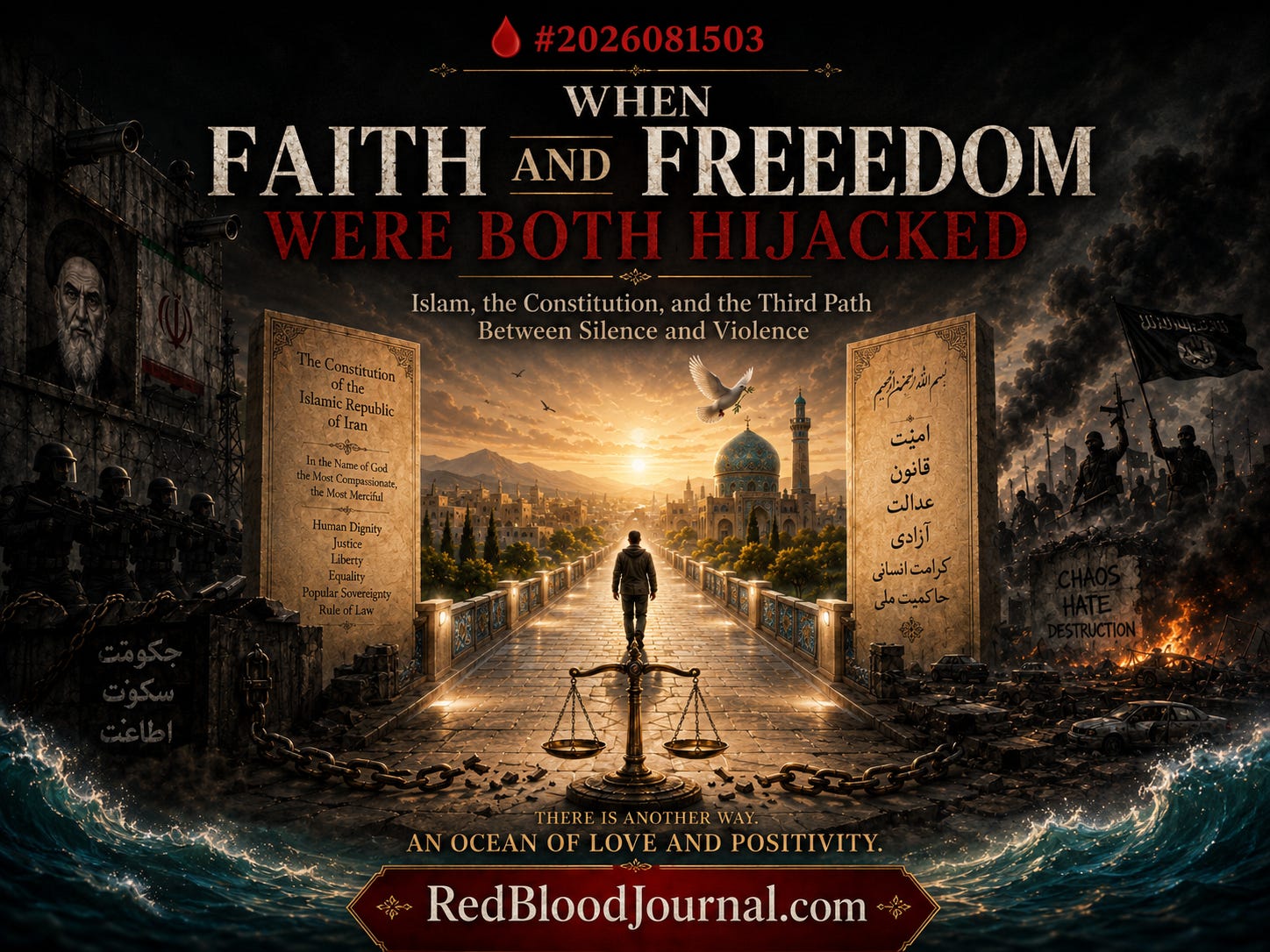
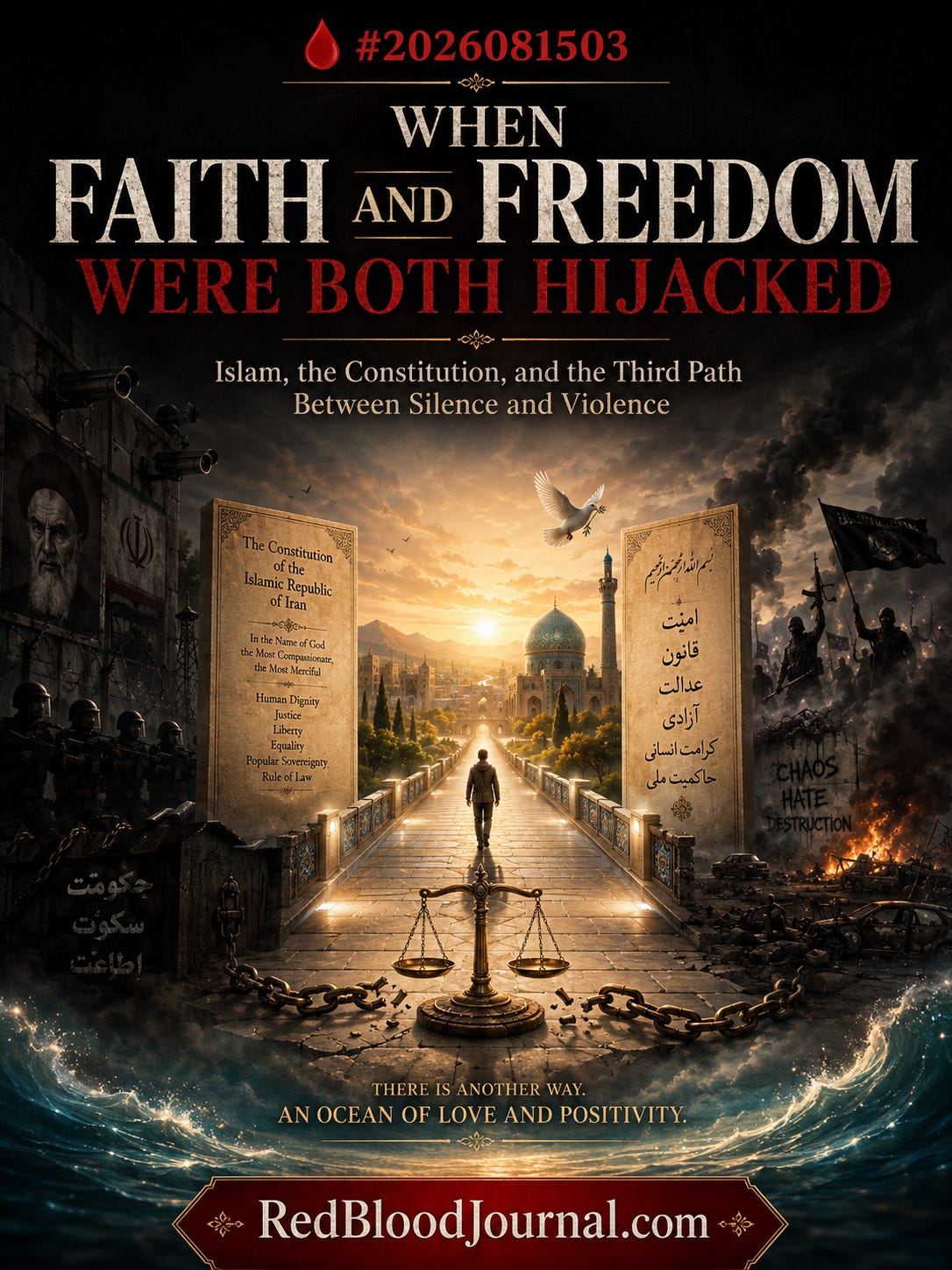
🩸 🌊 ⚖️ #2026081503 — When Faith and Freedom Were Both Hijacked
Islam, the Constitution, and the Third Path Between Silence and Violence
RedBloodJournal.com
There is a strange similarity between two things that, on the surface, appear to belong to completely different worlds:
Islam and the original American constitutional idea.
One is a religion.
The other is a political framework.
Yet when stripped away from the governments, institutions, politicians, clerics, corporations, parties, monarchies, intelligence services, billionaires, and bureaucracies that later wrapped themselves around them, both contain an unusually similar warning:
Human beings should not possess unlimited power over other human beings.
That may be why people are attracted to both.
And it may also explain why people become deeply disappointed when they discover what has been built in their names.
The Religion and the Regime Are Not the Same Thing
For many people outside the Muslim world, Islam is understood primarily through governments that publicly identify themselves as Islamic.
Iran.
Saudi Arabia.
Afghanistan under the Taliban.
Various monarchies and religious authorities throughout the region.
The problem with that method of understanding Islam is obvious.
It would be like understanding the U.S. Constitution exclusively by examining every action ever committed by the American government.
If Washington violates constitutional principles, that does not automatically mean the Constitution instructed Washington to do it.
Likewise, if a government declares itself Islamic and behaves brutally, that does not automatically establish that brutality as Islam.
A government can borrow the name of an ideal without following the ideal.
History is filled with this trick.
The Great Institutional Magic Trick
The process is surprisingly simple.
First, establish a beautiful principle.
Justice.
Freedom.
Equality.
Faith.
Human dignity.
Limited government.
Mercy.
Responsibility.
Then create an institution claiming to defend that principle.
Eventually the institution becomes powerful.
Then something very interesting happens.
The institution gradually begins protecting itself more aggressively than it protects the principle that justified its existence.
And finally comes the greatest trick of all:
The institution convinces the population that criticizing the institution means attacking the principle.
Criticize an Islamic government?
“You are attacking Islam.”
Criticize Washington?
“You hate America.”
Question a political party?
“You are helping the enemy.”
Question a religious authority?
“You are questioning God.”
Very convenient.
The institution and the principle have quietly been stapled together.
The Muslim Who Says Nothing
There is another Muslim who rarely appears on television.
He does not carry a rifle.
He does not scream religious slogans.
He does not demand that his neighbor follow his beliefs.
He may not even discuss religion very often.
He works.
He raises his family.
He helps people when he can.
He tries not to cheat others.
He tries to control his anger.
He tries not to humiliate people.
He gives quietly.
He forgives when possible.
He worries about his own behavior more than policing everyone else’s.
His religion is primarily an internal discipline.
He may believe that repeatedly announcing his spirituality would accomplish little except creating arguments.
So he keeps much of it inside.
Millions of people like this exist.
They don’t make spectacular television.
That is probably why the world hears much less about them.
Peaceful people rarely produce dramatic footage.
Then There Is the Angry Muslim
Now imagine another person.
He sees governments invoking religion while behaving corruptly.
He sees foreign governments preaching democracy while supporting dictatorships when strategically convenient.
He sees civilians killed.
He sees sanctions hurting ordinary families.
He sees rulers becoming wealthy.
He sees religious leaders behaving contrary to what they preach.
He sees international institutions applying principles selectively.
And eventually he concludes:
“Everyone is lying.”
This is where a dangerous fork appears.
One person retreats inward.
He says:
“I will preserve my peace and stay away from politics.”
Another becomes furious.
He says:
“Nothing changes peacefully.”
And somewhere along that second road, anger can become extremism.
Extremism then becomes violence.
And violence provides every authoritarian institution with exactly what it needs:
justification for more authoritarianism.
The circle completes itself.
There Is a Third Road
The choice does not have to be:
Silence or violence.
There is another possibility.
A person can remain deeply spiritual while rejecting religious dictatorship.
A person can oppose government abuse without hating everyone inside government.
A Muslim can defend Christianity.
A Christian can defend an atheist.
An atheist can defend a Muslim.
Not because they agree.
Because freedom becomes meaningless if it exists only for people who agree with us.
That principle sits very close to the heart of constitutional government.
And interestingly, it also sits very comfortably beside a spiritual philosophy based on humility and restraint.
The Constitution Controls the Government
The spiritual path controls the individual.
The constitutional path controls the state.
One says:
Control your ego.
The other says:
Control government power.
One warns the individual against arrogance.
The other assumes government officials are human beings capable of arrogance.
One tells a person:
Do not dominate another unnecessarily.
The other tells government:
You may exercise only the authority granted to you.
Put these together and something interesting begins to appear.
Not an Islamic dictatorship.
Not an anti-religious dictatorship.
Not unrestricted capitalism.
Not communism.
Not monarchy.
Not clerical rule.
Something much simpler:
a society where neither government nor religion owns the individual.
Iran’s Strange Opportunity
This brings us back to Iran.
There is an uncomfortable possibility worth examining.
What if the institution that spent decades constructing Iran’s present ideological system is also one of the few institutions capable of dismantling it quickly?
Consider the machinery already available.
Mosques.
Friday prayers.
Schools.
Television.
Government offices.
Religious networks.
Local organizations.
Clergy distributed throughout the country.
For decades that machinery has been capable of transmitting one narrative.
What would happen if the message changed?
Imagine a Friday sermon saying:
“Your neighbor does not need to believe what you believe.”
Imagine clerics saying:
“Political disagreement is not apostasy.”
Imagine state television announcing:
“Criticizing government is not betrayal.”
Imagine schools teaching:
“No political leader is above questioning.”
Imagine religious authorities saying:
“Faith obtained through fear is not faith.”
The narrative could move enormously quickly.
Perhaps faster than any foreign opposition organization could accomplish.
The Ultimate Revolution Might Be Retirement
This creates an extraordinary hypothetical.
What if the Islamic Republic eventually became the institution responsible for peacefully ending the political structure known as the Islamic Republic?
Not through collapse.
Not through civil war.
Not through invasion.
Not through another group arriving to take revenge.
But through gradual constitutional surrender.
Political prisoners released.
Independent newspapers permitted.
Political parties legalized.
Candidate vetting removed.
Courts separated from religious and political authority.
The military placed under accountable civilian institutions.
Free elections established.
Religious practice protected.
Nonreligious life equally protected.
And finally:
the Iranian population chooses the constitution.
Not Washington.
Not London.
Not a shah.
Not a supreme leader.
Not the CIA.
Not the IRGC.
Not an exile television network.
Not social media.
Iranians.
Religion Would Not Disappear
This point matters enormously.
Democracy does not require Islam to disappear from Iran.
That assumption may itself be one of the obstacles preventing peaceful change.
A democratic Iran could contain deeply religious Muslims.
Secular Muslims.
Christians.
Jews.
Zoroastrians.
Atheists.
Monarchists.
Republicans.
Social democrats.
Free-market advocates.
Socialists.
Nationalists.
People who care about politics.
And millions who would rather watch football.
All of them could remain Iranian.
The fundamental change would be that none receives permanent ownership of everyone else.
The Same Problem Exists in America
Americans should probably avoid becoming too comfortable while observing Iran.
The constitutional principle can also be hollowed out while its vocabulary remains perfectly intact.
A government can continue saying:
Freedom.
Democracy.
National security.
Constitution.
Rights.
Representation.
While citizens increasingly wonder who actually makes important decisions.
Corporate money grows.
Political parties become permanent industries.
Intelligence institutions operate largely outside ordinary public visibility.
Administrative agencies accumulate enormous authority.
Emergency powers expand.
Wars continue under different legal theories.
Citizens increasingly vote between organizations rather than directly controlling institutions.
Whether someone considers these developments constitutional evolution or constitutional erosion is a legitimate political debate.
But the underlying warning remains.
No society is protected simply because its founding document contains beautiful words.
Someone has to defend what those words mean.
Perhaps Islam and the Constitution Share the Same Enemy
Not Christianity.
Not atheism.
Not socialism.
Not capitalism.
Not East.
Not West.
The common enemy may be much older.
Human appetite for unchecked power.
Give a ruler religious authority and he may abuse it.
Give a corporation enormous economic authority and it may abuse it.
Give a government unlimited surveillance capability and eventually someone may abuse it.
Give a revolutionary movement unlimited moral certainty and eventually dissenters may become enemies.
The labels change.
The human temptation does not.
The Quiet Majority Problem
Many peaceful Muslims may already understand much of this internally.
But understanding something privately does not automatically change society.
One person remains silent because speaking threatens his job.
Another because it threatens his family.
Another because he dislikes confrontation.
Another because he believes spiritual peace is more important than political argument.
Meanwhile the loudest voices become disproportionately visible.
Government extremists.
Religious extremists.
Anti-religious extremists.
Foreign propagandists.
Political celebrities.
Professional outrage merchants.
The peaceful majority quietly goes to work.
And the world concludes that the loudest people represent everyone.
That may be one of modern civilization’s greatest optical illusions.
The Third Path Requires Courage
Nonviolence is sometimes mistaken for weakness.
It is almost the opposite.
Violence can happen in seconds.
Building a society where your political enemy is permitted to speak requires enormous discipline.
Winning an election is easy compared with peacefully losing one.
Protecting speech you enjoy is easy.
Protecting speech you despise is considerably harder.
Calling for freedom while powerless is easy.
Giving your opponents freedom once you become powerful is the real examination.
That is where democracy stops being a slogan.
The Red Blood Perspective
Perhaps Iran does not need another savior.
Perhaps America does not either.
Maybe the recurring mistake is waiting for one extraordinary individual to repair everything.
The shah.
The ayatollah.
The president.
The billionaire.
The general.
The revolutionary.
The opposition leader.
Then society hands that person extraordinary authority so that he can rescue everyone from the previous person who possessed extraordinary authority.
Human civilization appears remarkably committed to repeating this joke.
Perhaps the better question is not:
“Who should rule?”
Perhaps it is:
“How do we construct a society where nobody can permanently rule?”
That question belongs neither exclusively to Islam nor exclusively to America.
It belongs to humanity.
🌊 The Ocean of Love and Positivity Perspective
A genuine spiritual path does not require conquering another person’s mind.
It does not require forcing belief.
It does not require humiliating someone who disagrees.
The ocean does not ask every wave to have the same shape.
Some rise high.
Some remain small.
Some travel enormous distances.
Some disappear quickly.
But every wave remains part of the same ocean.
Perhaps society can work the same way.
A Muslim does not become less Muslim because a Christian lives freely.
A Christian does not become less Christian because an atheist speaks freely.
An atheist does not lose anything because a Muslim prays.
And government does not need to referee the human soul.
Government has enough trouble fixing potholes.
Perhaps faith belongs inside the individual.
Perhaps constitutional limits belong around government.
And perhaps love, restraint, dignity and freedom belong everywhere between them.
In an Ocean of Love and Positivity.
🩸🌊✨ Fantastic!
⚖️
Faith, Freedom, and the Limits of Power
Aug 15, 2026
This text explores the unexpected parallels between the founding principles of Islam and the original American constitutional framework, noting that both seek to limit humanity’s appetite for unchecked power. The author argues that institutions often hijack these ideals to protect themselves, falsely claiming that any criticism of the regime is an attack on the underlying faith or philosophy. By distinguishing between spiritual discipline and political control, the narrative suggests a “third path” where individuals embrace restraint and mutual respect rather than choosing between silence or violence. A vision is presented for societies like Iran and the United States to return to limited government, where no single group or leader can permanently dominate others. Ultimately, the source advocates for a world where faith resides within the individual and legal boundaries restrain the state, ensuring freedom for believers and non-believers alike. This perspective emphasizes that the protection of dissenting voices is the true measure of a free and stable society.


