


https://t.me/s/RedBloodTransmission/3269
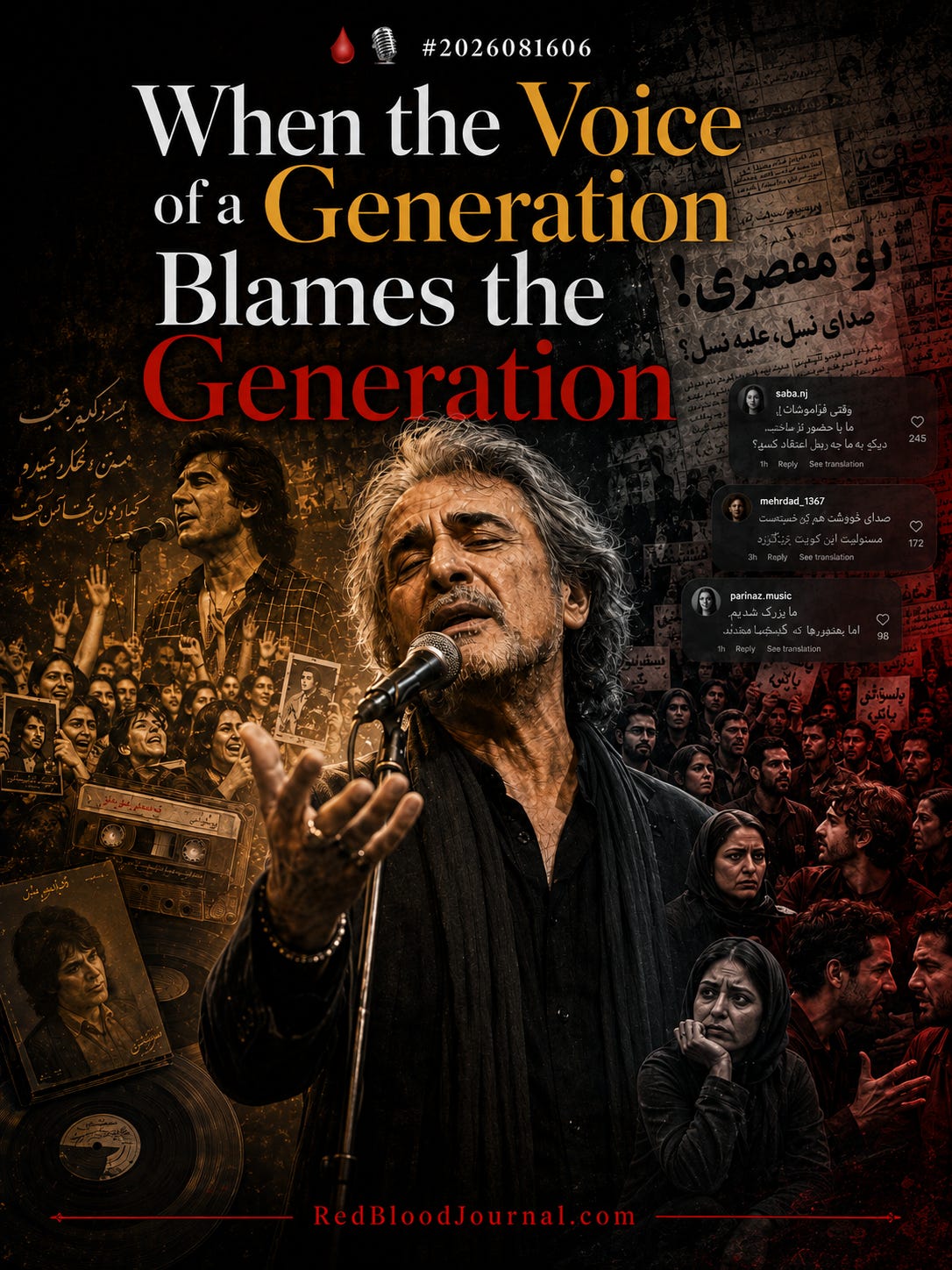
🩸 🎙️ #2026081606 — When the Voice of a Generation Blames the Generation
Dariush Eghbali, Conspiracy Delusion, Celebrity Power, and Why Iranian Trust Has Changed
RedBloodJournal.com
For more than half a century, Dariush Eghbali has occupied an unusual place in Iranian culture.
He was not merely a pop singer.
For generations of Iranians, that unmistakable deep voice carried heartbreak, exile, prison, poverty, political frustration, nostalgia and rebellion.
Songs such as Booye Gandom, Jangal, Bonbast, Faryad Zire Ab and many others became entangled with the political and emotional history of modern Iran.
That history makes what happened in August 2026 particularly interesting.
Because Dariush has released a song called “توهم توطئه — Tovahom-e Toot-e’e,” or “Conspiracy Delusion.”
The song was officially announced through Dariush’s own social-media presence as a work with lyrics by Farzad Fattahi and a video by Aslan Hafezi.
And instead of producing the familiar reaction—
Dariush has spoken for us—
the song has triggered something very different:
Some Iranians are asking whether Dariush is still speaking for them—or speaking at them.
That difference is the story.
Before Judging the Present, Remember the Dariush of the Past
Dariush Eghbali was born in 1951 and emerged nationally in the early 1970s. His distinctive bass voice and socially charged repertoire quickly made him one of Iran’s major popular singers. Apple Music describes him as one of Iran’s best-known singers and notes both his ballads and political songs.
His political reputation was not manufactured after leaving Iran.
It existed before the Islamic Revolution.
During the monarchy, Dariush was arrested more than once, with politically sensitive songs such as Jangal, Bonbast and Booye Gandom associated with his confrontational image.
Radio Farda, in discussing the political atmosphere of pre-revolutionary Iran, specifically identifies Booye Gandom as a symbolically oppositional song: Dariush sang of ordinary people receiving merely the “smell of wheat” while privileged others carried away the wheat itself.
This matters.
Because the young Dariush became part of a larger generation of Iranian artists who challenged the existing order through metaphor, poetry and political music.
To many young Iranians of that period, this was courage.
Dariush was not simply entertaining them.
He appeared to be standing beside them.
Then Came 1979
The revolution arrived.
The monarchy disappeared.
But the promised political paradise did not.
Dariush eventually left Iran and became part of the enormous Iranian cultural community in exile. His post-revolution career continued for decades, including songs critical of conditions in Iran. Academic work on Iranian diaspora music has described Dariush, alongside Googoosh, as among the most loved popular musicians of his generation.
That is an important distinction.
Dariush’s place in Iranian culture cannot reasonably be reduced to one political controversy.
Millions of personal memories surround his music.
Weddings.
Road trips.
Revolution.
Migration.
Prison.
First love.
Lost families.
Homes left behind.
Countries never seen again.
The Iran that disappeared.
For many Iranians, criticizing Dariush can therefore feel almost like criticizing an old family photograph.
There Is Another Dariush Story Too
His life also contains an unusually public struggle with addiction.
After overcoming his own substance dependence, Dariush founded the Ayeneh Foundation in 2000. The organization describes itself as independent, nonpolitical and nonreligious, focused on education, prevention and social harms.
Dariush later explained that Ayeneh began with educational programming intended to help addicts and their families understand addiction as an illness from which recovery was possible.
So the Dariush known to Iranians was constructed from several identities at once:
Singer.
Political voice.
Exile.
Recovered addict.
Humanitarian.
Social activist.
That history earned him enormous emotional capital.
And that is precisely why the present controversy matters.
The New Song Changes the Direction of the Finger
The August 16 program examined in this report describes Conspiracy Delusion as arguing that Iranian society has become chronically suspicious—seeing hidden hands behind events, attributing failures to outsiders and avoiding collective responsibility.
That idea by itself is worthy of discussion.
Iran certainly has conspiracy theories.
So does America.
So does Europe.
So does practically every society possessing both politics and an internet connection.
The harder question is different:
When does suspicion become delusion—and when does suspicion become experience?
That distinction appears to be where Dariush stepped onto politically explosive ground.
The Generation Dariush Once Sang To Has Changed
The Iran of 2026 is not the Iran of 1976.
The public evaluating Dariush today possesses fifty additional years of history.
The 1979 revolution.
The hostage crisis.
The Iran-Iraq War.
Political executions.
Factional struggles.
Reform movements.
The Green Movement.
Sanctions.
Intelligence operations.
Foreign intervention.
Cyberwarfare.
Diaspora political warfare.
State propaganda.
Opposition propaganda.
Social-media manipulation.
And enormous quantities of information that ordinary Iranians could never have accessed during Dariush’s early career.
Academic research into Persian-language Twitter has documented genuine attempts by different actors to manipulate Iranian online political discussion through inauthentic accounts.
So telling such a population that it sees conspiracies everywhere produces an immediate counterquestion:
What if some of the things they have been suspicious about really were happening?
The Comments Under the Song Tell Their Own Story
The transcript reviewed for this report contains a long selection of reactions attributed to commenters responding to Dariush’s new song.
The criticism is severe.
Some accuse him of blaming the victims.
Others argue that foreign intervention and domestic political manipulation are documented realities rather than fantasies.
Another recurring criticism is historical:
Some listeners believe the ideological generation that helped discredit the monarchy should examine its own role before lecturing later generations about political mistakes.
The transcript quotes reactions effectively telling Dariush:
You were one of the people throwing stones at the train. Do not now accuse us of doing it.
Those reactions are politically significant.
But they must also be handled carefully.
They are comments selected by the program, not a scientific opinion poll of Iranians.
They demonstrate the existence and intensity of a backlash.
They do not prove that all, most, or even a measurable percentage of Iranians have rejected Dariush.
That distinction matters.
Yesterday’s Dariush and Today’s Dariush
This produces one of the strangest reversals in Iranian popular culture.
Yesterday:
Dariush sang songs interpreted as criticizing those in power.
Today:
Some listeners believe Dariush is criticizing the population beneath the power.
That may or may not have been his intention.
But political art is eventually judged not only by intention.
It is judged by what the audience hears.
And a portion of this audience appears to hear:
“The problem is you.”
That is a very dangerous sentence to deliver to a population that believes it has spent decades paying for decisions made by governments, revolutionaries, ideologues and foreign powers.
This Leads to the Celebrity Problem
The controversy becomes even more interesting when placed beside another discussion in the same August 16 program:
Can anyone become enormously successful inside the Islamic Republic while remaining completely independent of the state?
The program includes comments attributed to actor and television figure Majid Vasheghani arguing that cultural production requires government authorization and that even individual actors in productions must receive approval.
This does not establish that every Iranian celebrity is a government operative.
Government permission is not the same thing as ideological loyalty.
A filmmaker receiving a permit is not automatically an intelligence asset.
An actor appearing on television is not automatically a propagandist.
Those distinctions are essential.
But the system itself creates a trust problem.
If government approval is necessary for professional survival, the audience can rarely know where professional compromise ends and political cooperation begins.
And That Is Where “Conspiracy Delusion” Becomes Complicated
Imagine living for decades inside a system in which:
the government controls broadcasting,
films require permission,
concerts require permission,
books require permission,
political speech has consequences,
journalists are constrained,
political factions leak information against one another,
and intelligence organizations—domestic and foreign—actively attempt to influence events.
Then someone says:
“You people are too suspicious.”
Perhaps they are.
But perhaps the more interesting question is:
What created the suspicion?
East Germany and West Germany Enter the Argument
The program makes another argument worth separating from its political rhetoric.
Consider Germany after World War II.
One population.
One language.
One history.
Two political systems.
Decades later, East and West Germany developed markedly different political and economic environments.
Or consider North and South Korea.
Again, essentially one people divided by geopolitical decisions and placed under radically different institutions.
The transcript uses those examples to challenge the simplistic proposition that a country’s political condition proves something inherent about the character of its people.
That argument deserves attention.
If institutions can reshape behavior, then widespread distrust under an opaque authoritarian system cannot automatically be diagnosed as a cultural defect.
It may partly be an adaptation.
The Iranian Public Has Changed Its Relationship With Celebrity
Something else has happened.
The age of the unreachable superstar is disappearing.
Fifty years ago, an Iranian heard Dariush on a record, radio or television.
The relationship flowed in one direction.
Artist → audience.
Today:
Artist → audience → investigation → archive → screenshot → argument → counterargument.
A singer releases a political song.
Within hours, people examine:
who wrote it,
who produced it,
who knows whom,
what the lyricist previously wrote,
what the singer said twenty years ago,
what his political associates believe,
and whether the message resembles another political faction’s narrative.
That does not automatically make every resulting allegation true.
But celebrity authority has fundamentally changed.
Fame no longer guarantees political credibility.
This May Be the Real Shock for Dariush
The younger Dariush became famous during an era when artists could become symbols larger than themselves.
The older Dariush now lives in an era when the audience can challenge the symbol.
That may explain some of the ferocity surrounding Conspiracy Delusion.
The public is no longer simply consuming the artist’s interpretation.
It is conducting an audit.
But History Should Not Be Rewritten Either
There is another danger.
One controversial song should not erase fifty years of artistic history.
Dariush really did sing politically sensitive material.
He really did become an important voice in Iranian popular music.
He really did build Ayeneh around addiction recovery and social education.
And he has continued publicly supporting human-rights causes; as recently as 2025 he publicly reacted against the flogging of dissident singer Mehdi Yarrahi.
Therefore the intellectually easy conclusion—
“Dariush was always fake”
—is not established by the evidence reviewed here.
But neither is the opposite conclusion—
“Dariush is Dariush, therefore his political interpretation must be correct.”
Past courage is not a lifetime exemption from present criticism.
The Most Interesting Possibility
Perhaps this controversy is not mainly about Dariush at all.
Perhaps Dariush has accidentally walked into a much larger historical confrontation.
The revolutionary generation versus the post-revolutionary generations.
One generation says:
We opposed injustice.
Another responds:
And what did your revolution produce?
One generation says:
Stop imagining conspiracies.
Another responds:
We grew up surrounded by things we were told were impossible until documents proved otherwise.
One generation asks the public to acknowledge its mistakes.
Another asks:
When will the intellectual and political classes acknowledge theirs?
That argument is much larger than one song.
The Dariush Paradox
There is therefore an extraordinary irony.
Dariush helped teach generations of Iranians to question authority.
Now some of those same Iranians are questioning Dariush.
Perhaps that is not betrayal.
Perhaps it is the inevitable outcome of the political culture that artists like Dariush helped create.
If an artist spends decades telling people:
Think. Question. Resist.
he cannot reasonably determine where their questioning must stop.
Not even when it reaches him.
The Red Blood Perspective
The central question raised by Conspiracy Delusion should therefore not be:
Is Dariush right or are his critics right?
The better questions are:
When does political suspicion become paranoia?
When does distrust become rational self-defense?
How much responsibility belongs to citizens?
How much belongs to rulers?
How much belongs to intellectuals?
How much belongs to revolutionary movements?
How much belongs to foreign powers?
And how much responsibility belongs to artists whose voices helped shape the political imagination of an entire generation?
The evidence examined here cannot answer those questions with a single verdict.
But it reveals something important.
Iranian society is no longer willing to give even its cultural legends immunity from examination.
And perhaps the strongest evidence of that transformation is that the man once celebrated for questioning the system is now being questioned by the people who grew up listening to him.
🌊 Ocean of Love and Positivity Perspective
A society does not mature by destroying its heroes.
Nor does it mature by worshipping them.
It matures when it can appreciate what someone contributed yesterday while still examining what that person says today.
Dariush can remain the voice behind songs embedded in millions of memories.
His humanitarian work can remain worthy of recognition.
His past political courage can remain part of Iranian cultural history.
And Iranians can simultaneously say:
We disagree with you now.
There is no contradiction in that.
Perhaps there is even something beautiful about it.
The singer gave the people a voice.
Eventually the people found their own.
And sometimes—
they sing back.
In an Ocean of Love and Positivity.
🩸🌊✨ Fantastic!
🎙️
The Dariush Paradox: When a Cultural Icon Blames His Audience
Aug 16, 2026
The provided text examines the 2026 controversy surrounding Dariush Eghbali, a legendary Iranian singer whose new song, “Conspiracy Delusion,” has sparked a significant rift with his audience. While Dariush was historically revered as a political voice for the marginalized, his recent lyrics are seen by many as blaming the Iranian public for their systemic distrust rather than acknowledging the reality of their hardships. This shift has prompted a generational confrontation, as younger listeners who were taught by artists like Dariush to question authority are now applying that same critical lens to the singer himself. The source explores how celebrity influence is changing in an era of digital transparency and heightened political skepticism. Ultimately, the text illustrates a maturing society that can respect an artist’s historical legacy while firmly rejecting their contemporary political interpretations. This evolution suggests that the Iranian public has transitioned from needing a symbolic representative to finding its own independent voice.


